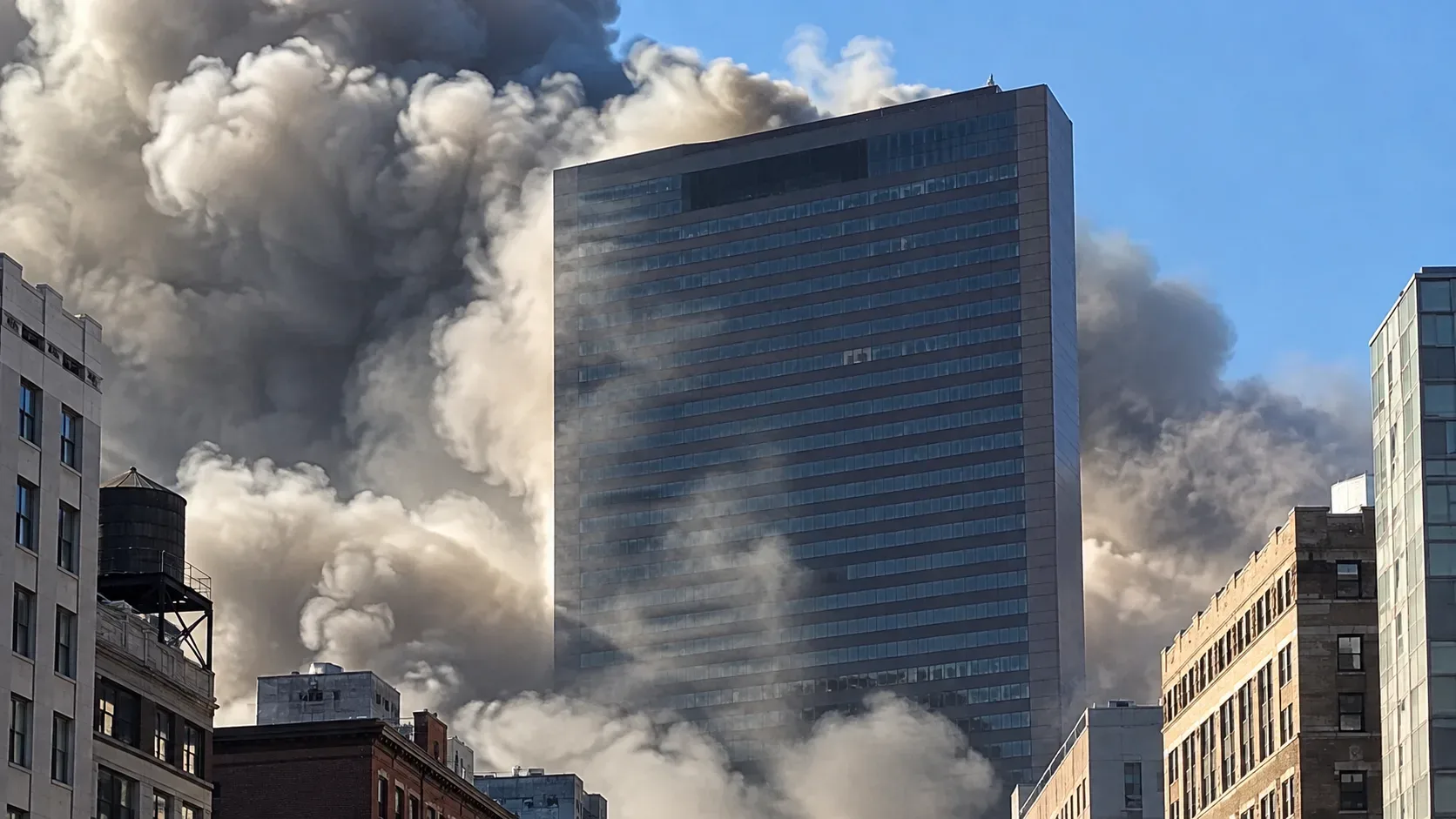
On September 11, 2026, the 2001 attacks mark their 25th anniversary. To reconstruct the sequence of the four aircraft, the safest starting point is not a viral timeline but the record consolidated by the National Commission on Terrorist Attacks Upon the United States. Chapter 1 of the report, “We Have Some Planes”, brings together air traffic control communications, airline records, radar data, calls made from the aircraft, and later investigative analysis.
The most important distinction is this: some times are precisely recorded events — such as takeoffs, radio communications, and impacts — while others are reconstructions, such as the likely moment a hijacking began. The Commission itself uses wording such as “likely takeover” to mark that difference. In this article, all times are given in Eastern Daylight Time (EDT, UTC−4), the local time on the U.S. East Coast on September 11, 2001.
The four flights in one parallel timeline
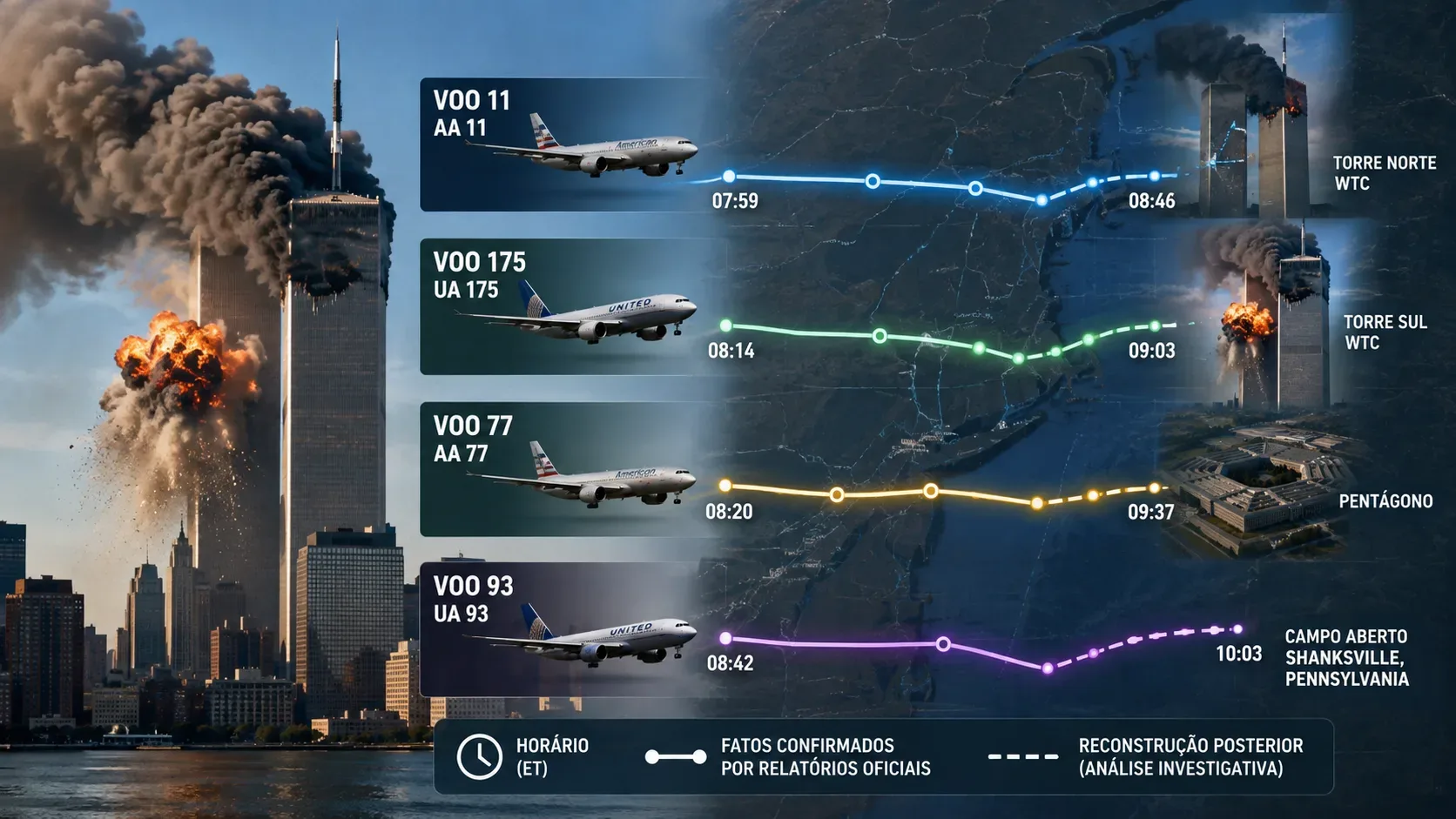
| Flight | Original route | Takeoff | Last routine communication / likely takeover | Impact |
|---|---|---|---|---|
| American Airlines 11 | Boston → Los Angeles | 7:59 | 8:14 / around 8:14 | 8:46:40 — North Tower of the World Trade Center |
| United Airlines 175 | Boston → Los Angeles | 8:14 | 8:42 / between 8:42 and 8:46 | 9:03:11 — South Tower of the World Trade Center |
| American Airlines 77 | Washington Dulles → Los Angeles | 8:20 | 8:51 / between 8:51 and 8:54 | 9:37:46 — Pentagon |
| United Airlines 93 | Newark → San Francisco | 8:42 | 9:27 / around 9:28 | 10:03:11 — Somerset County, Pennsylvania, near Shanksville |
This table summarizes the sequence, but it does not tell the whole story. The documentary value comes from separating what was observed at the time from what investigators later inferred by combining multiple sources.
American Airlines 11: the first flight to lose normal contact
AA 11 took off from Boston at 7:59. Shortly before 8:14, its flight profile and communications were normal. At 8:14, the crew made its last routine communication with Boston air traffic control. Seconds later, instructions to climb went unanswered. The Commission concluded that the hijacking began around that point.
At 8:19, flight attendant Betty Ong told American Airlines that the cockpit was not responding and that people had been injured. At 8:21, the transponder was turned off. By about 8:25, Boston controllers had enough information to treat the flight as hijacked; at 8:38, Boston Center notified the NEADS air defense sector. At 8:46:40, AA 11 struck the North Tower of the World Trade Center.
The methodological detail matters: “8:14” is both the time of the last routine communication and the likely beginning of the takeover. It is not a camera record or an onboard clock marking the exact second the cockpit was seized.
United Airlines 175: the second impact came 16 minutes later
UA 175 departed Boston at 8:14. At 8:42, its crew finished a transmission to air traffic control reporting a suspicious communication heard on the frequency — a message later connected to AA 11. This was the flight’s last normal communication.
The Commission places the takeover of UA 175 between 8:42 and 8:46. At 8:47, its transponder code changed. Beginning at 8:52, reports from people on board informed United Airlines that the aircraft had been hijacked. At 8:55, New York Center suspected a hijacking. At 9:03:11, UA 175 struck the South Tower of the World Trade Center.
The interval between 8:46:40 and 9:03:11 — just over 16 minutes — helps explain why many institutions were still processing the first impact when the second established that the event was not an isolated accident.
American Airlines 77: loss of radar contact and a return toward Washington
AA 77 took off from Washington Dulles at 8:20. At 8:51, it made its last routine radio transmission. The Commission estimates that the hijacking occurred between 8:51 and 8:54. At 8:54, the aircraft deviated from its cleared route and turned south; at 8:56, its transponder was switched off and primary radar contact was also lost for a period.
At 9:32, Dulles controllers observed a high-speed primary radar target later identified as AA 77. At 9:34, Reagan National Airport alerted the Secret Service to an unknown aircraft heading toward the Washington area. At 9:37:46, AA 77 struck the Pentagon.
This segment is one of the clearest examples of why a timeline must distinguish “what happened to the aircraft” from “when each agency knew what was happening.” The flight had been hijacked before the warning chain could reliably identify it.
United Airlines 93: a delayed takeoff changed the sequence
UA 93 was scheduled to depart at 8:00 but did not take off from Newark until 8:42, more than 25 minutes late. That delay meant the attacks on the Twin Towers unfolded while the flight was still relatively early in its trip.
At 9:24, the cockpit received a United Airlines message warning about possible cockpit intrusions after the New York attacks. The last routine air traffic control contact came at 9:27. The Commission places the start of the hijacking at 9:28. At 9:41, the transponder was turned off.
Passengers and crew made calls and learned that other aircraft had been used against the World Trade Center and the Pentagon. At about 9:57, they began an effort to regain the cockpit. The Flight 93 National Memorial, operated by the National Park Service, details this phase and records the impact at 10:03:11 in Stonycreek Township, Somerset County, near Shanksville, Pennsylvania.
The 10:03:11 precision does not come from a single witness. The Commission says that time is supported by prior NTSB analysis and by a combination of radar, the flight data recorder, the cockpit voice recorder, infrared satellite data, and air traffic control transmissions.
What is a recorded fact and what is a later reconstruction
A strong timeline does not have to choose between “total certainty” and “nothing is known.” It can state the level of evidence. For all four flights, takeoffs and impacts have highly precise recorded times. Last radio communications, transponder changes, and alerts among agencies also appear in operational records.
The exact instant when each aircraft was seized, however, is partly reconstructed. That is why the report uses ranges: 8:42–8:46 for UA 175 and 8:51–8:54 for AA 77, for example. For AA 11 and UA 93, the report links the likely takeover to the moments immediately after the last routine communications and abrupt changes in flight behavior.
That difference should be visible in any serious chronology. Treating an investigative estimate as if it were a directly captured timestamp creates false precision.
Why some older timelines conflict with the final report
The Commission devoted a section to “clarifying the record” because official accounts issued before the investigation was complete contained errors. One claim was that the military’s NEADS sector had received notice of the UA 93 hijacking at 9:16. The investigation found that this was incorrect: at that time, UA 93 was still proceeding normally.
It was also publicly stated that NEADS had been notified of the AA 77 hijacking at 9:24. According to the final report, the message received at that moment actually concerned an erroneous report that AA 11 was still airborne and heading toward Washington. The Langley fighters were scrambled because of that mistaken information, not because of an accurate notification about AA 77 or UA 93.
This explains how a viral timeline can reproduce a time that genuinely appeared in an early statement or document and still be outdated relative to the final reconstruction. The right reference is the consolidated record, not simply the first public version.
How to check a September 11 timeline
- Check the time zone: use one consistent basis. Here, EDT (UTC−4).
- Separate the event from institutional awareness: “the aircraft was hijacked” and “the FAA or NEADS was notified” are different facts.
- Look for ranges when inference is involved: a range such as 8:51–8:54 signals reconstruction, not a lack of rigor.
- Prefer consolidated records: Chapter 1 of the Commission Report is the central reference for the sequence of all four flights.
- Use primary archives for deeper research: the National Archives preserves FAA records related to September 11, including material transferred by the agency and used in investigations.
- For UA 93, cross-check the official memorial: the NPS maintains a detailed chronology and explicitly identifies its times as Eastern Daylight Time.
The essential sequence, without false precision
The four impacts occurred, in EDT, at 8:46:40, 9:03:11, 9:37:46, and 10:03:11. But the documentary story is more than four clock readings. Between those times were lost communications, transponder changes, reports from passengers and crew, decisions by controllers and airlines, and, in some cases, incorrect information circulating among agencies.
Twenty-five years later, the most faithful way to reconstruct that morning is to preserve the distinction between a recorded event, a likely moment, and later institutional knowledge. That is exactly what the final report makes possible — and what a simplified timeline often erases.