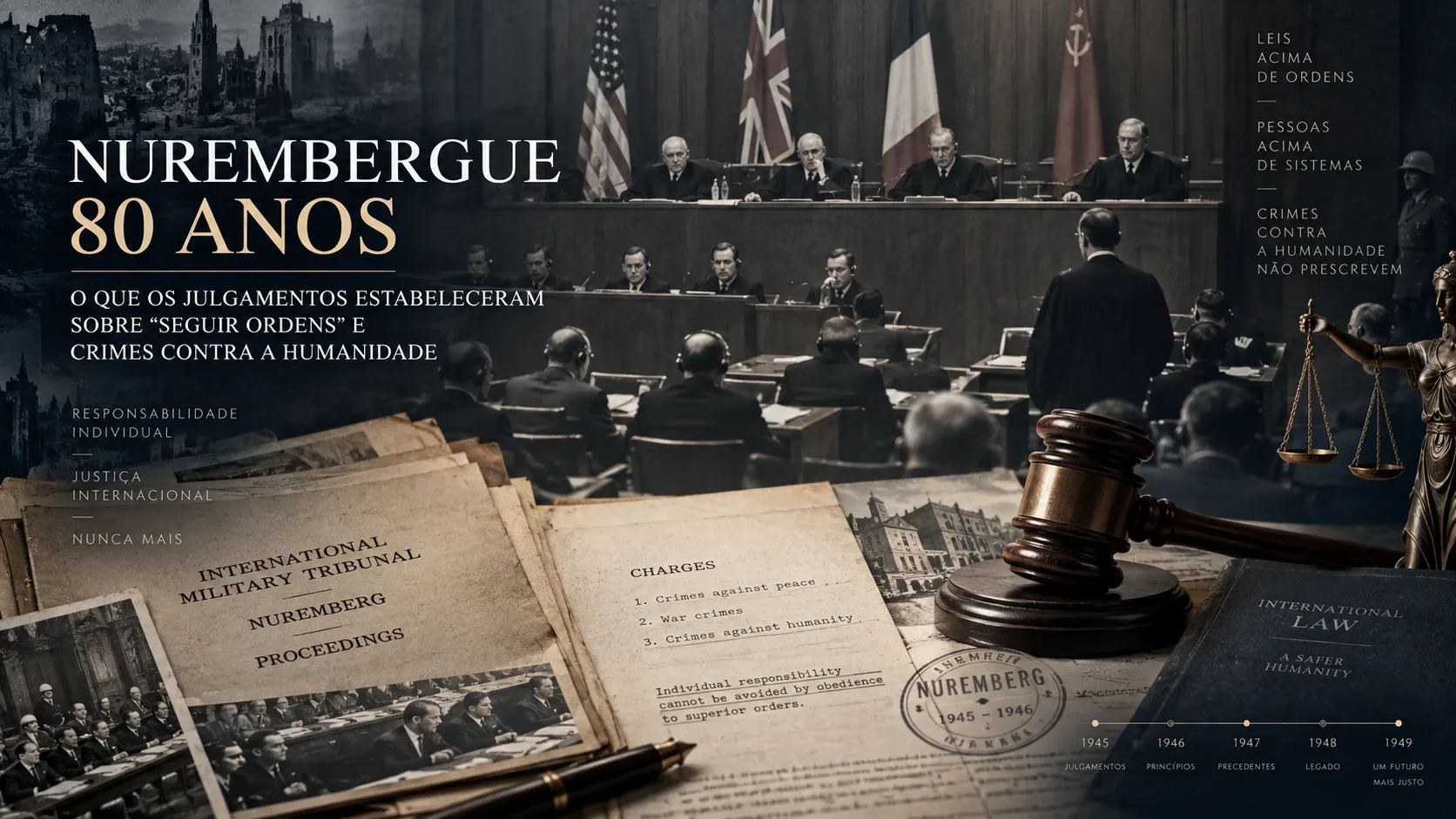
Eighty years after the verdict of October 1, 1946, Nuremberg remains associated with a simple idea: saying “I was only following orders” is not enough to erase criminal responsibility. The documents of the International Military Tribunal (IMT), however, show a more precise rule: an order from a government or superior did not automatically free a defendant from responsibility, although the Charter allowed it to be considered in sentencing; the judgment also tied responsibility to each defendant’s conduct and circumstances.
This distinction matters because Nuremberg’s legacy was not an abstract rule against all hierarchical obedience. The central point was different: crimes recognized under international law could generate responsibility for concrete individuals, including when they acted in the name of the state, held high office, or claimed to be carrying out orders.
What the Nuremberg Tribunal tried
The London Charter, signed on August 8, 1945, created the IMT to try the major war criminals of the European Axis. The trial of leading Nazi officials began on November 20, 1945. The judgment was delivered on September 30 and October 1, 1946; in the final outcome, 19 defendants were convicted and three were acquitted.
| Milestone | What it established |
|---|---|
| August 8, 1945 | The London Charter created the IMT and defined its jurisdiction. |
| November 20, 1945 | The trial of leading Nazi officials began. |
| September 30 and October 1, 1946 | The Tribunal delivered its judgment and decisions on the defendants. |
| December 11, 1946 | The UN General Assembly affirmed the principles recognized by the Charter and judgment. |
| 1950 | The International Law Commission formulated the Nuremberg Principles. |
Article 6 of the Charter placed three central categories within the Tribunal’s jurisdiction: crimes against peace, war crimes, and crimes against humanity. The proceedings also used a separate conspiracy count. The same Charter expressly stated that crimes within its jurisdiction gave rise to individual responsibility.
“Following orders” was not an automatic defense
Article 8 of the Charter is the starting point. It provided that acting under an order of the government or a superior did not free a defendant from responsibility, although the order could be considered in mitigation of punishment if the Tribunal found that justice required it. The original rule therefore had two parts that are often separated in popular summaries.
- The existence of an order did not erase responsibility. A defendant could not end the inquiry simply by proving that he was obeying a chain of command.
- The order could still matter. The Charter allowed the context of obedience to be considered in sentencing.
In its judgment, the Tribunal also stressed that international duties could override obligations of obedience imposed by the state. In other words, state authority would not operate as a shield for conduct regarded as criminal under international law.
This is more rigorous than the phrase “orders never matter” and more accurate than the opposite idea that a superior order automatically justified the conduct. What Nuremberg rejected was automatic exoneration based solely on the order.
The “moral choice” language appears in the 1950 formulation
Four years after the judgment, the UN International Law Commission formulated the Nuremberg Principles. Principle IV stated that acting under an order of a government or superior does not relieve a person of responsibility under international law when a moral choice was in fact possible.
This wording is not identical to Article 8 of the 1945 Charter. UN documentation identifies two important differences: the 1950 formulation incorporated the element of possible moral choice developed in the judgment, and it did not repeat the Charter’s clause on mitigation of punishment, treating sentencing as a matter for the competent court.
For that reason, when Nuremberg is summarized today as establishing that “following orders is not a defense,” it is useful to distinguish three layers: the written rule in the 1945 Charter, the interpretation in the 1946 judgment, and the later synthesis in the 1950 Nuremberg Principles.
Official position did not function as immunity either
Article 7 of the Charter addressed another defense argument: the defendant’s official position. Being a head of state or senior government official was not, by itself, to free a defendant from responsibility or mitigate punishment. The reasoning complemented the rule on superior orders: responsibility did not disappear because someone commanded in the name of the state or obeyed in its name.
The result was a legal proposition with major historical reach: people, not only states, could be held responsible for international crimes. That did not mean automatic guilt by office. The Tribunal still had to examine evidence about participation, knowledge, decisions, and acts attributable to each accused person.
What “crimes against humanity” meant at Nuremberg
The Charter defined crimes against humanity to include murder, extermination, enslavement, deportation, and other inhumane acts against a civilian population, as well as persecution on political, racial, or religious grounds in connection with crimes within the Tribunal’s jurisdiction. It was one of the formulations that helped consolidate the category in international law.
But it is important not to project all later international law back onto 1945. At Nuremberg, jurisdiction over crimes against humanity was closely connected to the war context and to the Tribunal’s other crimes. The United States Holocaust Memorial Museum summarizes that the judges limited their consideration of this category to acts committed during the war, even while acknowledging severe persecution before it.
This limit helps explain why the legacy is both decisive and incomplete. Nuremberg opened the way toward international accountability centered more clearly on individuals and helped consolidate crimes against humanity, but definitions and legal regimes continued to evolve in later decades.
What Nuremberg established — and what it did not
| Established or consolidated | Does not mean |
|---|---|
| Individuals can be held responsible for international crimes. | That everyone connected to a regime or chain of command was automatically guilty. |
| Official position does not eliminate responsibility. | That rank alone proves participation in a crime. |
| A superior order is not an automatic exemption. | That the context of the order can never matter; the Charter allowed possible mitigation of punishment. |
| Crimes against humanity became a central part of the IMT’s jurisdiction. | That the 1945 definition was identical to later international formulations. |
| The principles were affirmed by the UN and formulated by the International Law Commission. | That the whole of contemporary international criminal law was complete in 1946. |
How the Nuremberg Principles reached the United Nations
The legal legacy did not end with the sentences. On December 11, 1946, the UN General Assembly adopted Resolution 95 (I), affirming the principles of international law recognized in the Charter and judgment. In 1947, the Assembly tasked the International Law Commission with formulating those principles. The Commission adopted its final formulation in 1950.
This sequence matters because it prevents “the Nuremberg Principles” from being treated as a single text written by the judges in October 1946. There is a documentary chain: Charter, judgment, affirmation by the General Assembly, and later technical formulation by the Commission.
Which documents to read on the verdict’s 80th anniversary
For source checking, a good starting point is the Nuremberg Tribunal Charter in the ICRC database, especially Articles 6 through 8. The IMT judgment at Yale Law School’s Avalon Project allows readers to follow the reasoning used by the judges.
For the later stage, the United Nations maintains the page on General Assembly Resolution 95 (I) and the documentation on the International Law Commission’s formulation of the Nuremberg Principles. For historical context, the United States Holocaust Memorial Museum provides an overview of the Tribunal, the charges, and the verdict.
The legacy without the simplification
Nuremberg’s core move was to shift the discussion from the abstraction of the state toward the responsibility of concrete individuals. A claim that an order came from above no longer worked as an automatic escape; official position was not enough to remove responsibility; and crimes against civilians occupied a central place in the language of international criminal law.
At the same time, the documents show why the 80th anniversary calls for precision. The Charter allowed mitigation of punishment in cases involving superior orders, the “moral choice” element was made explicit in the 1950 formulation, and crimes against humanity still had limits specific to the IMT’s historical setting. Reading these layers together is the clearest way to understand what Nuremberg actually established — and what international law developed later.