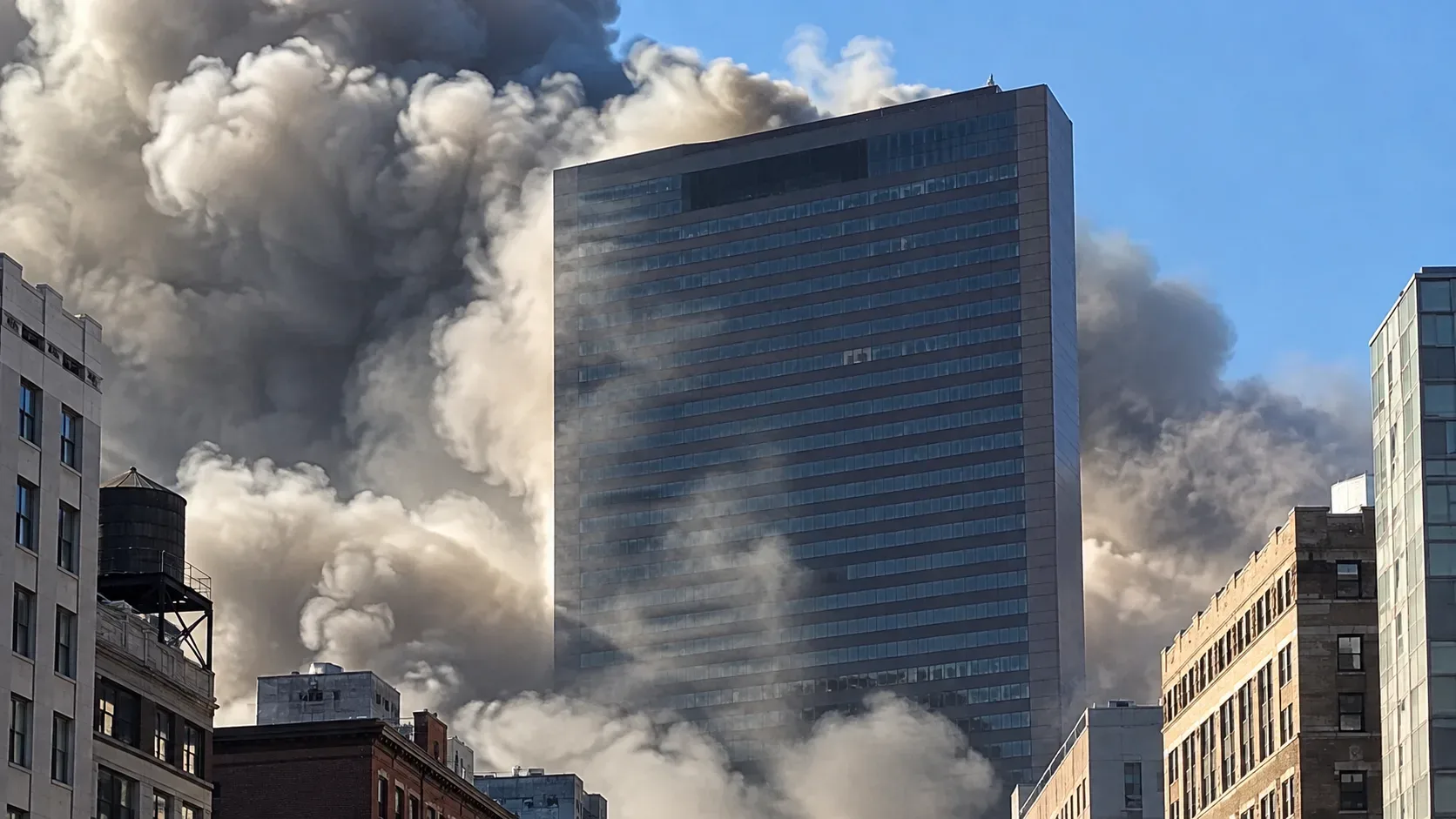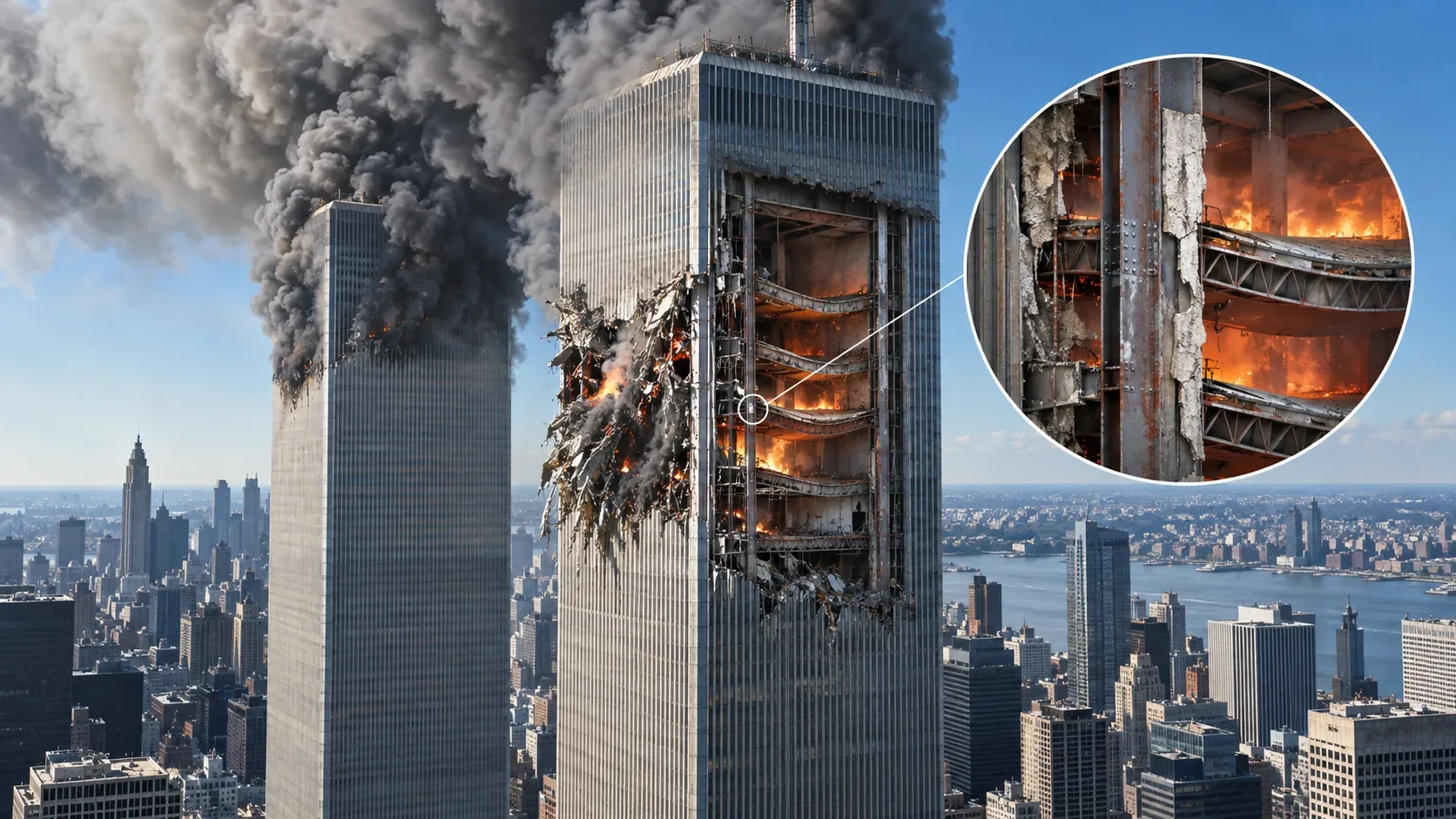
The steel did not have to melt for the Twin Towers to lose their ability to carry their loads. The National Institute of Standards and Technology (NIST) concluded that the collapses of WTC 1 and WTC 2 resulted from a combined sequence: the aircraft impacts severed and damaged columns, damaged floors, and dislodged part of the fireproofing applied to the steel; then, multi-floor fires heated structural members that had become more exposed, reducing their strength and stiffness and causing deformation. Heated floors sagged, pulled exterior columns inward, and contributed to the buckling of perimeter walls that initiated each collapse.
That explanation is different from the simplified claim that “jet fuel melted the steel.” NIST itself states that it did not report that the tower steel melted because of the fires. The technical issue is loss of performance at high temperature, combined with pre-existing structural damage—not melting.
Melting and losing strength are different things
Structural steel can remain solid while becoming far less able to carry weight. According to the NIST technical FAQ on the towers, steel melts at about 1,500 °C (2,800 °F). The agency estimated maximum upper-layer air temperatures of about 1,000 °C (1,800 °F) in parts of the fires.
NIST notes that when bare steel reaches about 1,000 °C, it softens and its strength can fall to roughly 10% of its room-temperature value. That does not mean every steel member in the towers reached 1,000 °C. It means that unprotected members exposed long enough to the fire environment could reach temperatures capable of producing yielding, deformation, and buckling well before melting.
This distinction resolves the apparent contradiction: a steel structure does not need to turn into liquid metal in order to fail. It only needs to lose enough strength and stiffness, at critical locations and under relevant loads, for the system to become unstable.
Step 1: the impacts damaged the structure, but the towers did not fall immediately
In NIST's reconstruction, the Boeing 767 aircraft struck the towers with great mass and speed. The impacts severed or damaged perimeter columns, affected parts of the core and floor systems, and redistributed loads to components that remained intact. Even so, both towers stayed standing after the impacts.
That matters because NIST does not attribute the collapses to impact alone. The structures initially managed to redistribute loads. The problem was that the post-impact condition left less margin to withstand the degradation that followed as the fires developed.
Step 2: loss of fireproofing made the heating far more consequential
The steel columns and floor trusses were coated with fire-resistive material, known as spray-applied fire-resistive material (SFRM). The investigation concluded that debris from the impacts dislodged this protection in important parts of the damaged zones.
This is central to NIST's conclusion. The agency found that the components that became critically weakened were those whose fireproofing had been removed. With insulation intact, steel heats more slowly; without it, steel can respond much more quickly to the temperature of the surrounding fire gases. In a historical reconstruction published by NIST, the agency summarizes that the towers would have remained standing without the combination of dislodged insulation and extensive fires.
Step 3: jet fuel ignited extensive fires; the structural problem was sustained heating
The impacts dispersed jet fuel across multiple floors and ignited large fires in several places at once. After the initial fireballs receded, fires continued where office combustibles, air, and ignition sources were available. The investigation also found that the impacts damaged water lines supplying sprinklers on the principal fire floors.
So a statement such as “jet fuel burns at X degrees” does not describe the collapse mechanism. Structurally, what matters is the combination of fire intensity, duration, distribution, and the condition of the fireproofing. NIST used fire-dynamics simulations to reconstruct how air temperatures evolved and then calculated the thermal response of steel and concrete components.
Step 4: floors sagged and pulled exterior columns inward
As heating progressed, floor elements and columns lost stiffness and strength. NIST concluded that heated floors developed large downward deformation—sagging—and that enough connections remained intact for the floors to exert horizontal pull on the perimeter columns.
That pull contributed to the inward bowing of the exterior walls observed before collapse. When columns that were already heated, damaged, and more heavily loaded became unstable and buckled, the upper section of each tower began to move. For NIST, that marked the initiation of global collapse.
WTC 1 and WTC 2 did not fail in exactly the same way
| Aspect | WTC 1 (North Tower) | WTC 2 (South Tower) |
|---|---|---|
| Shared sequence | Impact, structural damage, loss of fireproofing, fires, weakening, and deformation | Impact, structural damage, loss of fireproofing, fires, weakening, and deformation |
| Face associated with collapse initiation in NIST's reconstruction | South face | East face |
| Time from impact to collapse initiation | About 102 minutes | About 56 minutes |
| Emphasis in the reconstruction | Core weakening and floor deformation contributed to pulling the south wall inward | Significant floor sagging on the east side and major core damage contributed to pulling the east wall inward |
The different timelines do not contradict the general mechanism. NIST attributes the different intervals to the specific damage caused by each impact and to the time required for fires to weaken critical structural locations in each tower.
What happened after collapse began
Once the large mass of the upper floors began moving downward, the dynamic demand on the structure below became much greater than the static loads those floors normally carried. NIST concluded that the potential energy released by the downward movement of the upper section far exceeded the ability of the intact structure below to absorb that energy through deformation.
It is useful to separate two questions: what initiated the collapse and why it continued after initiation. NIST's detailed modeling focused primarily on the first. In its FAQ, the agency explains that reconstructing the events up to collapse initiation was essential; once a large upper section began falling, continued progression could be explained by mass, energy, and successive failure of the structure below.
What NIST says—and what it does not say
| Claim | NIST's documented position |
|---|---|
| “The steel had to melt for the towers to fall.” | No. NIST says it did not report structural steel melting in the fires before collapse. The mechanism depends on high-temperature weakening and deformation. |
| “The aircraft impacts alone brought down the towers.” | No. The towers remained standing after impact. NIST attributes failure to the combination of impact damage, dislodged fireproofing, and subsequent fires. |
| “Fire alone, without prior damage, explains the event.” | That is not NIST's conclusion. The investigation treats impact and fire as interacting events. |
| “The initiating mechanism was simply floors stacking up in a pancake collapse.” | No. NIST rejected the “pancake” model as the initiation mechanism. In its reconstruction, sagging floors remained connected enough to pull exterior columns inward. |
| “Jet fuel had to keep burning until the collapse to keep everything hot.” | No. Dispersed jet fuel was an important ignition source. Fires continued to involve office combustibles on the damaged floors and in areas to which the fires spread. |
| “The investigation says every steel member reached 1,000 °C.” | No. About 1,000 °C refers to estimated maximum upper-layer gas temperatures in parts of the fires; component temperatures varied with location, exposure time, and fireproofing. |
Why “the steel did not melt” is a misleading simplification
The statement begins with a correct fact—NIST does not say the tower's structural steel had to melt—and often ends with an incorrect inference: therefore, fire could not have contributed to collapse. That leap ignores how structural materials behave when heated.
In engineering, strength, stiffness, thermal expansion, deformation, support conditions, and load redistribution matter just as much as melting point. In the Twin Towers, according to NIST's reconstruction, those effects acted on structures that had already suffered extensive physical damage and localized loss of fire protection.
What is the short answer?
The Twin Towers did not collapse because the steel “melted.” According to NIST, they collapsed because impact and fire acted in sequence and together: the aircraft damaged columns, floors, and fireproofing; multi-floor fires heated and weakened exposed steel; sagging floors pulled exterior walls inward; columns lost stability; and once the upper section began descending, the structure below could not arrest the moving mass.
For the primary documentation, see the NIST technical FAQ, the About the Investigation page, and the NIST NCSTAR 1 final report.