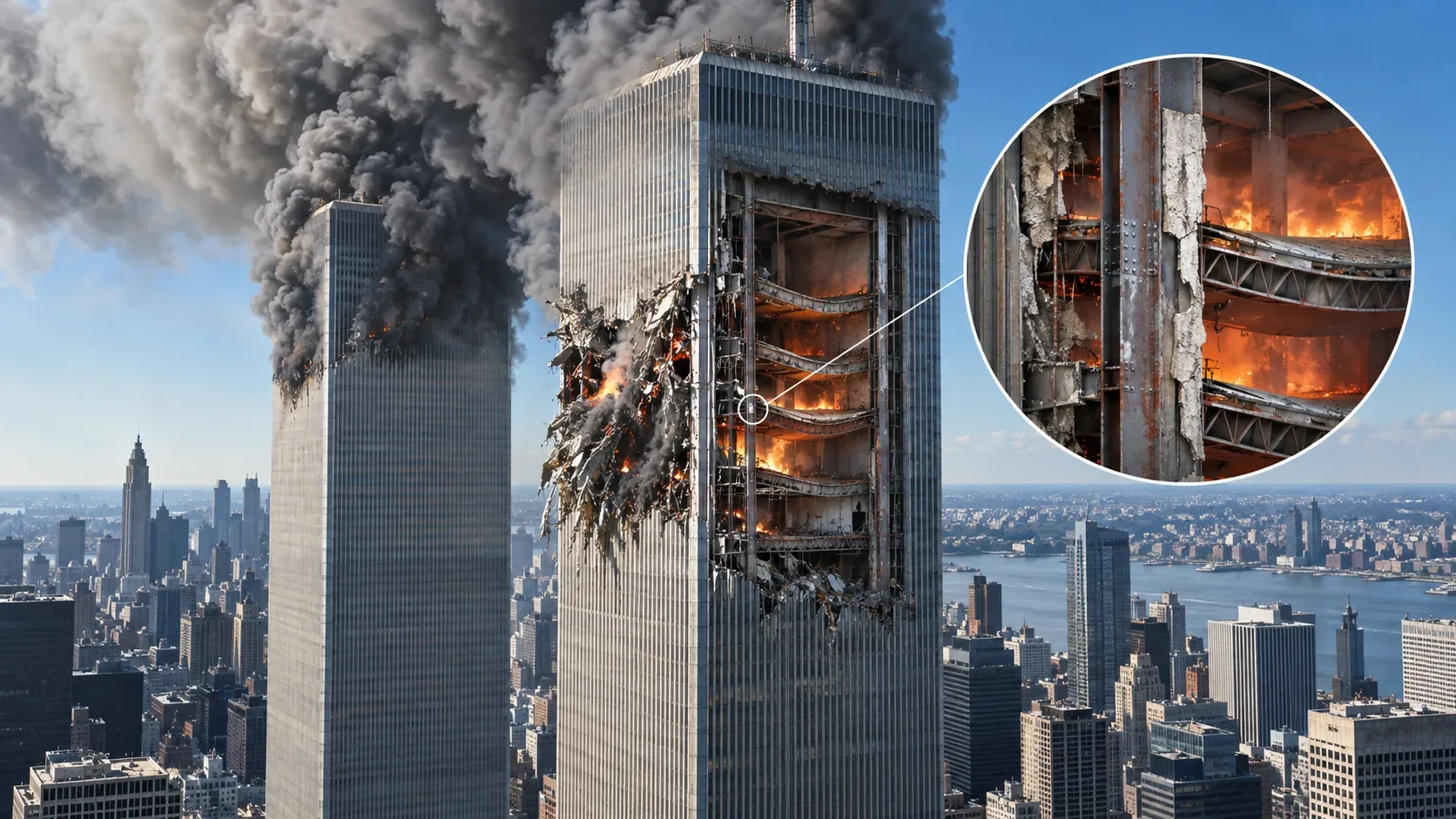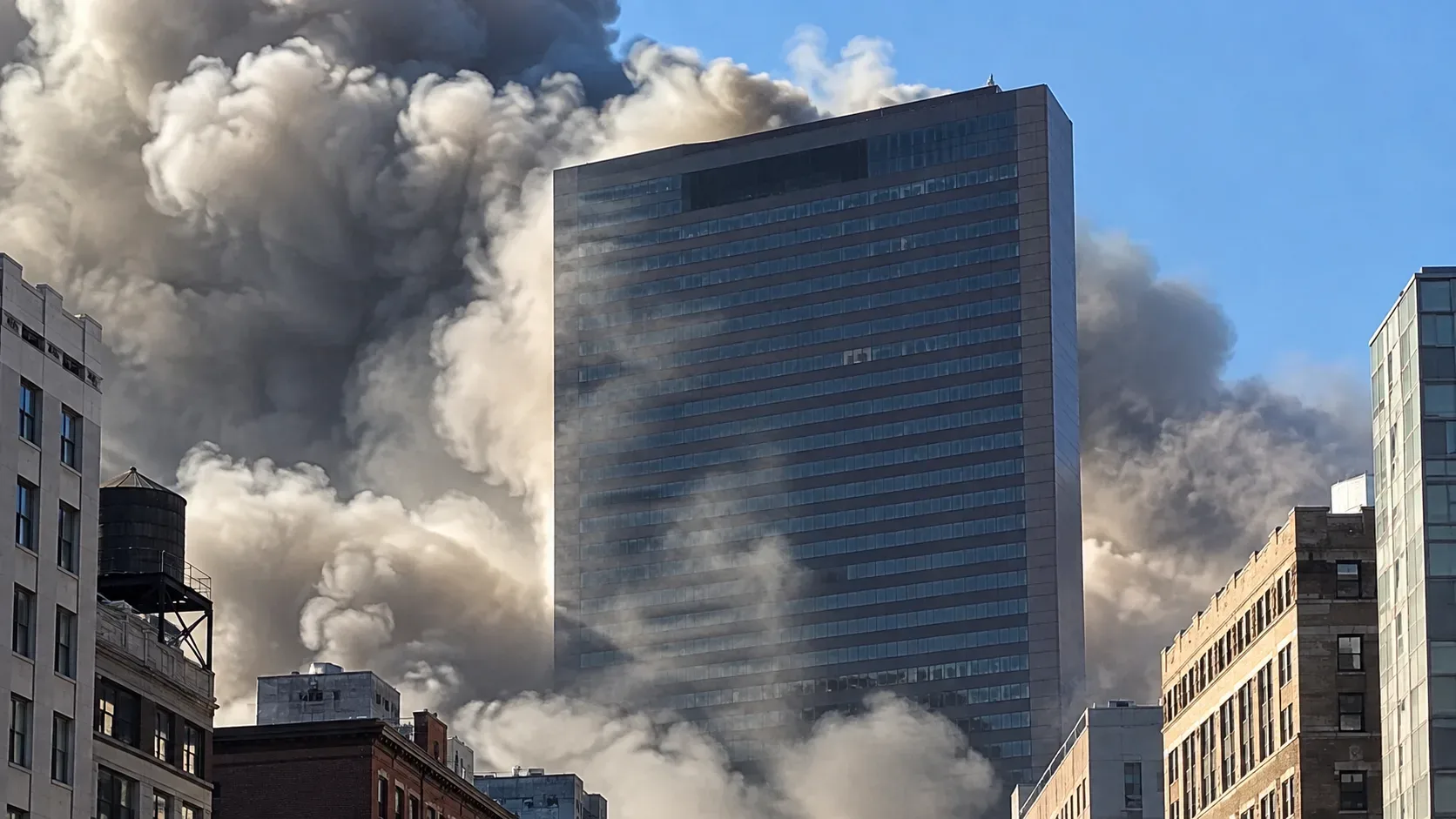
World Trade Center 7 (WTC 7) was not hit by an airplane on September 11, 2001. Even so, the 47-story building collapsed at 5:20:52 p.m. after nearly seven hours of fires. The final conclusion of the National Institute of Standards and Technology (NIST) was that those fires, started by debris from the North Tower and left uncontrolled on several floors after the loss of water supply to the sprinklers, triggered a sequence of progressive structural failures.
The central point of the investigation is less intuitive than the idea that “the steel melted.” According to NIST, the decisive mechanism was the thermal expansion of heated floor beams and girders. That deformation damaged connections and floors near Column 79, a critical interior column. Once it lost lateral support and buckled, failures propagated through the building’s interior until the exterior structure also lost support.
Short answer: why did WTC 7 collapse?
| Question | NIST conclusion |
|---|---|
| Was WTC 7 hit by an airplane? | No. The building stood north of the main complex and was not struck by an aircraft. |
| What started the fires? | Debris from the collapse of WTC 1, the North Tower, struck WTC 7 and started fires on at least ten floors. |
| Why did the fires burn uncontrolled? | City water lines were damaged, compromising the water supply to the sprinklers on the lower floors. |
| What was the main structural mechanism? | Thermal expansion of steel elements damaged the floor system and connections, leading to the failure of Column 79 and a progressive collapse. |
| Did debris alone bring the building down? | According to NIST, no. Debris started fires and caused damage, but the analysis concluded that the fires would have been sufficient to cause collapse even without the direct structural damage from debris. |
What happened to WTC 7 during the day
WTC 7 was a 47-story office building immediately north of the main World Trade Center complex. The North Tower, WTC 1, collapsed at 10:28 a.m. NIST concluded that pieces of debris struck the south and west faces of WTC 7 and started fires on multiple floors.
Not all of those fires had the same structural importance. The investigation highlighted fires on lower floors, especially Floors 7 through 9 and 11 through 13. Because the automatic sprinkler system on the lower floors depended on the city water supply, which had been damaged by the collapses of the Twin Towers, those fires were able to grow and spread uncontrolled.
The building burned for nearly seven hours, until its collapse at 5:20:52 p.m. That duration helps explain why NIST treated the event as a problem of structural response to fire, rather than as a repeat of the mechanism that brought down the towers, which had been directly struck by aircraft.
How NIST reconstructed the collapse sequence
1. Heat expanded beams and girders
As temperatures rose, steel floor elements expanded. NIST emphasizes that the steel did not need to melt to produce serious structural effects. Thermal expansion can generate significant displacement and horizontal forces well before the material reaches its melting point.
At WTC 7, long floor spans and the way some connections responded to lateral loads amplified that effect. NIST’s analysis concluded that expanding beams on the east side damaged the framing on several floors.
2. A girder lost its connection near Column 79
In the probable sequence described in the report, a girder on Floor 13 lost its connection to Column 79. The local failure contributed to floor collapses around that column and started a cascade of failures downward toward lower floors.
With multiple floors no longer providing lateral support, Column 79 was left insufficiently braced over roughly nine stories.
3. Column 79 buckled and failure spread through the interior
Column 79 then buckled. For NIST, this was the initiating event of the global progressive collapse. Failures first reached the interior columns on the east side and progressed to the roof, which is consistent with the early descent of the east penthouse seen in video footage.
Failures then advanced from east to west across the core columns. Only after the interior had lost much of its load-carrying capacity did the exterior façade begin to descend broadly and in a visually uniform way.
If debris was not the direct cause, what role did it play?
It is important to separate the trigger from the collapse mechanism. NIST concluded that debris from the North Tower started the fires and also caused physical damage to WTC 7. However, additional modeling indicated that the building still would have collapsed because of the fires even if the direct structural damage from debris were removed from the scenario.
That does not make the debris irrelevant: without it, according to the reconstruction, the fires that day would not have started in the same way. The investigation’s point is that the final structural failure did not depend on debris mechanically “knocking down” the building.
What about the free fall seen in videos?
NIST analyzed the visible descent of WTC 7’s north face and measured about 5.4 seconds for a section corresponding to roughly 18 stories. The analysis divided that descent into three stages:
- 0 to 1.75 seconds: acceleration below gravity;
- 1.75 to 4.0 seconds: acceleration approximately equal to gravity, a roughly 2.25-second period of essentially free fall;
- 4.0 to 5.4 seconds: acceleration again below gravity.
NIST therefore did not deny that a free-fall phase occurred. The agency’s interpretation is that, during this middle stage, the exterior had already lost substantial structural support because internal failures had developed before the façade began its obvious descent.
That sequence also helps explain why the fall can look nearly symmetrical from the outside: the exterior frame remained relatively intact during part of the internal failure process and lost support only in the final stages.
Did NIST investigate explosives and other hypotheses?
Yes. The investigation evaluated alternative hypotheses, including explosives, fuel-oil-fed fires, the role of the electrical substation beneath the building, and damage from debris.
Regarding explosives, NIST said it found no evidence consistent with a detonation large enough to disable the critical column. The agency estimated that an explosive event of sufficient size would have produced an extremely high sound level — on the order of 130 to 140 decibels at half a mile — and noted that such a sound does not appear in video records and was not reported in a compatible way by witnesses.
Regarding fuel-oil systems, the conclusion was that they could not sustain fires of sufficient duration and intensity to explain failure of the critical column, and that some scenarios would have produced visual signs, such as large amounts of smoke on particular floors, that were not observed.
The electrical substation beneath WTC 7 was also examined. NIST says it found no evidence that the substation contributed significantly to the fires or to the collapse.
What the NIST conclusion does not say
- It does not say that WTC 7 was hit by an airplane.
- It does not say that the steel had to melt. The explanation emphasizes thermal expansion, connection damage, and loss of support.
- It does not say that debris from the North Tower, by itself, brought the building down. Debris started fires and caused damage, but the final mechanism identified was fire-induced progressive collapse.
- It does not claim that every internal failure was directly filmed. The agency combined videos, photographs, documents, interviews, fire data, and simulations to reach a probable collapse sequence.
- It does not treat the roughly 2.25 seconds of free fall as incompatible with the analysis; that phase is part of NIST’s own published measurement.
How the investigation was conducted
NIST carried out a multi-year scientific and technical investigation of WTC 7. The work included design documents, photographs and videos, interviews with occupants and emergency responders, reconstruction of fire growth and spread, thermal analyses, and structural simulations.
The main public documents are NIST NCSTAR 1A, the final summary report, and NIST NCSTAR 1-9, which details the structural fire response and probable collapse sequence. NIST also maintains a WTC 7-specific FAQ.
Why the case was technically unusual
NIST described WTC 7 as the first known total collapse of a tall building caused primarily by fires. That does not mean high-rise fires normally produce total collapse. The investigation itself points to a specific combination of factors: long-span floors, connections vulnerable to horizontal thermal effects, unavailable sprinkler water on the critical lower floors, and a structural configuration that allowed a local failure to develop into progressive loss of support.
One lesson of the report was that structural fire engineering must consider not only the loss of steel strength at high temperatures, but also the displacement and forces generated by thermal expansion in complex structural systems.
What changed after the investigation
The WTC 7 report presented 13 safety recommendations, one new and 12 reiterated from the towers investigation. They covered structural integrity, structural performance under fire, active fire protection, and emergency response. In 2026, marking the 25th anniversary of September 11, NIST noted that the broader World Trade Center investigation had contributed to more than 40 changes to International Code Council building codes.
The general investigation page remains available at nist.gov/world-trade-center-investigation.
In summary
NIST’s answer to the question “how did WTC 7 collapse without being hit by an airplane?” is: prolonged, uncontrolled fires caused thermal expansion and floor-system damage that led to the failure of Column 79 and a progressive collapse from the interior outward. Debris from the North Tower was important in starting the fires, but the agency concluded that direct mechanical damage from the debris was not necessary to explain the collapse.
The investigation also measured an approximately 2.25-second free-fall phase during the visible descent of the façade and evaluated hypotheses including explosives and fuel-oil fires. To understand the case without sensationalism, the best starting point is to distinguish what was directly observed in video from what was inferred through technical reconstruction and to consult NIST’s reports and FAQs directly.