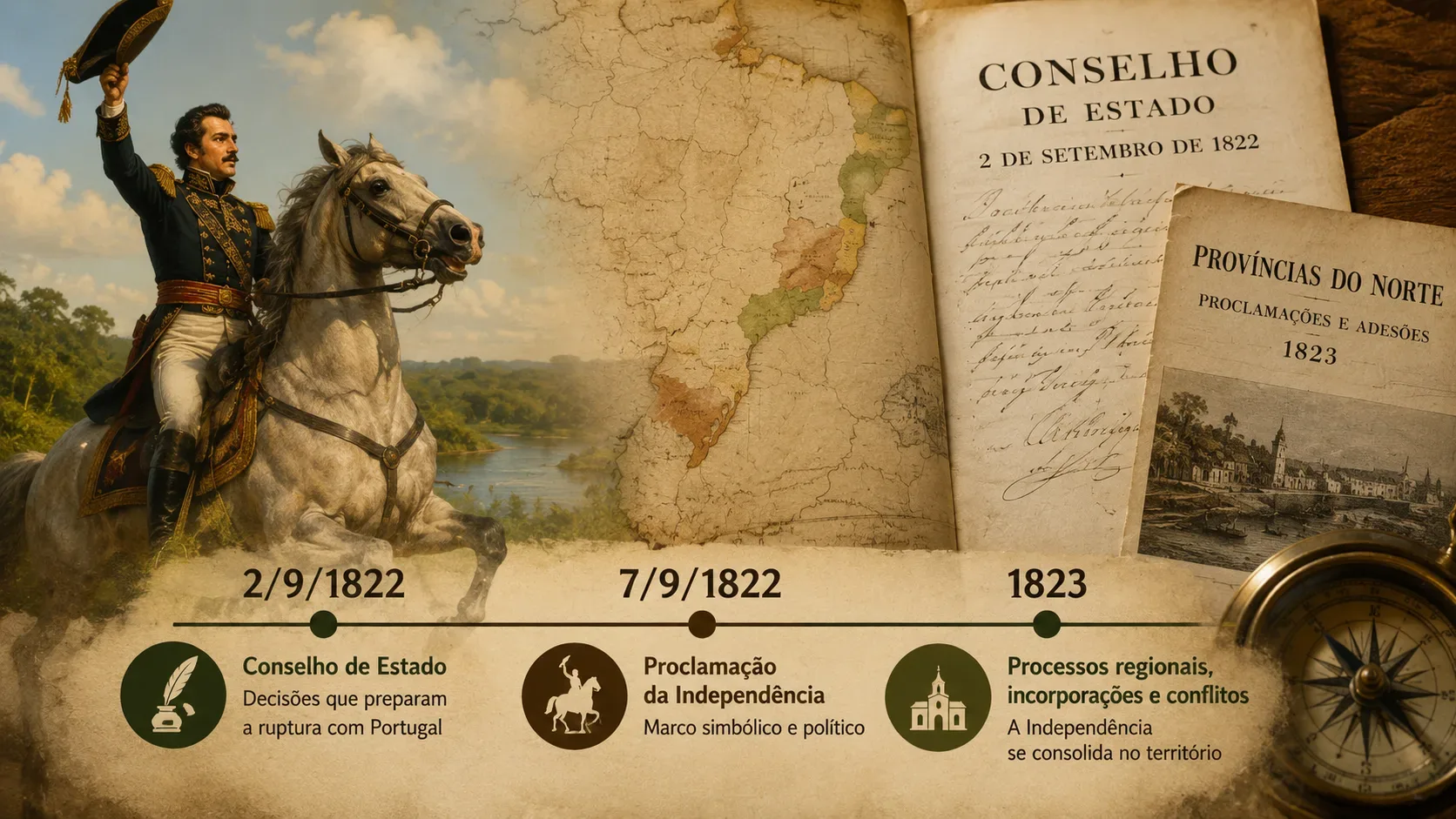
Short answer: September 7, 1822 is Brazil’s main national landmark for the political break with Portugal, but it did not, by itself, end the Independence process. Decisions made before the Ipiranga episode and wars, accessions and provincial incorporations that continued into 1823 reveal a longer chronology. If the criterion is formal Portuguese diplomatic recognition, the endpoint comes even later, in 1825.
The Brazilian National Digital Library itself treats September 7 as the temporal landmark of the separation, while also recording that political and military mobilization crossed other moments and regions. That is why the question “when did Independence end?” depends on what “end” means: declaration, organization of the new Empire, military victory in resistant provinces, or international recognition.
What happened on September 2, 1822?
Five days before Ipiranga, Maria Leopoldina was acting as regent while D. Pedro traveled in São Paulo. Institutional records place an extraordinary meeting of the Council of State in Rio de Janeiro on September 2, called and presided over by the princess, to assess new orders from the Cortes in Lisbon. The resulting political orientation was to resist the Portuguese measures, and the correspondence sent to D. Pedro helped shape the context of the decision taken on September 7.
This episode matters because it prevents a reading in which Independence was born from an isolated, improvised act with no prior developments. At the same time, it does not justify replacing one myth with another and claiming that “Independence really happened on September 2.” What took place was a rapidly accelerating sequence of political decisions, with different people and institutions participating in the break.
September 7: what the date actually marks
On September 7, 1822, D. Pedro received communications from Rio de Janeiro while in the province of São Paulo and declared the separation from Portugal. The episode on the banks of the Ipiranga became the national symbol of Independence and, over time, concentrated public memory of a broader process.
But the institutionalization of the new regime did not end that day either. D. Pedro was acclaimed emperor on October 12 and crowned on December 1, 1822. A document from Brazil’s National Archives highlights a revealing detail: even after September 7, he was still signing as prince regent before the acclamation.
Timeline: from September 2, 1822 to 1823
| Date | What happened | Why it matters |
|---|---|---|
| Sep. 2, 1822 | Extraordinary meeting of the Council of State, with Maria Leopoldina acting as regent. | Shows that decisive political moves preceded the Ipiranga episode. |
| Sep. 7, 1822 | D. Pedro declares the separation from Portugal in São Paulo. | The symbolic and political landmark later established as Brazil’s national Independence date. |
| Oct. 12, 1822 | D. Pedro is acclaimed emperor. | The new monarchical arrangement gains public and institutional form. |
| Dec. 1, 1822 | Coronation and consecration of D. Pedro I. | Completes another stage in the symbolic organization of the Empire. |
| Mar. 13, 1823 | Battle of Jenipapo in Piauí. | An example of armed conflict tied to the struggle for political control of the provinces. |
| Jul. 2, 1823 | Portuguese forces withdraw from Salvador after the war in Bahia. | In Bahia, Independence is celebrated on this date, after more than a year of conflict. |
| Jul. 28, 1823 | The General Chamber of São Luís formally records Maranhão’s “accession” to the Empire of Brazil. | Shows that alignment with D. Pedro’s government did not happen simultaneously across the territory. |
| Aug. 13, 1823 | Capitulation in Belém of elements loyal to Portugal. | Another sign that territorial consolidation advanced throughout 1823. |
Bahia: a case that challenges the idea of an “end” on September 7
Bahia is one of the clearest examples. Brazil’s National Archives describes a war with an initial phase from June to October 1822 and a second phase from October 1822 to July 1823. Forces aligned with the government in Rio de Janeiro, local troops and Portuguese contingents fought over Salvador and the Recôncavo until Portuguese forces left the capital in July 1823.
That is why July 2 remains Bahia’s central Independence date. The commemoration does not contradict September 7: it highlights another perspective on the same process, centered on the local war and the expulsion of Portuguese forces from Salvador.
Maranhão: “accession” did not mean simple agreement
In Maranhão, the temporal distance from Ipiranga is even more explicit. According to Brazil’s National Archives, the General Chamber of São Luís formally recorded on July 28, 1823 the province’s “accession” to the Empire of Brazil, almost eleven months after September 7.
The study itself warns that the word “accession,” used in official documents, can suggest voluntary and immediate agreement that does not match the complexity of events. There were political disputes, military pressure by land and sea, conflicts among local groups, and an administrative reorganization that continued after the formal act.
Piauí and Pará: Independence was also a war
In Piauí, the Battle of Jenipapo on March 13, 1823 became one of the best-known episodes in the struggle against Portuguese forces commanded by João José da Cunha Fidié. The institutional account of the Piauí Military Police emphasizes that, despite the tactical defeat of fighters supporting Independence, the clash weakened and diverted the Portuguese campaign. The episode helps explain why the formation of the new state cannot be reduced to a ceremony or proclamation in southeastern Brazil.
In Pará, the diplomatic chronology of the Alexandre de Gusmão Foundation records the capitulation in Belém of elements loyal to Portugal on August 13, 1823. Bahia, Maranhão, Piauí and Pará followed different paths, but together they make one point visible: the sovereignty of the new Empire had to be negotiated, fought over and institutionalized at different speeds.
So when did Independence end?
There is no single answer because each historical criterion produces a different date:
- If the criterion is the political declaration that became the national symbol: September 7, 1822.
- If the criterion is the public formation of the independent monarchy: the acclamation of October 12 and the coronation of December 1, 1822 are important stages.
- If the criterion is military and territorial consolidation in provinces that resisted the Rio de Janeiro government: the chronology must extend through 1823, with milestones such as Bahia, Maranhão and Pará.
- If the criterion is formal recognition by Portugal: the Treaty of Peace, Friendship and Alliance of August 29, 1825 recognized Brazil as an independent Empire.
So saying that “Independence ended on September 7” is too simple. But it would also be inaccurate to say the date had no real importance. It was a central point of rupture and became the main civic landmark of the process; the mistake is treating it as though the entire territory had changed political and military status at the same moment.
How to read September 7 without replacing one myth with another
- Do not turn September 2 into a new “single day.” The Council of State meeting helps explain the September 7 decision, but it is part of a chain of events.
- Do not treat the provinces as spectators. Bahia, Maranhão, Piauí, Pará and other regions had conflicts, local interests and different relationships with Lisbon and Rio de Janeiro.
- Do not confuse formal accession with consensus. In several places, incorporation into the new Empire occurred amid war, military pressure and internal disputes.
- Separate civic memory from historical chronology. A national date can represent a process without containing all of its events.
What the chronology changes in the interpretation
The value of looking from September 2, 1822 through 1823 is seeing that Brazilian Independence was simultaneously a political decision, institutional construction, war and territorial dispute. The “Cry of Ipiranga” remains a decisive landmark, but it stops looking like a switch that instantly disconnected Brazil from Portugal.
This reading also helps explain why different regions preserve their own dates and memories. September 7 organizes the national narrative; dates such as July 2 in Bahia remind us that separation was experienced differently and, in many places, only became concrete after conflicts that continued through 1823.