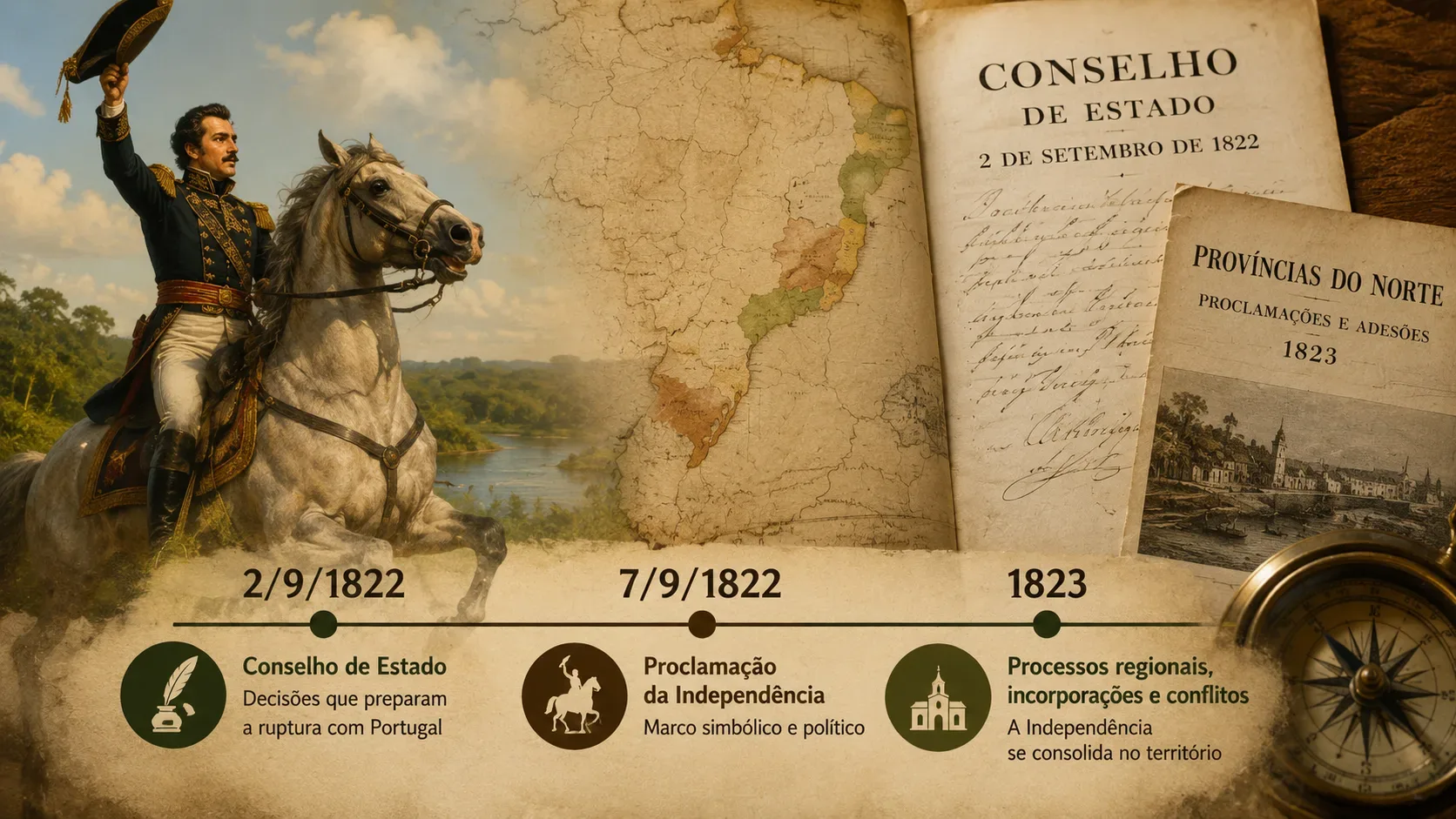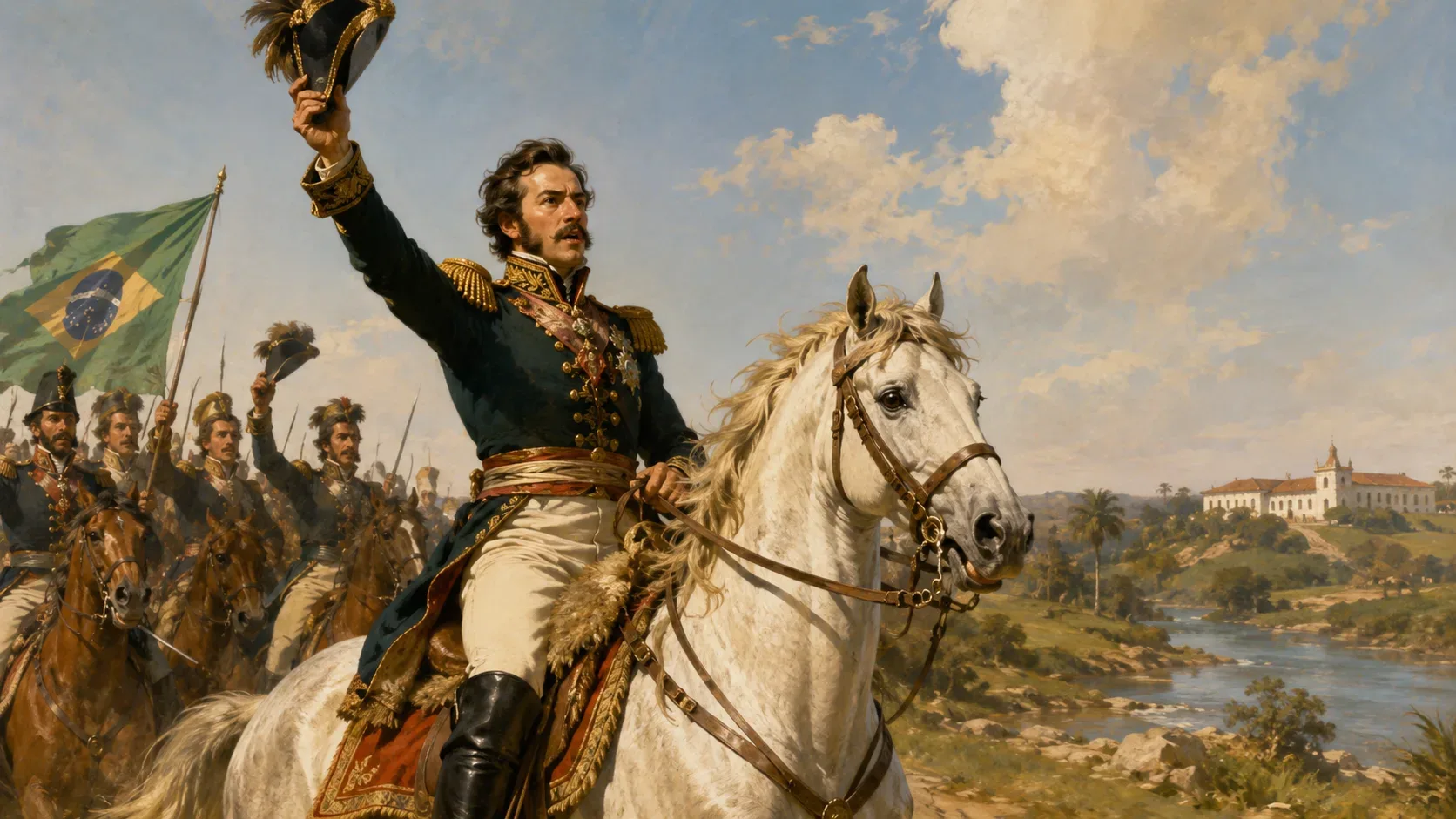
Short answer: it is reasonable to say that the future Dom Pedro I proclaimed the break with Portugal and that the formula “Independence or Death” was linked to the act by witnesses who took part in the journey of September 7, 1822. What does not exist is a contemporary transcript capable of proving, word for word, a single sentence exactly as it appears in schoolbooks. The surviving accounts were written at different times, differ in detail, and suggest that more than one proclamation took place that afternoon.
That changes the question. Instead of choosing between “it happened exactly like the painting” and “the phrase was invented,” the documentation supports a more precise conclusion: the decision to separate Brazil from Portugal and a proclamation using the formula “Independence or Death” have testimonial support; the cinematic scene and exact wording were consolidated later.
What happened on September 7, 1822
That day, Pedro de Alcântara was still prince regent. He was returning from Santos to São Paulo when he received correspondence sent from Rio de Janeiro amid the worsening conflict with the Portuguese Cortes. Documentary evidence and historical reconstruction converge on a central point: after reading the messages, Pedro decided on a political break with Portugal and communicated that decision first to people close to him and then to the Honor Guard.
A 2023 study in the Anais do Museu Paulista compared four accounts by participants in the journey and tried to reconcile their agreements and disagreements. The study is especially useful because it separates the different moments of the episode rather than treating the “Cry of Ipiranga” as a single frozen speech.
The testimonies were not all recorded at the same time
The weight of each account depends not only on who was present, but also on when the memory was written down. None of them functions like a recording or minutes produced at the moment of the event.
| Witness | When it was recorded | What it supports | Main caution |
|---|---|---|---|
| Father Belchior Pinheiro de Oliveira | Put into writing in 1827 or probably earlier, according to the Anais do Museu Paulista study | Distinguishes an initial declaration of separation before the prince’s entourage from a more solemn proclamation before the guard, in which the motto “Independence or Death” appears | It is retrospective and contains at least one geographical inaccuracy identified by researchers |
| Antônio Leite Pereira da Gama Lobo | His account was already considered old in 1854 | Witnessed the meeting with the Honor Guard and records the independence proclamation | His vantage point did not cover all the earlier events |
| Francisco de Castro Canto e Melo | April 14, 1862 | Describes the decision to separate and connects the episode with the formula “Independence or Death” | Written almost forty years later |
| Manuel Marcondes de Oliveira e Melo | 1862 | Describes the proclamation before the guard and the formula as a motto | The author himself acknowledged that forty years had erased details from his memory |
Those different dates matter. Belchior’s account is relatively close to the event; others were written decades later. At the same time, the existence of independent versions that predate Pedro Américo’s painting makes it impossible to reduce the phrase to an invention by the painter.
So did Pedro say exactly “Independence or Death”?
The documentation supports the formula, but not a stenographic quotation. The accounts agree on the core — break with Portugal, proclamation before companions and guards, symbolic gestures, and use of the expression “Independence or Death” — but they do not all reproduce the same sequence of words.
The account attributed to Belchior, for example, first describes a declaration of separation made essentially before the private entourage and then a more formal proclamation to the Honor Guard. Canto e Melo and Marcondes record different formulations around the same core. That is consistent with the way memories of a political event are fixed: the central meaning can remain stable even when the literal wording varies.
For that reason, two extreme claims are weak. Saying that “we know the exact sentence, syllable by syllable” overstates the evidence. Saying that “no one heard anything like it and the phrase was created in 1888” also ignores testimonies that predate the painting.
There may have been more than one “cry”
One of the most interesting contributions of the reconstruction in the Anais do Museu Paulista is the possibility of two moments of proclamation. In Belchior’s account, after the letters were read, Pedro announced the separation to a smaller group and sent word to the guard. Then, already before the soldiers, he made a more solemn declaration and used the motto “Independence or Death”.
This helps explain why witnesses describe similar but not identical speeches. School memory compressed several movements — reading the letters, making the decision, meeting the guard, removing Portuguese symbols, raising swords, and acclamations — into one dramatic instant.
What Pedro Américo’s painting added
Pedro Américo painted Independência ou Morte! between 1886 and 1888, more than six decades after the event. The monumental canvas, now at the Museu Paulista of the University of São Paulo, measures about 4.15 by 7.60 meters. Pesquisa FAPESP notes that the artist researched people, clothing, and animals, but worked within the conventions of nineteenth-century history painting: the scene was meant to be plausible, solemn, and worthy of a founding event, not a photographic reconstruction.
That is where choices appear that look like “errors” only if the painting is read as a photograph. The real party used mounts suited to the Serra do Mar, especially mules; the painting shows imposing horses. The clothing is more formal, the number of figures is enlarged, and the composition organizes the participants as a heroic military scene. Research has also identified compositional affinities with European paintings, especially Ernest Meissonier’s 1807, Friedland.
Those choices do not mean that Pedro Américo simply invented the event. They mean that he transformed testimonies, historical research, artistic conventions, and a national memory project into a synthetic image. The artist’s own discussions of history painting show that he understood the genre as an interpretation guided by essential facts and by the rules of art.
The painting did not create the phrase by itself — but it helped fix the scene
This is where documentary history and the history of memory meet. The expression “Independence or Death” already appeared in participants’ accounts before 1888. It therefore makes little sense to assign its origin to the painting.
What the canvas did was different: it gave the phrase an extraordinarily memorable visual body. A 2025 study in the Revista do Instituto de Estudos Brasileiros shows how photographs, engravings, exhibitions, and later schoolbooks expanded the image’s circulation. From 1896 onward, reproductions of the painting were already appearing alongside school texts about September 7. Over time, the painting was often treated as if it were a direct window onto 1822.
Pedro Américo therefore did not need to be the author of the phrase to shape profoundly how it is remembered. He helped fuse, in popular imagination, an expression transmitted by witnesses with a visual composition created sixty-six years later.
What is fact, what is probable, and what is reconstruction
- Well-supported fact: on September 7, 1822, Pedro received political correspondence during the journey and announced the break with Portugal.
- Well supported by testimony: a solemn proclamation took place before the guard, and different accounts associate it with the formula “Independence or Death”.
- Probable, but not demonstrable word for word: that the phrase was spoken exactly in the short, isolated form taught in schoolbooks.
- Later reconstruction: turning all the afternoon’s movements into one perfectly choreographed scene with war horses, immaculate uniforms, and a large military formation.
- Decisive influence of the painting: visually fixing the episode and making that heroic version recognizable to generations.
Verdict
If the question is “did Pedro say something equivalent to ‘Independence or Death’ that afternoon?”, there are important testimonies supporting a yes. If the question is “can we prove that he shouted the exact canonical sentence in one single instant identical to the painting?”, the answer is no.
The myth is not simply the existence of the phrase. It lies in turning a sequence of decisions and proclamations, remembered differently by witnesses, into one unique, visually perfect scene that seems to have been recorded live. Historical documentation supports the core of the proclamation; Pedro Américo gave that core the image that eventually looked more real than the uncertainty of the sources themselves.