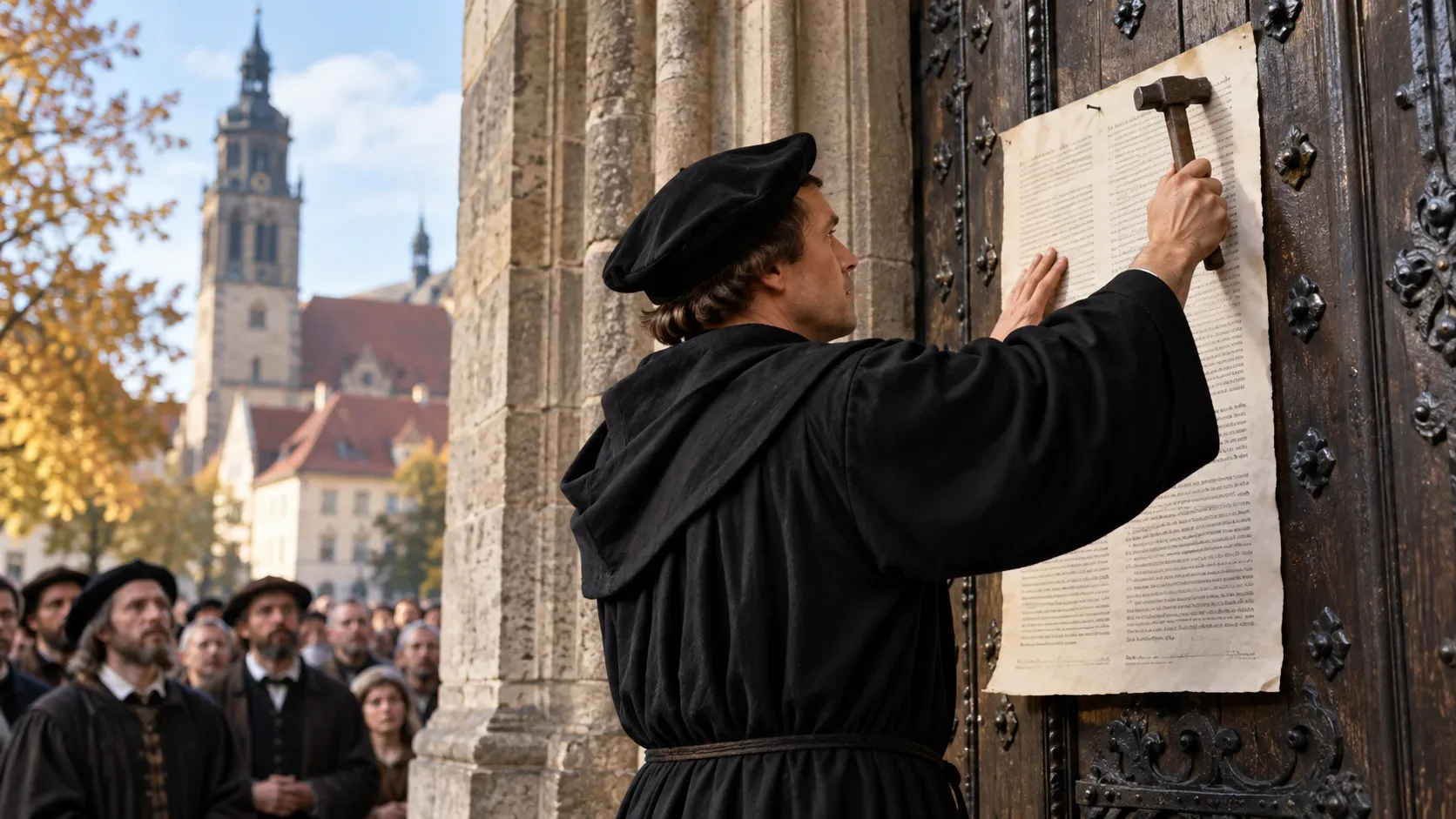
The image of Martin Luther striking a hammer to fasten the 95 Theses to the door of Wittenberg's Castle Church does not carry the same level of historical certainty as the 1517 document itself. The existence of the Theses, their character as an invitation to academic disputation, the date of 31 October 1517, and the rapid circulation of the text are well documented. The posting on the door is plausible, fits university practices of the period, and is supported by later testimony, but it remains debated among historians.
What is certain: the 95 Theses existed and were written for debate
The document known as Disputatio pro declaratione virtutis indulgentiarum, the 95 Theses, is a genuine text from 1517. The Library of Congress describes a copy of an edition printed in Nuremberg that same year. The heading announces that the propositions are to be discussed at Wittenberg under Luther's presidency and invites those who cannot attend to take part by correspondence.
That matters because the document's genre is different from the popular image of a revolutionary manifesto already aimed at a mass audience. It was written in Latin and arranged as a sequence of propositions for theological disputation. The German History in Documents and Images page emphasizes precisely this academic context.
The Theses attacked abuses and claims associated with indulgence preaching, especially the idea that payments automatically guaranteed spiritual benefits. But the text is not a simple, fully formed rejection of all papal authority: some propositions distinguish what Luther regarded as legitimate and illegitimate uses of indulgences. Reading it as though it already contained the entire later Reformation program erases the historical development that followed.
31 October 1517: the letter is firmer evidence than the hammer
There is one particularly strong piece of evidence for the date of 31 October: Luther wrote that day to Archbishop Albrecht of Mainz, criticizing the effects of indulgence preaching and enclosing his propositions. The Annotated Luther, indexed by JSTOR, includes both the 95 Theses and the letter dated 31 October.
So when the question is “what happened on 31 October 1517?”, the safest answer is: Luther formalized his objections, sent them to an ecclesiastical authority, and set his theses into academic circulation. The famous door scene is an additional question, not the sole basis for dating the episode.
An evidence ladder: from the document to the door story
| Level | What we know | Confidence |
|---|---|---|
| 1 | The 95 Theses are a 1517 Latin document structured for academic disputation. | High |
| 2 | Luther wrote to Albrecht of Mainz on 31 October 1517 and sent the propositions. | High |
| 3 | The text was printed and spread rapidly; the Library of Congress records 1517 editions in Leipzig, Nuremberg, and Basel. | High |
| 4 | Posting theses to announce disputations was compatible with Wittenberg university practice. | Well supported as context |
| 5 | Luther personally posted, or had the 95 Theses posted, on the Castle Church door on 31 October. | Plausible, not conclusive |
| 6 | Luther staged a dramatic public hammering while consciously “launching the Reformation.” | Later tradition and iconography |
Why historians debate the door story
The problem is not that the scene is impossible. On the contrary, Volker Leppin and Timothy J. Wengert, in a study devoted to the evidence for and against the posting, show that university procedures existed for publicly announcing disputations. That makes a posting entirely compatible with academic routine in Wittenberg.
At the same time, the best-known source for the scene is later. Philip Melanchthon wrote in 1546, after Luther's death, that the propositions had been published and publicly posted at the church by the castle. Melanchthon was not in Wittenberg in October 1517, so he was not an eyewitness. There is also a note by Georg Rörer, a close collaborator of Luther, in a 1540 copy of the New Testament used in Bible revision work, stating that theses on indulgences were posted on the doors of Wittenberg's churches.
Those records matter, but they do not settle every question. Luther himself, in later recollections of the beginning of the controversy, did not leave an unambiguous account of the hammer-and-door scene. Leppin and Wengert conclude that there are good arguments on both sides and treat the issue as historically interesting but ultimately not resolvable with certainty from the surviving sources.
“On the door” does not necessarily mean a theatrical break
Even if a posting took place, the popular interpretation often adds elements the sources do not guarantee. Doors of churches connected with a university could serve as places for notices. In that context, putting theses there was a way to announce a debate, not necessarily an act of vandalism, a proclamation to a crowd, or an already conscious declaration of rupture with Rome.
The Library of Congress notes that later iconography often shows Luther as a defiant monk with hammer in hand, whereas the initial purpose of the Theses was scholarly disputation. The symbolic force of the image grew as the Reformation came to be narrated retrospectively around a single “founding moment.”
The door seen today is not the door from 1517
There is also an important material detail. According to the city of Wittenberg, the old wooden door of the Castle Church was lost in the fire of 1760. The current bronze door was installed in 1858 and bears the Latin text of the Theses cast into its panels.
That means there is no surviving “original door” that could be examined for nail holes or other physical traces of a 1517 posting. The modern door is above all a monument to the historical memory of the episode.
So did Luther nail the 95 Theses to the door?
The historically responsible answer is: he may have posted them, and there are serious reasons to regard the story as plausible, but it cannot be treated as proven with the same confidence as the existence of the Theses and the letter of 31 October.
The documentary core of 1517 is firmer: the propositions existed, were intended to provoke debate, criticized abuses connected with indulgences, were sent to authorities, and quickly entered print circulation. The hammer-on-the-door image compressed that process into a simple and powerful scene — useful as a symbol, as long as it is not mistaken for a historical photograph.
How to separate fact, inference, and tradition
- Documented fact: there is a 1517 text of 95 propositions and a letter dated 31 October tied to the indulgence controversy.
- Contextual fact: posting theses and notices for disputations was a possible university practice in Wittenberg.
- Plausible inference: Luther or someone connected with the university may have put the Theses on one or more doors to announce the debate.
- Open question: whether this happened exactly on 31 October, on which door or doors, and by whose hand.
- Later tradition: the dramatic scene of Luther alone, hammering a manifesto before onlookers as a self-conscious inaugural act of the Reformation.
This distinction does not diminish the importance of the 95 Theses. It simply shifts attention from the cinematic gesture to the evidence that actually survives — the document, the correspondence, the printed circulation, and the later reports that turned an academic episode into one of the great symbols of European history.