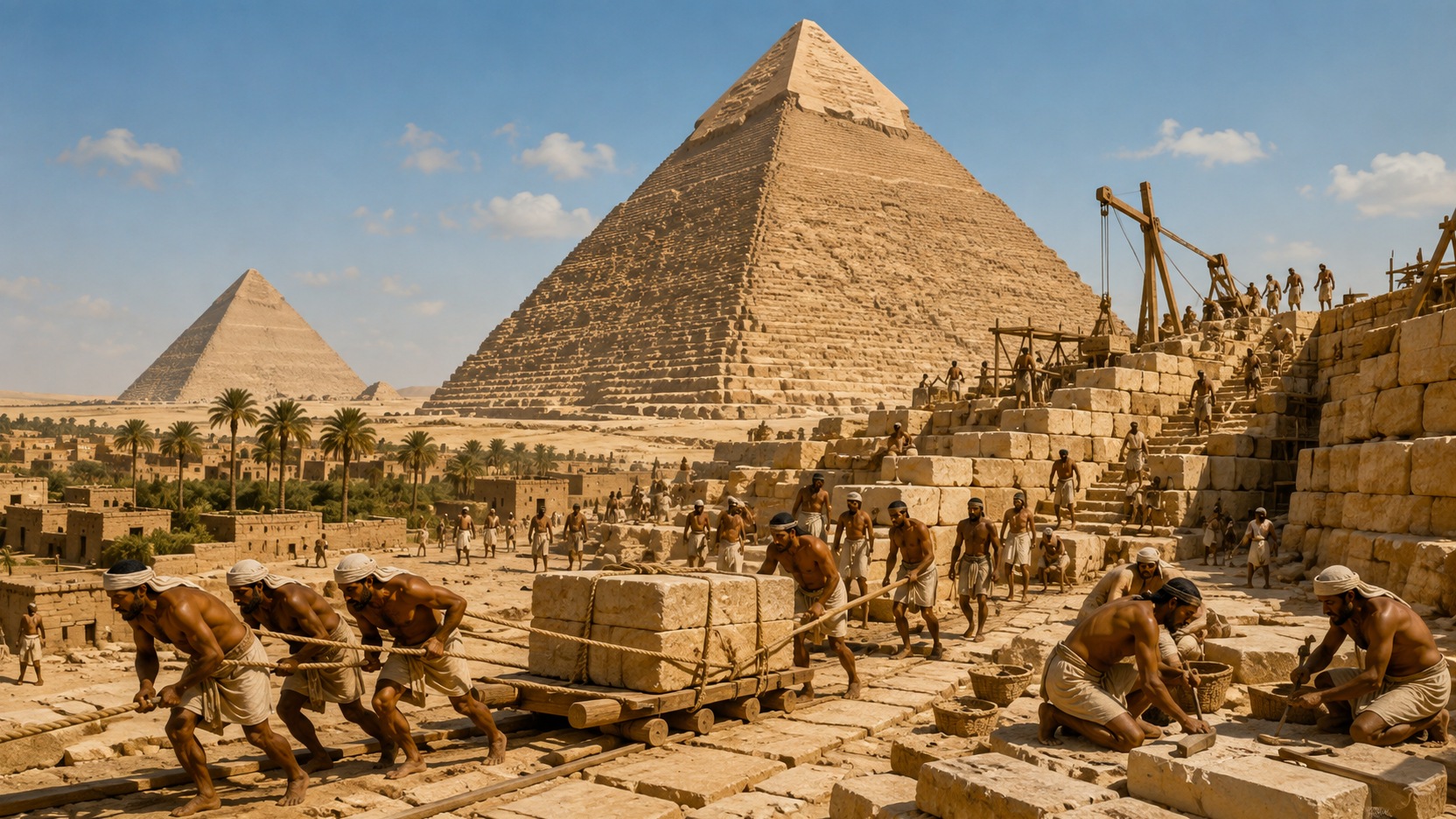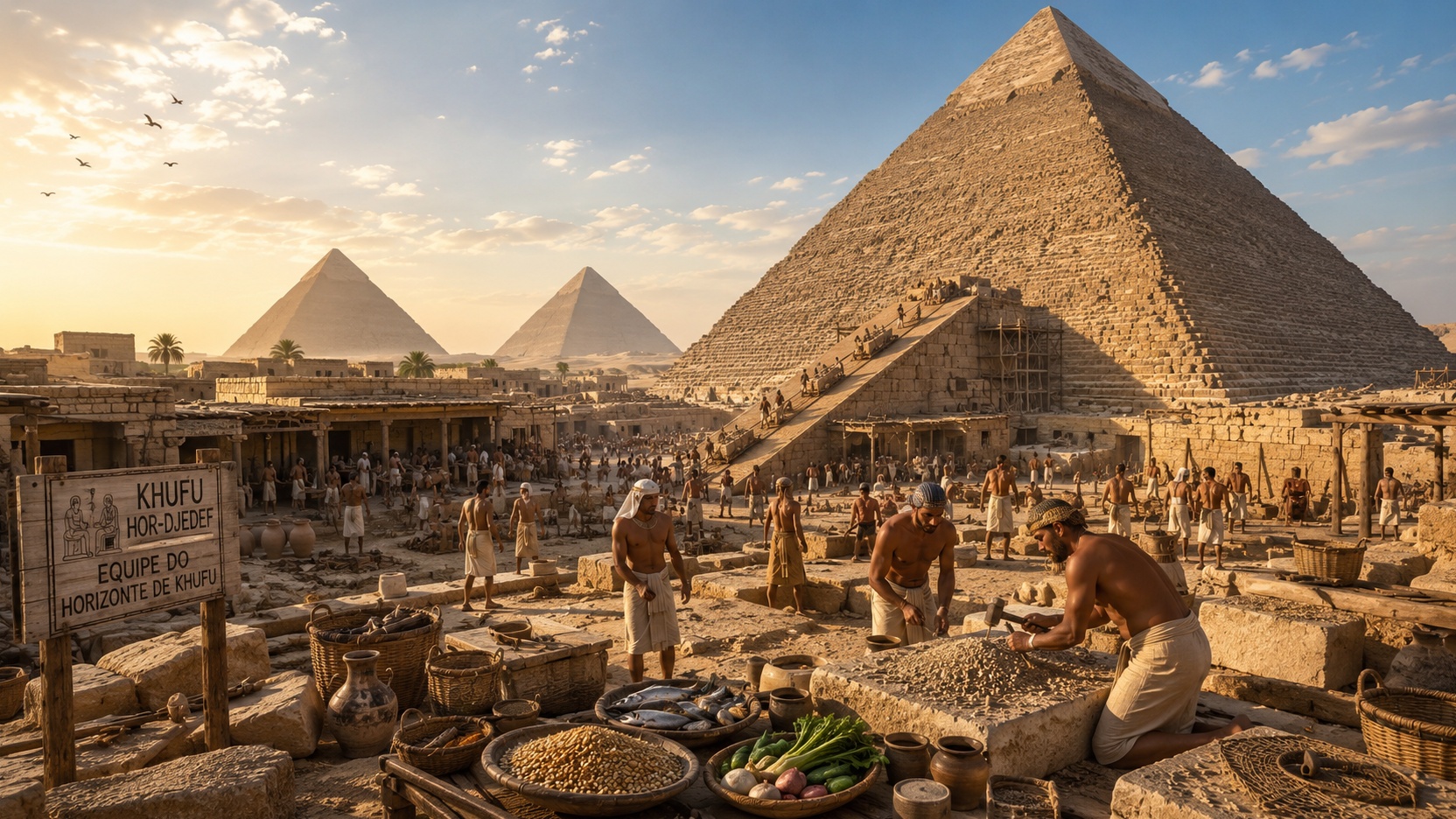
The popular image of thousands of slaves in chains lifting the pyramids of Giza is not the picture that emerges from archaeology. What the excavations show is a complex state operation, with Egyptian workers organized into teams, specialized artisans, administrators, cooks and support staff living or working in facilities made to support a colossal work.
This, however, does not authorize the opposite and equally simplistic conclusion that all were free, voluntary, salaried workers in the modern sense. In Old Kingdom Egypt, compulsory labor for the state, forms of dependency, and different legal positions coexisted. The most useful question, therefore, is not just “were they slaves?” but what types of workers were involved, how they were recruited, fed, and managed, and what the evidence can actually show about their degree of freedom.
The short answer: the slave myth doesn't fit the body of evidence
If “slaves” means the popular scene of a mass of foreign captives held under chains and whips to build the pyramids, this image finds no direct support in the archaeological record at Giza. Instead of an improvised prison camp, archaeologists found a planned city linked to real projects, with accommodation, houses, streets, workshops, kitchens, bakeries, warehouses, silos and administrative areas.
The workforce also does not appear to have been homogeneous. There is evidence of different layers of status, from experts and scribes to teams subjected to heavy labor. This point is essential: a well-stocked settlement does not prove that every person involved in construction had the same condition, just as the presence of state coercion does not automatically transform all workers into slaves.
Heit el-Ghurab: the city that changes the question
About 400 meters south of the Sphinx, excavations begun in the late 1980s revealed the settlement known as Heit el-Ghurab, the “Lost City of the Pyramids”. The preserved area exceeds several hectares and was built by the crown to support the large pyramidal complexes of the Fourth Dynasty. The association is especially strong with Chephren and Menkaure, while earlier phases can reach the period of Cheops.
What matters for the question about workers is the variety of structures. There weren't just spaces where people slept. The settlement included craft workshops, industrial areas, kitchens, bakeries, warehouses, grain silos, small houses and larger residences or offices linked to the administration. This reveals a system capable of gathering labor, producing tools, preparing food, storing resources, and coordinating the flow of materials.
A gigantic project required a city of support
The pyramids weren't just built by men pulling blocks. For each team directly involved in quarrying, transporting or laying stone, a set of less visible activities were required: making and repairing tools, preparing bread, brewing beer, slaughtering animals, cooking, transporting water, organizing stocks, recording deliveries and supervising work parties.
This infrastructure helps correct a common problem in the popular image of construction. Work was not just physical force concentrated in front of the pyramid. It was a logistics chain fed by resources coming from different parts of Egypt and distributed by a central administration.
Bakeries, grains and meat: food is not a detail
The archeology of Heit el-Ghurab found bakeries with large containers used to prepare bread and a huge amount of fragments of these ceramic molds scattered throughout the settlement. Large silos were also part of the administrative complex. Archaeological texts and comparisons indicate that bread and beer were basic elements of the rations provided on real work projects.
Animal remains add another layer to the picture. Cattle, sheep and goat bones appear in quantity, and studies of the site indicate regular slaughter to supply thousands of people. The distribution, however, was not equal: areas associated with larger houses present higher concentrations of prestigious foods, while galleries show a different consumption profile. This suggests hierarchy within the settlement itself.
Therefore, the phrase “the builders were well fed” needs to be used with caution. Some of the residents of Heit el-Ghurab may have belonged to groups of relatively high status, such as experts, members of organized teams, supervisors or personnel linked to the administration. The settlement should not automatically be treated as a perfect sample of all workers mobilized for the pyramids.
Administration: thousands of stamps and a state-controlled city
Excavations have recovered thousands of clay seal impressions. These seals were used to close containers, doors, documents and other objects and bore names, titles and signs linked to the administration. The material shows the presence of scribes, priests and other officials operating in an environment in which assets and responsibilities needed to be controlled.
The combination of accommodation, productive areas, large-scale food and administrative records points to a project coordinated by the crown. This scenario is very different from the idea of a crowd without formal organization. Building the pyramids required bureaucracy, supervision and division of tasks.
Merer's diary shows teams and logistics in the reign of Cheops
Another set of documents helps to see the construction from the side of those who performed specific tasks. Papyri found in Wadi el-Jarf on the Red Sea coast preserve records of a team led by an inspector named Merer. Part of these diaries describes the transport of limestone blocks from the Tura quarries to the Giza region during the reign of Cheops.
These records are not a complete list of all the builders of the Great Pyramid, nor do they resolve the question of the workers' legal status. Its value lies in showing an identifiable work unit, with leadership, routes, movements and tasks recorded. In other words, they confirm a system of teams and logistics that matches the organization observed archaeologically at Giza.
“Receiving bread and beer” does not prove freedom
It is common to find the statement that the builders “were paid with bread and beer” and, therefore, could not be slaves. The first part is based: food rations were central to the supply of large projects. The second part is excessive inference.
In an economic system without a modern monetary wage as the main reference, food, drink and other goods could function as provision, compensation and redistribution. The fact that someone received rations does not alone indicate whether that person could refuse the service, choose another employer or abandon the work. The food shows that the State needed to keep the workforce functioning; does not automatically resolve the issue of freedom.
Corveia: compulsory work is not the same as slavery
Studies on work in the Old Kingdom consider the possibility that a significant part of the workforce was recruited by corvee, that is, a temporary obligation to provide service to the State. This type of mobilization could be organized by communities, properties and local administrations and does not correspond, by definition, to slavery as the permanent property of one person by another.
At the same time, calling this system “free labor” would be misleading. If the provision was mandatory, there was coercion. The important distinction is legal and social: temporary state obligation, dependency, permanent skilled work, and slavery are different categories, even though they may all involve little autonomy for those who work.
The problem is that the documentation from the Fourth Dynasty does not allow us to accurately reconstruct the social contract of each group present in Giza. Experts themselves debate the extent to which the residents of Heit el-Ghurab represent ordinary workers, better-status organized crews, service personnel, shipping groups, or a combination of these roles.
What about foreign captives?
Ancient Egypt experienced the capture of foreigners and different forms of dependence. Old Kingdom texts record captives in other contexts, and later periods more clearly document the use of prisoners in state work. This means that slavery or captive labor was not unknown in Egyptian society.
The remaining step is to directly link these captives to the construction of the great pyramids of Giza on a scale sufficient to support the popular narrative. Specialist literature notes that, for the Old Kingdom, there is evidence of captives, but not direct evidence of groups of foreign slaves constituting the main workforce of the pyramids. The hypothesis of recruitment of Egyptians due to state obligations remains most compatible with much of the available framework, although the exact proportion of each category remains uncertain.
What the evidence demonstrates and what it only allows us to infer
Archaeology shows that there was a planned infrastructure in Giza to support workers, artisans, administrators and support staff. It demonstrates large-scale bread production, grain storage, meat consumption, workshops, accommodation and intense administrative activity. The Merer papyri demonstrate organized teams transporting materials to Giza during the reign of Cheops.
This evidence makes it very difficult to support the film version of a pyramid built primarily by a mass of chained foreign slaves. But they do not demonstrate that the entire workforce was voluntary, that everyone received the same treatment or that no legally dependent person participated in the construction.
It is also not safe to use the dietary pattern of the best-supplied sectors of Heit el-Ghurab as proof that all pyramid workers had a privileged diet. The site itself reveals inequality between areas and functions, and researchers discuss whether some of its residents had a higher status than ordinary workers.
So who built the pyramids of Giza?
The most faithful answer to the evidence is: an Egyptian workforce organized by the State, made up of different groups. There were manual laborers, skilled artisans, team leaders, scribes, administrators, cooks, and other necessary professionals.
to maintain the work. Part of this contingent may have worked permanently or specialized; another part may have been mobilized by service obligations to the State.
This conclusion is less simple than “they were slaves” or “they were free employees”, but that is precisely why it comes closer to what archeology allows us to say. Giza shows a society capable of organizing people, food, materials, transportation and bureaucracy on an extraordinary scale. The current debate is no longer about currents imagined in films, but about the concrete forms of mobilization, compensation, hierarchy and coercion within this state machine.
The question about slaves, therefore, does not end with a change of label. The advance of archeology was to replace the myth with a better formulated historical problem: which people did each part of the work, under what obligations and with what position within Old Kingdom society. It is in this terrain, between material evidence and the limits of what it can reveal, that the most solid answer needs to remain.