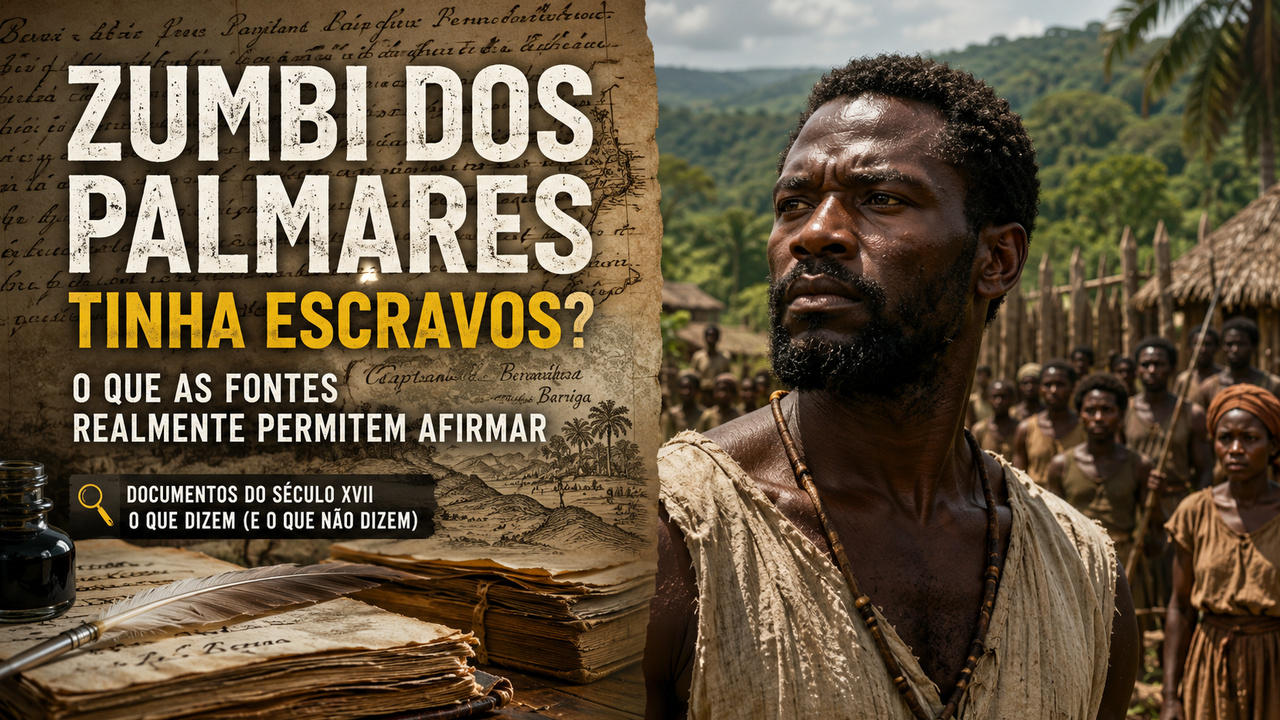
The safest answer is less simple than the phrase circulating on the internet: the known documentation does not prove that Zumbi dos Palmares owned enslaved people as individual property. Sources from the 17th century record a hierarchical Palmar society, conflicts, fugitives, prisoners and people taken to the slums. They also show that colonial authorities demanded the return of black people who had fled to Palmares. None of this, however, automatically amounts to proof that Zumbi was a slave owner in the legal and economic sense of Portuguese colonial slavery.
This does not make the opposite answer certain. Saying that there is no documentary proof of individual ownership does not mean proving that any form of captivity, coercion or dependency existed in Palmares. The central point is different: between what the documents actually record and the categorical statement that "Zumbi had slaves" there is an interpretative leap that needs to be explained.
The correct question is more specific than it seems
The phrase "Zumbi had slaves?" mixes at least three questions. One is to know if there were people in conditions of dependence or captivity within the various huts in Palmares. Another is to know how people captured or removed from mills and towns were incorporated. The third, much more specific, is to know if there is a document saying that Zumbi, as an individual, owned enslaved people.
These questions do not have the same level of evidence. The sources allow us to see political hierarchies, military actions and forms of incorporation of the population. They are much less clear when trying to convert these signs into an institution of internal slavery with defined rules and, above all, when trying to attribute personal property of human beings to Zumbi.
The main problem: almost everything was written by Palmares' enemies
Palmares did not come to us through an archive produced by its own inhabitants. What survived in greater quantity was written by governors, military, religious, chambers and
other agents from the colonial world who wanted to fight, negotiate, manage or describe the mocambos. Therefore, documents are indispensable and, at the same time, need to be read as texts produced in situations of war and political dispute.
The main narrative of the period has long been known as the List of wars made in Palmares de Pernambuco. The critical edition organized by Sílvia Hunold Lara and Phablo Roberto Marchis Fachin showed that the text has different handwritten versions, was produced in 1678 to highlight the performance of governor Dom Pedro de Almeida and circulated for a long time in a printed transcription that had gaps and problems. The researchers attributed the authorship to Father Antônio da Silva and compared the manuscripts preserved in Évora and Torre do Tombo.
This methodological detail is decisive. The Relationship cannot be read as a neutral camera pointed at Palmares. She organizes events to build a dangerous enemy and, at the same time, magnify the victory of the authorities. Lara and Fachin draw attention to the silences, the ambiguities and the need to cross-reference the narrative with other documents produced in the same context.
The 1678 manuscript mentions Zumbi, but does not say that he owned slaves
In the narrative of the 1675 campaign, the character appears spelled as Zambi and is described as a general of arms, a warrior of great valor and the main obstacle to colonial troops. The text reports that he was injured in combat and remained alive. It is an important reference because it shows his military position before the political rupture of 1678.
What the document does not do is record a property relationship between Zumbi and enslaved people. There is no description of slaves belonging to Zumbi, of purchases and sales carried out by him, of hereditary transmission of captives, of compulsory labor organized as personal assets or of any other documentary mechanism that allows individual ownership to be asserted with certainty.
There is also a chronological limitation. The critical analysis of the manuscript highlights that the narrative was composed when many subsequent events had not yet occurred. Zumbi's dissent in relation to the peace agreement, his concentration with part of the Palmarinos in the Serra da Barriga region and the campaigns of the 1680s belong to a moment that that 1678 narrative could not describe retrospectively. Using it to fill in everything you want to know about Zumbi's later government creates a false continuity.
The 1678 agreement is one of the keys to the confusion
The agreement negotiated in 1678 between the government of Pernambuco and Ganga Zumba is one of the most important sources for understanding the issue. The text promised freedom to those born in Palmares and demanded that black people who had fled colonial settlements to the slums be handed over. In other administrative records, authorities called these people captives who were allegedly usurped from residents.
From a colonial point of view, the logic is clear: a person who had escaped from a mill continued to be considered the property of his former master. When the government demanded its return, it was reaffirming the colony's slave rights. The document proves that there were people in Palmares who the colonizers classified as escaped slaves. It does not prove, in itself, that these people continued to be enslaved within Palmares nor that they were the property of Ganga Zumba, Zumbi or another leader.
The difference is important because the same person could occupy incompatible legal positions depending on which side described them. For a plantation owner, she was a runaway slave who
should be refunded. For those who lived in Palmares, their daily conditions could be different. Without documentation produced by the Palmarinos themselves, this transition from one category to another is difficult to reconstruct.
Were there people forcibly taken to the shacks?
There is strong evidence that yes. The Report accuses the Palmarinos of attacking towns, taking slaves and violently treating the residents' wives and daughters. In one episode of the campaign, a young mulatto, daughter of a resident of Sirinhaém, appears among people captured by colonial troops and is described as someone who had been taken by black people from Palmares. Other documents and narratives from the period also associate the Palmares assaults with the removal of people from neighboring properties.
This set prevents a romantic image of Palmares as a space without conflict, coercion or hierarchy. A community at war for decades could incorporate voluntary fugitives, relatives, allies, prisoners and people taken against their will. But the existence of capture or kidnapping does not automatically resolve the slavery question. To reach this conclusion it would be necessary to know what the status of these people was after incorporation: whether they could leave, whether their work was compulsory, whether they were negotiable, whether their status was passed on to their children and who exercised property rights over them.
Political hierarchy is not automatic proof of slavery
The documentation describes Palmares as a network of huts with chiefs, officers, guards, military leaders and figures called kings, potentates or lords. Ganga Zumba is presented with rituals of deference and a house surrounded by family and officials. Zombie appears in a prominent military position. Therefore, the idea of a completely egalitarian society does not correspond to what the sources allow us to see.
But hierarchy is not synonymous with slavery. Royalty, political dependence, clientele, kinship, military service, collective obligation, and captivity can coexist in different ways. Comparisons with societies in West-Central Africa help historians formulate hypotheses about Palmares, especially because many of its inhabitants had origins or cultural links with that region. The problem appears when the comparison stops being a hypothesis and starts functioning as a substitute for non-existent proof.
The phrase "he was an African leader from the 17th century, therefore he had slaves" may seem plausible to those who know slave societies of the period, but it is still an inference. Historical context allows us to ask better questions; does not authorize attributing a specific practice to a person without evidence connecting it to it.
Captive, slave, piece and fugitive are not transparent words
Colonial documents use words such as slave, captive, piece, black and fugitive within their own legal and political universe. Portuguese troops called the people imprisoned in Palmares and then divided up, handed over to former masters or subjected to decisions by the authorities, pieces. This describes what the victors intended to do with those captured; does not, in itself, tell you what their social condition was before the attack.
The same care applies to the word captive. In certain passages, it can designate someone held captive by colonial forces. In others, it appears linked to people that the residents of Pernambuco considered their property and wanted to recover. Translating all these occurrences into a single modern and stable notion of "slave of Palmares" erases who is speaking, in what situation and with what interest.
There is also a problem of textual transmission. An important part of historiography worked for decades with old editions, translations of Dutch reports and transcriptions that did not always perfectly reproduce the manuscripts. Recent philological research does not make sources simple; on the contrary, it shows why an isolated word needs to be checked in the original, in the version of the document and in the context in which it was recorded.
What Sílvia Hunold Lara’s historiography adds
Sílvia Hunold Lara's work is especially useful because it shifts the question of "which version should we believe?" to "what can each document demonstrate?". In Palmares & Cucaú and the critical edition Guerra contra Palmares, the reconstruction arises from the crossing of correspondence, administrative records, manuscripts, maps and different versions of the 1678 narrative.
This method reveals, for example, that the agreement with Ganga Zumba cannot be reduced to a simple surrender. The authorities recognized Palmarian leaders, negotiated through emissaries, promised land and freedom to part of the population and tried to transform the residents of Cucaú into vassals subject to the colonial government. The episode shows a complex political border between freedom, subjection and enslavement.
It also shows why it is risky to fill documentary silence with certainties. When a source does not say that Zumbi owned slaves, the historian should not transform the absence into proof that he never had any dependents or captives. But you also cannot use the general context of Atlantic slavery, the existence of hierarchies or the behavior of other leaders to write as fact what the document does not record.
So there was slavery inside Palmares?
The question remains open if formulated broadly. It is plausible that Palmares harbored coercive relationships and different degrees of dependence, and the sources record captured people, hierarchies and internal conflicts. It is also possible that practices brought or recreated by Central African groups influenced the Palmarina organization. The available documentation, however, does not allow us to simply equate these relationships with the colonial slave system that transformed people into negotiable property, transmitted and exploited within the plantation economy.
Prudence goes both ways. There is no solid basis to describe Palmares as a modern, homogeneous and fully egalitarian community. There is also no solid basis for describing it as a copy, on a smaller scale, of Portuguese manorial society. The mocambos existed in confrontation with this society, negotiated with it, attracted fugitives, carried out attacks and developed their own political structures.
Documented fact, hypothesis and extrapolation
What is documented
It is documented that Palmares brought together many fugitives from slavery, maintained a hierarchical political and military organization, carried out attacks on colonial properties, incorporated people from outside and negotiated an agreement in 1678 that provided for freedom for those born in the mocambos and the return of those who had fled the villages. It is also documented that Zumbi occupied a very prominent military position and later became the main pole of resistance to the agreement.
What can be formulated as a hypothesis
The existence of captivity, coercive labor or internal dependencies in Palmares can be investigated, as well as possible connections with political practices in Central-West Africa. These
hypotheses are historically legitimate when they make clear what evidence supports them and what gaps remain.
What goes beyond the evidence
To state, without qualification, that Zumbi had slaves as if there were a document registering his individual property goes beyond what known sources demonstrate. The phrase transforms a possibility or an inference about Palmar society into a proven biography of Zumbi.
What the sources really allow us to say
The most precise formulation is this: among the central documents known today and critically worked on by historiography, there is no direct proof that Zumbi dos Palmares owned enslaved people. There is evidence of a hierarchical society, of wars, of people being captured, of fugitives that the colonial order continued to treat as slaves and of relationships that do not fit into an idealized image of absolute freedom.
This is different from declaring that all forms of captivity were absent. Palmares' story is precisely a case in which the quality of the response depends on respecting the difference between document, interpretation and inference. What the archives allow us to say is more complex than a slogan: the specific accusation against Zumbi is not documented, and the social complexity of Palmares should not be erased to produce certainty in the opposite direction.