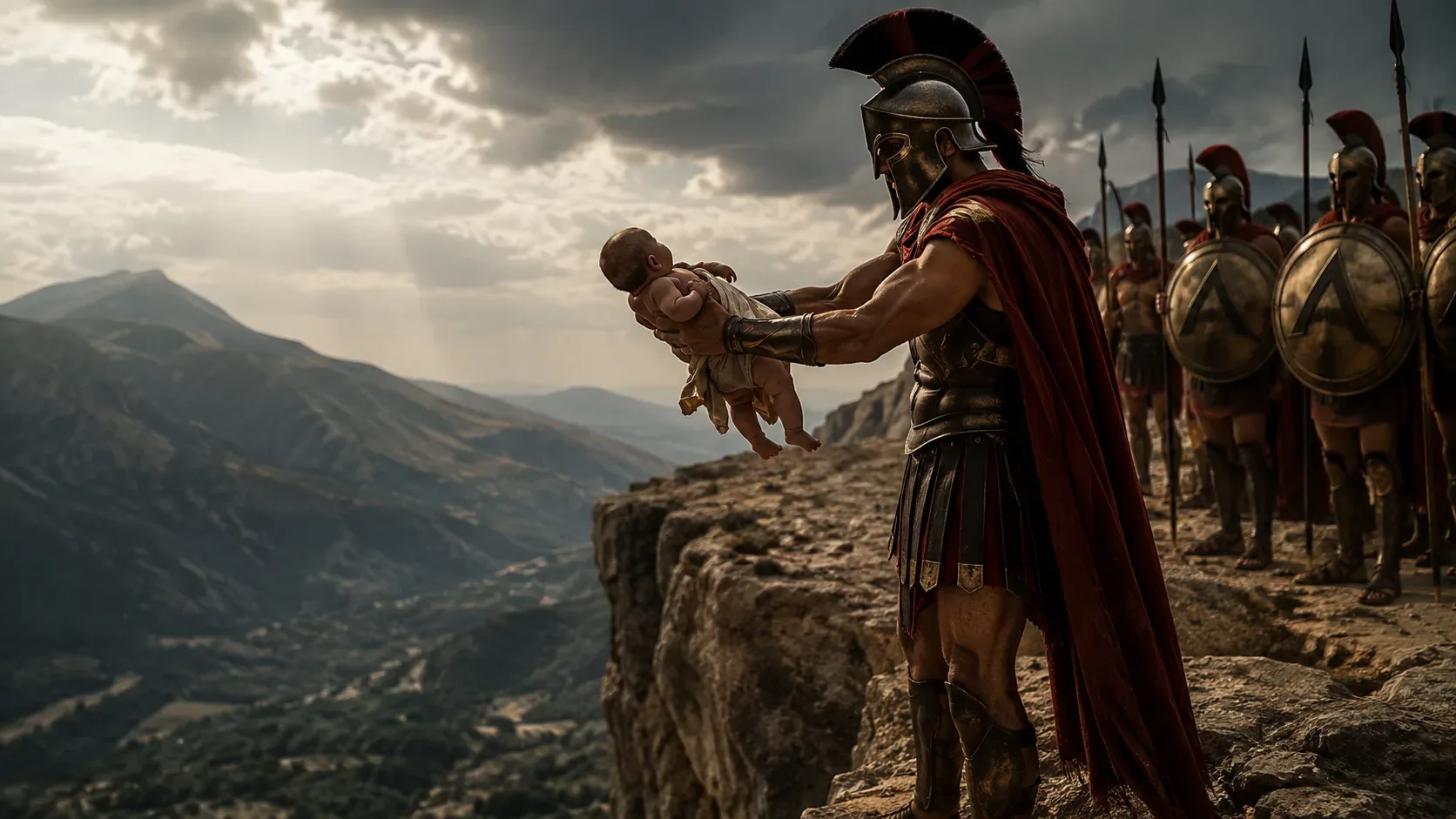
There is not enough evidence to treat the popular image of Spartans throwing babies off a cliff as established historical fact. What survives is an account by Plutarch, written many centuries after Archaic and Classical Sparta, stating that newborns were inspected by elders and that those deemed unsuitable were sent to the Apothetae, described as a chasm-like place at the foot of Mount Taygetus. Archaeology at the site cautiously identified today with ancient Kaiadas has uncovered a large quantity of human remains, but it has not confirmed newborn or small-child remains. That contrast weakens the popular version without allowing the opposite conclusion that no form of infant exposure ever occurred in Sparta.
What Plutarch actually wrote
The key passage is chapter 16 of the Life of Lycurgus. Plutarch says that the father did not decide alone whether to raise the child: he took the infant to a place called the Lesche, where the elders of the tribe examined it. If it was judged “well-built and sturdy,” it was ordered to be raised; if it was judged unsuitable, it was sent to the so-called Apothetae, “a chasm-like place” at the foot of Mount Taygetus. The text is available through the Perseus Digital Library.
This is a striking account, but it is important to note exactly what it does not say. Plutarch does not describe a warrior hurling a baby from a cliff, does not narrate a throwing ceremony, and in this passage does not use the name Kaiadas. The popular formula turns “sent to the Apothetae” into a much more specific scene than the surviving source allows us to reconstruct.
Where the “throwing babies off a cliff” image came from
The modern version combines three separate steps: inspection of newborns, rejection of those considered weak or deformed, and deliberate death by a fall. The first two appear in Plutarch’s account; the third is a later interpretation. Even if one accepts Plutarch’s narrative, neither the verb nor the description of the place requires us to imagine that the child was hurled. Exposure—abandoning someone in a place to die—and precipitation—throwing someone from a height—are different practices.
It is also common to merge the Apothetae and Kaiadas as though they were unquestionably the same geographical point. That equation is possible in some reconstructions, but it should not be presented as certain. The archaeological report on the Trypi rock-cleft uses cautious language when relating it to ancient Kaiadas, and the literary tradition about the place includes punitive uses that had nothing to do with children.
What archaeology found at Kaiadas
A rock-cleft near Trypi, about 10 km from Sparta on the slopes of Taygetus, has been investigated since the 1980s and is often identified with the Kaiadas known from ancient sources. The Chronique des fouilles en ligne, associated with the École française d’Athènes, records a renewed anthropological research program begun in 2003. Its report says that investigation up to that point had not confirmed newborn or small-child remains; most of the skeletal material probably belonged to men with a biological age of 18 to 35.
That pattern matters because it is not what one would expect from a deposit formed mainly by systematic disposal of babies. At the same time, the report does not turn absence into a universal proof: it concerns the sampled and studied material at that site, and the identification of the Trypi cleft with ancient Kaiadas is presented as an archaeological conclusion supported by several clues, not as mathematical certainty.
Kaiadas has a better-documented punitive use
Another ancient source helps explain the adult bones. In the History of the Peloponnesian War, Thucydides says that after the death of the regent Pausanias, the Spartans considered throwing his body into Kaiadas, “where they cast criminals.” The text is available in the Perseus Digital Library. This reference, much earlier than Plutarch, associates Kaiadas with punishment and the disposal of condemned people.
The anthropological profile from the Trypi cleft—dominated by young and adult men—fits that use better than a burial place for rejected newborns. Archaeological reports also mention materials such as iron rings and a skull fragment with an arrowhead embedded in it, finds compatible with violence, captivity, or execution. They do not solve every detail of the site, but they provide a positive explanation for the concentration of adult human remains.
What the absence of baby bones can—and cannot—prove
The safest conclusion is negative and limited: the archaeology of this site has not corroborated the story that rejected babies were systematically killed there. That is different from saying that science has “proved no Spartan baby was ever exposed.” An archaeological find answers only for the place, layers, preservation conditions, and remains that were actually studied.
- It can show: that the analyzed material from the Trypi Kaiadas is dominated by adolescents and adults, especially men, rather than newborns.
- It can weaken: the automatic equation between Plutarch’s account and mass infant killing at that particular site.
- It cannot by itself demonstrate: that no newborn was exposed anywhere else, at any point in Spartan history.
- It does not prove Plutarch invented the story: his testimony remains a literary source that must be critically assessed.
Why Plutarch requires caution as a witness
Plutarch wrote the Life of Lycurgus around the end of the 1st and beginning of the 2nd century CE, long after the period in which the institutions traditionally attributed to Lycurgus were supposed to have formed. This does not make his text useless: late authors can preserve older traditions and documents. But the chronological distance prevents us from treating the passage as an eyewitness record of Archaic Sparta.
Ancient Sparta is also shaped by what scholars often call the “Spartan mirage”: authors from different periods idealized, criticized, or moralized the city as a model of extreme discipline. Accounts that combine physical strength, collective control, and severe upbringing therefore need to be compared with other sources and archaeology instead of being repeated in isolation.
The academic debate has changed substantially
In 2021, Debby Sneed published “Disability and Infanticide in Ancient Greece” in Hesperia. She argues that passages from Plutarch, Plato, and Aristotle, when read in context, do not support the idea that killing or exposing disabled children was a legally mandated or typical response in ancient Greece. She brings together literary, material, and bioarchaeological evidence for care and survival among people born with congenital conditions.
The debate remains open even over the wording of Plutarch’s chapter 16. A recent proposal by Lucia Pepe, published in 2025 and summarized in the University of Milan repository, argues for an even more radical reading: Plutarch’s scrutiny may have concerned boys old enough to enter the agoge, and the criterion for rejection may have involved legitimacy of birth rather than physical disability. It is a specific thesis, not an established consensus, but it shows how far the passage is from being transparent.
So, did Spartans throw babies off a cliff?
| Claim | What supports it | Assessment |
|---|---|---|
| Newborns were examined by elders | Plutarch, Life of Lycurgus 16 | An ancient literary tradition, but recorded very late and without direct independent confirmation. |
| Rejected babies were sent to the Apothetae | Plutarch | This is what the text says; the historicity of the practice remains disputed. |
| They were “thrown off a cliff” | Popular interpretation of the account | More specific than the source: Plutarch does not describe the act of throwing. |
| Kaiadas was the dumping place for babies | Later association between texts and site | Not corroborated by the anthropology of the Trypi site; newborn or small-child remains were not confirmed. |
| Kaiadas was used for convicts and prisoners | Thucydides and the profile of the human remains | Much better supported by the available literary and archaeological evidence. |
Verdict: a late tradition, not an archaeologically proven fact
The answer most faithful to the evidence is not simply “yes” or “no.” Plutarch really does preserve a tradition in which children judged unsuitable were sent to the Apothetae, but he does not describe babies being hurled from a cliff. Archaeology at the place usually associated with Kaiadas has not produced the pattern of infant remains that would confirm that image; it has produced mostly young adult remains, consistent with ancient references to a place of punishment.
Therefore, the statement “Spartans threw babies off a cliff” should be treated as a modern simplification of a late and disputed source. The secure historical fact is that Plutarch’s account exists. What remains uncertain is how far it reflected an actual practice, when such a practice may have occurred, and exactly what happened to those who were rejected.
Sources to check
- Plutarch, Life of Lycurgus, ch. 16 — Perseus Digital Library.
- Thucydides, History of the Peloponnesian War, book 1 — Perseus Digital Library.
- Chronique des fouilles en ligne — Trypi (ancient Kaiadas), 2003 anthropological research.
- Debby Sneed, “Disability and Infanticide in Ancient Greece,” Hesperia 90.4 (2021).
- Lucia Pepe, study on the interpretation of Plutarch, University of Milan (2025).