The safest answer is: the available evidence does not support the popular image that the pyramids of Giza were built primarily by a mass of enslaved people, treated as property and forced to work under surveillance. But correcting this myth should not become another simplism. Saying that “they were not slaves” does not mean that they were all free, voluntary and salaried workers in today's terms.
What archeology and Old Kingdom texts suggest is a mixed state labor system. There were artisans, administrators, foremen and other specialists linked to the site for longer periods. Alongside them, the State could mobilize groups of workers under obligation, under a corvée regime, that is, work owed to authority as part of the obligations imposed on the population. These people received provisions and were integrated into organized teams. This is very different from both the caricature of slaves in chains and a modern company with free employment contracts.
Short answer: they weren't slaves, but they weren't modern employees either
The idea that thousands of slaves were forced to build the pyramids has become a very powerful cultural image. It combines the monumentality of the buildings with a modern expectation: if the effort was gigantic, it seems intuitive to imagine an equally gigantic contingent of people without any autonomy.
The problem is that the main evidence from Giza points to another reality. The settlement linked to the builders, food traces, production areas, administrative records and papyri accompanying transport teams show a workforce organized by the State, divided into functions and supported by a planned infrastructure.
This undermines the notion that the work essentially depended on property slaves. At the same time, the very functioning of the Egyptian State made it possible to requisition labor. A person mobilized by corvée was not necessarily someone else's property, but neither did he choose service with the freedom of a modern employee who accepts or refuses a contract.
Why the word “slave” complicates the discussion
Applying a single modern category to Egypt about 4,500 years ago creates a problem of historical translation. Egyptian documentation records different forms of dependence, service, compulsory work, war captivity and attachment to institutions. Old terms do not perfectly correspond to contemporary legal categories.
This does not mean that slavery or other harsh forms of servitude did not exist in Ancient Egypt. There is evidence of prisoners of war employed as labor and of different situations of dependence throughout Pharaonic history. The specific point is different: there is no good basis for transforming this general reality into proof that the main workforce of the great pyramids of Giza were slaves in the classical sense of people owned as property.
The distinction matters because “compulsory labor” is a broader category than “slavery.” An authority can force someone to provide service without that person being legally owned by a master. Corvée is an example of this type of obligation.
Heit el-Ghurab: the city that changes the question
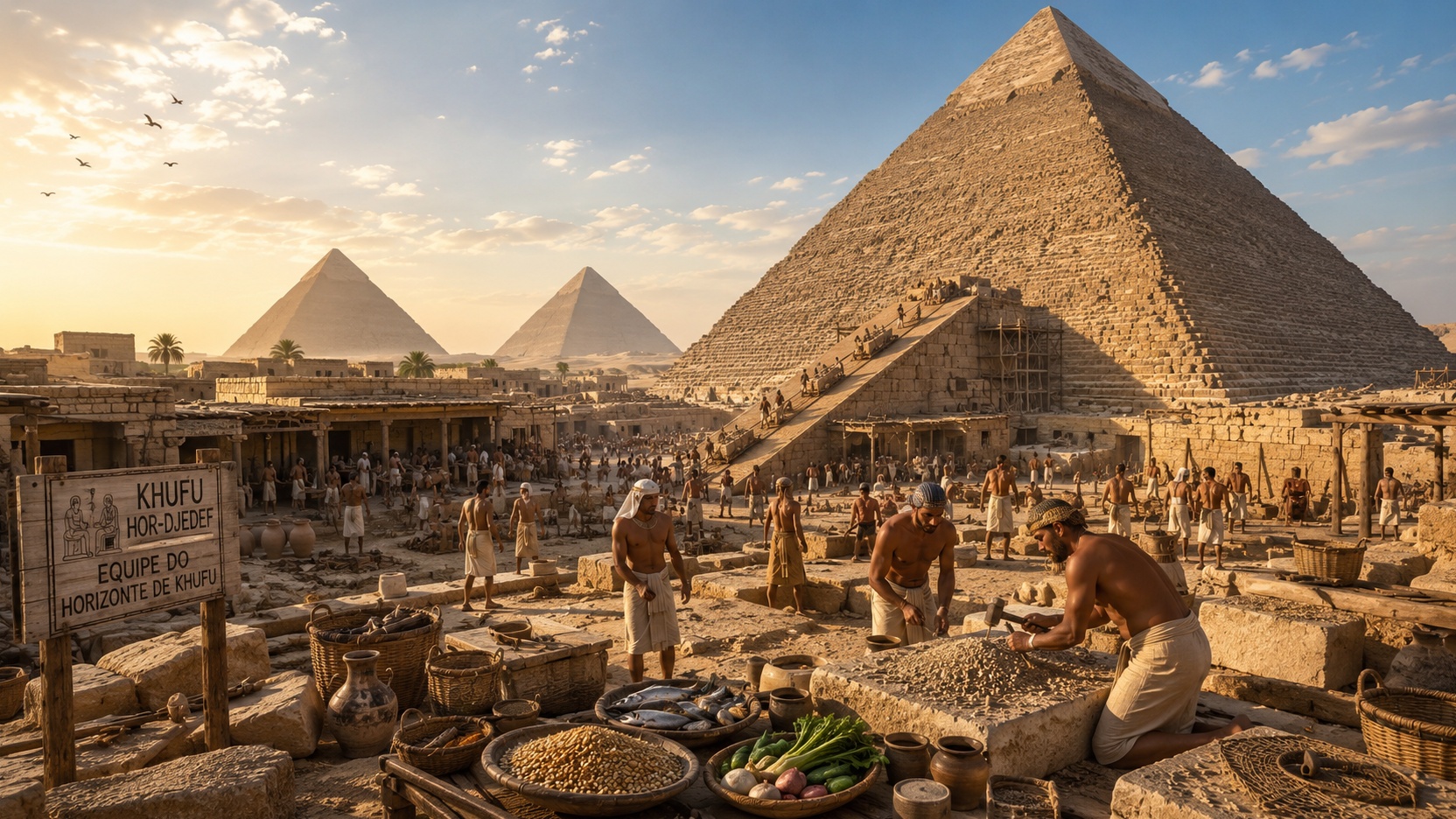
One of the most important pieces of evidence is south of the Sphinx, in the settlement known as Heit el-Ghurab, or “Wall of the Raven.” Excavations by Ancient Egypt Research Associates have identified a 4th Dynasty urban area measuring more than seven hectares, planned as a base of operations for the Giza pyramid complexes.
The place wasn't just a dorm. There were streets, workshops, production yards, bakeries, kitchens, warehouses, administrative areas, houses and large silos. The site records a community made up of manual workers, artisans, cooks, managers and employees responsible for maintaining the flow of materials and food.
This infrastructure reveals two things. The first is that building a pyramid required much more than dragging stones: it was necessary to feed people, manufacture and repair tools, distribute raw materials, manage stocks, organize transport and maintain a support population. The second is that the enterprise had strong state coordination.
None of these findings, in isolation, proves that the workers were “free”. A State may also feed people subject to compulsory obligations. The settlement shows organization and provision, not a modern employment contract.
Bread, beer, meat and provisions: payment or support for the construction site?
The feed is often used to claim that the builders were “paid employees”. It's too quick a conclusion.
In Heit el-Ghurab, archaeologists found bakeries, huge quantities of bread pans, and facilities associated with food production. Egyptian texts show that bread and beer were basic items distributed on royal work projects. Archaeozoology has also found large quantities of bones from cattle, sheep and goats, with patterns that point to organized supply on a broad scale.
This makes it clear that management kept the workforce fed. It also indicates that the provisions could function as part of the remuneration or institutional obligation to support those working on the project. But the word “salary” should be used carefully. Egypt at that time did not operate with a monetary labor market similar to today's, and receiving food does not automatically transform a compulsory relationship into voluntary employment.
The best reading is simpler: workers were provisioned. Some experts probably held stable, valued positions; others could be present for mandatory shifts. The same logistical system could support people with different social situations.
Teams, managers and shifts: a managed construction site
The remains of Giza show a workforce divided into groups and subject to hierarchies. Inscriptions and graffiti from teams associated with the works, in addition to the physical organization of sectors of the settlement, suggest work units with their own leaders.
In the Heit el-Ghurab gallery complex, AERA estimates that certain spaces could house dozens of men per gallery and discusses the possibility of these units corresponding to rotating groups. The exact interpretation of all the buildings is still debated - some galleries may have served military or guard functions - but the pattern reinforces the existence of a rigid collective organization.
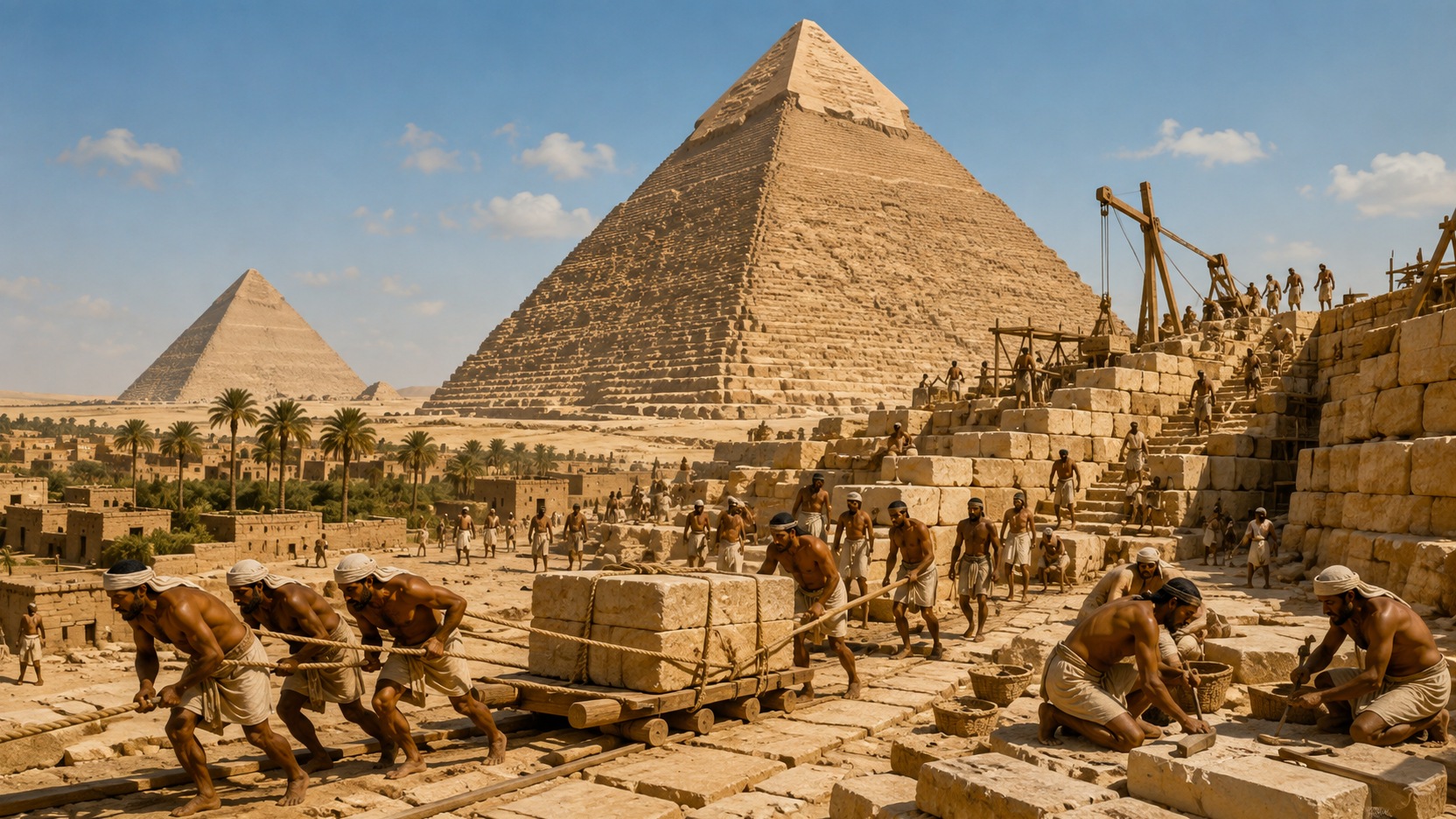
This detail is important because the image of thousands of people working in an undifferentiated way does not match what appears in the archaeological record. Construction required specialization, supervision and coordination between bricklayers, transporters, boatmen, artisans, cooks, scribes and administrators.
Merer's Diary shows work in motion
The papyri found in Wadi el-Jarf give a rare insight into daily administrative life at the end of Cheops' reign. The so-called Merer Diary records the activities of a team led by Inspector Merer and describes the transport of limestone blocks from Tura to the Akhet-Khufu region, the Great Pyramid complex.
The document is not a construction manual and does not explain how all the blocks were laid. Its importance lies in something else: it shows an identifiable team, under command, carrying out missions, navigating controlled routes and delivering material linked to the real project. It is direct evidence of bureaucratized logistics, not of an anonymous mob led by physical force alone.
It's also a good reminder that “who built the pyramid” includes people who may have never placed a block on the face of the monument. Transporters, navigators and supply workers were part of the construction chain.
Corveia: compulsory work without being property slavery
Corveia is the term used by historians for forms of compulsory work required by a public authority. In pre-monetary societies or with taxation heavily based on goods and services, the State could charge not only products, but also working time.
In the Egyptian Old Kingdom, documents and academic summaries indicate that the population could be requested for works, expeditions, quarries and other state tasks. Exemption decrees are especially revealing: when an institution was given the privilege of not providing workers for certain services, it is implied that this obligation normally existed.
Applied to Giza, this helps to understand why the expression “free workers” is insufficient. Some of the workforce may have been temporarily mobilized as a state duty. These people could receive food, accommodation and institutional protection, without this making the mobilization voluntary.
At the same time, we should not transform “corvée” into a unique explanation for each person present on the construction site. Permanent specialists, officials, administrators and skilled artisans had different relationships with the state. The construction of the pyramids was too large and too complex to fit into a single category of worker.
Workers' tombs: evidence, not certificate of freedom
South of the Giza plateau, a necropolis associated with workers and construction supervisors was identified. There are simple tombs and others that are more elaborate, some with titles and elements that allow us to reconstruct positions within the work organization.
These tombs are relevant because they show that at least some of the people linked to the enterprise had social identity, family relationships, recognized roles and access to funerary practices. This does not fit well with the image of a mass that is entirely disposable and has no place in Egyptian society.
But there is an important limit. Being buried near one's place of work is not legal proof of freedom. People subject to state obligations could also have family, religion, community status, and burial. The tombs help to reject the caricature, but do not allow us to say that all the builders were voluntary workers.
So who built the pyramids of Giza?
The answer most compatible with all the evidence is that the pyramids were built by Egyptians organized into a broad state work structure. In this structure there were specialized professionals and permanent staff, in addition to teams mobilized for periods of time for transportation, extraction, construction and support tasks.
Part of this mobilization probably worked through corvee. Instead of paying only with currency - which was not the basis of the labor economy of that period - the State distributed food and other resources and maintained facilities to house and supply the workforce.
The existence of slavery and prisoners of war in Ancient Egypt should not be erased. What is missing is evidence to place these groups at the center of the construction of Giza as if they were the predominant force responsible for the monuments.
What the evidence does not allow us to say
We do not know the individual status of each person who worked in the Cheops, Chephren and Menquerino complexes. We also do not have a complete registry of the workforce capable of separating, in percentages, how many were permanent specialists, how many were on rotational service, how many were institutional dependents and whether there were people enslaved in specific tasks.
Estimates of the total number of workers vary depending on the model used. Archeology can reconstruct settlements, food, work sectors and some groups, but it does not provide a complete census of the construction site.
It is also prudent to avoid the popular phrase that “peasants only built the pyramids during the Nile flood”. Seasonality certainly affected agriculture, transportation, and labor availability, and river levels were crucial to logistics. Still, reducing all construction to idle farmers for a few months hides the presence of experts and active administration over long periods.
Why “they weren’t slaves” became a misleading answer
The phrase works well as a correction to a visual myth: chains, whips and thousands of captives carrying blocks under the sun. The problem appears when it is followed by “they were salaried employees”, as if the only alternative to slavery was the contemporary job market.
Between these two images there is a wide zone of dependency relationships. Pharaonic Egypt was a centralized state capable of requisitioning people, products and services. The worker could be recognized, fed and integrated into a team and still be fulfilling an obligation that he did not freely choose.
So the more precise formulation is less comfortable, but historically better: the builders of Giza do not appear to have been predominantly property slaves; They were a heterogeneous state workforce, combining specialization, administration, provisions, and varying degrees of compulsion.
The best answer avoids both extremes
The pyramids do not need an army of slaves to be explained. They require something perhaps more impressive: a State capable of bringing together resources from various regions, feeding large groups, maintaining specialists, organizing teams, transporting stone by land and water and repeating this effort for years.
At the same time, this state capacity had a human cost that should not be romanticized. Corvée is mandatory work. Provision is not synonymous with freedom. A dignified grave does not automatically transform an obligation into a choice.
This is why the question “were the pyramids built by slaves?” deserves a two-part answer. The popular model of a mass of chained slaves is not supported by the total evidence from Giza. But replacing this myth with the image of modern workers, fully free and hired, also distorts the past. Between one extreme and the other is the real system that archeology begins to reconstruct: organized teams, experts, state obligations, provisions, and a society in which work, taxation, and power were deeply linked.