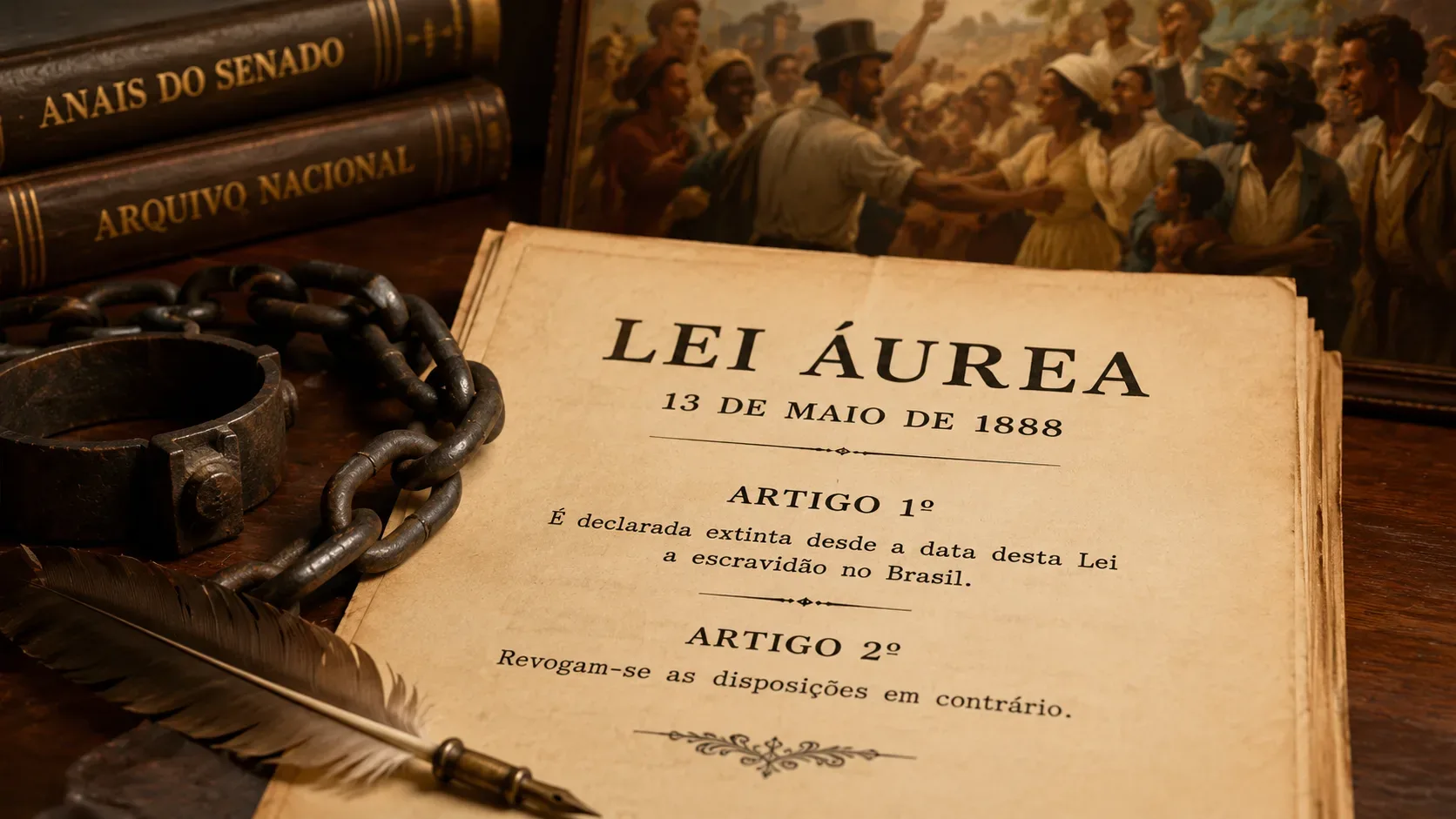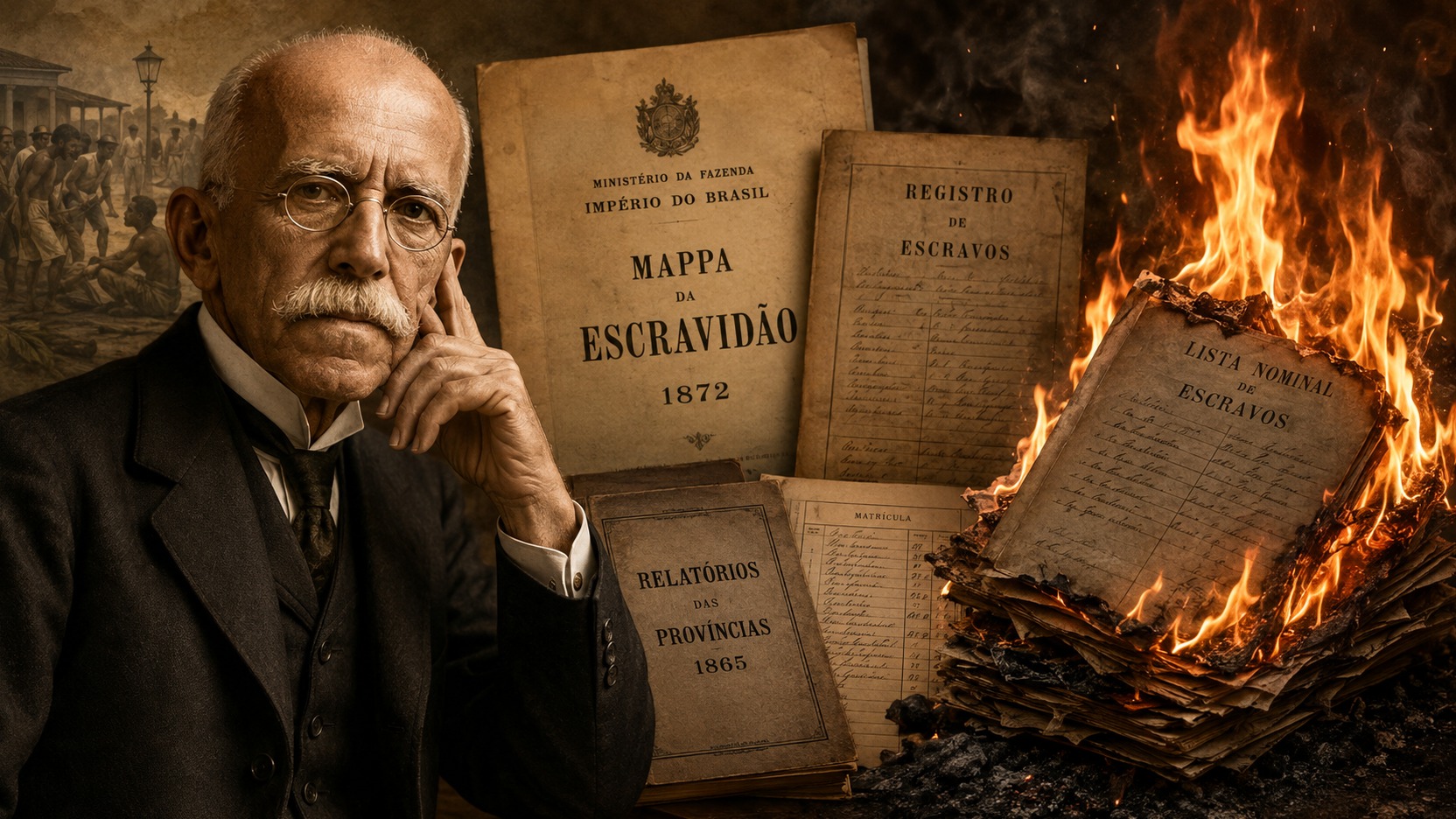
The literal answer is no. Rui Barbosa signed, on December 14, 1890, an order to destroy papers, registration books, and other documents related to slavery that were held in offices of the Ministry of Finance. The measure caused serious documentary loss and affected valuable sources on enslaved people, their owners, and the administration of the system. But it did not reach every document on slavery in Brazil, nor was there a single national archive that concentrated that universe of records.
Documentation on slavery was scattered across tax offices, notary offices, courts, churches, provincial governments, municipal councils, newspapers, private collections, and other archives. Part was destroyed by the 1890 order and later measures; part survived precisely because it circulated through different institutions or existed in copies.
What Rui Barbosa actually ordered in 1890
The decision of December 14, 1890 is direct about its administrative scope. Rui Barbosa, then Minister of Finance in the Provisional Government of the Republic, ordered papers, books, and documents related to the so-called servile element to be requisitioned from the Treasury Offices under that ministry. The text expressly mentions the registration rolls of enslaved people, of ingênuos - children born free to enslaved women - and of freed sexagenarians.
The same decision created a commission, composed of abolitionist João Fernandes Clapp and the administrator of the Rio de Janeiro Revenue Office, to gather the material and destroy it at the Customs House in the then Federal Capital. Documentation assembled by the Fundação Casa de Rui Barbosa records a first burning on December 19, 1890. Shipments arriving from other units were to be destroyed as they came in.
That is enough to rule out an equally mistaken version of the episode: that the burning was a later invention. The order existed, was signed by Rui Barbosa, and began to be carried out while he was still in office.
Why the registration rolls were so important
The national registers of enslaved people were not simply memorial lists. They had administrative, fiscal, and legal functions. Historian Robert W. Slenes showed that the major national registration drives of 1872-1873 and 1886-1887 gathered individual information that is now valuable to the social and demographic history of slavery.
These records could indicate name, age, family ties, owner, and other data, depending on the series and the copy consulted. They also served as evidence in property relations and in procedures linked to emancipation legislation. That is why the loss of books and declarations held by Treasury offices was not merely symbolic: it eliminated an important part of the documentary infrastructure created by the slaveholding state itself.
Did the order seek to erase slavery or prevent compensation?
Here it is necessary to separate what the document says from what the historical context allows us to conclude. The justification written by Rui Barbosa on December 14 uses moral and republican language: slavery would be a stain from the past, and its administrative traces should disappear in homage to the citizenship of freed people. The word compensation does not appear as a stated motive in that decision.
At the same time, the debate over compensating former slaveholders was concrete and predated the order. In July 1888, Joaquim Nabuco read in the Chamber a petition asking for the cancellation or invalidation of the general registration books precisely to prevent new compensation claims. In November 1890, one month before the burning order, Rui Barbosa rejected a proposal tied to compensation for former slaveholders and stated that it would be fairer to find a way to compensate the formerly enslaved without burdening the Treasury.
For this reason, the interpretation that the destruction also sought to remove the documentary basis for future compensation claims is strong and appears both in the classic study published by the Fundação Casa de Rui Barbosa and in later research. But the more precise formulation is this: preventing compensation is a historical explanation supported by the context and the sequence of acts, while the formal justification of December 14 spoke of eliminating the administrative traces of slavery.
Reducing everything to a single intention impoverishes the episode. The gesture may have been, at the same time, abolitionist in its political framing, fiscal in its effects, and destructive to historical memory.
Destruction continued after Rui Barbosa left the ministry
Another detail often disappears from shortened versions. Rui Barbosa was no longer Minister of Finance on May 13, 1891, when Circular No. 29 gave new impetus to the destruction. The document was signed by his successor, Tristão de Alencar Araripe, and ordered the urgent incineration of assessment books and declarations used to collect the tax on enslaved people, as well as action on related court orders.
This does not remove Rui's responsibility for the initial 1890 order. It does show, however, that the policy of destruction was adopted and continued by other agents of the republican government. It also corrects the common statement that Rui personally ordered a major burning on May 13, 1891: on that date, the implementation circular came from another minister.
Nor was the process limited to a single bonfire in Rio de Janeiro. Documentation assembled by the Fundação Casa de Rui Barbosa records a public incineration in Salvador on May 13, 1893. The minutes mention papers stored at the Customs House, the state Treasury, and the Government
Secretariat, and state that documents considered to be of historical interest were exempted. The case in Bahia shows how implementation extended over time and could involve local selections.
What was actually destroyed
The safest core of the answer is Treasury documentation linked to the legal and fiscal status of slavery. The 1890 order covered books and papers of the Ministry of Finance, especially registration rolls and records tied to enslaved people, ingênuos, and freed sexagenarians. The 1891 circular mentions even more concretely assessment books and declarations used to collect the tax on enslaved people.
Slenes identified the national registrations of 1872-1873 and 1886-1887 as central targets and concluded that, apparently, copies kept at local tax collection offices were destroyed on a large scale. This opened real gaps: series that would have allowed researchers to track individuals, families, and ownership structures ceased to exist continuously in many places.
The popular expression "burning of the slavery archives," therefore, is not false when used as the name of the episode. It becomes misleading when "archives" is understood to mean every document produced over more than three centuries of slavery in Brazil.
What survived in notary offices, courts, churches, and other collections
The fragmented nature of nineteenth-century bureaucracy itself prevented total destruction. Private and notarial documents, deeds, probate inventories, wills, and court cases were not automatically within the reach of an order directed at offices of the Ministry of Finance. Many of these sets remain central sources for research on slavery.
Slenes drew attention to a decisive point: copies or reproductions of data from the registration rolls appeared in notary offices and were attached to probate inventories and other proceedings. These duplicates were not affected in the same way. Books of classification boards and other local series could also survive because they were outside Treasury collection offices, although their preservation varies greatly from city to city.
Parish records of baptism, marriage, and death form another documentary universe. Newspapers, private correspondence, runaway advertisements, purchase and sale records, manumission letters, freedom suits, criminal proceedings, provincial reports, municipal documentation, and statistical publications also make it possible to reconstruct parts of the experience of slavery. None of these sources perfectly replaces what was burned, but together they disprove the idea of absolute documentary erasure.
The Fundação Casa de Rui Barbosa itself today maintains collections related to slavery, Abolition, and post-Abolition, with digitized documents and references from different fonds. This is concrete evidence that research was not left without sources - although it was left with gaps that cannot be fully reconstructed.
The damage to memory was real even without total destruction
Saying that many documents survived should not become a way to minimize the loss. A national administrative series is valuable precisely because it offers more standardized and comparable coverage. When registration books and fiscal records are destroyed, researchers must depend on accidental copies, derivative documents, or local collections that survived unevenly.
This affects demographic research, family histories, studies of slaveholding property, and attempts to follow individual trajectories. In some places, the remaining documentation is rich; in others, the void is larger. The result is an asymmetric documentary memory, conditioned by
what escaped destruction, routine disposal, fires, humidity, administrative reforms, and other later losses.
An article published in 2026 in the journal Mana returned to the episode as an example of how documents circulate among institutions and change status over time. This perspective helps explain why the question "what was burned?" cannot be answered only with the name of one person or one bonfire: it is necessary to follow the trajectory of the papers, their copies, and the offices that held them.
Was Rui Barbosa the only person responsible?
No. He was the author of the initial order of December 14, 1890, and that documentary responsibility is unequivocal. But the idea of rendering records of slave property unusable had already circulated among abolitionists since 1888, received political support, and was later carried out and expanded by other members of the republican administration.
It is also inappropriate to turn Rui Barbosa's abolitionist trajectory into automatic absolution. A politician could fight slavery and, at the same time, adopt a decision that we now recognize as gravely harmful to documentary heritage. The reverse is also true: the destruction of sources does not, by itself, prove that the objective was to hide the existence of slavery or deliberately erase the memory of Black Brazilians. Supporting that specific intention would require going beyond what the order and the context demonstrate.
The most accurate sentence to summarize the episode
The most faithful formulation is: Rui Barbosa signed, on December 14, 1890, an order to destroy documents related to slavery that existed in offices of the Ministry of Finance, especially registration rolls and papers of a fiscal and administrative nature. The destruction was carried out in stages, continued after he left the government, and caused important historical losses.
What is not correct is to turn that decision into "Rui Barbosa burned all the documents on slavery in Brazil." There was no single archive that gathered everything, the order had an institutional scope, and a large quantity of sources remained in notary offices, courts, churches, local archives, private collections, and other institutions.
The episode becomes clearer when both caricatures are abandoned. There was no total erasure of the documentation of slavery, but neither was there a simple bureaucratic cleanup without historical consequences. There was a policy of destroying important state records, in a post-Abolition context marked by disputes over property, compensation, citizenship, and memory - and historiography still works with the gaps it left behind.