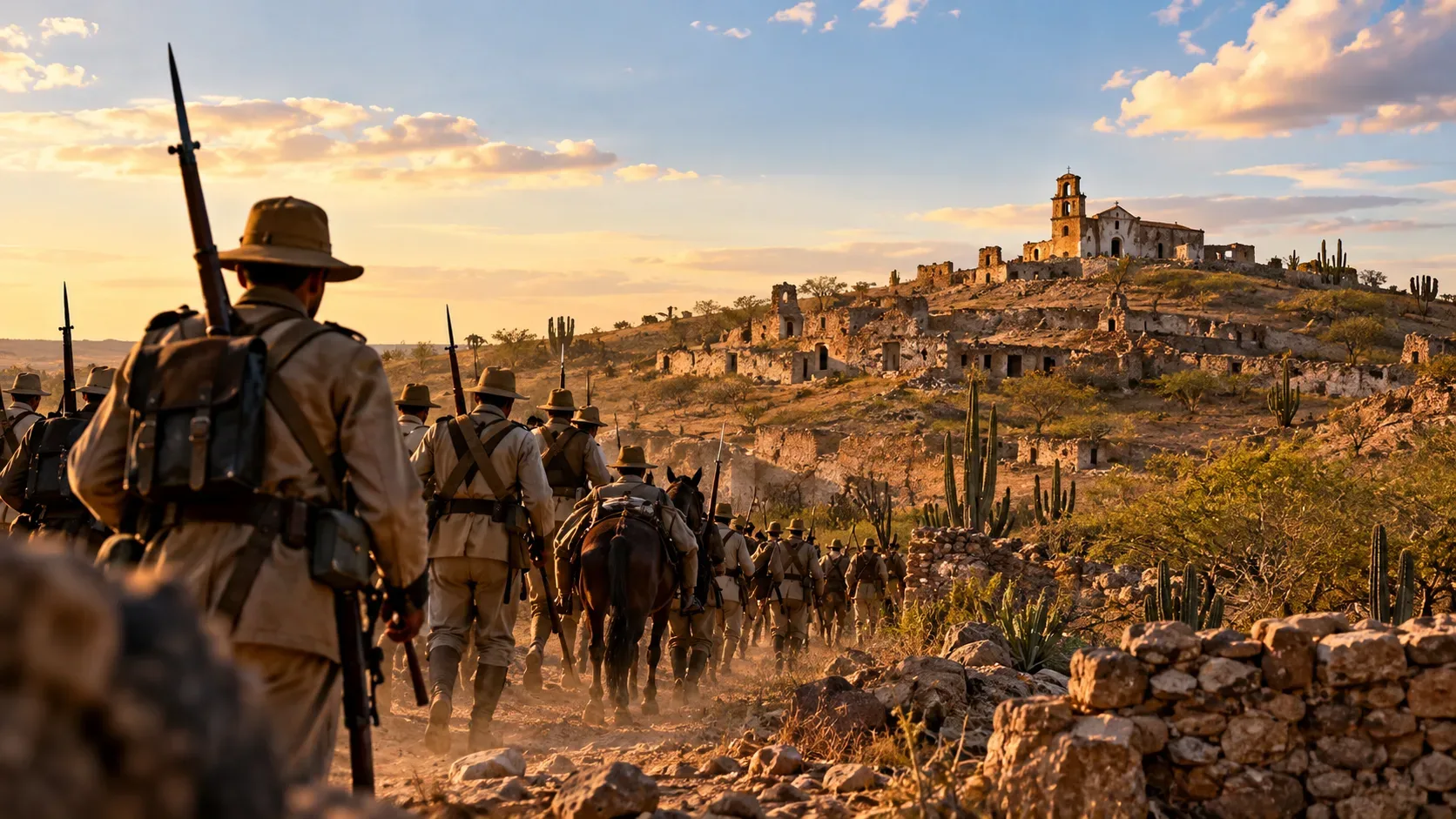
Between November 1896 and October 1897, the forces sent against Belo Monte, better known as Canudos, changed in scale, command, and method. The first two expeditions were organized with forces linked to the government of Bahia and ended in withdrawal. The third marked a more direct entry of the federal government and the regular Army, but it was also defeated. The fourth turned the campaign into a large national operation, with two columns, reinforcements, artillery, a reorganization of supply, and a prolonged siege, ending with the destruction of the settlement on October 5, 1897.
What changed between the four expeditions
| Expedition | Command and composition | Scale recorded by the sources | Main change | Outcome |
|---|---|---|---|---|
| 1st, November 1896 | Lieutenant Manuel da Silva Pires Ferreira, with a Bahian force and limited medical and logistical support | About 100 rank-and-file troops in Fundaj; the Museum of the Republic chronology records 113 soldiers, plus officers, a doctor, and guides | Small operation triggered by fears that residents of Canudos would march on Juazeiro | Fighting at Uauá and withdrawal before reaching Belo Monte |
| 2nd, January 1897 | Major Febrônio Pereira de Brito, still with forces from the state of Bahia | The consulted sources disagree: about 250 men in Fundaj; 609 soldiers and 10 officers in the Museum of the Republic chronology | Larger force, with artillery, but still vulnerable to terrain, exhaustion, and supply problems | Fighting at Serra do Cambaio and nearby areas; withdrawal on January 20 |
| 3rd, February and March 1897 | Colonel Antônio Moreira César, in an expedition organized by the federal government | About 1,300 soldiers in the consulted chronologies | Clear federalization of the campaign, regular troops, and an attempt at a more decisive assault | Moreira César is mortally wounded, command collapses, and the force retreats, leaving equipment behind |
| 4th, 1897 | General Artur Oscar de Andrade Guimarães, with two columns, brigades, and reinforcements from several parts of the country | The Museum of the Republic records about 5,000 men initially and 8,000 to 10,000 after reinforcements; Fundaj describes two columns with more than 4,000 soldiers each | Long national campaign with greater firepower, successive reinforcements, and direct attention to logistics | Siege, capture, and destruction of Canudos; the last defenders die on October 5, 1897 |
1st expedition: a small force that did not reach Canudos
The armed conflict began after a dispute connected to an order of timber for the new church at Belo Monte. Delivery was delayed, and rumors spread that residents of Canudos would go to Juazeiro to take the material by force. Local authorities requested troops from the Bahian government.
The first expedition was therefore limited in scale. Under Lieutenant Manuel da Silva Pires Ferreira, the force advanced through the backlands but was attacked at Uauá on November 21, 1896. The Museum of the Republic chronology records 113 soldiers, plus officers, a doctor, and guides, while Fundaj summarizes the detachment as about one hundred rank-and-file troops. After the fighting, the force withdrew to Juazeiro and gave up reaching the settlement.
The key point in this phase is that the government was still treating the problem with a relatively small force. The clash at Uauá showed that the resistance would not be dismantled by a brief incursion and also exposed the difficulty of operating across long distances in the sertão.
2nd expedition: more men and artillery, but the same terrain and supply problems
The second expedition, led by Major Febrônio Pereira de Brito, increased the scale and included artillery. An important documentary disagreement appears here. Fundaj gives about 250 men. The Museum of the Republic chronology records 609 soldiers and 10 officers. Because the two institutional sources do not provide the same strength, it is safer to treat the number as disputed rather than select one figure without qualification.
What is not disputed in the consulted sources is the result. The column fought the Conselheiro followers at Serra do Cambaio and near Canudos, suffered severe wear, and withdrew on January 20, 1897. Accounts emphasize wounded men, exhaustion, inability to advance, and shortages involving ammunition, food, and water.
Compared with the first attempt, the force and firepower had grown. That change did not solve the combined effects of distance, terrain, ambushes, physical exhaustion, and supply. The second defeat showed that simply increasing men and weapons did not guarantee the capture of Belo Monte.
3rd expedition: the campaign moves to the federal level and seeks a quick victory
After two withdrawals, the third expedition was organized by the federal government and placed under Colonel Antônio Moreira César. The Museum of the Republic and Brasiliana Fotográfica record about 1,300 soldiers. The commander had military prestige, and the operation aimed to end the conflict with a stronger regular force.
The attempt failed. Moreira César was mortally wounded during the fighting, and the command crisis deepened with the death of Colonel Pedro Nunes Tamarindo during the retreat. The Museum of the Republic chronology also records that weapons and equipment abandoned by the soldiers were used by the defenders of Canudos.
This third defeat had consequences beyond the battlefield. National repercussions intensified, and the interpretation of Canudos as a threat to the Republic gained space in the press and political debate of the period. The FGV Historical Atlas notes that the upheaval after the failure helped drive the mobilization of a much larger response.
4th expedition: from an attacking column to a national siege campaign
The fourth expedition was prepared after the disaster of Moreira César's force. Command went to General Artur Oscar de Andrade Guimarães. The operation brought together two columns, several brigades, and troops from different parts of the country. The figures vary according to the source and the moment being counted: the Museum of the Republic chronology indicates about 5,000 men initially and a total of 8,000 to 10,000 after reinforcements arrived; Fundaj describes two columns with more than 4,000 soldiers each.
The jump was not only numerical. The fourth campaign lasted for months and required a much more complex supply structure. Fundaj records that in August the Minister of War, Marshal Carlos Machado de Bittencourt, established himself at Monte Santo to address the troops' logistical and supply problems. The Museum of the Republic also records the arrival of reinforcements and the national expansion of the force.
The strategy came to combine advances by columns, artillery, occupation of positions, reinforcements, and siege. Even then, government forces suffered losses and difficulties before closing the ring. The fighting ended on October 5, 1897, with the death of the last defenders and the destruction of the settlement.
The sequence reveals five main changes
- Scale: a small force in the first expedition gave way, in the fourth, to thousands of soldiers and successive reinforcements.
- Level of government: the first operations were conducted with Bahian forces; the third and fourth had direct and increasing federal involvement.
- Organization: the campaign evolved from smaller detachments and columns to brigades, two large columns, and a broader command structure.
- Logistics: shortages of water, food, ammunition, transport, and physical endurance repeatedly appear as limits. In the fourth expedition, supply became an explicit operational priority.
- Method of combat: the first attempts sought to advance and disperse the resistance. The last campaign became a prolonged operation of approach, reinforcement, siege, and destruction of the settlement.
Why do troop numbers vary among the sources?
Historical documents and later syntheses do not always count the same universe. One source may record only the initial detachment, another may include officers and support personnel, and a third may count reinforcements added during the campaign. For the second and fourth expeditions, the consulted institutional sources present different numbers. The most rigorous approach is therefore to report the discrepancy and link each figure to its source.
The language of contemporary documents also requires care. The Museum of the Republic chronology calls attention to the broad use of the word "jagunço" in newspapers, letters, and reports to describe the community of Belo Monte. That vocabulary was part of the dispute over how Canudos was represented and should not automatically be repeated as a neutral label for all residents.
What the comparison helps explain
Canudos was not one battle repeated four times. The campaign changed after each defeat. The government enlarged its forces, shifted command toward the federal sphere, increased weaponry and artillery, brought reinforcements from different states, and eventually treated supply and siege as central problems. At the same time, the earlier defeats showed how terrain knowledge, organized resistance, and logistical difficulties could offset growing material superiority.
Reading the expeditions as a sequence also avoids reducing the conflict to a simple opposition between "the Army" and "Canudos." The sources themselves show distinct stages of state mobilization and record how the political perception of the conflict changed after the defeats. The fourth expedition was the result of a military and political escalation built over almost a year.