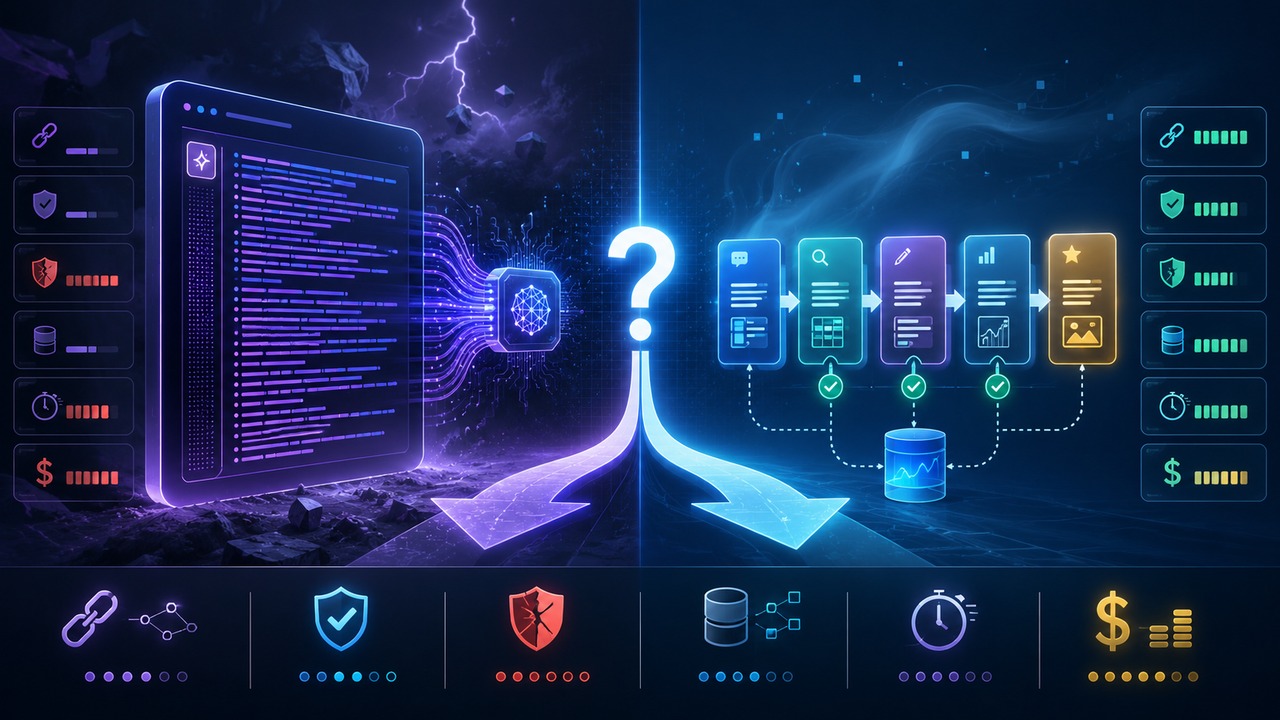
The choice between mega-prompt and prompt chaining should not start with the size of the prompt text. The most useful criterion is another: does the system need to control something between one step and the next? If the only thing that matters is the final response and the model can receive all the relevant context at once, a single call is often the best starting point. If an intermediate result needs to be validated, recorded, transformed, approved, used by a tool or capable of changing the next path, separating the work into calls creates architectural value.
Here, mega-prompt means a single call that brings together objective, context, rules, criteria and several execution instructions. Prompt chaining means an explicit sequence of calls in which the output of one step feeds, constrains, or conditions the next. This is different from asking the model to "think step by step" within the same answer. Chaining is in the application and in the flow between calls; The model's internal reasoning can exist in either architecture.
Complexity alone does not require the creation of a chain
Current models can handle planning and multistep tasks within a single interaction, so there is no rule like "more than three steps requires chaining". Anthropic's current documentation says that its recent models handle much of the multistep reasoning internally and reserve explicit chaining for situations where it is important to inspect intermediate outputs or enforce a pipeline structure. Google Cloud documentation, on the other hand, highlights that breaking complex tasks into subtasks can increase controllability, debugging, and accuracy. The two orientations are not contradictory: they point to the boundary between reasoning that can stay inside the call and control that needs to exist outside of it.
The OpenAI documentation follows a similar logic in recommending that complex workflows be evaluated by task success, completeness, required evidence, tokens, latency and cost. In other words, counting calls is not enough. An architecture with fewer calls may be worse if it fails more; an architecture with more calls can be worse if it just repeats context and increases time without creating a useful checkpoint.
Dependency between stages: the most important question
If the steps are just parts of the same elaboration, a single call tends to better preserve the context and avoids the cost of transporting intermediate results. Imagine a task of writing a technical response that needs to consider objective, audience, tone, and constraints. While you could describe this as "analyze, plan, write, and review," these phases may just be the internal process needed to arrive at a single result. Automatically turning them into four calls may not add real control.
Chaining gains strength when the next step depends on an intermediate artifact that must exist explicitly. This is the case of extracting entities from documents before querying a bank, classifying a request before choosing a tool, producing a plan before taking actions, or generating a draft that needs to undergo independent verification. In these cases, the intermediate output is not just thought: it becomes the state of the system.
A simple way to test this boundary is to ask: if I delete the intermediate output and let the model solve everything at once, do I lose the ability to make any important decisions? If the answer is no, the chain has probably not yet justified itself. If the answer is yes, the division is already fulfilling an engineering function.
Validation: when a checkpoint changes the architecture
Validation is one of the strongest reasons to separate calls. In a mega-prompt, the model can be instructed to check its own work before responding, but the software only receives the result at the end. This may be sufficient when the error is cheap, reversible, and easy to detect later.
In a chain, the system may require one contract per stage. An extract may need to comply with a schema before moving forward. A rating may need to meet a confidence rule or fall under human review. A draft can be compared to objective criteria before the editing stage. The practical difference is that the pipeline can stop, repeat or change route before the error is incorporated into the final product.
This pattern also appears in Anthropic's recommendation to use separate calls for generate, review, and refine when recording, evaluating, or branching at any point. The gain does not come from a supposed magical effect of "more prompts". It comes from the possibility of observing and governing what happens between them.
Fault isolation: chains help, but also propagate errors
A mega-prompt provides a single point of failure. This simplifies operation and observability: there is one input, one response, and one outcome to evaluate. The problem is that, when the answer is incomplete, it can be difficult to know whether the cause was interpretation.
goal, evidence selection, data transformation, formatting, or some combination of these factors.
A chain makes diagnosis more local. If the extraction is correct and the classification is wrong, the error is easier to reproduce and correct. You can also repeat just the problematic step instead of rerunning the entire flow.
But modularity does not eliminate failures; it can create cascading failures. A poor extraction feeds a seemingly consistent classification, which feeds a recommendation even further from the source. Therefore, a useful chain is not just a sequence of prompts. It needs stopping criteria, contract validation, and a clear decision about what to do when a step produces insufficient output.
State: a call hides the process, a chain externalizes parts of it
In the single call, much of the state is implicit in the context received by the model. This is convenient when the job is short and self-contained. In a chain, the state becomes a design element: which fields should go through stages, what should be discarded, what needs to be persisted and what information can be recalculated.
This externalization can improve traceability and allow branching. For example, a triage step might route simple cases to an inexpensive response and complex cases to a more capable model, tool, or human. It also allows an intermediate result to be reused for more than one step without asking the model to generate it again.
The risk is to transform the entire conversation into a permanent state for convenience. The more history that is resent unnecessarily, the greater the chance of repeating instructions, increasing tokens, and mixing old decisions with the current task. A good chain carries the minimum necessary state, preferably in a predictable and validatable format.
Latency: sequential steps have a visible price
Each sequential call creates another waiting period between entry and exit. For an interactive interface where the user expects an immediate response, this cost may be more important than the marginal control improvement. If the work can be resolved in one call with stable quality, breaking it into five steps tends to lengthen the time to result.
Not all decompositions need to be sequential. Google's documentation distinguishes chaining, in which one output feeds into the next, from aggregation, in which independent subtasks can run in parallel and then be combined. This distinction matters because two independent tasks should not form an artificial chain just because they are in the same workflow.
So the correct question about latency is not "how many steps are there?", but "how many dependencies actually need to be serialized?". Whatever can be done in parallel can reduce wall time; Anything that needs to wait for validation will inevitably add latency in exchange for control.
Cost: more calls does not automatically mean more expensive or cheaper
It's easy to assume that a single call always costs less, but the total depends on how much context each step receives, how much intermediate text is generated, what templates are used, how much work needs to be repeated, and how many failures require retry. A poorly designed chain can resend the same context several times and pay for intermediate outputs that do not add value. A well-designed chain can use a small model for simple tasks, reserve a more expensive model for a difficult step, and avoid complete re-executions when something fails.
The safest guideline is to measure cost per successfully completed task, not cost per call. OpenAI's own current documentation recommends comparing total tokens, latency, cost, calls, shifts and retries along with the final quality. This way of measuring avoids optimizations that appear efficient on the request counter, but produce more errors or more corrective work.
Same problem in a call and in a chain
Consider a system that receives dozens of customer comments and needs to deliver a prioritized improvement plan.
Mega-prompt version
A single call receives comments and complete instructions: identify recurring problems, group themes, estimate impact, prioritize actions and write the final plan. This architecture can work very well when the volume fits the context, the taxonomy does not need to be reused, and no one needs to approve the groupings before recommendation. The benefit is simplicity: one request, one set of instructions, and one final response.
The weak point appears when the plan goes wrong. It can be difficult to separate whether the error started in problem extraction, grouping, priority, or wording. There is also no natural point to reuse extracted themes in another process.
Chaining prompt version
On the first call, the model extracts issues and evidence from each comment in a structured format. The software validates the format and rejects incomplete records. In the second call, the validated problems are grouped and classified. In the third, the system applies priority rules or requests human review for borderline cases. Only then does a final call transform the approved data into a readable action plan.
The chain is larger, but each boundary has a function: validating data, isolating errors, saving state or authorizing the next step. If these functions are not necessary, the same decomposition may just be computational bureaucracy.
What the research shows, and what it still does not allow us to conclude
A work published in the 2024 Findings of ACL compared two ways of refining summarization. In prompt chaining, draft, critique, and review were performed in three separate calls. In the so-called stepwise prompt, the same phases
were requested within a single generation. In the main experiment, the chaining strategy achieved the most wins in quality comparisons, including 77 wins out of 100 reported comparisons. The authors themselves limit the conclusion to the studied summarization scenario and ask for validation in other tasks.
This detail is important because it avoids transforming a specific result into a general law. The study shows that separating generation, criticism and review can produce real gains under certain conditions. It does not show that any complex task is better when divided into several calls.
A 2026 preprint on automated generation of academic reports reached a conclusion favorable to chaining in its use case: the multi-step pipeline was compared to an optimized single-shot baseline and showed greater reliability and a smaller improvement in the textual similarity metric used. Because it is a narrow, domain-specific case study and assessment, it serves as evidence that architecture can make a difference, not as a universal benchmark.
In another direction, 2026 research on multi-agent workflows reinforces a useful caution: more components do not guarantee a better result. A study with seven benchmarks showed that, in homogeneous workflows, a single model running multi-round decomposition could match the performance of multi-agent configurations at a lower cost in its environment. The lesson for prompt chaining is that decomposing the task and multiplying executors are different decisions. Sometimes you just need to stick to a single model and make the steps explicit.
A practical method for deciding without dogma
Start with the smallest architecture that passes your test
First assemble a single call with a clear objective, context, constraints, success criteria and output format. Run an assessment with representative cases. If it delivers the result with sufficient consistency, simplicity is a real advantage: fewer points of failure, less state, and less orchestration latency.
Divide at the exact point where a need for control appears
When the errors show a pattern, look for the boundary. The extraction may need to be validated before generation. Perhaps a search needs to happen only after classifying intent. Maybe a human needs to approve a decision before firing a tool. It is within this limit that a new stage usually pays for itself.
Give a contract at each stage
A step without its own criteria is difficult to test. Define what goes in, what should go out, which fields are mandatory, what evidence needs to be preserved and what characterizes failure. The clearer this interface is, the less chance the chain will turn into just one long conversation fragmented into several requests.
Measure the entire system
Compare success rate, completeness, errors per step, retries, end-to-end latency, tokens, and cost per successful task. If the chain increases quality but doubles latency in a time-sensitive product, you may need to reduce steps. If a
single call is cheap, but requires a lot of corrections, the operational cost may be hidden outside the API.
The pocket rule
Keep a single call when the task is a conceptually single transaction: all the context can be provided at once, only the end result needs to be consumed, and there is no important external decision in the middle of the way.
Use prompt chaining when boundaries between steps need to exist for the software: validate, branch, register, reuse, call tools, change models, ask for approval, or repeat only part of the work.
The central difference is not "short prompt versus long prompt". It's internal reasoning versus external architecture. The mega-prompt lets the model coordinate the process within a call. The chain transforms parts of this process into observable and controllable states. The right choice is the one that delivers the necessary quality with the lowest level of orchestration that your tests can justify.