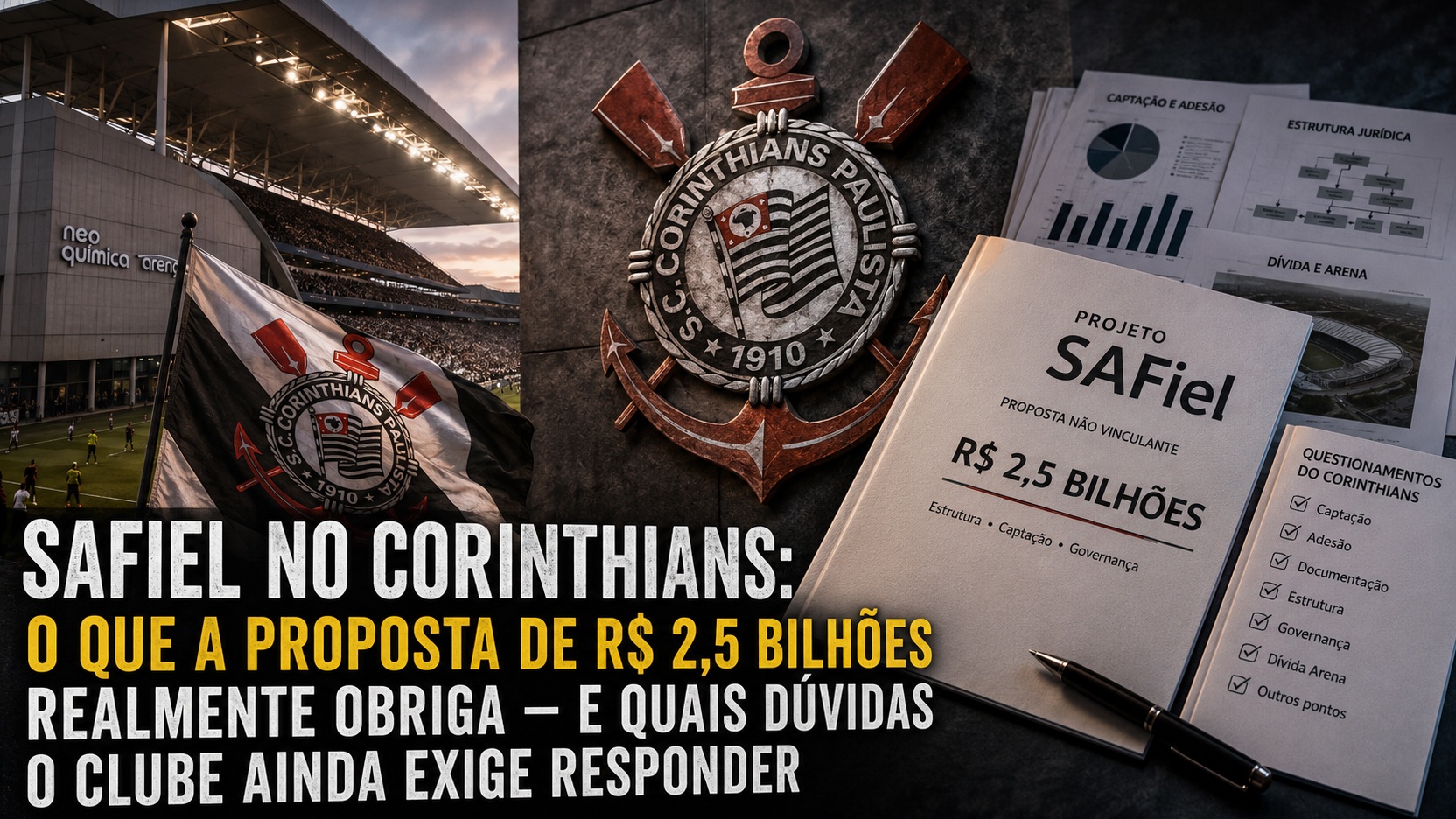
The short answer, as of the night of August 29, 2026, is this: SAFiel's R$ 2.5 billion is not an amount already guaranteed to Corinthians. The figure appears in the project's documents as a fundraising reference. The June 2 proposal also does not require the club to approve or establish the SAF, but it contains an important exception: Clause 9 is expressly binding and would produce immediate legal effects if the document were signed.
That distinction is at the center of the discussion. Calling the text merely a "non-binding proposal" can suggest that signing it creates no practical consequence. The document itself says otherwise on specific points. At the same time, treating the R$ 2.5 billion as funding already available would also be an overstatement: fundraising still depends on a financial structure, firm commitments, due diligence, possible regulatory review and internal approvals.
Where the R$ 2.5 billion comes from
The SAFiel Book 2.0, released in May, raised the project's reference investment amount to R$ 2.5 billion, with the possibility of supplementation up to R$ 3 billion. The model provides for 10 million common shares at a reference value of R$ 250 each, which mathematically produces R$ 2.5 billion. The material separates distribution among a popular tranche, the broader retail market and anchor investors, while also allowing non-voting preferred shares as a fundraising supplement if necessary.
The Book itself, however, contains a caveat that should not be ignored: financial information and intended results are presented as estimates, not as a commitment or guarantee. The study says it starts from a base of at least 10 million Corinthians supporters considered economically active and works with an adhesion rate below 5% to reach the reference fundraising amount.
That is exactly the premise Corinthians decided to test. According to the questionnaire sent by the club, its directors want to know how Datafolha, Ipsos/Ipec, IBGE, Serasa, Anbima, B3 and Instituto Locomotiva databases were combined, whether different populations were treated as comparable, what effective financial capacity was attributed to supporters and which conservative, intermediate and pessimistic scenarios support the model. The club also asks for verifiable examples of widely distributed capital raisings that achieved similar conversion and wants to know whether the Book can be audited.
In other words: the calculation of 10 million shares at R$ 250 explains the architecture of the figure, but it does not prove that there are enough buyers to subscribe and pay in that capital.
The June proposal treats the amount as a reference, not as a ready check
The Second Non-Binding Proposal, dated June 2, 2026, is more operational than the Book. In it, the reference amount is again R$ 2.5 billion, potentially reaching R$ 3 billion in the event of excess demand. The text says that any flexibility regarding the reference fundraising amount would require consensus between the parties.
Later, among the conditions for completion of the transaction, the document lists the raising of approximately R$ 2.5 billion in firm subscription commitments, "or an amount that enables the project to proceed." This reinforces that the figure is a central target of the structure, but, in the published document, it does not operate as an unconditional promise that the group will deposit R$ 2.5 billion before the transaction.
The distinction also helps explain why the share capital of Invasão Fiel S.A. entered Corinthians' questionnaire. The club pointed out that the company responsible for the proposal was incorporated in July 2025 and has share capital of R$ 3,000, asking for details about its structure, history and ability to organize a billion-real transaction. A small share capital, by itself, does not prove an inability to lead a market fundraising effort; but it also does not demonstrate that the necessary money has already been secured. It is precisely this bridge between the corporate vehicle and the resources actually available that Corinthians wants documented.
How SAFiel intends to separate football from the association
In the June version, the transaction provides for the creation of a Sociedade Anônima do Futebol that would receive the so-called Football Perimeter. This perimeter includes, by way of example, rights over players, sponsorship and broadcasting contracts, infrastructure linked to sporting operations, intangible assets and obligations related to football.
The proposal indicates that SAFIEL would be controlled by Invasão Fiel S.A., while Sport Club Corinthians Paulista would be a founding shareholder with special rights, including a golden share and representation in governance structures. The club's final economic interest is not fixed as a simple percentage in the document: it would depend on valuation, the determination of net indebtedness and adjustments provided for in the definitive documents.
The model also promises broadly distributed ownership among Corinthians supporters, limits per CPF, councils with distributed representation, protection of symbols and a reversibility clause. A significant portion of these mechanisms, however, still depends on the future SAF's bylaws, a shareholders' agreement, a subscription agreement and other documents that the proposal itself lists as definitive instruments still to be negotiated.
This point matters because several benefits publicized by the project, such as estimated royalties of R$ 600 million over ten years, an investment of up to R$ 50 million in the social club and detailed governance rules, are proposed terms for a future structure. They should not be confused with money already received or with an obligation that has been definitively constituted today.
What "non-binding" really means in this document
The proposal states that the ultimate objective, namely the creation of the SAF, remains subject to a series of conditions. These include approval by Corinthians' statutory bodies, formal creation of the SAF, valuation and due diligence, fundraising through firm commitments, possible regulatory approval of the offering, third-party consents and execution of the definitive documents.
Therefore, signing the proposal published in June would not be equivalent to voting on the SAF, transferring football operations at that moment or completing the transaction. The text itself requires a new stage of approval and documentation.
There is, however, an explicit exception. Clause 12 says the letter is non-binding, "except for Clause 9," which would have immediate legal effect upon signature. That wording led Corinthians to ask in writing which responsibilities would begin before any final decision on the SAF.
What Clause 9 would require
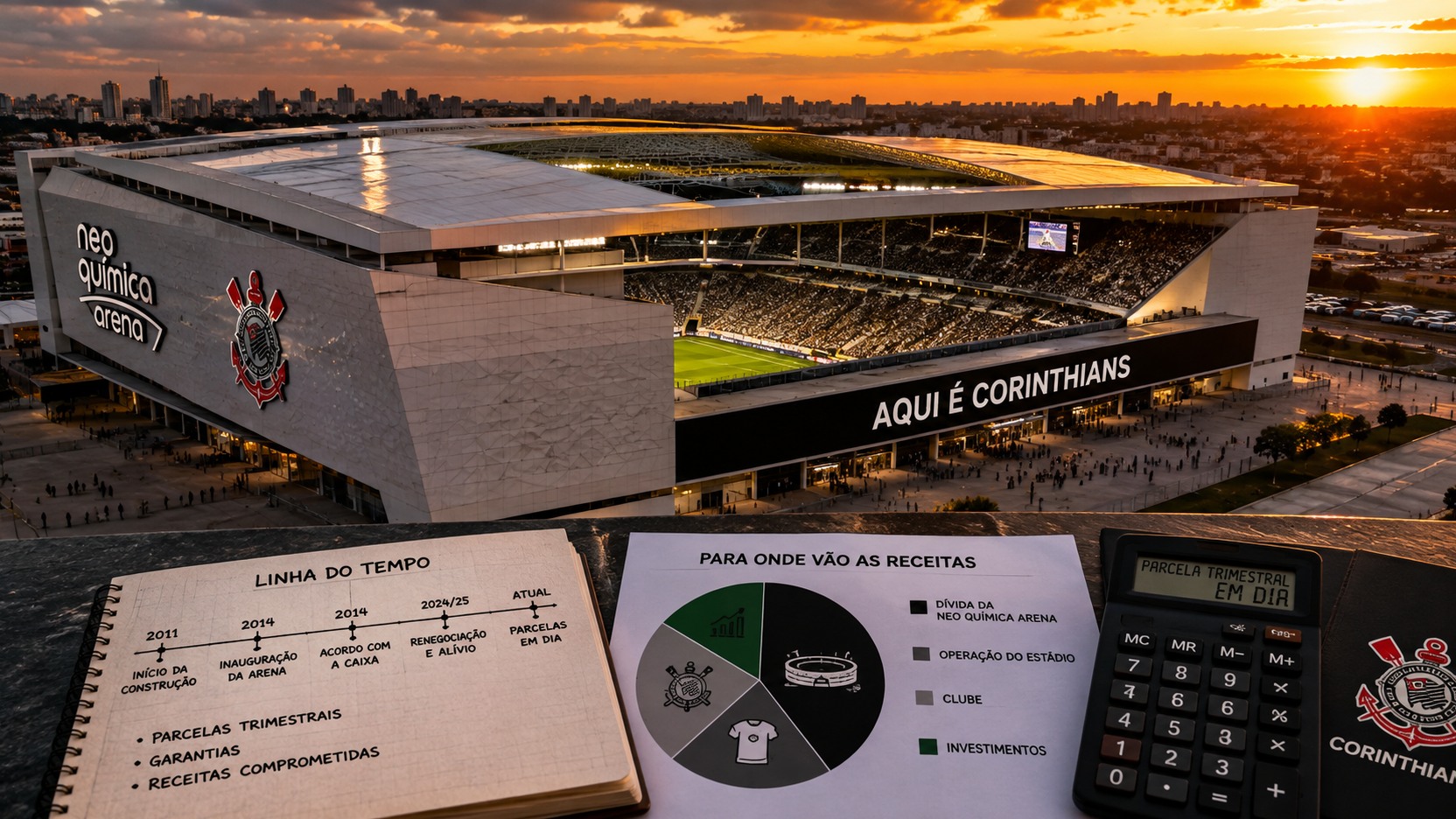
The first binding item deals with advance fundraising. Invasão Fiel undertakes to use "best efforts" to obtain resources before the public fundraising, during due diligence, for two possible purposes: critical cash-flow commitments and/or repayment of the Arena debt owed to Caixa Econômica Federal.
"Best efforts" is an obligation to act, but it is not the same as an absolute guarantee that the amount will be raised by a certain date. In this item, the published wording does not set an immediate minimum amount or a specific deadline for paying off the Arena.
The second item addresses what would happen if the transaction were not completed after resources had been advanced. Amounts advanced to the social club would be converted into a repayment obligation, under conditions still to be negotiated. In the case of funds used for the Arena debt, the text provides for a structure involving assumption of the creditor-side position under the contract, with reimbursement to be defined under market terms. The costs of due diligence conducted by a Big Four firm, meanwhile, would remain exclusively with Invasão Fiel even if the transaction did not move forward.
Clause 9 also provides for confidentiality regarding information exchanged, establishes that each party bears its own costs unless otherwise agreed in writing, defines arbitration for disputes and sets a 60-day term, extendable by agreement or until execution of the definitive documents.
That is why Corinthians' concern about expenses is not merely semantic. The club wants to define which costs, reimbursements and responsibilities could arise in the preliminary phase and avoid having the president's signature interpreted as authorization for financial obligations that should pass through other
internal bodies.
Does the proposal create exclusivity for SAFiel?
In the published text of the June 2 proposal, Clause 9 does not contain an express exclusivity provision barring Corinthians from talking to other interested parties. Annex A, however, acknowledges that future ancillary documents may contain exclusivity or lock-up clauses.
Corinthians decided not to leave the matter implicit. In the questionnaire disclosed on August 29, the club asks whether signing the proposal would prevent it from reviewing or negotiating other SAF projects during the document's term.
Until there is a formal response from the proponents, the safest reading is to separate two things: the public version of the letter does not present an explicit prohibition on negotiations with third parties in the binding clause, but the club wants written assurance that no interpretation, ancillary document or later stage will produce that effect without specific approval.
Why Corinthians is also demanding explanations about data and compliance
Another set of questions concerns the origin of the information used in the model. The club asks SAFiel to identify the documents, databases and sources used and to clarify whether internal information to which Maurício Chamati had access when he participated in the Independent Finance Committee was used in the project.
Corinthians cites a confidentiality agreement signed by Chamati in 2024 and wants to verify compliance with the confidentiality obligations. The club's own statement, as reported by UOL, emphasizes that the due-diligence points do not amount to a conclusion regarding illegality, responsibility or guilt. The issue therefore should be treated as an open compliance review, not as a proven accusation.
The Arena debt changed the tone of the negotiation
On August 28, Osmar Stabile publicly raised the bar: he said he would be willing to sign a stronger commitment if SAFiel presented resources to pay off the Neo Química Arena debt. The group responded that it accepts developing a new binding proposal and said it intends to approach the board on Monday, August 31, to begin drafting the document.
That statement is relevant, but it still does not amount to repayment of the Arena debt or the existence of a new signed contract. As of the night of August 29, what exists publicly is the parties' willingness to discuss a proposal different from the non-binding June letter.
If the new draft actually requires an advance of resources for the Arena before completion of the SAF transaction, the risk and economic structure of the negotiation will change significantly. It will be necessary to verify where the money will come from, in which instrument it will be placed, who will be the creditor if the SAF is not approved, what guarantees will exist and whether there will be a right to reimbursement. Those details cannot be presumed from a statement of intent.
What still needs to be clear before calling this a deal
The project already has a relatively detailed architecture, but several decisive points remain open. The main financial question is whether the fundraising target can be turned into verifiable firm commitments and at what pace. On the corporate side, definitive documents are still needed to set the economic interest, governance, veto rights, reversibility, transfer of assets and the relationship between the association and the SAF.
The consequences of any advance payment toward the Arena if the main transaction is not approved also need clarification, as do whether exclusivity exists, the extent of expenses assumed by each side and the traceability of the information used in the Book.
The institutional process itself remains essential. The published proposal makes the transaction conditional on statutory approvals and the General Assembly. Therefore, a presidential signature on a preliminary document, or even the negotiation of a binding proposal, does not automatically replace the internal deliberations required to create the SAF.
What can be said today about SAFiel
SAFiel is no longer just a generic idea and already has a Book, a letter of intent and a published governance design. That makes a more precise documentary analysis possible. And that reading produces two conclusions that may appear contradictory, but are not.
The first is that the R$ 2.5 billion is not guaranteed simply because it appears in the project. It represents the reference fundraising amount of a model that depends on investor participation and that the Book itself classifies as an estimate, not a guarantee.
The second is that the June proposal is also not a document without consequences. It does not require Corinthians to create the SAF, but it contains binding clauses on advance fundraising efforts, possible repayment or reimbursement, confidentiality, expenses, arbitration and term.
The key point now is the transition from design to proof. Corinthians wants evidence regarding fundraising capacity, methodology, origin of the data, structure of the proposing company and legal effects of signing. And, after Stabile's remarks about the Arena, SAFiel agreed to discuss a stronger proposal. Until that new draft exists and is reviewed by the competent bodies, promise, estimate, preliminary obligation and final decision remain different things.