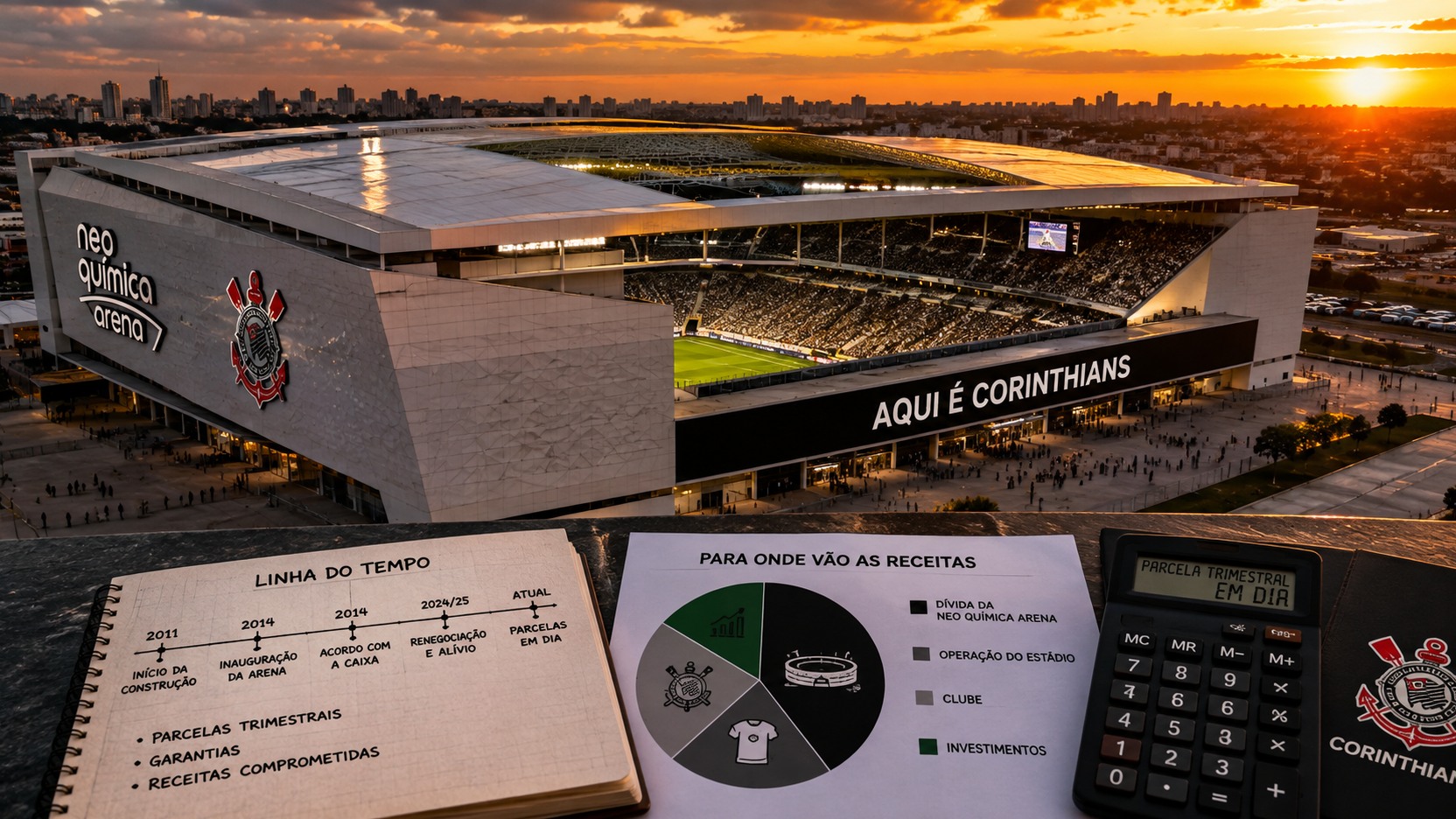
The safest answer to “how much does Corinthians still owe for Neo Química Arena?” needs a date. The 2025 financial statements recorded a debt balance of approximately R$642 million with Caixa Econômica Federal on December 31, 2025. In 2026, the club kept the first two known quarterly installments up to date, of around R$28 million each, totaling approximately R$56 million until July. This does not, however, authorize us to conclude that the current balance is simply R$642 million minus R$56 million.
The reason is that each installment includes interest and amortization, while the contract is adjusted by a rate linked to the CDI plus 2% per year. The balance therefore changes over time. Without an updated statement after the March and June payments, the defensible number continues to be the last official balance published, accompanied by the information that the 2026 installments were due until the second installment.
How much does Corinthians pay in 2026
Current refinancing provides for four payments per year, normally due in March, June, September and December. Report on July 21, 2026 reported that the first two installments of the year were around R$28 million each and that the total disbursement projected for 2026 was approximately R$115 million. The remaining two installments were scheduled for September 25th and December 25th.
These amounts are not fixed installments like those of a common real estate loan. The contract itself, as described in the club's financial statements, combines increasing amortizations with interest of 2% per year plus the CDI variation. Therefore, the weight of each quarter depends on the outstanding balance and the financial cost of the period.
There is still an important difference between numbers that appear in reports about 2025. Corinthians' balance sheet records R$126.083 million in additions to transfers to repay Caixa's financing that year. Some articles that only deal with the four periodic installments mention around R$93 million. These two numbers should not be mixed as if
were exactly the same metric: the first comes from the accounting record of transfers linked to the Arena structure; the second is presented as the sum of quarterly installments. Without a detailed reconciliation of each movement, the most prudent thing is to preserve both sections and explain what each one measures.
How debt arrived at the current model
The original financing was contracted in 2013, with Caixa as the institution transferring resources from the BNDES Pró-Copa Arenas program. The stadium opened in 2014, but the payment flow did not follow the initial design. Years of default and disputes led to further restructuring.
The fourth amendment to the contract was signed on July 25, 2022, and the restructuring was completed that year. The new arrangement extended the deadline until December 2041, redesigned guarantees, linked accounts and the way revenue was allocated. In 2023 and 2024, payments were concentrated on interest and charges accumulated from the previous period. The most effective amortization of the principal began to occur from 2025.
This helps to understand why Arena may have received large transfers without the balance falling at the same speed. During part of the schedule, a relevant portion of the money served to normalize interest and charges, and the financial correction continues to affect the remaining balance.
Where does the Arena money go
The central point of the agreement is not just “how much is paid”, but what revenues are tied to financing. The 2025 financial statements detail a package of fiduciary assignments and guarantees that transforms various sources of revenue into protection for Caixa.
Box office
The contract binds 55% of the Arena's gross box office revenue. This means that a full house does not fully convert into free money for football. There are operating costs for the game and, in addition, a relevant portion of gross revenue is linked to financing.
In 2025, Corinthians reported R$115 million in ticket sales at the Neo Química Arena and R$217 million in total stadium revenue. The administration stated that the Arena's operation was surplus. Still, the club's operating surplus and liquidity are different things: an asset can generate positive results and, at the same time, require strong debt service and maintain revenues under contractual obligations.
Naming rights
One hundred percent of Arena's naming rights revenues are included among the credit rights given as collateral. The current contract with Neo Química was signed in 2020, and Corinthians and Caixa have been discussing alternatives since 2025 to reevaluate this asset and study a possible solution that would reduce Arena's liabilities.
This negotiation is not equivalent to a settlement that has already been completed. Until August 2026, public sources consulted indicated ongoing conversations, with valuation of the stadium and naming rights used as a reference. As long as there is no new formal instrument, the current financing contract and the current package of guarantees are valid.
Awards, athlete sales and television
The agreement also covers 50% of prizes for men's football in the event of a title or runner-up, 30% of receivables from the sale of men's football athletes and revenue from broadcasting rights for the Brazilian Championship in expected default situations.
In practice, this explains why the Arena's debt can affect areas that appear to have no direct relationship with the stadium. A player sale or a championship award may be financially relevant to build a squad, pay suppliers or settle sporting obligations, but part of these resources may be previously linked as a guarantee of the contract with Caixa.
The reserve account is the point that squeezes liquidity the most
In addition to the installments, the contract requires a reserve account equivalent to four quarterly installments of principal and interest, that is, approximately one year of debt service. The amount required is not fixed: it follows the size of the installments.
In the financial statements as of December 31, 2025, the balance recorded in this account was R$23.908 million, and the full constitution of the reserve still appeared as an accessory obligation under regularization. Reports from 2026 estimated that, with installments in the range of R$20 million to R$30 million, the necessary cushion could be between approximately R$80 million and R$120 million.
The logic of the reserve is to protect the creditor against future delays. For Corinthians, however, it reduces flexibility: resources that could circulate in the cash register need to remain available within the guarantee structure. If the reserve is not adequately covered, the bank can activate earmarked revenues to restore contractual protection.
It was precisely this type of mechanism that gained visibility when part of the prize money for the 2025 Copa do Brasil was retained by Caixa. The episode showed that guarantees are not just theoretical clauses; they could interfere with the flow of money that the club hoped to use on other fronts.
Why a profitable stadium still puts pressure on cash
The contradiction is only apparent. Corinthians states that the Neo Química Arena operation is in surplus and has been increasing revenue from box office, boxes, events and seats. This is positive for the asset. But the club carries, at the same time, long financing, indexed and protected by very broad guarantees.
The first problem is the format of the disbursement. Instead of a small expense distributed monthly, cash faces quarterly peaks of tens of millions of reais. Even if the club knows the date in advance, it is necessary to accumulate liquidity for March, June, September and December.
The second problem is the financial cost. As the contract charges 2% per year plus CDI, high interest rates make debt service more burdensome and reduce the speed at which payments reduce the principal.
The third problem is overlapping guarantees. Box office, naming rights, awards, athlete sales and, in certain scenarios, broadcasting rights are no longer completely free sources.
This reduces the ability to quickly redirect money to salaries, image rights, signings, legal settlements or sports debts.
The fourth problem is the reserve account. Even when the quarter's installment has been paid, the contract continues to require protection for subsequent installments. The effect on cash, therefore, does not end on the due date.
Does the Arena's debt form part of Corinthians' total debt?
Yes, but it is important to separate categories. The financing of Neo Química Arena is a specific obligation linked to Caixa and the stadium's corporate and financial structure. In the 2025 balance sheet, the balance of approximately R$642 million was treated as a relevant part of the club's total debt.
Arena Financing
This is the liability covered in this article: long-term contract with Caixa, final maturity in 2041, quarterly payments, interest and amortization, in addition to the guarantee package. The money passes through the Arena structure, which involves the SPE and the Arena FII, but the central financial creditor of the contract is Caixa.
civil RCE
The Centralized Execution Regime brings together civil debts in a judicial payment plan. It is another obligation, with its own rules and percentage of revenue allocated to the plan. Paying the RCE does not reduce the stadium's debt, and paying the Arena does not pay off the RCE's creditors.
Tax debt
The agreement with the Attorney General's Office of the National Treasury consolidated tax liabilities into a separate transaction. It is also not Neo Química Arena’s debt. It weighs in the same club's cash flow, but has a different creditor, schedule and guarantees.
Football debts
Transfer bans, installments for acquiring athletes, commissions, salaries and image rights belong to another layer of liabilities. These commitments may compete for liquidity with the Arena, but should not be added to the balance of R$642 million as if they were part of the same contract.
This separation is essential to understand headlines about “total debt”. Corinthians can reduce one obligation and increase another in the same period. Therefore, a drop in Arena's balance does not mean, alone, an equivalent improvement in the club's overall debt.
What the renegotiation with Caixa tries to change
Since 2025, Corinthians and Caixa have been discussing alternatives to reduce the weight of the contract. One of the paths involves naming rights and the economic evaluation of the stadium. The club's interest is to transform a valuable commercial asset into a mechanism capable of amortizing a larger portion of its liabilities and, at the same time, alleviating restrictions on current revenues.
Until August 15, 2026, however, there was no new definitive agreement in the public sources consulted that would replace the 2022 refinancing. What exists is a negotiation. Therefore, projections of settlement due to naming rights, sale of assets or change of manager must be considered
treated as possibilities, not as debt already eliminated.
The number worth tracking now
To know if the situation really improves, there are four indicators that are more useful than an isolated headline about “how much was paid”. The first is the official outstanding balance updated after the 2026 installments. The second is how much of each payment corresponds to interest and how much actually repays the principal. The third is the required and effectively constituted level of the reserve account. The fourth is the volume of revenue that remains blocked or transferred as collateral.
Today, the picture is this: the last official closing balance is around R$642 million on December 31, 2025; the first two installments of 2026, of approximately R$28 million each, were paid; the year had a projected disbursement of around R$115 million; and the contract continues with a deadline of December 2041, unless further renegotiated.
That's why just saying “Corinthians owes R$642 million for the Arena” only tells half the story. The other half is in the way of money: how much comes out per quarter, how much becomes interest, how much reduces principal and how much income stops being free before it even enters the cash register.