
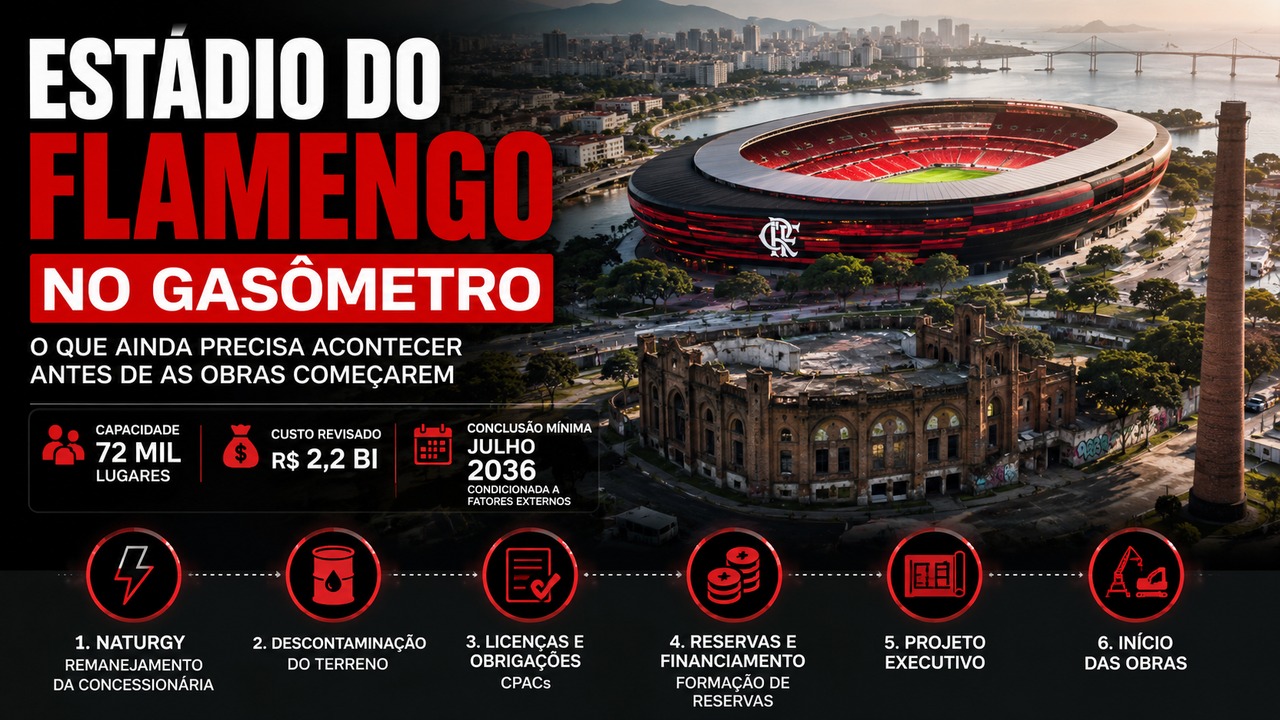
The purchase and possession of the Gasologista land does not mean that Flamengo is already in the phase of building stands. In August 2026, the project remains active, but the start of work depends on a chain of technical, urban planning and financial steps. The most important thing to understand about the timeline is this: before discussing concrete and structure, the club needs to clear and prepare the land.
Flamengo's official page about the new project, published in September 2025 and updated on July 22, 2026, places the relocation of Naturgy, the cleaning of the land, obligations linked to the agreement and urban certificates and the structuring of the executive project among the steps prior to construction. In interviews in July and August 2026, President Luiz Eduardo Baptista, known as Bap, reinforced that the stadium was not abandoned, but avoided transforming these steps into a new promise of a date for the start of the work.
The central point: Flamengo has not yet reached the construction phase
The current stage is best described as preparation and feasibility. The club already has the land and has carried out surveys, topography, historical heritage, vegetation and contamination. It also revised the economic design of the stadium. This is different, however, from having a site cleared and an executive project ready for contracting and execution.
The practical sequence is conditioned. The gas infrastructure needs to go; the area needs to be decontaminated and released; legal and urban planning obligations must be closed; the club needs to define how to finance the arena without compromising its operation; and the executive project needs to transform the conceptual solution into engineering documentation capable of guiding the work. Until these fronts converge, talking about an exact date for the first foundation is speculative.
1. Naturgy: the first physical land block
The Naturgy structure is the easiest bottleneck to visualize because it occupies a significant part of the area and maintains active gas operations. In the diagnosis released by Flamengo, the concessionaire occupied around 55% of the land with a substation linked to the supply of the metropolitan region. The club reported that a statement from the company, dated September 2025, estimated the relocation would take four years after obtaining a new address for the facility, a step attributed to the City Hall.
This means that the four years should not be read as a simple timer started when the land was purchased. There is a previous condition: defining and making viable the location that will receive the structure. In July 2026, Bap again cited the impasse and said that, as long as the installation and active pipes remain in place, Flamengo cannot advance on the area as if it were free for construction.
The practical effect is important. Even if the club had all the money needed to build the arena today, it would still face a concrete technical barrier. Therefore, Naturgy's departure comes before any responsible forecast for the start of heavy work.
2. Decontamination: the stage that begins after the area is cleared
Gasmetro has an industrial history, and soil contamination is not treated by the club as superficial cleaning. In the official material, Aecom, hired to study the remediation strategy, identified an extensive base of public studies on the area. The preliminary report cited by Flamengo projected 18 to 24 months for decontamination after Naturgy's departure.
This order greatly alters the reading of the schedule. Relocating gas infrastructure and environmental remediation are not entirely parallel tasks. The deepest part of decontamination depends on clearing the land. In July 2026, Bap summarized this stage as about two years after the removal of the dealership structure.
The club itself links remediation to obtaining the necessary licenses to begin construction. Therefore, decontamination is not a finishing detail of the land: it is a prerequisite for the area to move from an industrial passive to a site capable of receiving a stadium.
3. Agreements, urban certificates and licenses are still part of the way
The legal situation of the land has advanced since the purchase in 2024. In December 2025, there was a favorable opinion from the FGTS Board of Trustees regarding the Conciliation Term linked to the economic-financial rebalancing of the expropriation, a step that consolidated Flamengo's possession of the area and allowed the following steps to proceed.
This does not eliminate all business-related obligations. The club's official material, updated in July 2026, still includes the monitoring of measures linked to certificates of additional construction potential and the definitive agreement with the entities involved among the next steps. Documents from the FGTS Board of Trustees had already recorded that the agreement depended on compensatory measures associated with CEPACs not consumed on the ground and corresponding public acts.
For the fan, the translation is simple: having the land does not mean having all authorizations and urban planning obligations terminated. The sequence also involves public acts, compensation and licensing. These items may advance while other fronts are underway, but should not be confused with automatic authorization to begin construction.
4. Money is another dependency, even after the land is technically ready
Flamengo also changed the financial logic of the project. In the 2025 presentation, FGV recalculated the previous plan at R$2.66 billion with inflation, contingencies and inputs updated, reaching R$3.1 billion when considering the cost of capital. The board presented an optimized version of 72 thousand seats with a target cost of R$2.2 billion, including stadium, contingencies, land, capital cost and surroundings.
More important than the isolated number is the way to pay. The current management started to defend internal generation of resources and formation of a reserve before taking over construction. In August 2026, Bap stated that, in a simplified account, saving a relevant part of the annual income could take something like 15 to 20 years to form the necessary amount, depending on the profitability of the money and future capital alternatives.
This statement does not create a new official opening deadline. It shows that the project has a second hurdle beyond engineering: the club does not want to finance the stadium in a way that severely reduces its ability to invest in football. Therefore, even when the land is released, the moment to start the work will also continue to be an economic decision.
5. Executive project: when the idea becomes documentation to build
The executive project appears in Flamengo's planning as a medium and long-term priority. This phase is different from a model, conceptual images or a preliminary study. It is here that architecture and engineering need to detail structures, installations, access, foundations, materials, urban interfaces, budget and construction methods at a level sufficient for contracting and execution.
Soil and contamination studies help to reduce uncertainties that affect this design. A stadium of this size cannot have foundations and a schedule defined responsibly without knowing the geotechnical and environmental conditions of the terrain. Therefore, part of the technical work carried out before construction works to prevent expensive decisions from being made based on incorrect assumptions.
When the executive project is mature, the club will be able to more accurately compare cost, deadline, contracting model and financing strategy. Before that, closed construction numbers must be treated as estimates, not as executed contracts.
6. Only then comes the physical work on the stadium
The construction itself is the last step in this chain, not the first. In the diagnosis presented in 2025, Flamengo estimated that the previous stages could prevent the start of the work for six to seven years, to which would be added approximately three years of
construction. It was in this context that the club abandoned its old promise of opening in 2029 and started talking about a minimum conclusion in July 2036, subject to external factors.
This date of 2036 needs to be read carefully. It functions as a minimum reference for the revised planning, not as a guarantee of delivery. In July 2026, Bap avoided giving a completion date. In August, when discussing the strategy of creating resources without sacrificing football, he signaled that the economic decision could push the construction of the stadium even further.
Therefore, there is no necessary contradiction between there being an official reference of 2036 and the president talking about a longer financial horizon. The first is a minimum date within a planning arrangement and obligations; the second is an assessment of when the club could consider it economically rational to mobilize capital to build.
What needs to happen, in practical order
The most useful order to follow the project begins with the relocation of Naturgy and the physical release of the area. Then comes decontamination and environmental preparation that allow us to move forward with licensing. In parallel, the club and the public authorities need to terminate legal and urban planning obligations related to the land and Porto Maravilha certificates.
At the same time, Flamengo intends to build resources and define a financing structure that does not put pressure on football. With the terrain conditions better known and previous obstacles resolved, the executive project can be consolidated at a level sufficient to contract construction. Only then does the stadium actually enter the construction phase.
So when does construction start?
Today there is no reliable date to answer this question with a specific day, month or even year. What exists is a verifiable sequence of dependencies. Naturgy remains a physical blockade; decontamination comes later; licenses and urban planning obligations need to be complied with; the board wants to build up cash before taking on the investment; and the executive project still integrates the stages prior to construction.
The best way to follow the Gasometer, therefore, is to ask the question “what is the new date?” by “which dependency was actually resolved?”. When there is a new location and effective schedule for Naturgy, environmental clearance, urban planning obligations completed, consolidated executive project and approved financial model, the debate about the beginning of the work will become much more concrete. Until then, any date needs to be presented as a conditional hypothesis, not as a promise of inauguration.