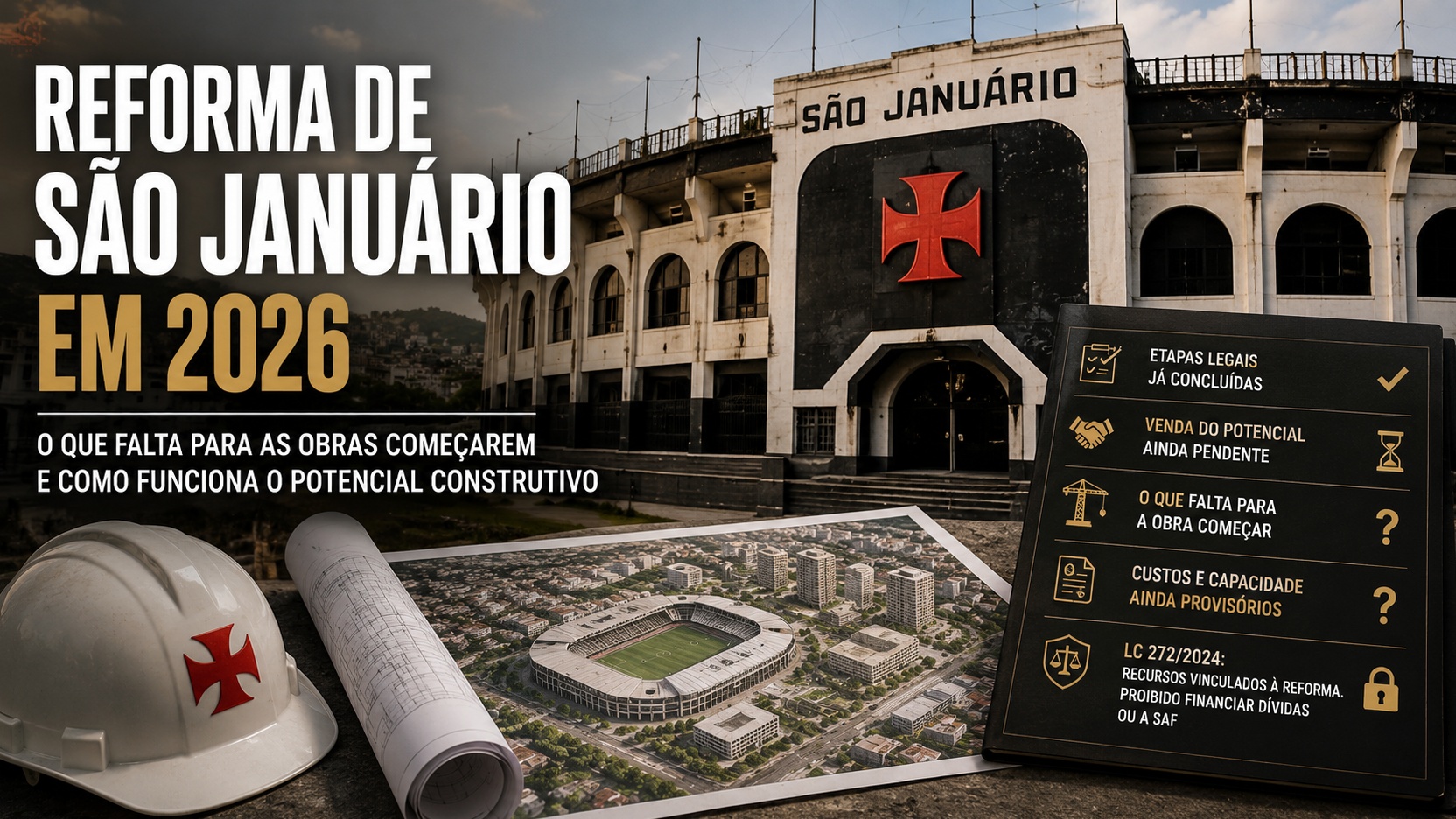
In August 2026, the reform of São Januário is not waiting for a new law to come into existence. Complementary Law 272/2024 has already been sanctioned and regulated, the Specific Purpose Company required for the operation has been created and the term authorizing the commercialization of the construction potential has been signed with the City Hall. The point that remains unresolved is financial and commercial: Vasco has not yet concluded the sale of the right to build, which it intends to use as the main source of funds for the work.
This is why previous predictions for starting the reform were falling behind. The club has already worked with January 2026, then treated the first semester as unlikely and reached the second semester without an official date to close São Januário. On July 25, internal management of the project passed to a working group led by Alan Belaciano. On August 7, Pedrinho once again discussed the construction potential with Rio City Hall. Even so, the most recent information is that commercialization continues without sufficient progress to allow the start of works.
What has already been resolved in the legal way
The central political stage was completed in 2024. Complementary Law 272, of July 3 of that year, established the São Januário Stadium Consortium Urban Operation and created the mechanism that allows the transfer to third parties of part of the right to build that will not be used on the complex's land. The standard also defined receiving areas, counterparts, supervision and rules to prevent the operation's money from being diverted to other club purposes.
In December 2024, Rio Decree 55,511 regulated the law and detailed the execution of the Transfer of the Right to Build, known by the acronym TDC. The decree set the transferable construction potential that can be applied in the receiving areas at up to 280 thousand m², subject to the factors and urban limits provided for in the legislation. It also detailed the activities of the City Hall, Companhia Carioca de Parcerias e Investimentos, CCPar, and the Special Purpose Company.
Another important step took place on May 23, 2025, when Vasco's partners approved the creation of the SPE. There were 3,059 voters, with 2,315 votes in favor. The company was formally incorporated in August 2025 and became the structure responsible for receiving, marketing and managing the rights linked to the operation.
On October 3, 2025, Vasco and City Hall signed the definitive term for the transfer of construction potential. The signing eliminated a doubt that existed months before: whether or not the club already had formal authorization to put this right on the market. Since then, the main obstacle has ceased to be the creation of the legal mechanism and has become the completion of sales.
What is holding back reform in 2026
The problem today is finding buyers with real estate projects capable of absorbing the construction potential in the permitted areas and in economic conditions that make sense for all parties. It is not enough for a developer to want to buy an abstract number of square meters. It must have, or make viable, a receiving property compatible with urban planning rules and with the volume of potential it wishes to use.
SOD Capital had preference to negotiate a very large portion of the operation and was studying the use of potential in land in Barra da Tijuca. The exclusivity agreement received extensions, but the purchase was not made official. On February 13, 2026, the preference ended and Vasco opened the competition to other interested parties.
In the following months, there were meetings with companies in the real estate sector and with the City Hall, but no solution replaced the sale that was expected to close with SOD. A specialized report on the real estate market published in May highlighted a problem of scale: there was interest in parts of the potential, but not necessarily in absorbing the 280 thousand m² in a single operation. The legislation allows partial use of the potential, therefore there is no legal obligation to sell everything to a single buyer. The difficulty is structuring a set of businesses that generates sufficient cash, within a period compatible with the beginning and continuity of a project of this size.
This detail helps to separate two questions that are often mixed up. Vasco already has the right to commercialize the potential. What it still doesn't have is the revenue effectively guaranteed by sales in sufficient volume to support the decision to start the renovation.
How the construction potential of São Januário works
Constructive potential is, in simplified terms, the amount of area that legislation allows to build on a given piece of land. In the case of São Januário, the complex does not use the full potential that urban legislation recognizes for the area. The Consortium Urban Operation transformed this difference into a right that can be transferred to enterprises located in receiving sectors defined by law.
In practice, the buyer does not acquire the stadium, nor a part of the São Januário land. He acquires the right to add buildable area to another property that is eligible to receive the TDC. The quantity effectively usable in the receiving batch depends on the rules of that sector and the equivalence factors provided for in the legislation. Therefore, 1 m² of nominal potential in São Januário does not necessarily mean 1 additional m² built anywhere in the city.
The operation also needs to be documented. The potential term is in the name of the SPE and, when the right is transferred to a receiving property, the City Hall issues the corresponding certification. The transfer and alienation must be registered in the properties involved. The decree also allows partial use, which makes it possible to sell smaller lots instead of relying on a single deed for the entire stock.
Why the buyer needs suitable land
Constructive potential only has economic value if there is a project that can use it. This is why the availability of land in Barra and other receiving sectors appears so often in negotiations. A company may consider the price of the right attractive and still not complete the purchase if it is unable to close the acquisition of the land where it intends to apply this potential or if the final bill for the real estate project does not close.
In addition to the amount paid to Vasco, the receiving enterprise must comply with licensing, occupation parameters and municipal counterparts. The legislation defines specific sectors and does not transform the 280 thousand m² into a credit that can be applied freely in any neighborhood in Rio. This limitation is essential to understand why a legally ready authorization can still take months to turn into money.
The City Hall can change urban planning rules through new legislation, but this is different from stating that the reform is waiting for LC 272/2024 to be approved again. The law is already in force. Possible future changes may make the potential easier or more interesting for the market, but the basic mechanism already exists.
Money from the sale cannot be used to pay debt or fund SAF
LC 272/2024 created an explicit lock for the destination of resources. The money obtained from the benefits of the operation must be applied to the interventions foreseen in the Urban Operation Plan. The law prohibits using these amounts to pay debts of Club de Regatas Vasco da Gama or Vasco SAF, salaries, prizes, athletes' rights, player loans, commitments before or after the law and investments outside the purposes defined by the operation.
The rule also prohibits transferring resources to the SAF. This is important because São Januário continues to belong to the associative club and the urban operation was created to protect and modernize this heritage, not to finance corporate football.
There is also a nuance that tends to disappear in shorter explanations. Not all of the money linked to the operation is restricted to the stands or inside the stadium. The legislation determines that at least 6% of the amounts collected be applied outside the limits of São Januário, in other contributions foreseen for the surrounding area. Therefore, the most accurate formulation is that the resources are linked to the reform and interventions of the Consortium Urban Operation, and not to Vasco's general fund.
How the law controls the release of resources
The SPE was not created just to receive potential. It functions as a layer of financial and governance segregation. LC 272/2024 provides that the proceeds from the sale are deposited in an SPE account or in an equivalent custody mechanism, with release linked to the physical progress of the work and the supervision of CCPar.
The law allows that a portion equivalent to 20% of the total value of the operation's rights can be used at the beginning to acquire goods or rights necessary for the implementation of São Januário. The remainder is subject to compliance with the conditions and guarantees provided for in the legislation. The regulatory decree reinforces that the use of values must follow the physical schedule and implementation of the counterparts.
This reduces the chance of money being received and spent outside of the project, but it also means that financial engineering needs to talk to the construction schedule. It’s not enough to announce a sale. It is necessary to formalize the operation, organize guarantees, licenses, projects, contracts and measurements so that cash is released throughout execution.
How much does renovation cost today
The number of R$500 million was for a long time treated as a reference for the reform because the project presented in 2024 was budgeted at approximately R$506 million. This amount, however, should no longer be treated as the definitive 2026 budget.
At the beginning of this year, Vasco was already working with an estimate close to R$800 million so that the revitalization would be financially sustainable. The difference was attributed to the updating of civil construction costs and the project review. The club itself and the reports that follow the topic treat this value as an estimate, not as the contracted price of the work.
At the same time, the sale of construction potential continues to be estimated at more than R$500 million. The bill shows why the commercialization of rights is central, but also why it may not be enough to pay for the final version of the project on its own. Vasco designs the naming
rights the stadium as one of the main complementary revenues and also evaluates other commercial partnerships linked to the new complex.
The capacity of the new São Januário is not yet closed
Another number that changes depending on the project phase is capacity. The design approved and released in 2024 worked with 47,383 seats. Afterwards, the Pedrinho administration began to study larger and smaller alternatives, with a range of 43 thousand to 57 thousand fans, trying to balance popular capacity, construction cost and sustainability of the stadium's operation.
At the end of 2025, internal evaluations pointed to something close to 45 thousand places as a possible reference. This does not transform 45 thousand into definitive official capacity. In 2026, as funding and executive design continue to be fine-tuned, any number in this range should be read as a project estimate, not a contracted, immutable specification.
The same goes for the deadline for work. The 2024 project spoke of around three years of execution. With no work order and no start date, there is currently no reliable inauguration date that can be calculated simply by adding three years to a previous political forecast.
What needs to happen for the work to really begin
The sale needs to become an executable financial commitment
The first practical step is to close sales of construction potential in a volume that provides security to contract and start the work. The law allows partial commercialization, but the club needs to have a financial structure that does not leave the renovation without resources midway. This was exactly why Vasco's directors began to avoid promising the start without guaranteed money.
Transfers must be formalized at the receiving properties
Each business needs to move beyond commercial intent and reach formal instruments of assignment, certification and registration. The buyer must demonstrate that it can utilize the potential in the receiving property and comply with applicable licensing rules. This is the point at which the availability of land and the viability of the buyers' projects stop being details and start to define whether the transaction closes or not.
Project, licensing and schedule need to be ready for execution
Decree 55,511 requires an Urban Operation Plan, technical projects, detailed budget, physical-financial schedule and monitoring by CCPar. The work must be compatible with the approved legal project and with other authorizations from the competent bodies. The existence of the term of construction potential does not replace these technical steps.
Only then does the work order stop being a prediction
Until these elements are aligned, any month indicated for the start of the reform will be a goal, not a guaranteed date. Recent history shows this clearly: the expectation of January 2026 was not confirmed, the first semester was discarded in practice and August arrived with the stadium operating normally and the club still negotiating the main source of financing.
Can the renovation begin without selling 100% of the potential?
From a legal point of view, the regulations allow partial use of the construction potential. Therefore, it is not correct to say that the law obliges Vasco to sell the 280 thousand m² in a single block before any movement. The resource release design itself provides for an initial stage and monitoring proportional to the progress of the work.
From a financial point of view, however, the question is more difficult. A renovation currently estimated at hundreds of millions of reais requires contracts, guarantees and cash flow predictability. Starting just because a small portion has been sold can increase the risk of stalling. The public stance adopted by the club has been to not initiate irreversible interventions in São Januário without assurance that the financial structure is in place.
Therefore, the most correct answer in 2026 is: there is no simple requirement for full sale of a single business, but the real start depends on a level of financing that Vasco has not yet demonstrated that it has secured.
Project status in August 2026
São Januário has already gone through the legal stages that, two years ago, were the big question mark. The Consortium Urban Operation exists, the regulations exist, the SPE exists and the commercialization agreement was signed. The bottleneck has moved.
Today, the renovation depends mainly on transforming the construction potential into effective revenue compatible with the updated budget for the work. The attempt to concentrate on SOD did not lead to a definitive purchase, the exclusivity ended in February and Vasco began looking for other buyers. Until the August 7th meeting with City Hall, there had not been enough sales announced to unlock construction.
This also explains why values, capacity and dates need to be treated with care. R$500 million is a reference for commercializing potential and the old budget; around R$800 million is the most recent cost estimate, which is not yet definitive; 47,383 seats belong to a previous version of the project; and the range discussed later was also not frozen as a final capability.
The objective fact, at this moment, is simpler: the renovation of São Januário is legally viable, but financially it is not yet ready to begin. The next truly decisive milestone will not be a new project image or another calendar forecast. It will be the signing of sales capable of placing protected money in the SPE structure and allowing Vasco to transform planning into work.