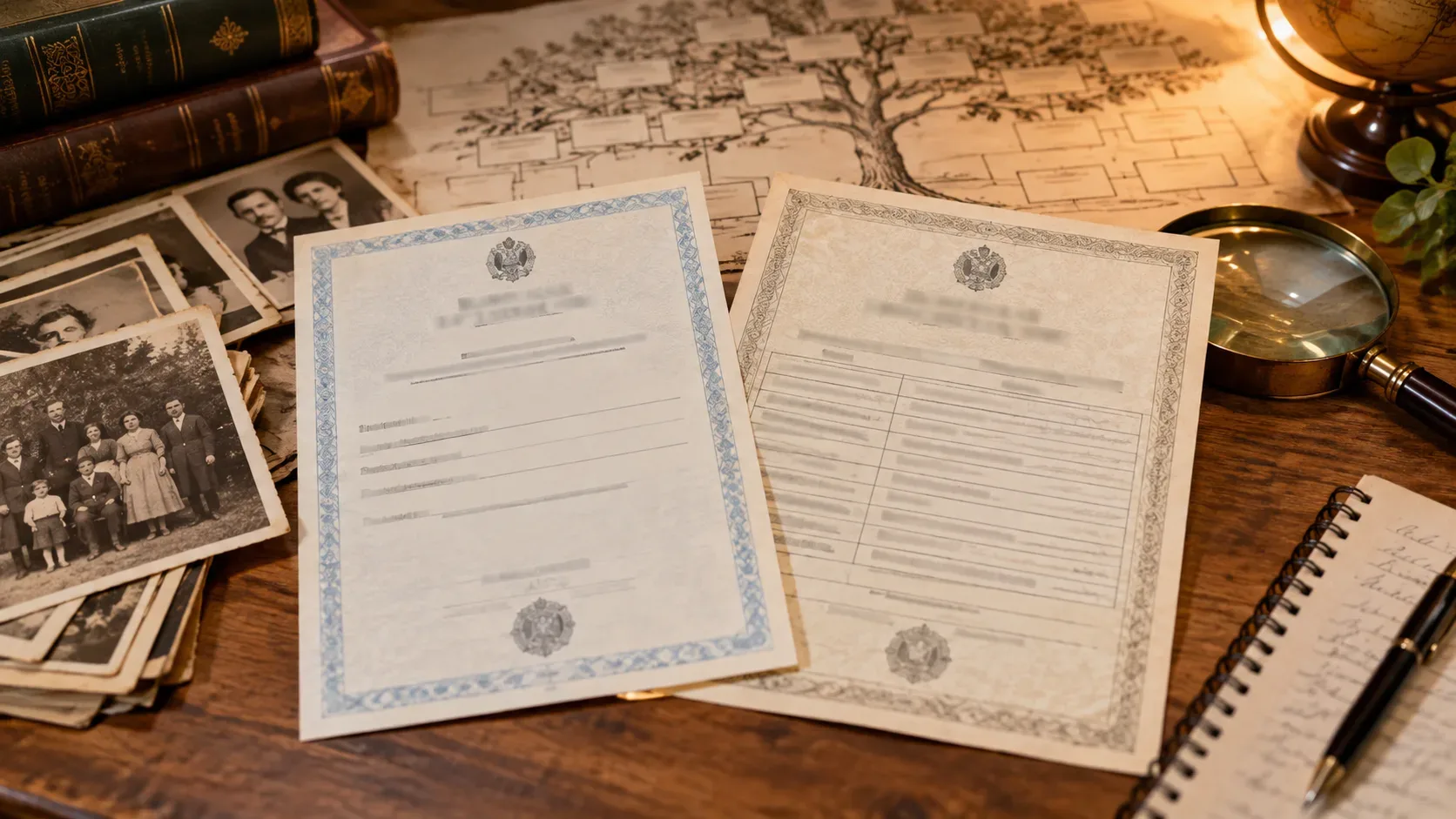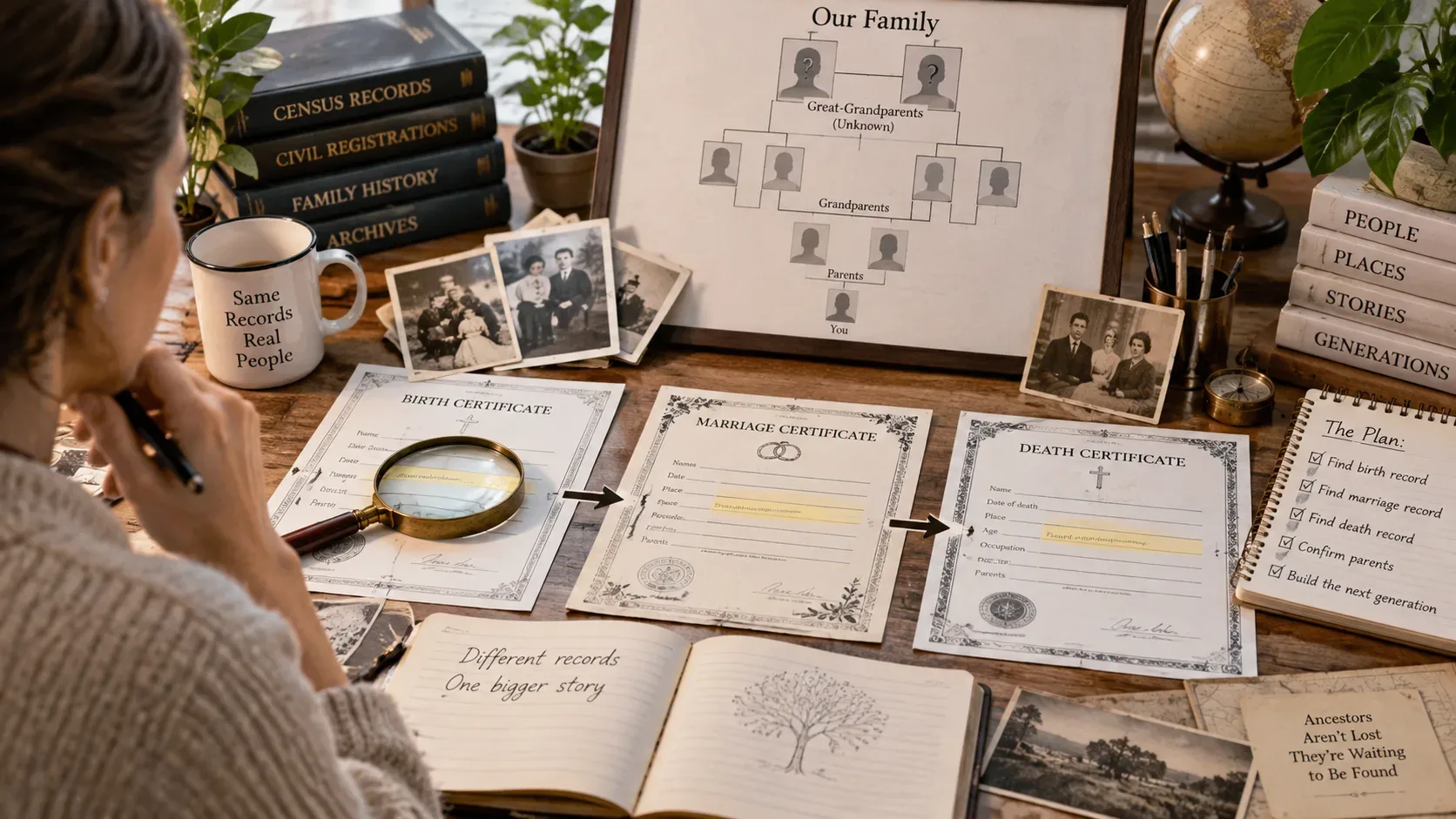
To find your great-grandparents' names when nobody in the family knows them, the safest approach is not to search directly for the great-grandparents. Start with a person in the generation immediately below them—usually a grandparent whose identity you already know—and use civil records to identify that person's parents. Those parents are the great-grandparents you are looking for.
The most efficient order is not the same for every family. It depends on what you already know. If you know a grandparent's spouse and an approximate marriage date or place, the marriage record is often an excellent starting point. If you know the birth place and year fairly well, the birth record may resolve the generation immediately. If you only know where and when the person died, the death record can provide clues that lead back to earlier records.
First, choose an anchor person
Before searching surnames, choose one grandparent whose identity is well established. Build a minimal profile with everything you know: full name, name variants, spouse, children, places of residence, and approximate years of birth, marriage, and death.
This prevents a common genealogy mistake: finding someone with a similar name in another place and jumping to an earlier generation without proving the relationship. Each step has one simple goal: a record should connect the known person to their parents. Only after that connection is supported should you begin researching the parents' lives.
Which certificate should you search first?
| What you already know | Best record to start with | What to look for | Next step |
|---|---|---|---|
| Spouse, marriage place, or approximate marriage period | Marriage | Parents of bride and groom, ages, birthplaces, residence, and marital status | Use the parents' names and birthplaces to locate birth and other records |
| Municipality and approximate birth year | Birth | Parents' names and, in some collections and periods, grandparents' names; place and date of registration | Confirm the parental couple through marriage, siblings' births, or other records |
| Death place and date, but little earlier information | Death | Parents, spouse, age, birthplace, residence, and informant when available | Work backward to marriage or birth records and confirm the clues |
The available fields vary by period, registry office, and collection. In a FamilySearch Brazilian collection for Rio Grande do Sul, for example, birth records may include parents and both maternal and paternal grandparents; marriage records may include the parents and birthplaces of the bride and groom; and death records may include parents, spouse, and place of origin. This shows what civil records can contain, but it does not mean every Brazilian record contains every field.
When marriage is the best starting point
If you know the couple who were your grandparents, search for their marriage first. A marriage record places two people in the same event and frequently identifies the parents of each spouse. For someone trying to identify great-grandparents, that can reveal two parental couples at once.
Besides the names, record ages, birthplaces, residence, and any reference to widowhood or a prior marriage. Those details help separate people with the same name and point to where birth records may be found. FamilySearch allows marriage searches using one spouse and adding the other as a filter, including tests with name variants.
When to start with a birth record
A birth record is especially strong when you know the correct municipality and can narrow the year range. The known person is the subject of the event and the record normally identifies the parents. In some Brazilian historical collections, paternal and maternal grandparents also appear, which can move the research back two generations—but treat that as a possibility, not a universal rule.
If the birth record lists only the parents, you have still found what you needed: the names of the great-grandparents. The next step is to search for that couple's marriage or their children's records to confirm spelling, places, and family relationships.
When a death record can unblock the search
A death record is useful when the family knows where someone died but does not know where the person was born or married. It may provide parents' names, spouse, birthplace, age, and residence. In many cases, that is enough to identify the town or couple that should be researched in earlier documents.
Use the death record as a clue and a cross-check, not automatically as the final authority on birth or parentage. Personal details may have been supplied by a relative or another informant. If a death record conflicts with a record created closer to the birth or marriage event, investigate the discrepancy before choosing one version.
A decision tree that avoids dead ends
- Choose a known grandparent. Do not start with someone merely assumed to belong to the great-grandparent generation.
- Identify the easiest event to locate. Marriage if you know the couple; birth if you know place and year; death if it is the only well-documented event.
- Extract everything, not just the parents' names. Copy dates, places, ages, occupations, residences, witnesses, and the informant's name when present.
- Turn each fact into the next search. Birthplace points to a birth record; a spouse points to marriage; identified parents allow searches for siblings and other children of the couple.
- Confirm the relationship in another source. A matching name is a clue; two or more consistent records provide much stronger evidence.
- Only then move back another generation. Once the grandparent's parents are supported, they become the new anchor people.
How to record name variants without getting lost
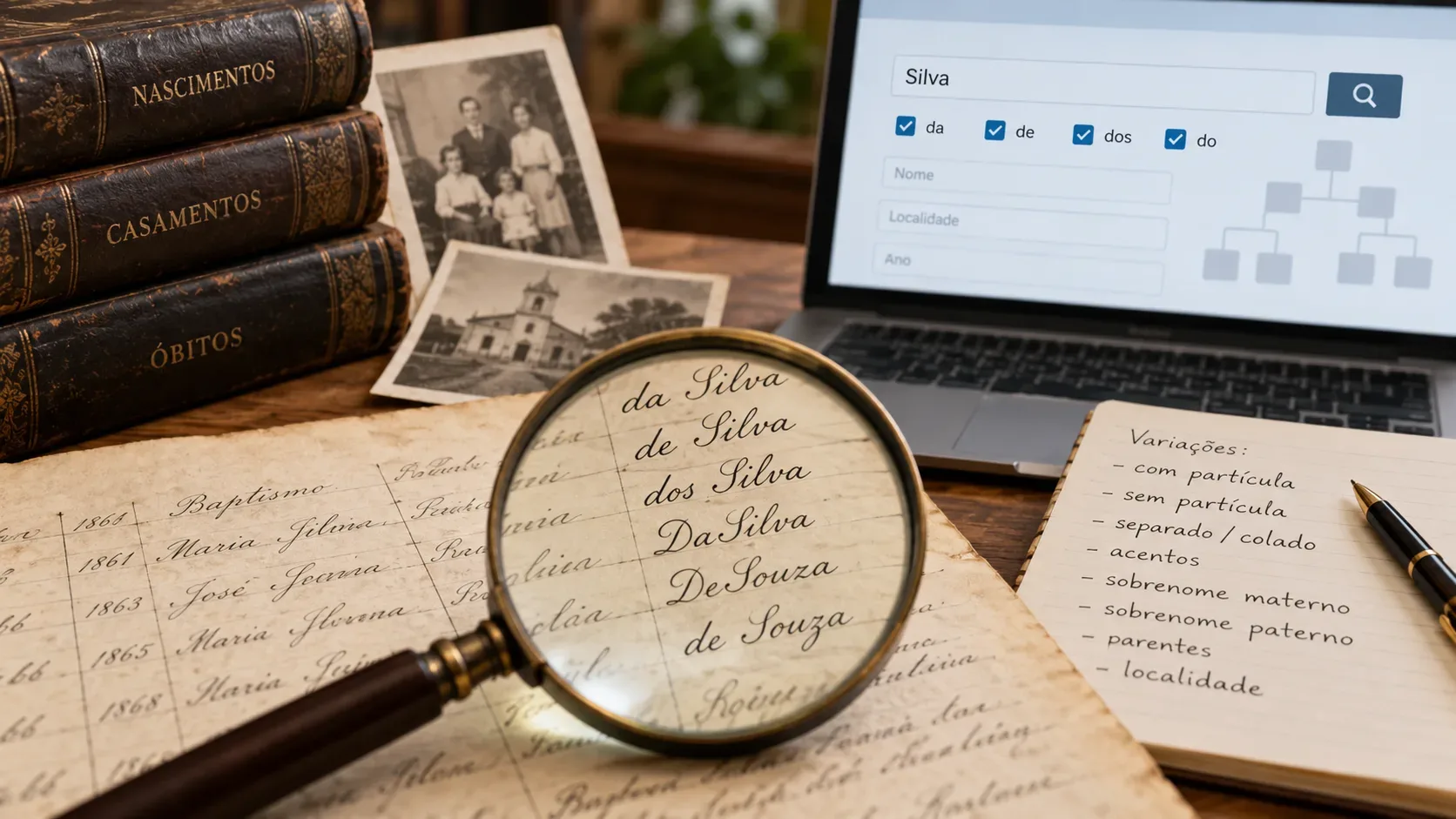
Historical indexes and records may use different spellings, omit surnames, use married names, or contain abbreviations. FamilySearch itself recommends testing spelling variations and nicknames and notes that records and indexes can contain errors, estimates, and differences from the original image.
Instead of “correcting” the record, keep a small research log. For every finding, record:
- the name exactly as written in the document;
- the normalized form you use for searching;
- record type and date;
- the locality exactly as written;
- parents, spouse, and relevant witnesses;
- the link, book, page, entry, or record number when available;
- a note separating documented facts from hypotheses.
This is particularly important in families with common surnames, spelling changes, or migration between municipalities. The same person can appear under slightly different forms over a lifetime, while different people can have almost identical names.
Place is as important as the name
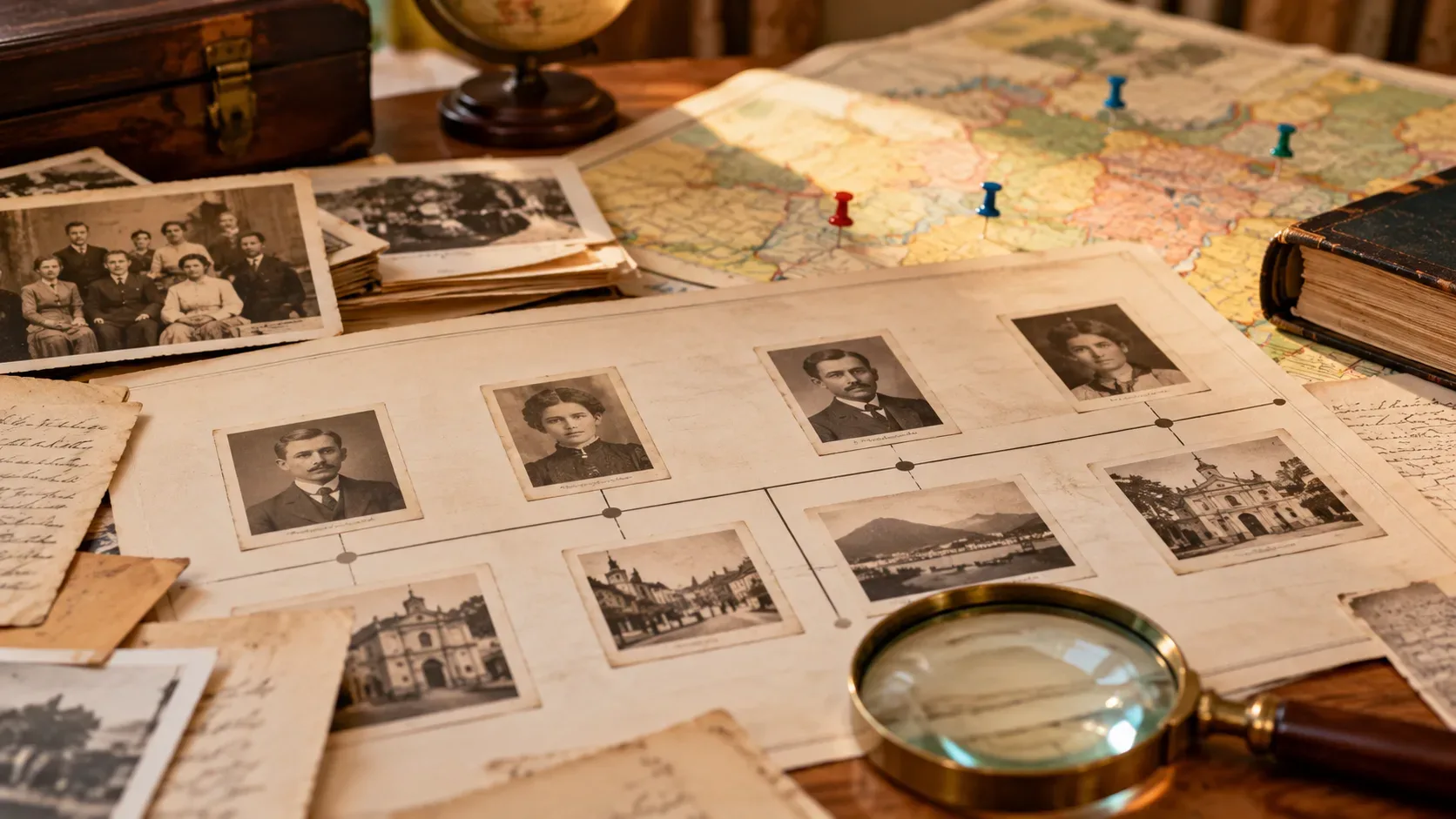
When two people have similar names, the combination of location, spouse, parents, and age range is usually more useful than the name alone. Record the municipality in each document and remember that administrative boundaries and place names may have changed over time.
If a search produces no result, do not immediately assume the record does not exist. Widen the year range, remove a middle name, search one parent at a time, search by spouse, or look for siblings. FamilySearch recommends starting with fewer search fields and refining later, testing variants, and viewing the original record image when available.
Do not confuse an index with the original record
An indexed search result may show only part of the record. When an image of the register or certificate is available, open it. FamilySearch notes that images can contain more information than search summaries and that indexes can include errors or spelling variations.
In genealogy, a seemingly minor detail can be decisive: a birthplace, a recurring witness, a residence, or the way a mother's name was recorded. Copy the context before moving on to the next person.
Hypothetical example: from a known grandparent to the great-grandparents
Imagine you know your grandfather was named Antônio Ribeiro, was married to Helena Costa, and lived in a certain town, but nobody remembers his parents' names. You find Antônio and Helena's marriage record and it names Antônio's parents. Those two names become your working hypothesis for the great-grandparents.
The next step is not to immediately search for the parents of those presumed great-grandparents. First, find Antônio's birth record or another document from his life and check whether the same parents appear. If parentage and locality are consistent, the relationship is much stronger. Only then should you begin researching each great-grandparent as a new anchor person.
What to do when records disagree
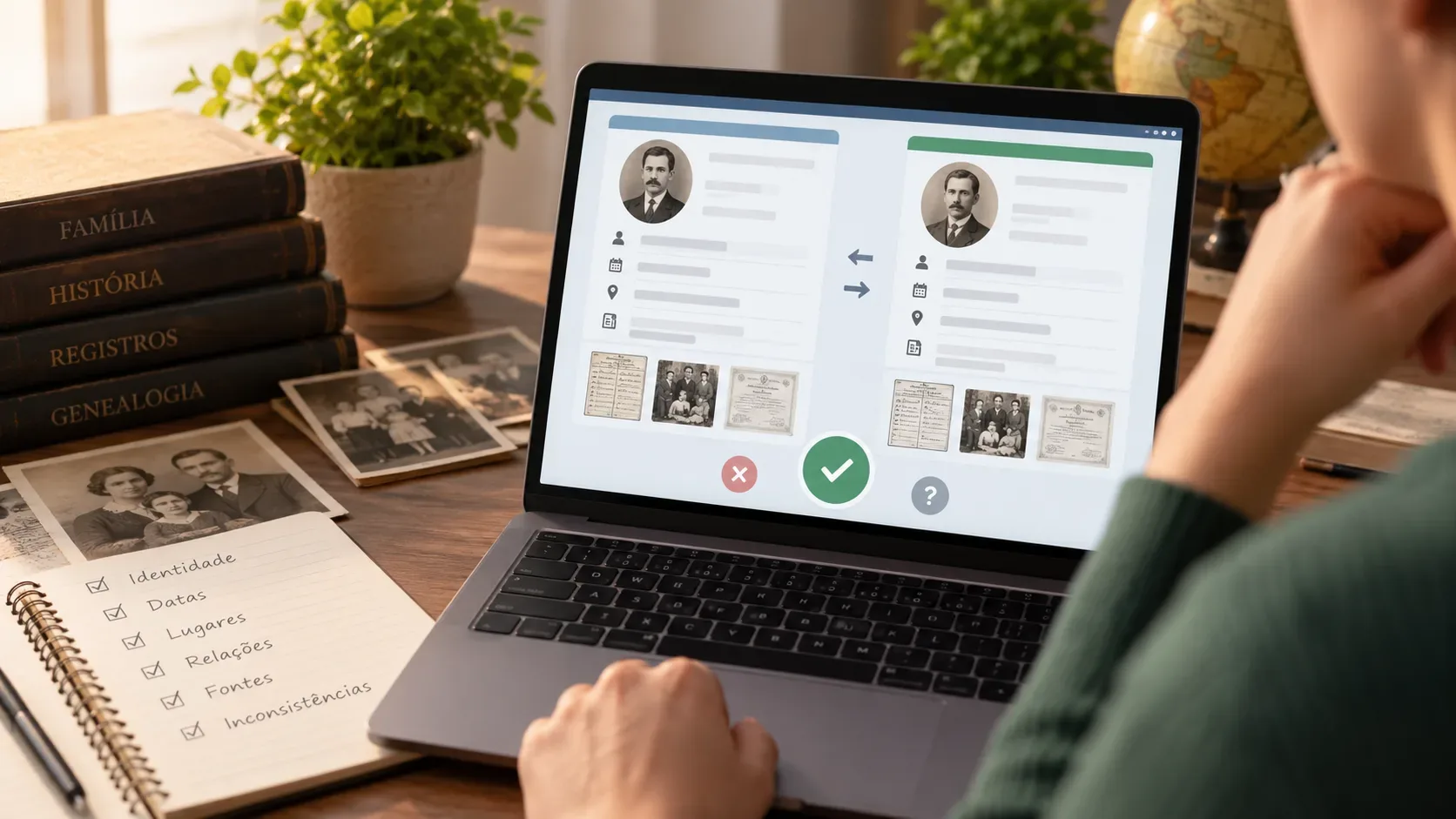
Small spelling differences are common and do not by themselves prove that two records refer to different people. Differences in parentage, locality, or age require more caution. Compare the whole set of facts: spouse, children, occupation, residence, witnesses, and chronology.
State conclusions with levels of confidence. “Probably the same person” is not the same as “the relationship is supported by two independent records.” This discipline prevents an old hypothesis from becoming an unquestioned “family fact” in later generations.
Checklist before saying you found the great-grandparents
- Did you start from a grandparent whose identity was already reasonably established?
- Is there at least one record connecting that person to their parents?
- Do the parents' names appear consistently in another source or in the wider family context?
- Do place, age, and spouse fit the chronology?
- Did you record name variants instead of erasing the differences?
- Did you save the reference to the record or original image?
When those answers are positive, the research stops being a surname hunt and becomes a chain of evidence. That is what allows you to identify unknown great-grandparents without skipping generations or relying only on family memory.