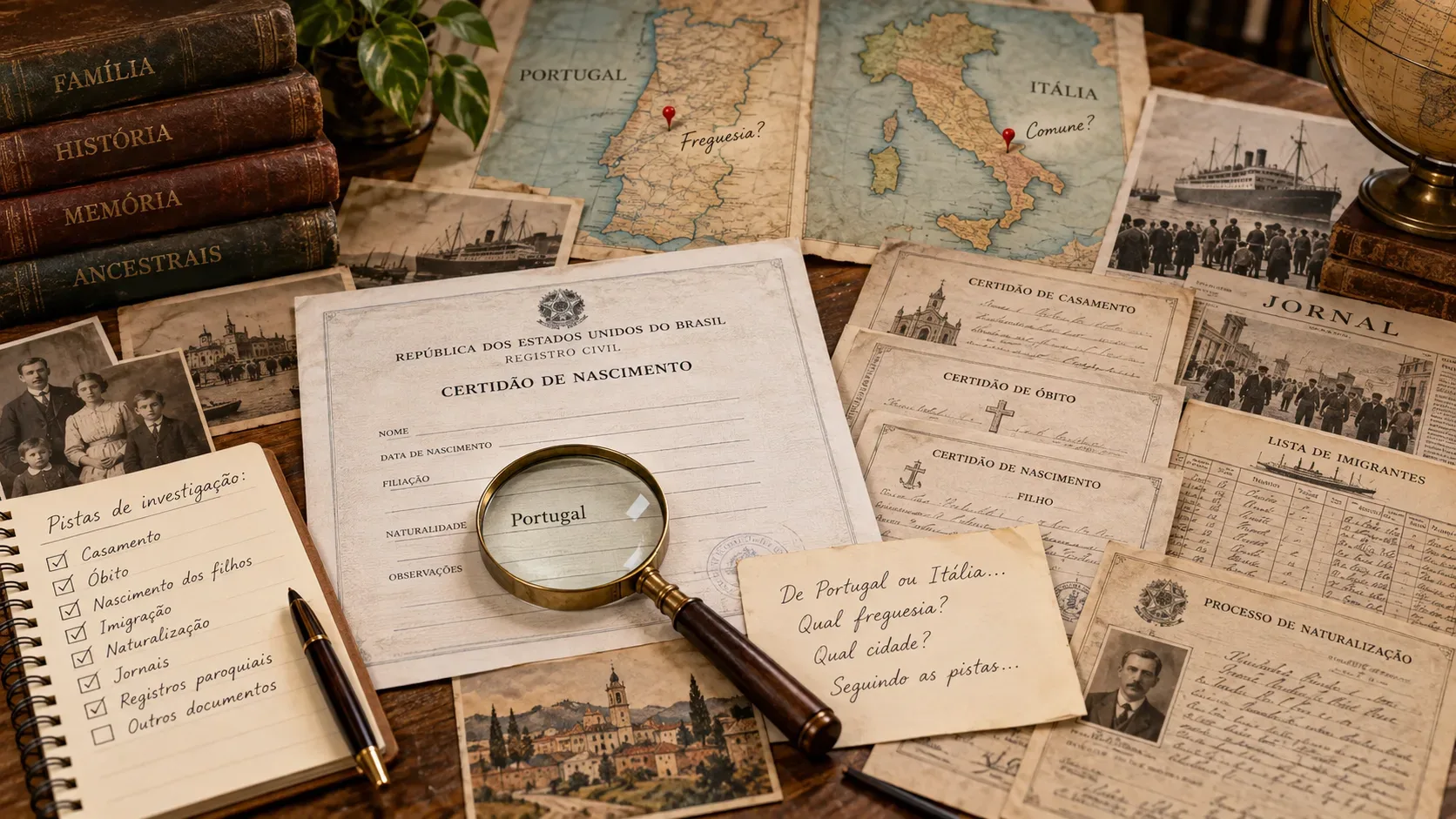
If a Brazilian certificate says only “Portugal” or “Italy,” you still do not have a precise enough place to search for a birth record in the country of origin. The efficient approach is not to search thousands of parishes or comuni at random, but to build a chain of evidence in Brazil until a town, parish, municipality, province, district or another testable place appears.
In practice, the sequence that usually reduces dead ends is: the immigrant’s marriage and death records, records of the children, naturalization and foreigner-registration files, immigration sources, newspapers, and only then Portuguese or Italian archives. At every step, record the spelling exactly as it appears, the document date, who supplied the information and how strong the clue is.
Why “born in Portugal” or “born in Italy” is still too broad
Portugal and Italy are starting points, not practical search localities. To reach a birth or baptism record, you normally need to narrow the search to a local administrative or ecclesiastical unit. In Portugal, that may mean a parish (freguesia) and municipality (concelho); in Italy, a comune and its provincial context. Place names may also have changed, been absorbed into other municipalities or appear under historical spellings.
Do not treat the first town name you find as an automatic answer. The same name can refer to different places, a transcription may be wrong, and an informant may have known only the broader region. The goal is to turn a single clue into a geographic hypothesis supported by more than one record.
1. Start with civil records created in Brazil
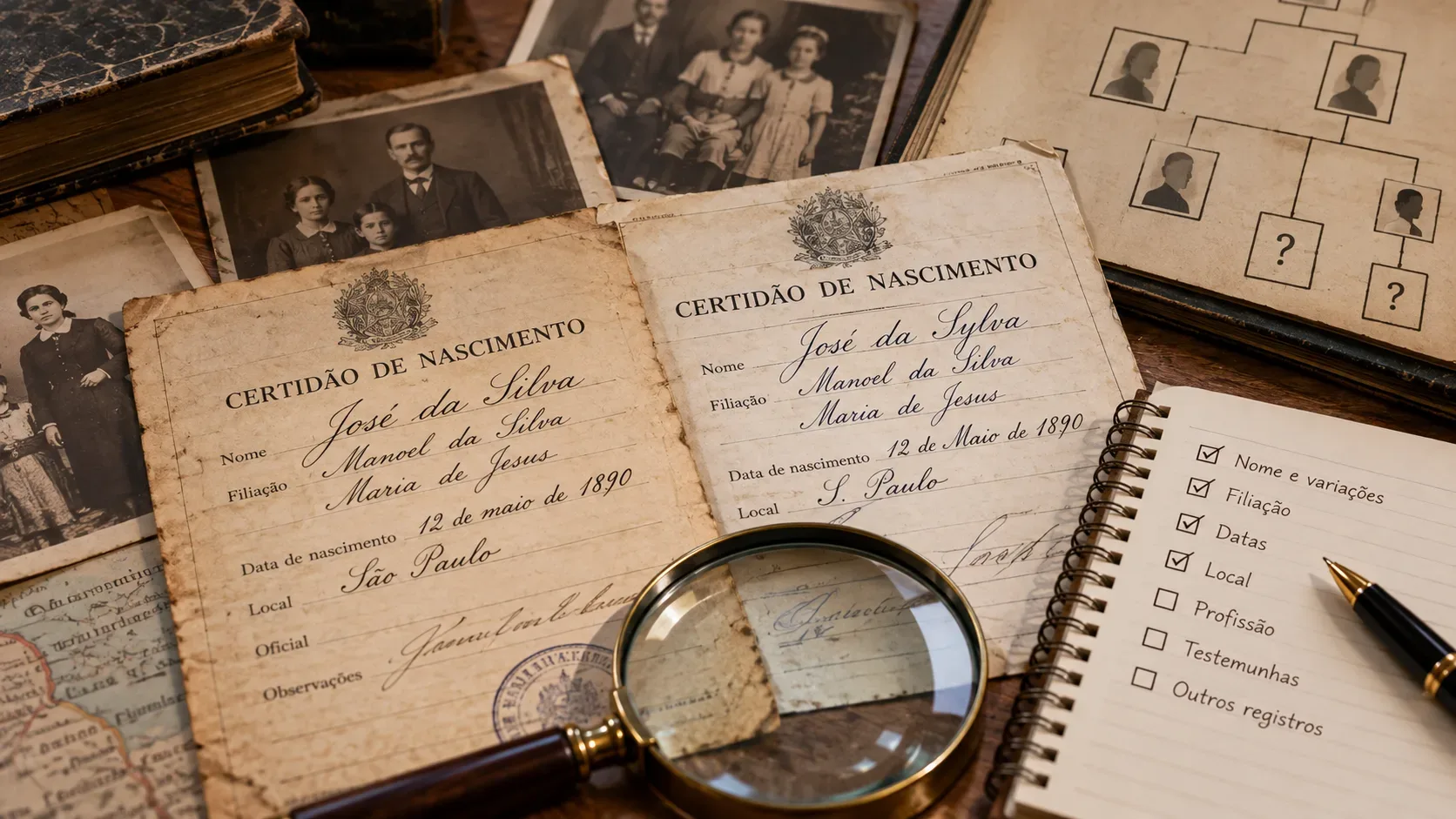
Family civil records are the first layer because they were created around major events in the ancestor’s life. Content varies by period, registry office and record type, but historical collections show that marriage, birth and death records can include birthplace, parentage, residence and parents’ origins. In FamilySearch collections of Brazilian civil registration, for example, marriage descriptions may include birthplaces of the bride, groom or their parents, while death records may include nationality and origin. See one example of possible fields in Brazil, Rio de Janeiro, Civil Registration.
| Record | What to extract | How to evaluate it |
|---|---|---|
| Immigrant’s marriage | Birthplace, parents’ names, age, residence, witnesses | A strong clue when the ancestor took part in the event, but verify the original image whenever possible. |
| Immigrant’s death | Origin, nationality, parentage, spouse, age | The informant may have been someone else; treat the locality as a clue that needs confirmation. |
| Children’s births | Parents’ origins, grandparents’ names, residence | Compare several children: a detail missing from one record may appear in another. |
| Children’s marriages and deaths | Parents’ origins, alternate surname spellings, grandparents | Useful collateral sources when the immigrant’s own records are sparse or hard to locate. |
Do not rely only on a typed index. When an image of the record book exists, read the entire entry and check margins, descriptive phrases, witnesses and annotations. An index can simplify a locality, modernize a spelling or omit information present in the image.
2. Look for naturalization and foreigner-registration files
If civil records do not resolve the locality, move to administrative records about the immigrant. Brazil’s National Archives says its holdings on foreigners include passenger-arrival lists, foreigner-registration files, naturalization proceedings and other record groups. It also explains that a naturalization proceeding is the set of documents submitted for a request for Brazilian citizenship and that naturalization was not compulsory.
That makes this source a possibility, not a guarantee. A file may contain parentage, dates, declarations and attachments that help distinguish people with the same name or narrow the place of origin, but the contents vary. For naturalization proceedings and foreigner files, the National Archives recommends supplying data such as the person’s full name, parentage and, when possible, birth or death date.
On its Foreigners’ Entry page, the institution also describes immigration and hostel records. Record every identifier you find — case number, ship, arrival date, port or registration number — because these connect separate sources.
3. Use immigration records to build family context, not to expect a town on every passenger list
Passenger lists and immigrant-hostel registers are valuable for confirming arrival, approximate age, family group, ship and nationality. But the Brazilian National Archives notes that place of birth appears only rarely on arrival lists. A list may therefore confirm that you have the right person without solving the birthplace.
The Immigration Museum of the State of São Paulo provides digitized registration books, passenger lists, call letters, applications and newspapers. Registration books can be searched by surname and include data such as arrival date, age, nationality and relationship. Those fields help identify relatives who travelled together and can then be searched in civil records and newspapers.
This is often decisive: the main ancestor’s record may say only “Italian,” while a sibling’s marriage, a child’s certificate or a newspaper item names a more specific locality. Researching the family as a group is often more productive than repeatedly searching one person.
4. Search newspapers with multiple spellings
The Brazilian National Library’s Digital Newspaper Library allows searches across periodicals by words, time period and place. Newspapers may contain marriage and death notices, immigrant-association news, business notices, tributes and community reports that mention someone as “native of” or connect a family with a specific locality.
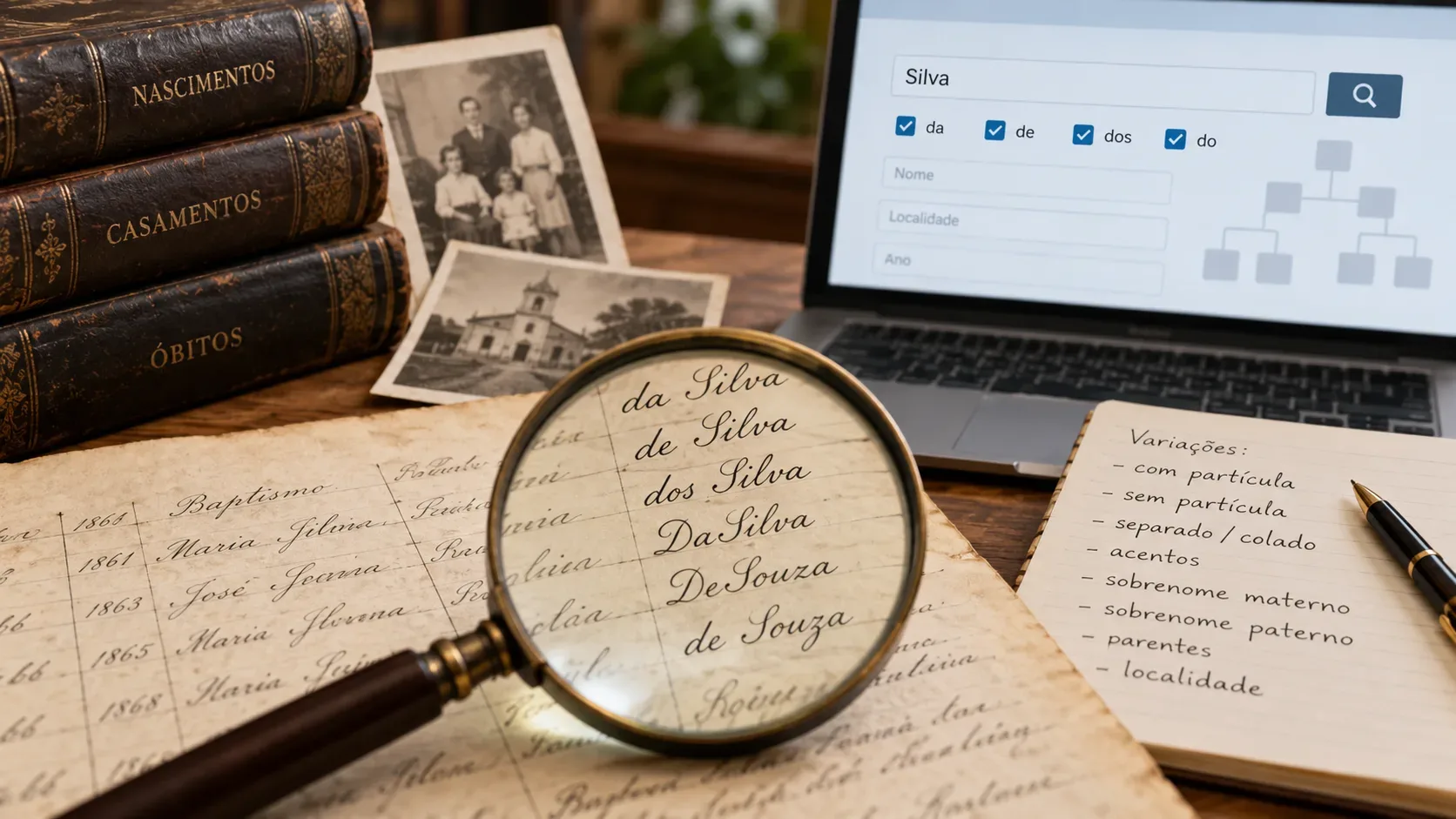
Search variants. Portuguese and Italian surnames may have been adapted, abbreviated, split or joined in Brazil; given names may alternate between the original form and a Brazilian form. OCR on old newspapers also makes mistakes, so try the surname alone, a spouse’s name, occupation, neighborhood, ship name and combinations of relatives.
5. Build an evidence log before choosing a locality
Do not normalize information too early. First record what the document actually says; put your interpretation in a separate field. A simple structure prevents a hypothesis from becoming “fact” through repetition:
| Field | What to record |
|---|---|
| Source | Marriage, book and page; naturalization case; newspaper; passenger list |
| Exact spelling | Copy the name and locality exactly as written |
| Document date | Helps compare proximity to the event and possible administrative changes |
| Informant | The immigrant, spouse, child, third party or clerk |
| Place cited | Country, region, province, district, municipality, parish, comune |
| Interpretation | Possible modern form without erasing the original spelling |
| Confidence | High, medium or low, with a short reason |
When two independent sources converge on the same locality — or one particularly strong source fits the rest of the identity evidence — you have a hypothesis worth testing. If sources conflict, do not simply pick the most convenient version; find another record that can explain the difference.
6. Only then open Portuguese or Italian archives
If the clue points to Portugal
Once you have a parish, municipality or at least a district and an approximate time period, the search becomes much more controlled. Portugal’s Digitarq network provides descriptions and images from archival collections, including parish series of baptisms, marriages and deaths organized by parish in district archives. Use the candidate locality, year range and parents’ names to test whether a record belongs to the same family.
If the clue points to Italy
In Italy, the Ministry of Culture’s Portale Antenati provides civil-registration records searchable by locality, year and record type, including births, marriages and deaths. It also identifies the State Archive holding the series. If a locality changed name, became a hamlet of another municipality or belongs to a historical administrative arrangement, preserve that relationship instead of searching only the modern name.
How to decide whether you have the right parish or town
A matching name alone is not enough. Before calling an origin confirmed, compare a cluster of identifiers: full name, parents’ names, approximate birth year, spouse, occupation when available, siblings or associated relatives, and the migration chronology. The more common the name, the stronger the identity test should be.
Keep two questions separate: “Is this the locality named in the Brazilian evidence?” and “Does this European record belong to my ancestor?”. The first is a geographic question; the second is an identity question. You can identify the correct town and still attach the wrong person if you do not compare parentage, dates and family links.
A practical sequence that avoids wasted effort
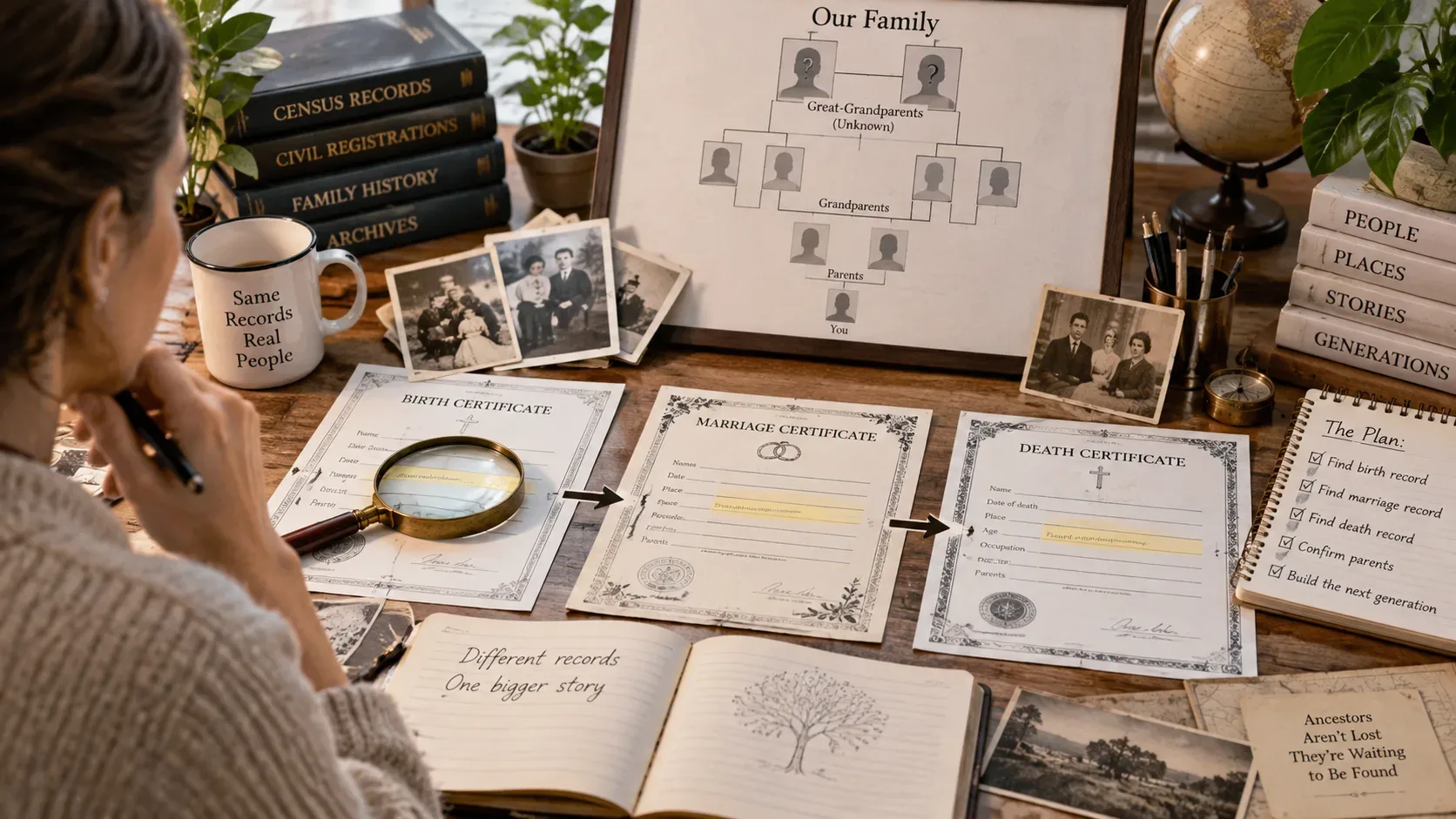
- Collect the immigrant’s marriage and death records and copy the birthplace wording exactly.
- Check birth, marriage and death records for several children, not just one.
- Search naturalization and foreigner-registration files using name, parentage and approximate dates.
- Use immigration and hostel records to confirm family group, arrival and relationships.
- Search newspapers with alternate spellings and relatives’ names.
- Build the evidence table and mark contradictions.
- Once a testable locality appears, search Portuguese or Italian records by place, period and parentage.
- Confirm identity by comparing parents, age, spouse and chronology before concluding.
Common mistakes that slow the research down
- Starting with a surname across the whole country: a surname does not prove a parish or comune.
- Trusting an unsourced public tree: use it as a clue, not as proof.
- Ignoring siblings and children: close relatives may preserve the geographic detail missing from the main ancestor’s records.
- Treating a port of departure as a birthplace: those are different facts.
- Rejecting spelling differences: language changes, abbreviations and clerical errors are common in historical documents.
- Accepting an index without checking the image: whenever the original is digitized, compare the transcription with the document.
The goal is a chain of evidence, not a convincing guess
When a certificate says only “Portugal” or “Italy,” the answer rarely comes from one lucky search. Progress comes from narrowing the problem in layers: identify the family securely in Brazil, find a specific geographic clue, compare independent sources and only then test the locality in the country-of-origin records.
This is slower than choosing a town because a surname looks common there, but it avoids the most expensive genealogical error: building multiple generations on the wrong person.