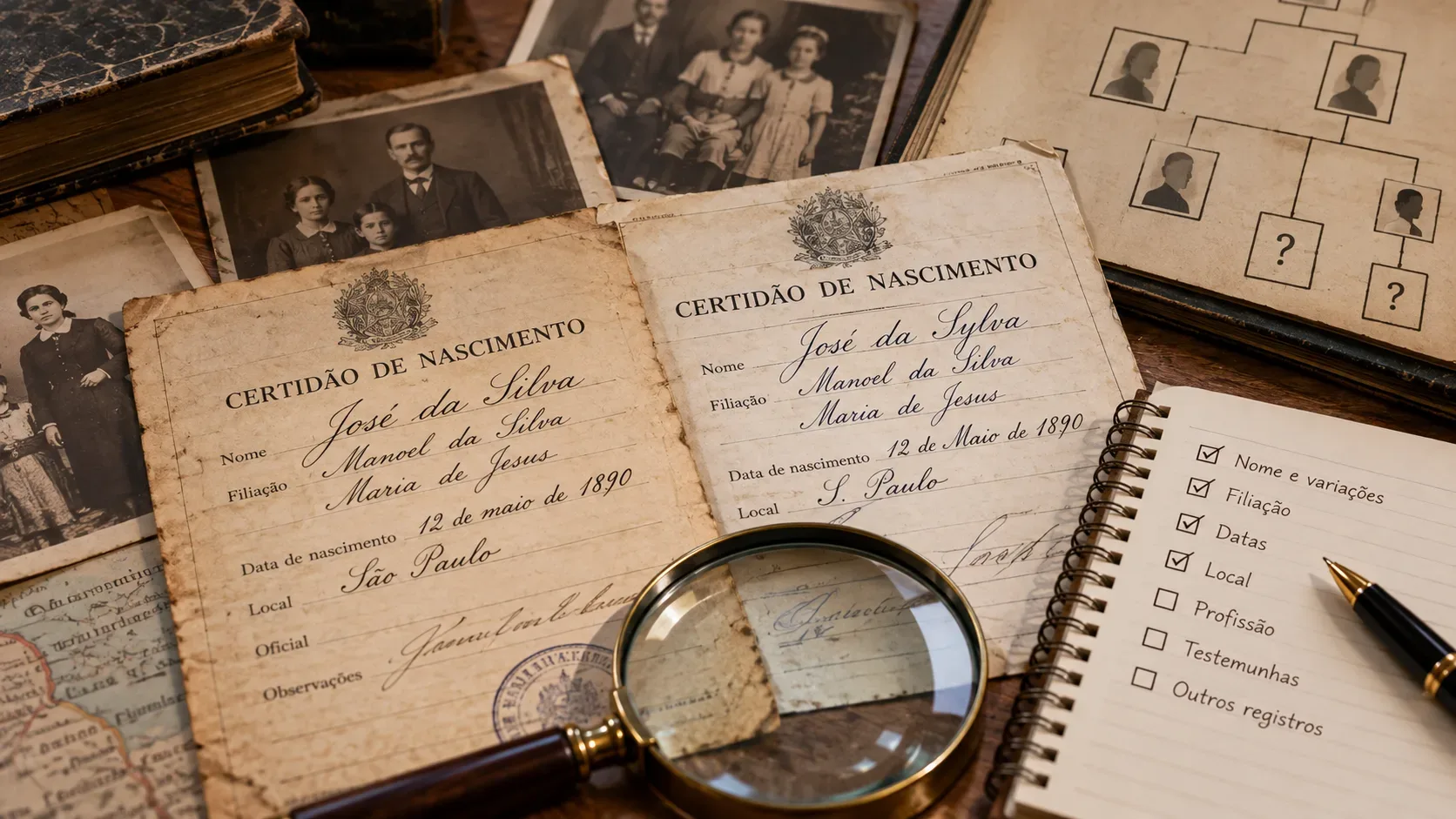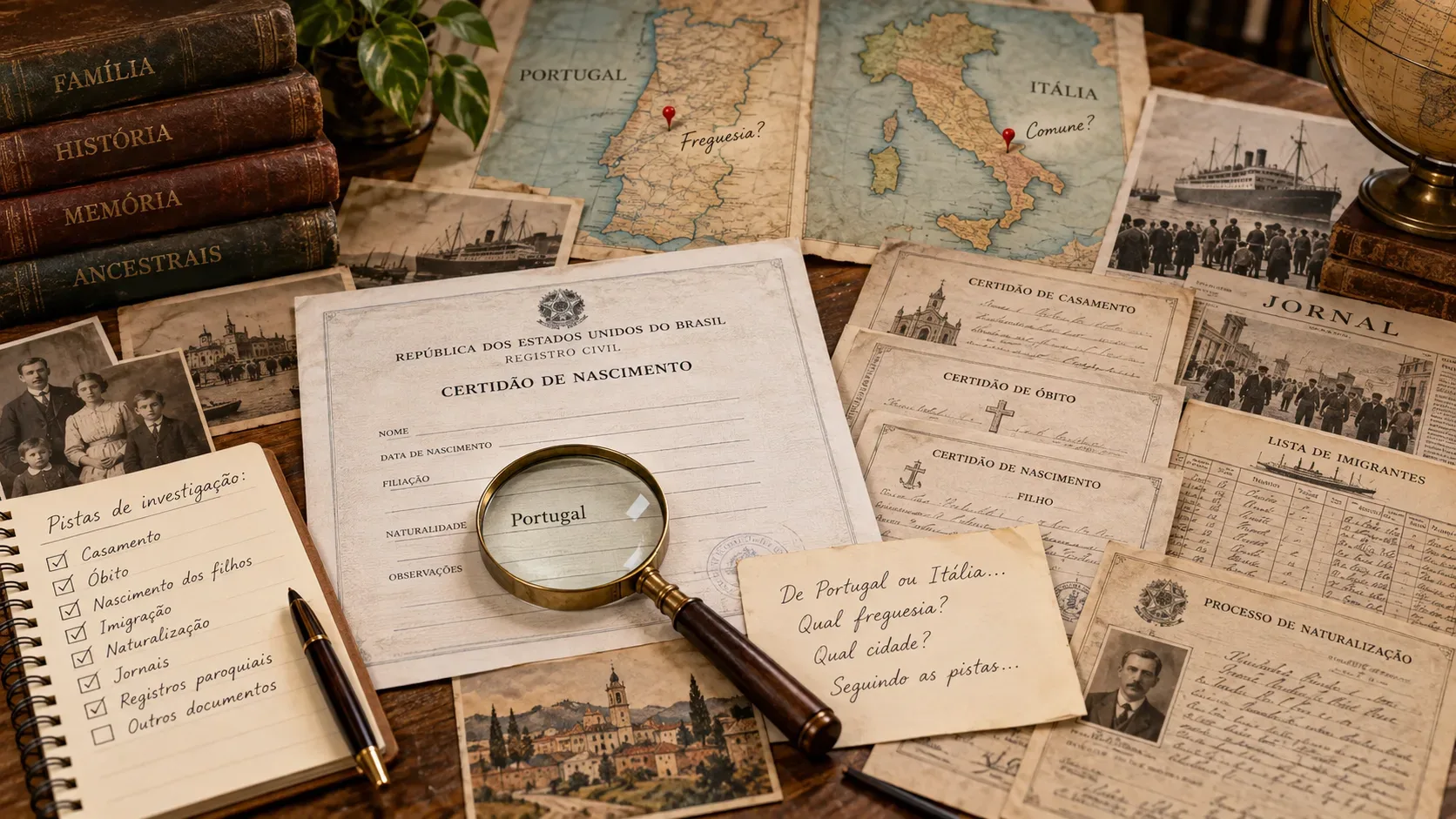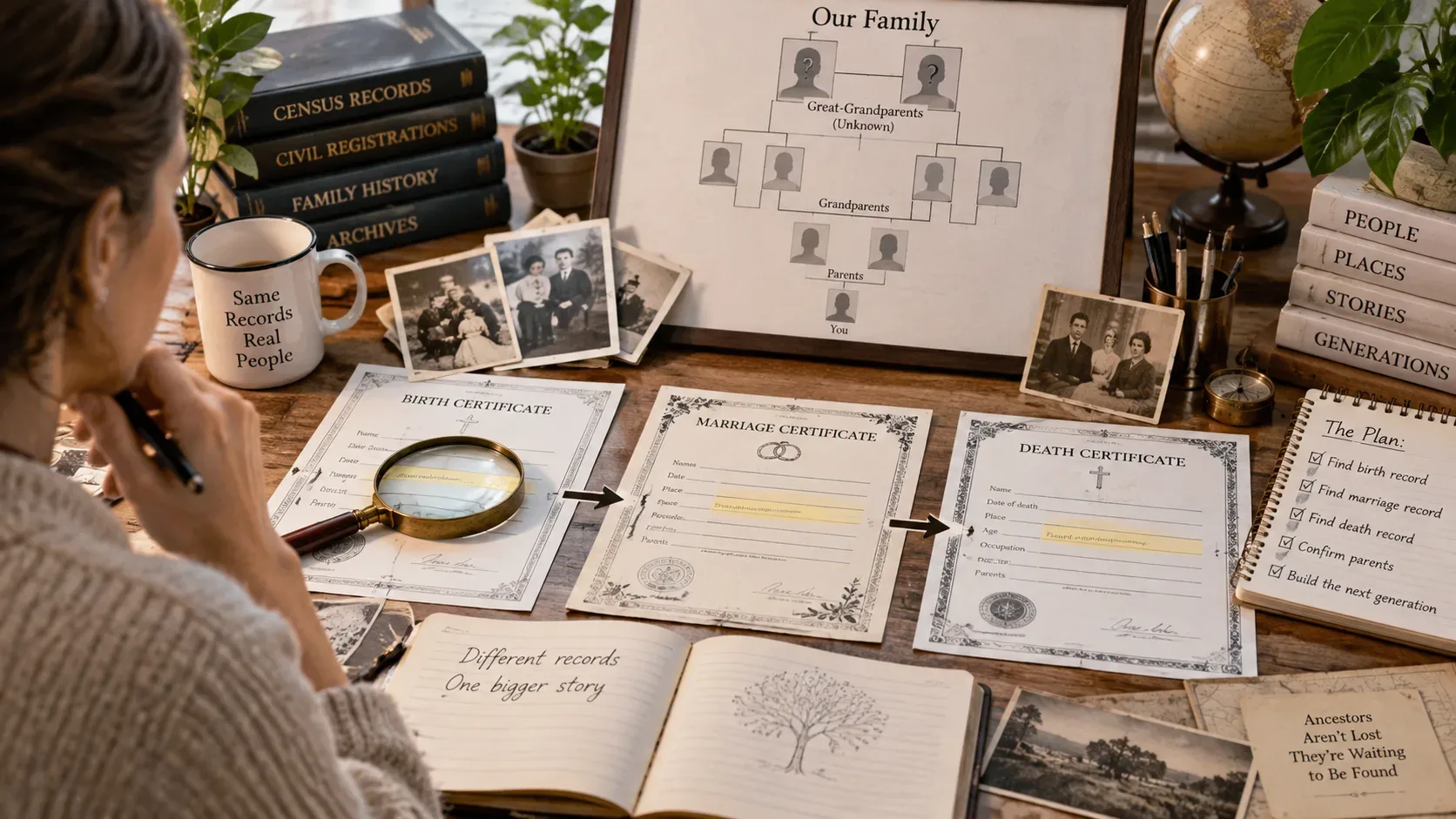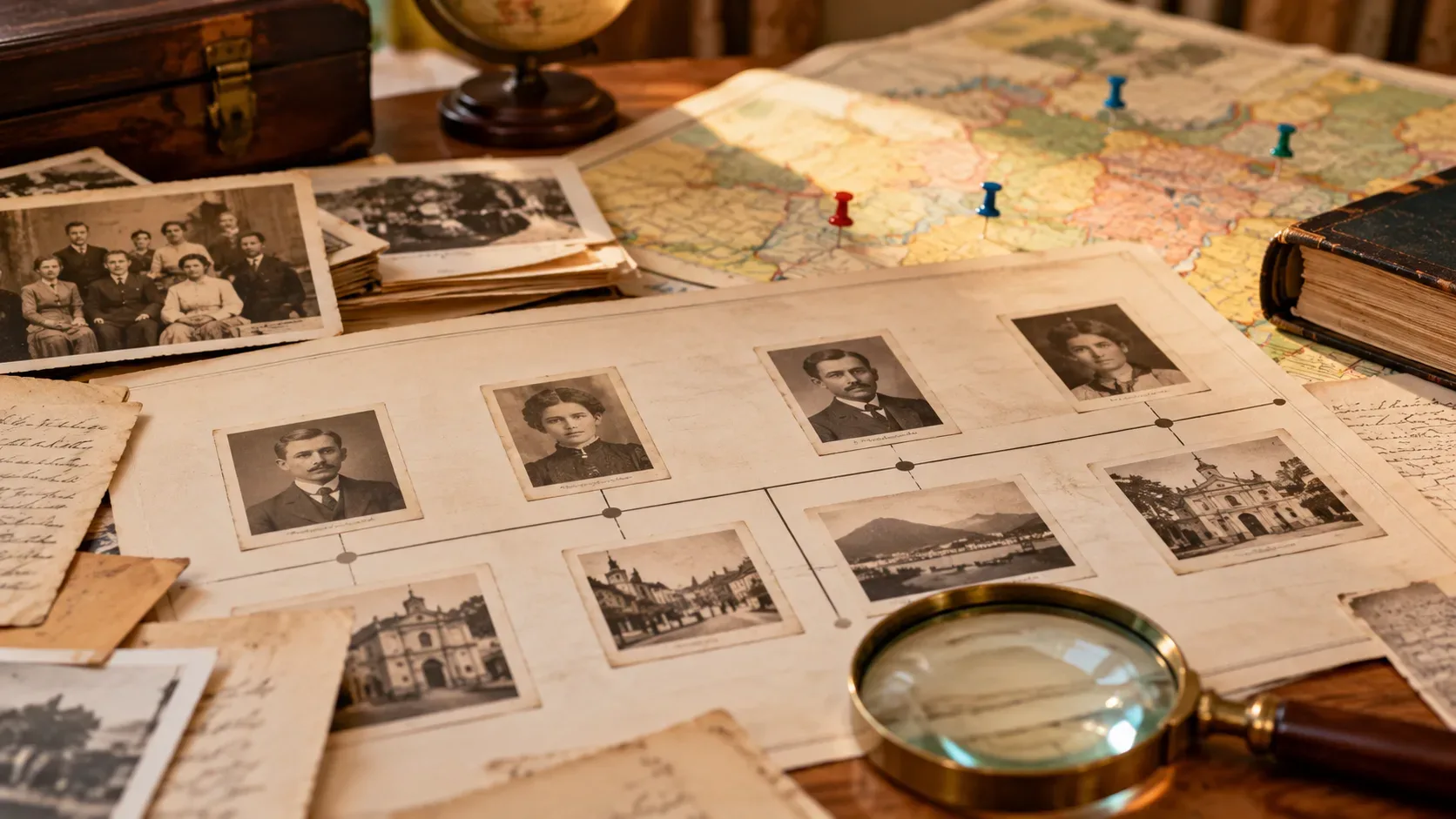
To organize a timeline of ancestors documented in different towns or cities, record each event separately, including its date, place, named person, and source. Sort the events, compare identity clues, and keep any unproven connection between records as a hypothesis. A coherent chronology helps guide research, but it does not, by itself, prove that two names refer to the same person or that two people are related.
Start with records, not an assumed family tree
Gather available civil certificates, parish entries, marriage and death records, censuses, immigration documents, probate records, and other material. Whenever possible, work from the complete record image: indexes and transcriptions help you find entries but can omit details or introduce errors. Preserve the original file and note where the record was found.
Extract four groups of information: names, dates, places, and explicitly stated relationships. The US National Archives recommends using these elements in genealogical research and moving from the known to the unknown. Do not fill in missing surnames, parentage, or dates just to close gaps.
Use one row per event and keep the source beside the information
Your working unit is the documented event, not a finished biography. One record can yield several rows: a marriage entry documents the ceremony, but may also mention residence, birthplace, age, and parents’ names. Distinguish the event date from the date an entry was made, registered, issued, or copied.
| Field | What to record |
|---|---|
| Identifier | Your own code for the event and the document, such as E01 and D01. |
| Named person | Name exactly as written; note variants in a separate field. |
| Event and date | Birth, baptism, marriage, residence, death, etc.; specify an exact date, range, or approximation. |
| Place | The location as written in the record and, separately, its identified present-day location. |
| Source | Archive or registry office, collection, volume, folio, entry number, image or URL, and access date where relevant. |
| Reading and status | Faithful transcription or summary, uncertain reading, discrepancy, and as-yet unconfirmed hypothesis. |
Fictional organizational example, without assigning kinship: an 1898 marriage record in Town A mentions “Maria de Souza,” born in Town B; a 1930 death record in Town C mentions “Maria Souza.” Enter them as separate events. A matching name and a geographically plausible route warrant comparison, not merging identities.
Reconcile towns and dates without erasing historical geography
Record the municipality, parish, district, and jurisdiction as they appeared in the source. In a separate field, add the confirmed present-day identification, if available. Changes in place names, administrative boundaries, and spelling can make one place appear under different names; similarly named places also require care. Do not automatically equate birthplace with residence or the place of registration with the place where an event occurred.
Use a chronological sequence and, if useful, a parallel track for each town. Show moves only when supported by records; between an event in Town A and one in Town B, write “possible move, date unknown” instead of inventing a journey or address. If only a year is known, do not assign a day or month.
Test identity before linking records
Compare independent clusters of clues: name and variants, age or age range, occupation, spouse, named parents, children, witnesses, address, and sequence of places. One matching detail is rarely enough, particularly with common names. FamilySearch recommends checking vital information and sources before merging apparently duplicate profiles.
- Consistency: ages, relationships, and dates should not create unexplained contradictions.
- Documentary link: seek records explicitly identifying a spouse, parent, or child; attribute any statement of kinship to its source.
- Corroboration: find another relevant source, preferably created in a different context, to test the hypothesis.
- Alternatives: consider namesakes and distinct families before concluding that there is only one person.
Even a record naming parents can contain an informant’s error or a transcription error. The genealogical proof standard described by the National Genealogical Society combines reasonably exhaustive research, complete citations, correlation of evidence, conflict resolution, and a reasoned written conclusion. Do not turn a hypothesis into a fact just because it simplifies the family-tree diagram.
When two records disagree
Keep both values with their respective sources. Compare who supplied the information, when the record was created, whether the informant had first-hand knowledge, and whether you have the original image or only an index. An age reported on a death record may be less precise than a birth date recorded close to the event, but assess each case individually; no record type is infallible.
In the timeline, use notes such as “birth year: 1870 according to D01; 1872 according to D04; discrepancy unresolved.” If a conflict prevents identification, keep the records under separate candidate identities until more evidence emerges. Failure to find a record does not, on its own, establish that an event never occurred.
How to cite and preserve material for later checking
Note the holding institution, collection, catalogue reference, volume and page or entry, plus an image identifier or URL when available. The UK National Archives guidance emphasizes that precise references allow others to locate and verify a record. Keep a legible copy, give the file a stable code, and link it to the relevant timeline row; do not rely solely on links that may change.
When completing a working version, distinguish documented event, probable interpretation, and open question. The timeline should reveal what is known and guide the next search. Include kinship links in a family tree only when supported by examined evidence, and make uncertainties explicit.