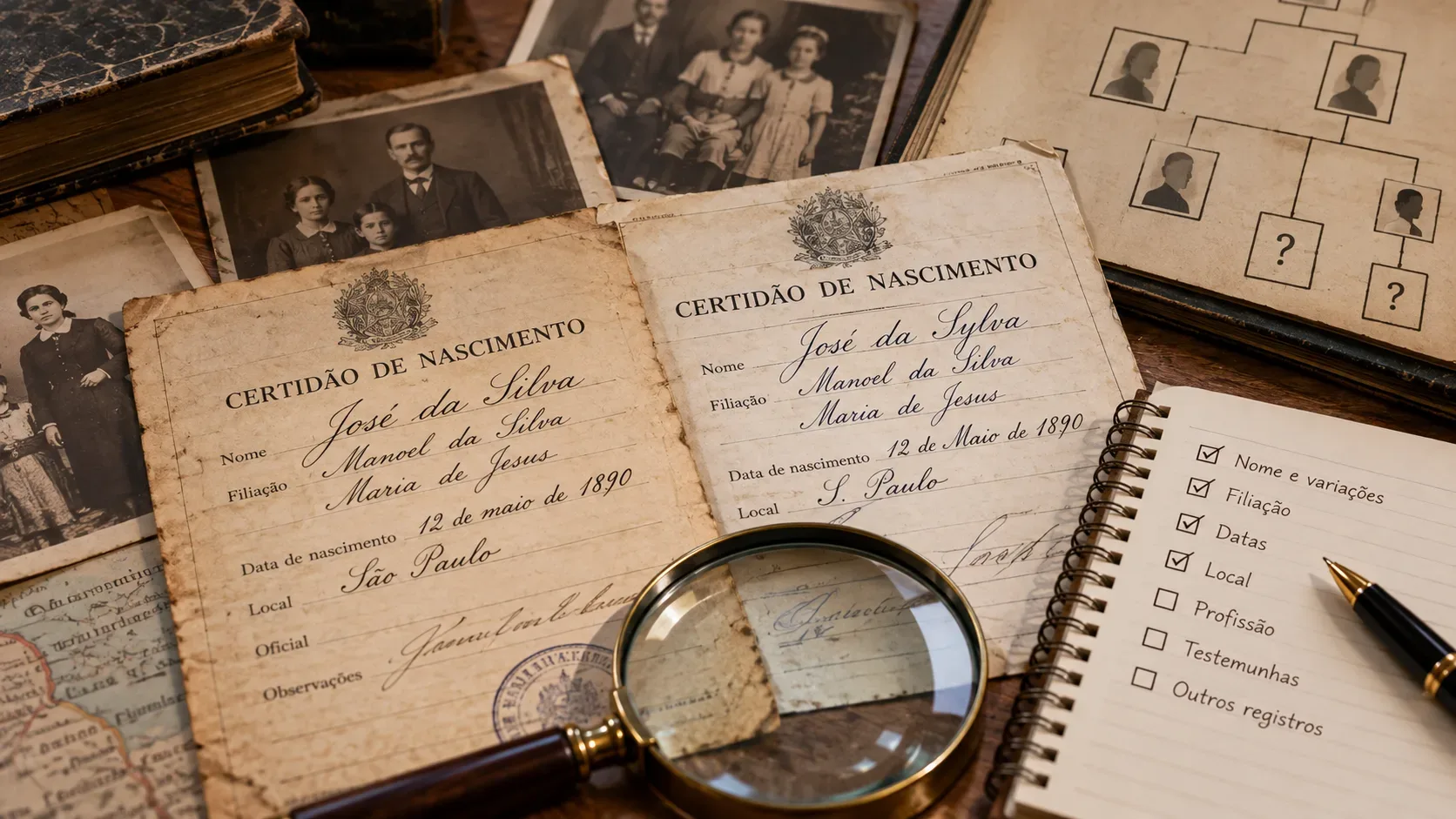
Certificates from the same family can disagree on name spelling, age, place of birth, and important dates. This does not automatically mean that the documents refer to different people, but it also does not justify assuming they refer to the same person. The safest method is to compare a body of evidence, assess each source, and explain the discrepancies.
Start with identity, not spelling
Form a clear hypothesis: were records A, B, and C created about the same individual? Then look for information that strengthens or weakens it. Compare names, parents, spouse, residence, occupation, relatives, witnesses, and chronological sequence.
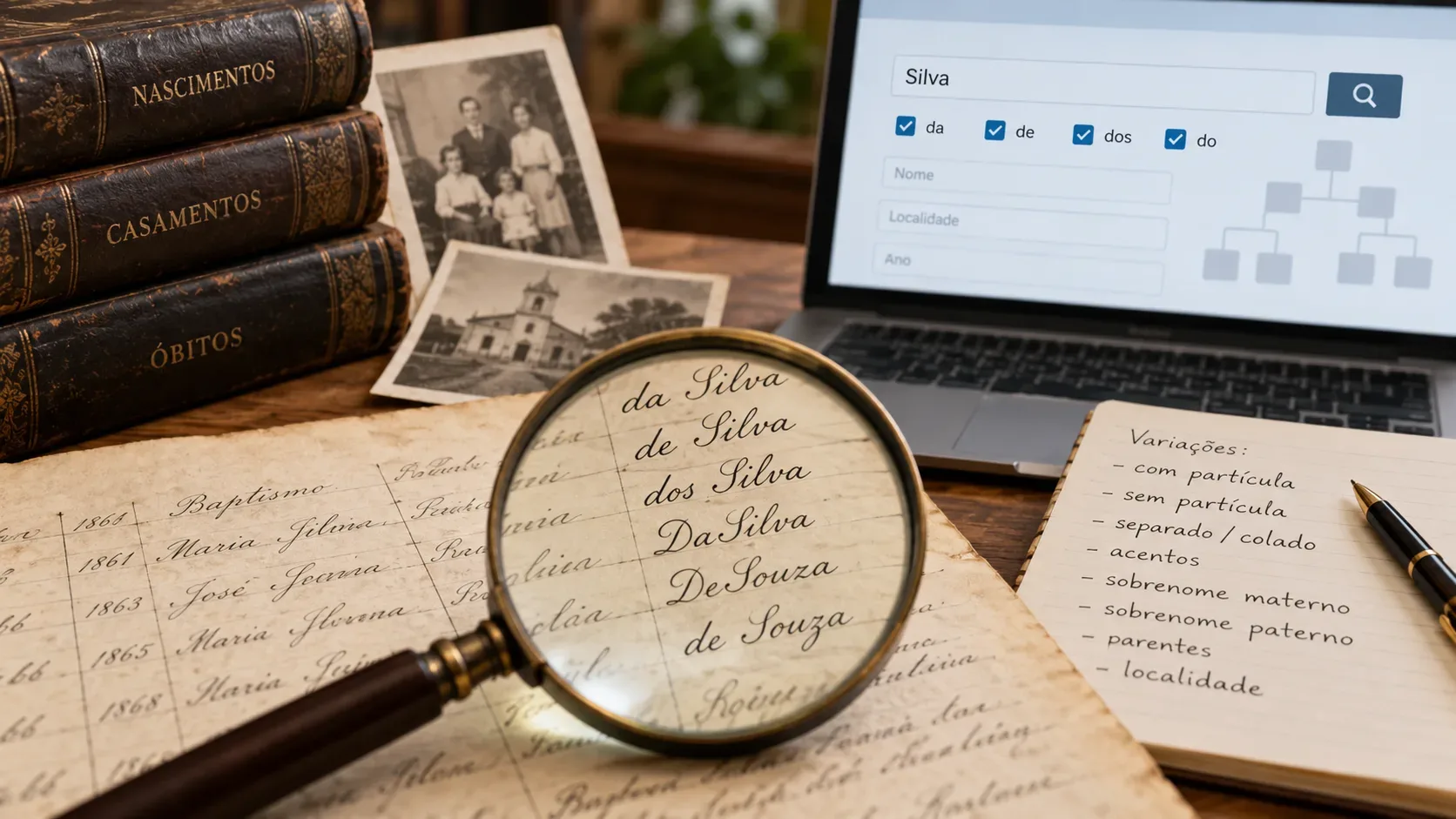
Spelling variations are common in historical research. Brazil’s National Archives states that its DocJud database standardizes names to help users who do not know the recorded spelling, while some records can also be found through the original spelling. A spelling difference alone therefore does not prove separate identities.
Build a comparison matrix
| Element | What to compare | How to interpret it |
|---|---|---|
| Name | Spelling, surnames, abbreviations, additional names | Compare with other identifiers, not in isolation |
| Parents | Parents’ names and variants | Especially useful for separating same-name individuals |
| Dates and ages | Birth, marriage, death, stated age | Calculate the implied birth year when only age is given |
| Place | Birth, residence, marriage, death, registration | Test whether the geographic path is plausible |
| Occupation | Occupations at different times | Can support identity but may change |
| Associates | Spouses, godparents, informants, neighbors, witnesses | Recurring associates can connect ambiguous records |
| Source | Record type, date, informant | Consider proximity to the event and the informant’s knowledge |
A similar name is a clue, not proof
Similar spelling can connect records, but it does not settle identity. The same applies to a matching date. Common names may belong to several people, and dates may be estimated or reported incorrectly. Look for combinations less likely to occur by chance, such as the same parents, spouse, locality, and recurring associates.
Treat conflicting dates as conflicts to explain
Record exactly what each document says. Do not change a date to make it fit another. Ask when the record was created, what event it documents, and who probably supplied the information. A birth record and a death record created decades later have different informational contexts.
Evaluate the source and the information separately
An official document does not guarantee that every statement is equally accurate. Ask where the record came from, who supplied each fact, and whether that fact directly answers the identity question.
The proof methodology presented by the National Genealogical Society emphasizes sufficiently broad research, analysis and correlation, conflict resolution, and a written conclusion. Finding an important certificate is part of the process, not necessarily the end.
Use associates and a timeline
Expand the research to spouses, children, siblings, godparents, witnesses, neighbors, and other associates. People who recur across different documents can help distinguish individuals with the same name. Build a chronology with event date, document date, place, age, relatives, and associates.
Test whether the life path is compatible. Two records attributed to one person should not place that person in incompatible contexts at the same time without additional explanation.
Seek independent sources
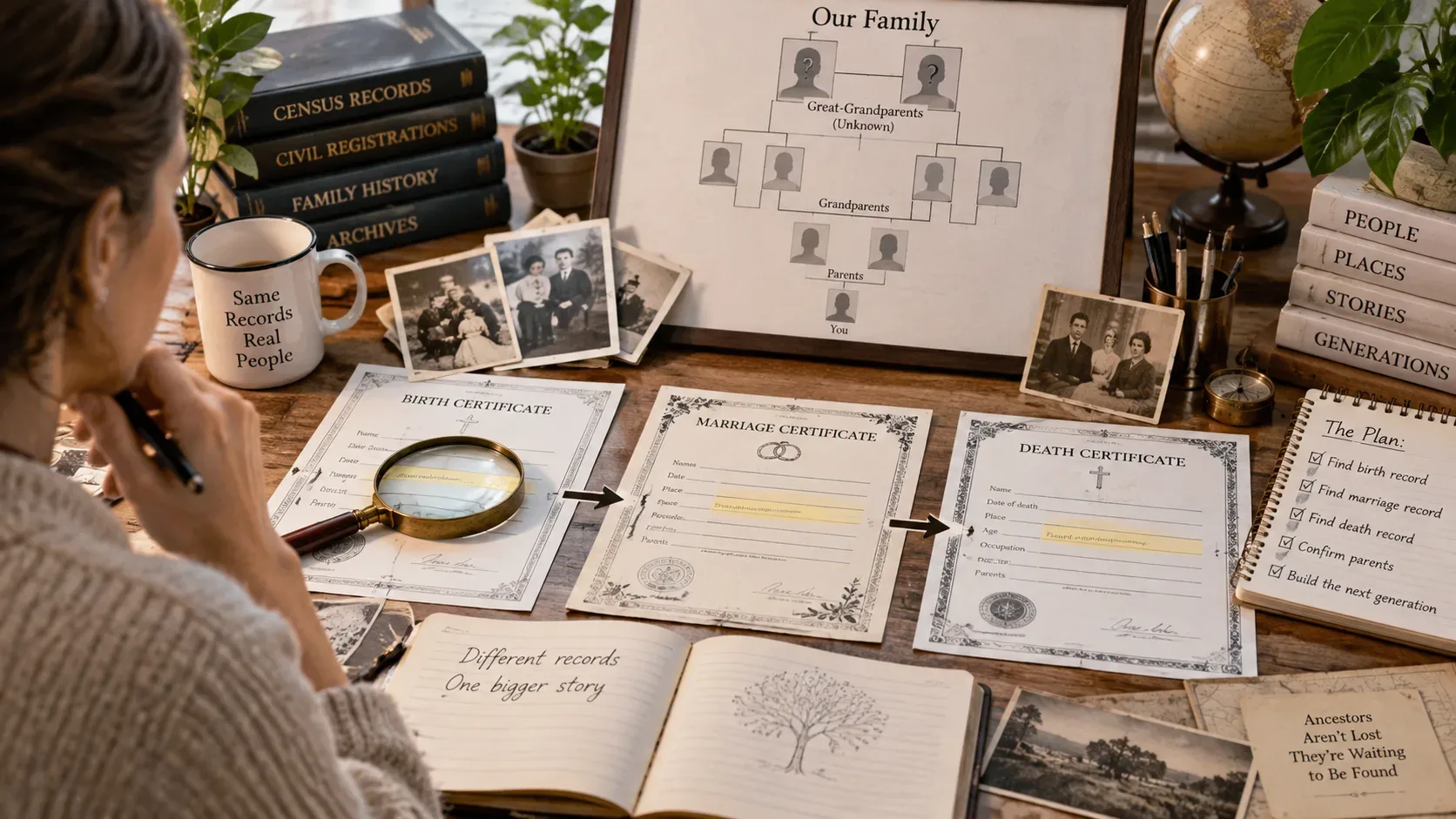
If two certificates conflict, look for a third source capable of testing the disputed point. Depending on time and place, useful sources may include marriage, death, baptism, marriage application, probate, immigration, military, notarial, newspaper, or cemetery records. The goal is not to accumulate documents but to obtain relevant evidence.
Do not hide contrary evidence
A reliable conclusion must address what does not fit. If a record names a different parent or spouse, or places the person somewhere incompatible, document the conflict and seek a source-based explanation. If the documentation cannot resolve the discrepancy, preserve the uncertainty instead of forcing a merge in the family tree.
A practical protocol
- Transcribe the data without normalizing it.
- Record the reference for every source.
- Build the matrix for names, parents, places, dates, occupations, and associates.
- Create a timeline.
- Assess who supplied each fact.
- Search independent sources.
- Explain conflicts before merging profiles.
- Write a short conclusion covering supporting evidence, contrary evidence, and remaining uncertainties.
A clue and proof are not the same thing
A clue points in a direction. A sound genealogical conclusion comes from broad research, identified sources, analysis, correlation, and reasonable resolution of conflicts. Two different spellings can belong to the same person, while two identical spellings can belong to different people.
Before merging records, preserve the original data and note why you concluded that the documents do, or do not, refer to the same individual. This makes the conclusion reviewable when new evidence appears.