The short answer is that the origin of a surname and the origin of your family are not the same thing. A dictionary can explain how a name came about; a map can show where it appears most frequently; but only a sequence of documents linked to your own family allows you to say where that branch that came to you came from.
The research becomes much safer when you separate four questions: what the surname means, where it was registered, what is the oldest occurrence that you can prove in your family and which documents connect this person to subsequent generations. Mixing these layers is the main reason for hasty conclusions like “my surname is Italian, so my family came from this city” or “there are many people with that name in a region, so we are related”.
Etymology is the history of the name, not its family tree
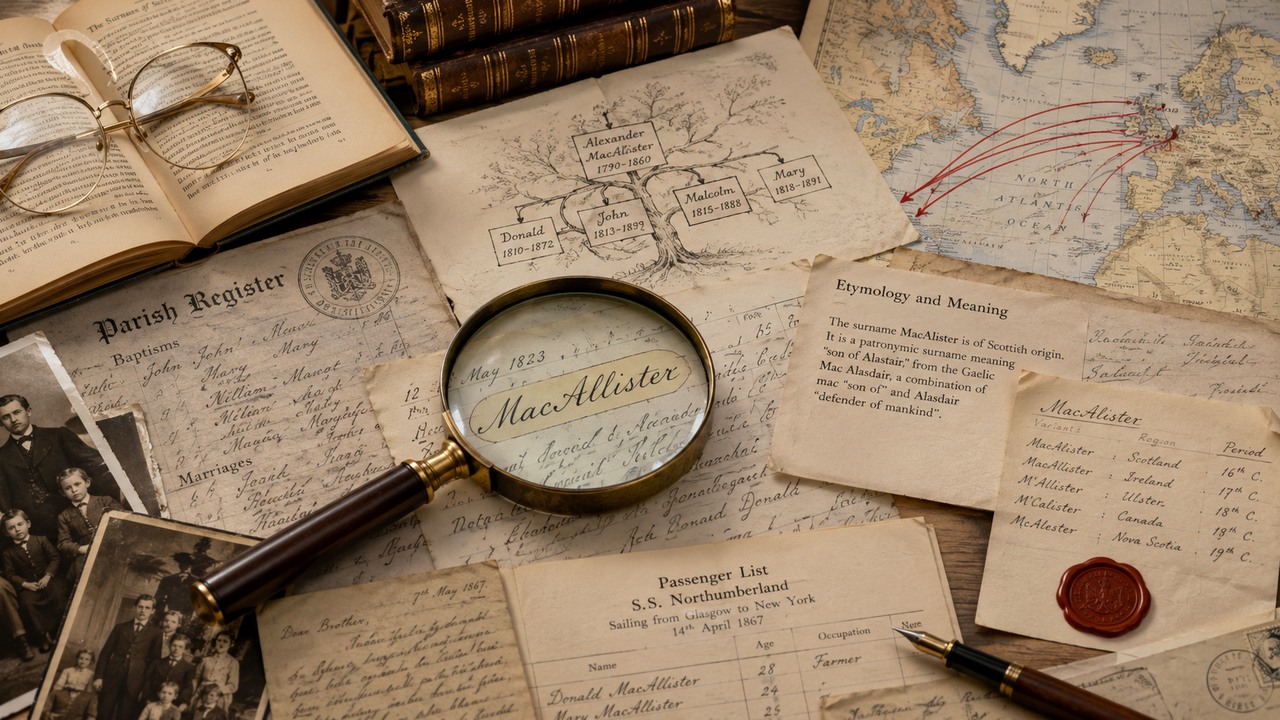
Etymology tries to explain the linguistic formation of the surname. Depending on the naming tradition, it may have arisen from a profession, a place, a first name used as a patronymic or matronymic, a nickname or another characteristic that ended up becoming hereditary.
This information is useful because it creates hypotheses. If the name has a toponymic origin, for example, you can investigate the places associated with the ancient form of the name. If it is occupational, however, it is entirely possible that unrelated families adopted equivalent surnames in different places. Even rare surnames can result from distinct roots that, with spelling changes, ended up converging into a similar current form.
Therefore, treat the meaning found in surname tools as context, not as a certificate of origin. He answers “how this name could have come about”, not “who was the first ancestor in my family to use it”.
Geographical distribution shows concentration, not relatedness
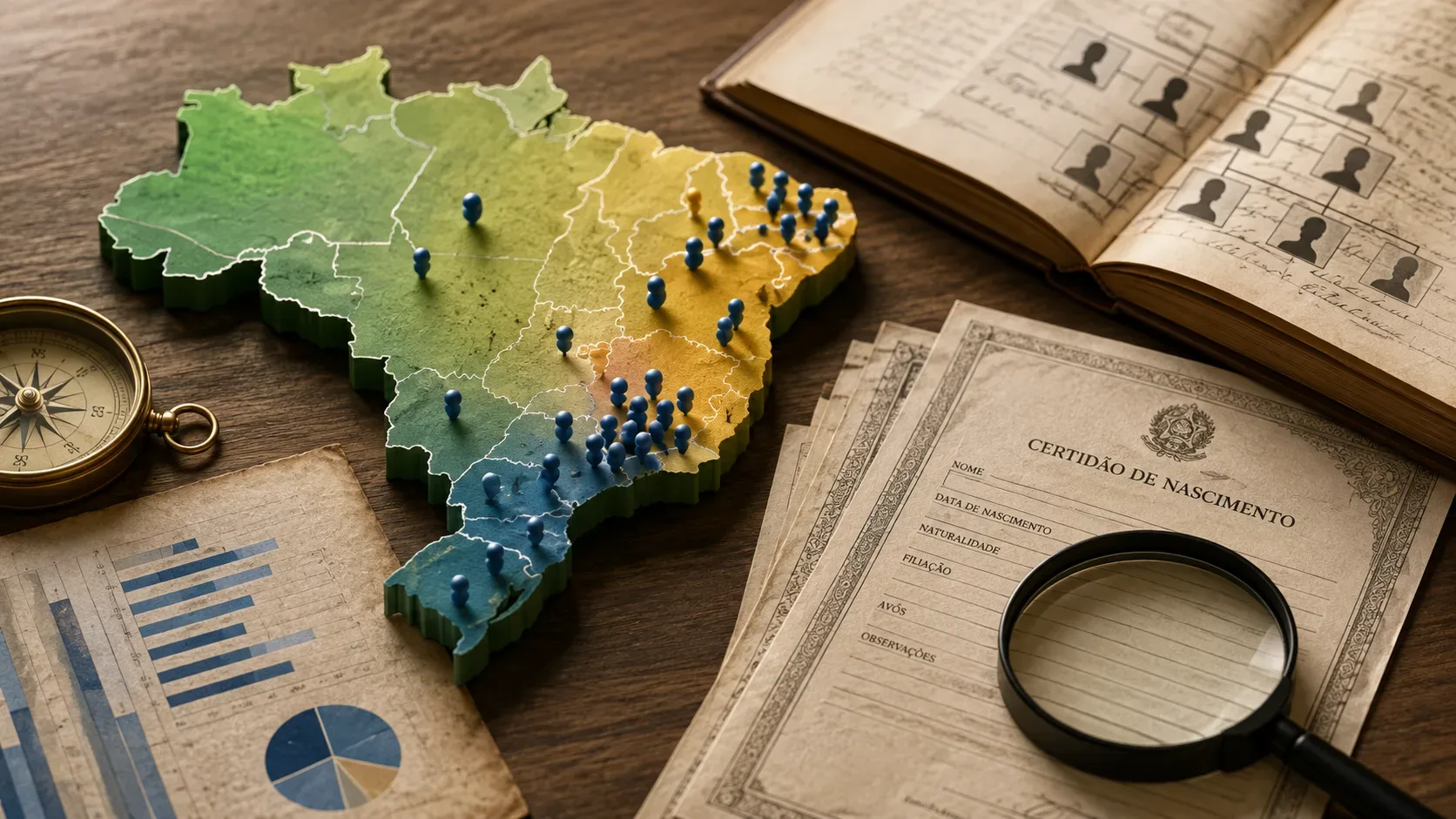
Surname maps are a second layer. Services like Geneanet and similar tools display where certain spellings appear in their databases and, in some cases, allow you to observe changes over time. This may reveal concentrations useful for directing a search.
The decisive point is understanding the source and era of the map. A current concentration may reflect recent migrations, uneven growth of certain sectors or simply the cut of the base used by the service. A historical map from another era may point to a different scenario. FamilySearch recommends looking at the time period represented because the map's usefulness depends on it being consistent with when the ancestor lived.
The best reading is: “here is a clue that deserves investigation”. The worst is: “the darkest point on the map proves where my family was born”. Maps help you choose files, parishes, municipalities and spellings to search; They do not replace the documentary connection between people.
The first occurrence in your family changes the question
Instead of looking for “the origin of the surname Silva, Rossi, Kowalski or MacAllister” in an abstract way, formulate a question about a specific person. Who is the oldest ancestor of this branch that you can safely identify? Where was he born, married, lived or died? Who were your parents, spouse and children? How does the surname appear in each document?
This change seems small, but it transforms research. Archives and historical bases were not created to answer the question “where did my surname come from”. They record people in specific events. Genealogical work consists of connecting these events by names, dates, places and family relationships.
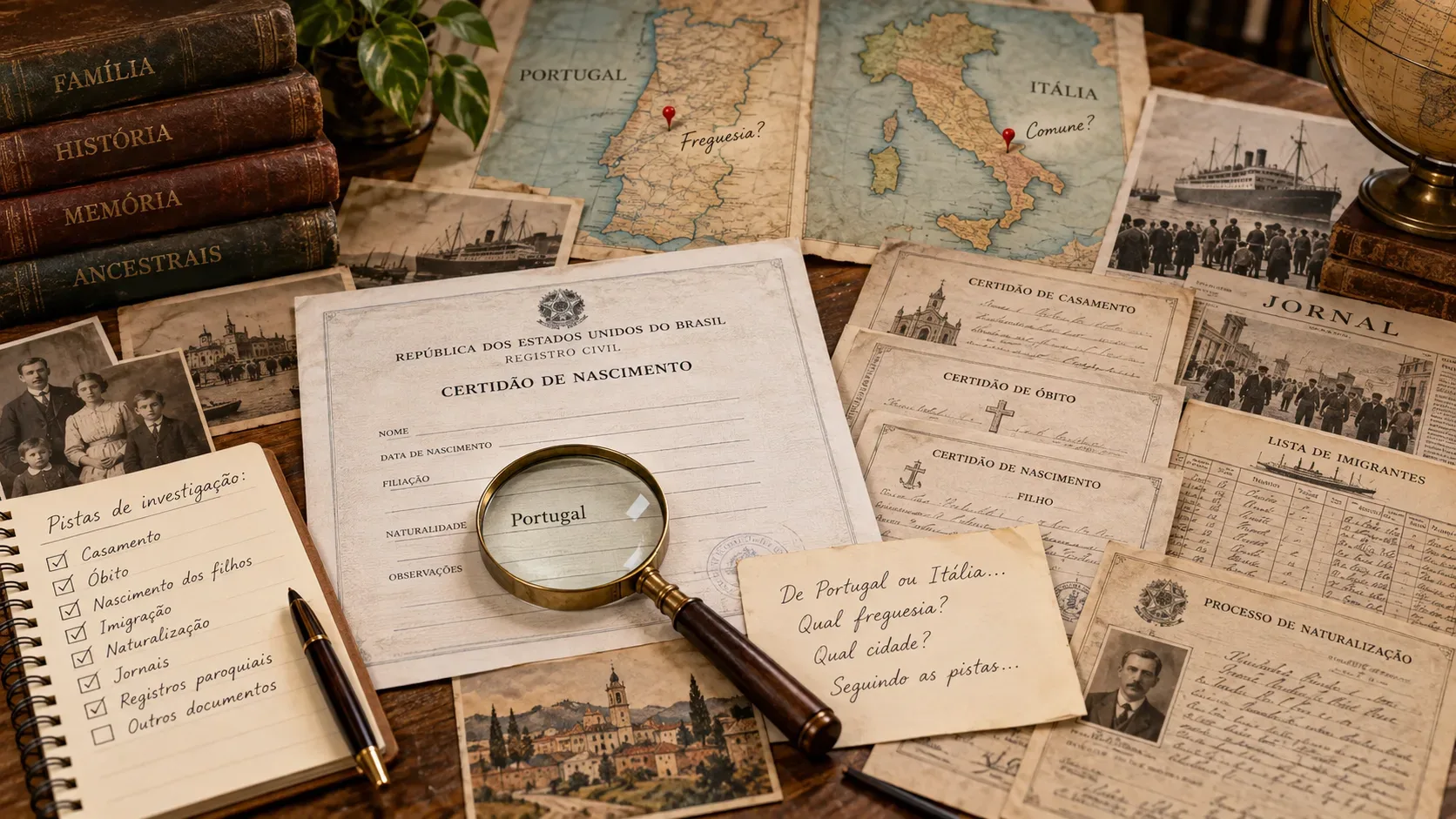
A solid practice is to start with the known and go back one generation at a time. Certificates, religious records, immigration documents, naturalization processes, military records, inventories, newspapers and other collections can provide different parts of the same identity. The oldest document you find is not automatically the first bearer of the surname; it's just the oldest hit your search has reached up to that point.
The documentary chain is what transforms hypothesis into lineage
A documented lineage does not depend on the surname remaining identical. It depends on demonstrating that the people linked in successive generations are really those that the documents indicate.
Imagine that a marriage certificate identifies a person's parents. This person's birth or baptism record can confirm these parents and add location or age. A previous record can then lead to the next generation. The value is in the correlation between sources, not a single name coincidence.
When two records conflict, don't automatically choose the one that matches your family history. Compare who provided the information, how close the record was produced to the event, whether the person could have known that data and whether other independent sources confirm one of the versions. The standard of proof used by professional genealogists emphasizes sufficiently extensive research, documentation of sources, joint analysis of evidence, resolution of conflicts, and a jointly supported conclusion.
A simple matrix to avoid mixing evidence
Etymology: serves to understand training possibilities
Use surname dictionaries, onomastic studies, and meaning tools to survey ancient forms, languages, origin categories, and competing interpretations. The strength of this evidence lies in the history of the name. Its limitation is that it does not identify, by itself, your family branch.
Distribution: used to decide where to look
Use maps and indices by period to locate concentrations and possible dispersal routes. Compare different eras and find out from which base the points were extracted. The strength is in reducing a geographic universe. The limitation is that frequency does not demonstrate kinship.
First familiar occurrence: serves to anchor the search in a person
Look for the oldest record you can safely assign to your branch, but keep the conclusion tentative. Record date, place, relatives mentioned, profession, religion when available and any details that help distinguish homonyms. The strength is in transforming a generic surname into an identifiable genealogical problem.
Documentary chain: serves to prove continuity between generations
Connect each generation to the previous one with compatible evidence and document where each piece of information came from. When there are gaps, assume there is a gap. A surname that is the same on both sides should not be used to pass without additional proof.
Variant spellings are no exception: they are part of the research
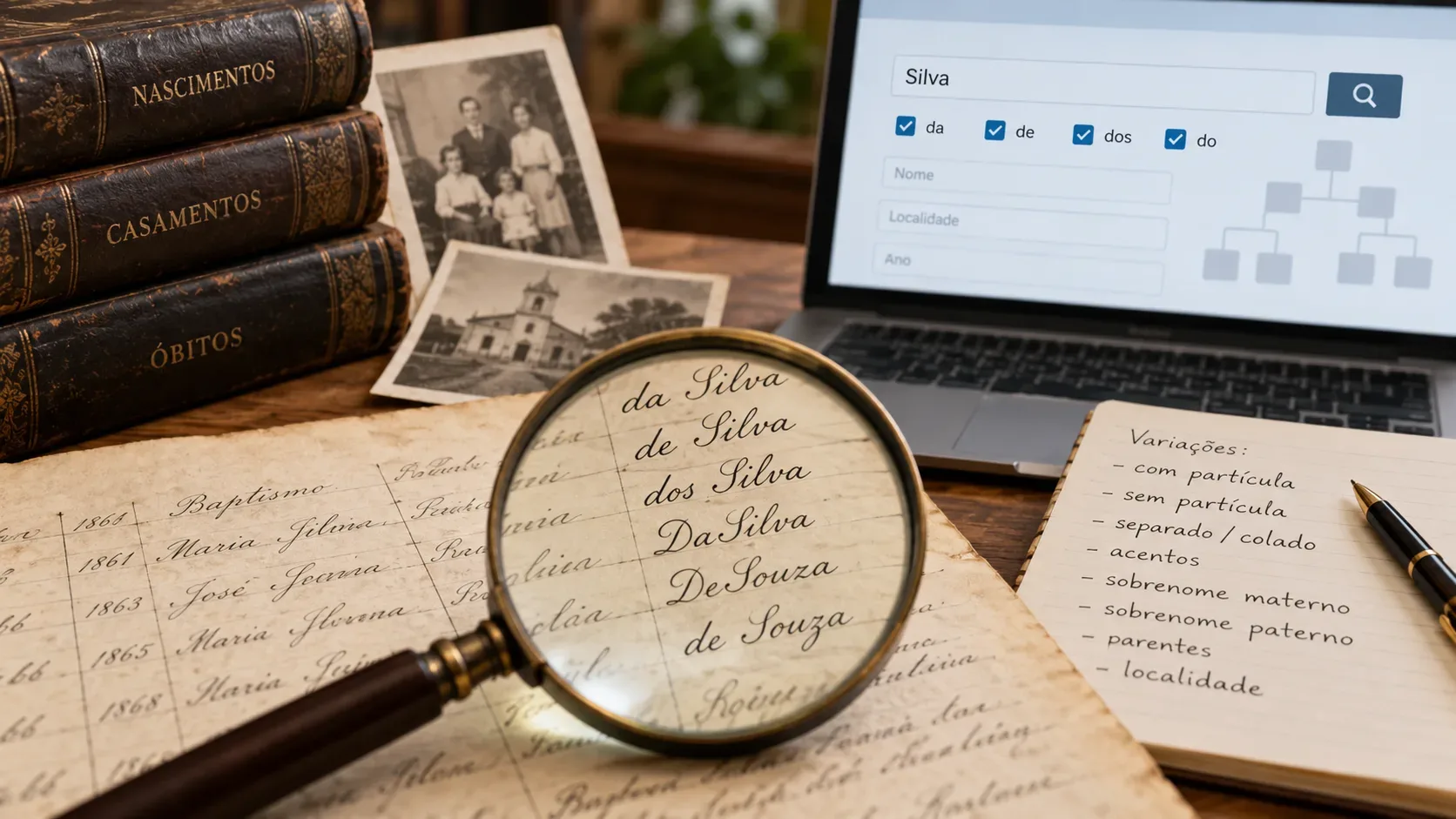
Historical research often encounters spelling changes. FamilySearch recommends testing variants, aliases, and forms used before and after a migration, and checking the image of the original document because indexes may contain transcription errors, estimates, and different spellings.
Don't normalize too soon. If an ancestor appears as De Luca in one record, Deluca in another, and Di Luca in a third, retain the form found in each source and note the variants that appear to belong to the same person. Identity must be supported by a combination of age, location, relatives, profession and chronological sequence, not just the visual similarity of the surname.
It is also worth researching how a clerk of the time could have understood the sound of the name. Language change, limited literacy, accent, abbreviation and adaptation in the destination country can produce spellings that today seem distant. An unexpected variant could be just the bridge to a previous generation.
Migration can change the surname without revealing the place of origin
If the family branch has undergone international migration, the point of arrival is usually easier to document than the point of departure. Passenger records, entry of foreigners, naturalization and registration of immigrants can inform nationality, origin, destination, relatives or other clues that allow you to return to your previous country.
In Brazil, the National Archives maintains sets related to the entry and stay of foreigners. The service reports the existence of documents from 1875 to 1987, and the entry database through the Port of Rio de Janeiro brings together information from 1875 to 1910, with fields that may include name, ship, date of entry, nationality, profession, marital status, origin and destination. This type of record can bring the
searches for a concrete location, but still needs to be linked to the correct person within your tree.
Civil records are also essential. Birth, marriage and death can provide affiliation, place of birth, age and other data capable of connecting generations. In the Brazilian case, part of the historical civil records preserved by the National Archives was digitized in cooperation with FamilySearch, which shows how a search initiated in a surname tool can advance to documents of specific people.
What to do when two origins seem equally plausible
Contradictory results are normal. One site might attribute the surname to one place, another to a different linguistic root, while your family documents point to a third region. This doesn't require picking a winner right away.
First, check if the sources are speaking of the same spelling and the same period. Then see if they describe the linguistic origin of the name, the geographic concentration of people who carry it, or a specific lineage. Many contradictions disappear when these questions are separated.
If the divergence remains, keep more than one hypothesis open and look for records that can distinguish them. A wedding that mentions the birthplace of the parents, a baptism with recurring godparents, a passenger list with more detailed origin or an inventory that identifies relatives may have more power to resolve the issue than another surname meaning page.
How to know if you have progressed from hypothesis to documented family origin
Real advancement happens when you can tell the history of the industry without relying on leaps based solely on surnames. You know which person is being accompanied at each stage, you can explain how one document connects to the next, you have preserved the spellings that appear in the sources and recorded conflicts that have not yet been resolved.
At this point, etymology and maps remain useful, but they occupy the right place: they help to interpret the context and choose new research paths. The conclusion about your family comes from records that link specific people through time.
If there is still a gap of decades between two people with the same surname and no evidence of kinship between them, the research is not over. It is better to write “linkage hypothesis” than to turn a coincidence into ancestry.
The most efficient path is to go from the known to the unknown
Start with the documents you and your family already have and identify the oldest generation that is well proven. Then, move on to civil and religious records, immigration bases and local collections corresponding to the places and periods found. Only then use surname maps and etymological studies to expand or test hypotheses.
This method avoids two common mistakes at the same time: imagining that the meaning of the name determines the family history and believing that the region with the highest concentration of the surname is automatically the birthplace of its branch. Family origin ceases to be a ready-made answer and becomes a conclusion constructed, document by document.