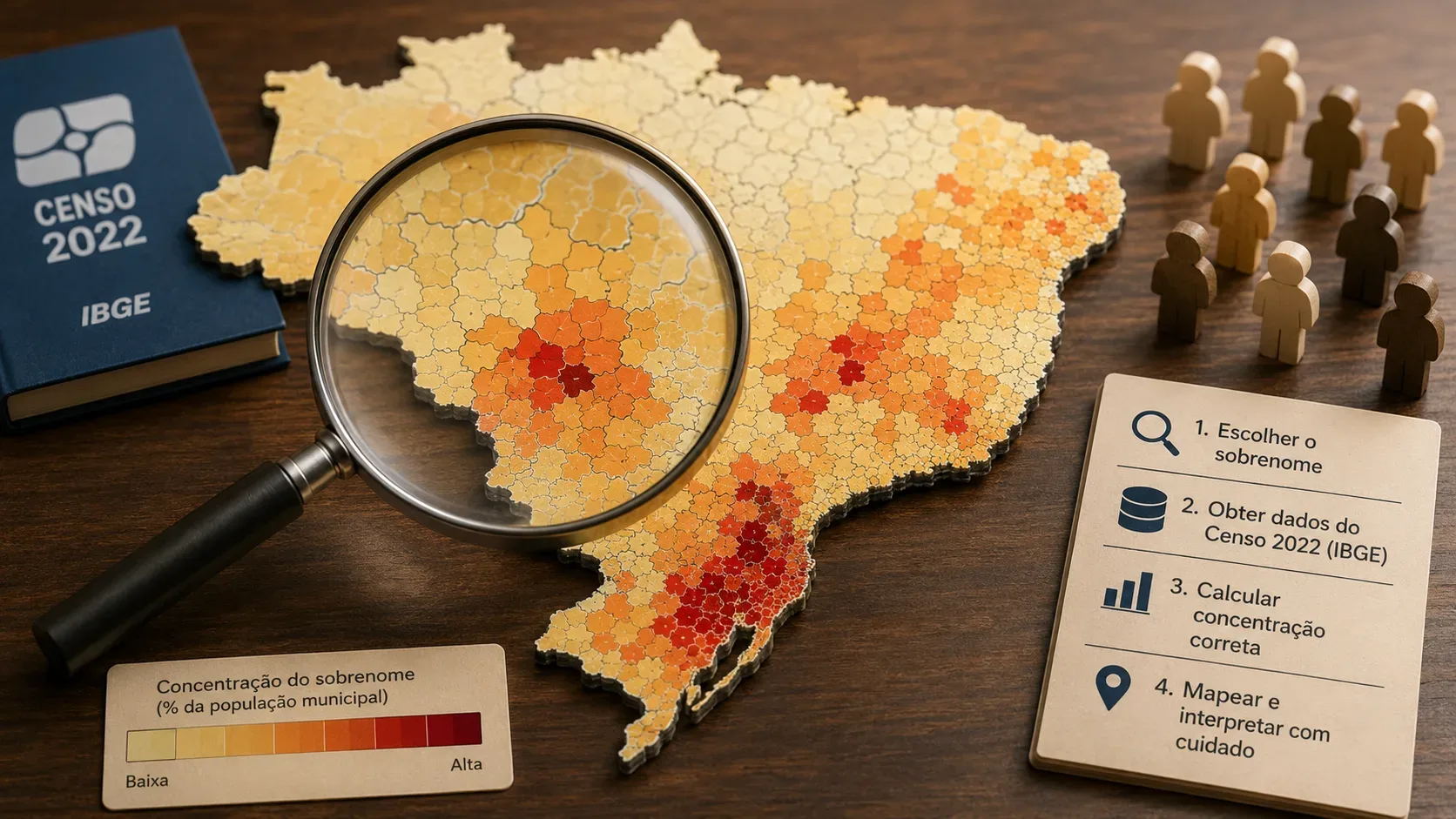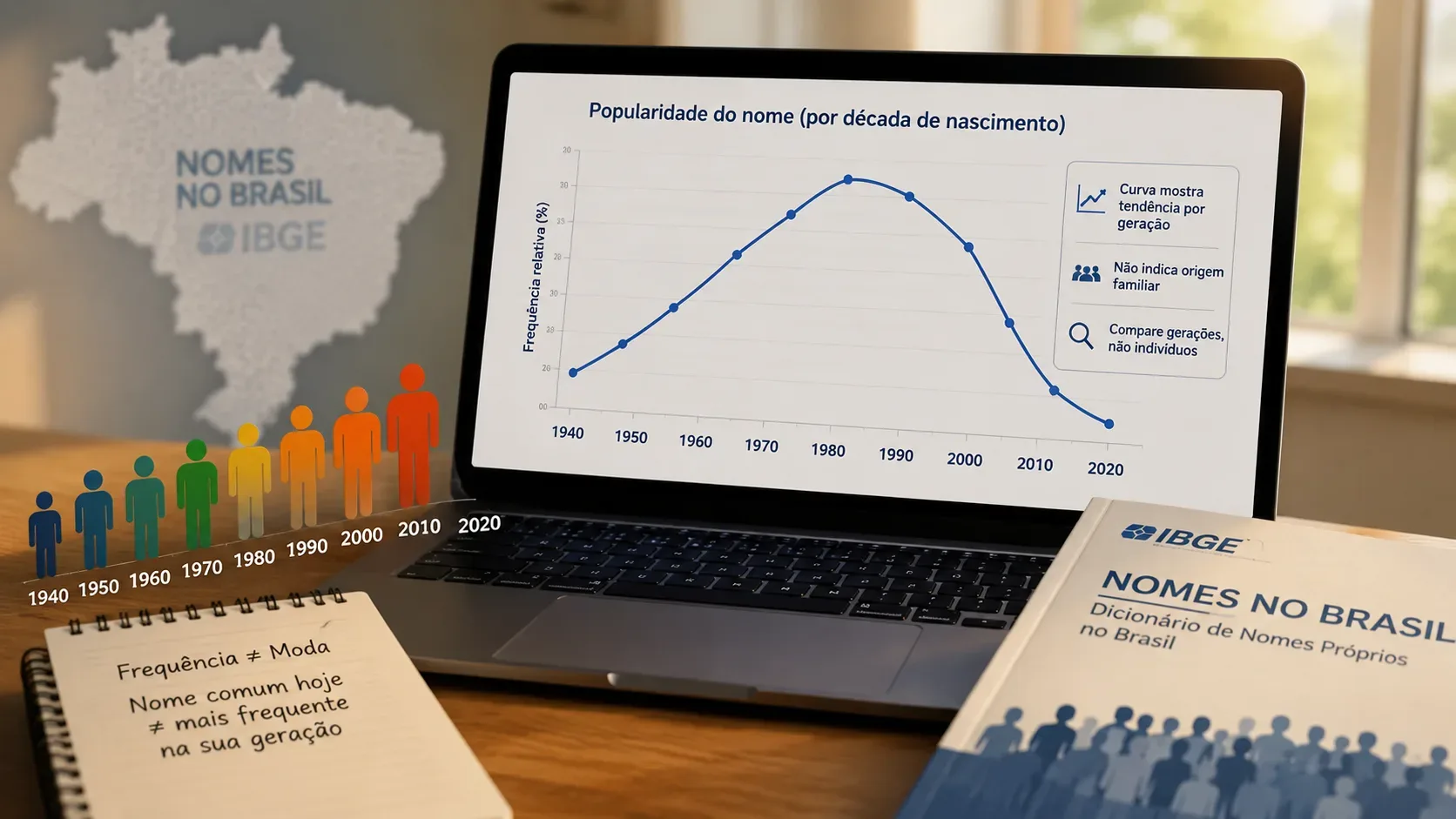
To find out how many people have your surname in Brazil, IBGE’s Nomes no Brasil tool is one of the most direct references: it uses resident records from the 2022 Population Census and lets you check surname frequency for Brazil, states and municipalities. The result, however, must be read as a population statistic — not as a count of relatives.
The edition based on the 2022 Census contains more than 200,000 different surnames. The survey uses the list of residents on August 1, 2022 and covers about 203 million people in 90.7 million households. For surnames, IBGE calculates the frequency of the recorded terms regardless of their position within the full surname.
How to check how many people have your surname
- Open Nomes no Brasil.
- Choose the surname search rather than the given-name search.
- Enter the surname you want to research. If the spelling is uncertain, try variants separately.
- Read the frequency for Brazil first: it indicates how many census residents had that surname among the terms recorded in their name.
- Then switch the geographic filter to a state or municipality and compare the absolute frequency with the local population percentage.
- Use the ranking and geographic distribution to understand whether the surname is very common, rare or relatively concentrated in certain places.
IBGE states that the website can generate rankings for Brazil, states and municipalities and that opening an entry shows the total number of people and its concentration by location.
What surname “frequency” actually means
In the tool, frequency is the number of people in the selected geographic area whose recorded surname contains that term. The Census collected given names and surnames in separate fields. In the surname field, enumerators were instructed to record all of a resident’s surnames; when that was not possible, only the last surname could be recorded. For publication, surname terms were counted regardless of the order in which they appeared.
This has an important consequence: the same person can contribute to the frequency of more than one surname. Someone called, for example, “Carvalho Mendes” is counted under Carvalho and also under Mendes if both were recorded and meet the disclosure rules. Therefore, you should not add the frequencies of different surnames to estimate the population.
Frequency, percentage and ranking do not mean the same thing
| Metric | What it answers | How to interpret it |
|---|---|---|
| Frequency | How many people have the surname in the selected area? | An absolute count of census residents associated with the surname. |
| Percentage | What share of the local population has the surname? | More useful for comparing concentration across places of different sizes. |
| Ranking | Where does the surname rank among the most frequent? | Shows relative popularity, not family origin. |
| Geographic distribution | Where does the surname have a stronger presence? | Shows spatial patterns but does not prove migration, ancestry or kinship. |
Imagine a surname with 5,000 people in a large state and 2,000 in a small state. The first state has a higher frequency, but the second may have a higher percentage. If the question is “where is this surname more concentrated?”, percentage is usually more informative than the raw count.
Why a surname may not appear
An absent result does not necessarily mean nobody has that surname. The Nomes no Brasil Technical Note sets minimum disclosure thresholds that also protect statistical confidentiality:
- for Brazil as a whole, the term must have a frequency of at least 20;
- for a state, a frequency of at least 15 is required;
- for a municipality, a frequency of at least 10 is required.
These thresholds explain why a surname’s national total can be larger than the sum of the state values shown, or why a state total can exceed the sum of the municipalities displayed. Some occurrences may be suppressed in smaller geographic cuts.
Data processing also affects spelling. IBGE says spelling variants were counted separately and diacritical marks such as accents and cedillas were not considered. Connectors such as “da”, “de” and “do” and similar forms were also excluded during processing. If the search does not return the expected result, try the main surname form and plausible variants.
Frequency is not proof of kinship
| IBGE data can indicate | IBGE data alone does not demonstrate |
|---|---|
| How many people have a given surname | That all of them belong to the same family |
| In which states or municipalities it is more frequent | That the surname originated in those places |
| Where it represents a larger share of the population | That two people with the same surname share a recent common ancestor |
| How common or rare the term was in the 2022 Census | A genealogical lineage, family tree or degree of kinship |
This distinction follows from the nature of the database itself. Nomes no Brasil is a statistical publication of names and surnames from the Census; it does not reconstruct family trees or automatically connect people in different households or generations by ancestry. A matching surname is therefore a clue, not genealogical proof.
A widespread surname may also belong to multiple family lines with no recent relationship to one another. Even when there is regional concentration, that pattern can reflect a mix of migration history, population size, family transmission of surnames and other processes. The map shows where the surname is found; by itself, it does not explain why it got there.
How to use IBGE in genealogy without overstating the data
The best genealogical use of the tool is to guide hypotheses. If a surname has a high percentage in a region connected to your family history, that can help decide where to look for records. Confirmation then needs to come from documents that link specific people across time.
- Compare full names, not just one surname.
- Check dates and places of birth, marriage and death.
- Look for parent-child relationships in civil, religious and other historical records.
- Watch for spelling changes and surnames added or omitted across generations.
- Use IBGE distribution as population context, not as a substitute for family documents.
A quick checklist for interpreting your search
- How many people? Read the national frequency.
- Is it common or rare? Check the ranking and percentage.
- Where is it more common? Compare states and municipalities, favoring percentages when measuring concentration.
- Are values missing? Remember the thresholds of 20 for Brazil, 15 per state and 10 per municipality.
- Does this prove kinship? No. Use the result only as context or as a lead for documentary research.
In short, Nomes no Brasil answers the statistical question “how many people have this surname and where are they?” very well. The question “are these people related?” requires a different kind of evidence. Keeping those questions separate prevents a frequency-and-distribution tool from being turned into a genealogical conclusion the data cannot support.