Finding your surname among the most common in the city may seem like a decisive clue about your family history. The data is useful, but it answers a much more limited question: how many people in the census used that surname in a given territory on the reference date of the 2022 Census.
It does not tell you where the surname originated, when it arrived in the municipality, whether all its bearers descend from the same family or whether you are entitled to the nationality of another country. Statistical frequency, linguistic origin, genealogy, ethnicity, and citizenship are different categories — and mixing them produces attractive but fragile conclusions.
The new edition of the tool Names in Brazil, launched by IBGE on November 4, 2025, uses the list of residents from the 2022 Demographic Census, whose reference date is August 1, 2022. IBGE Educa informs that the base brings together more 200 thousand different surnames; in the national ranking, Silva, Santos and Oliveira occupy the first three positions.
What the Names in Brazil tool really shows
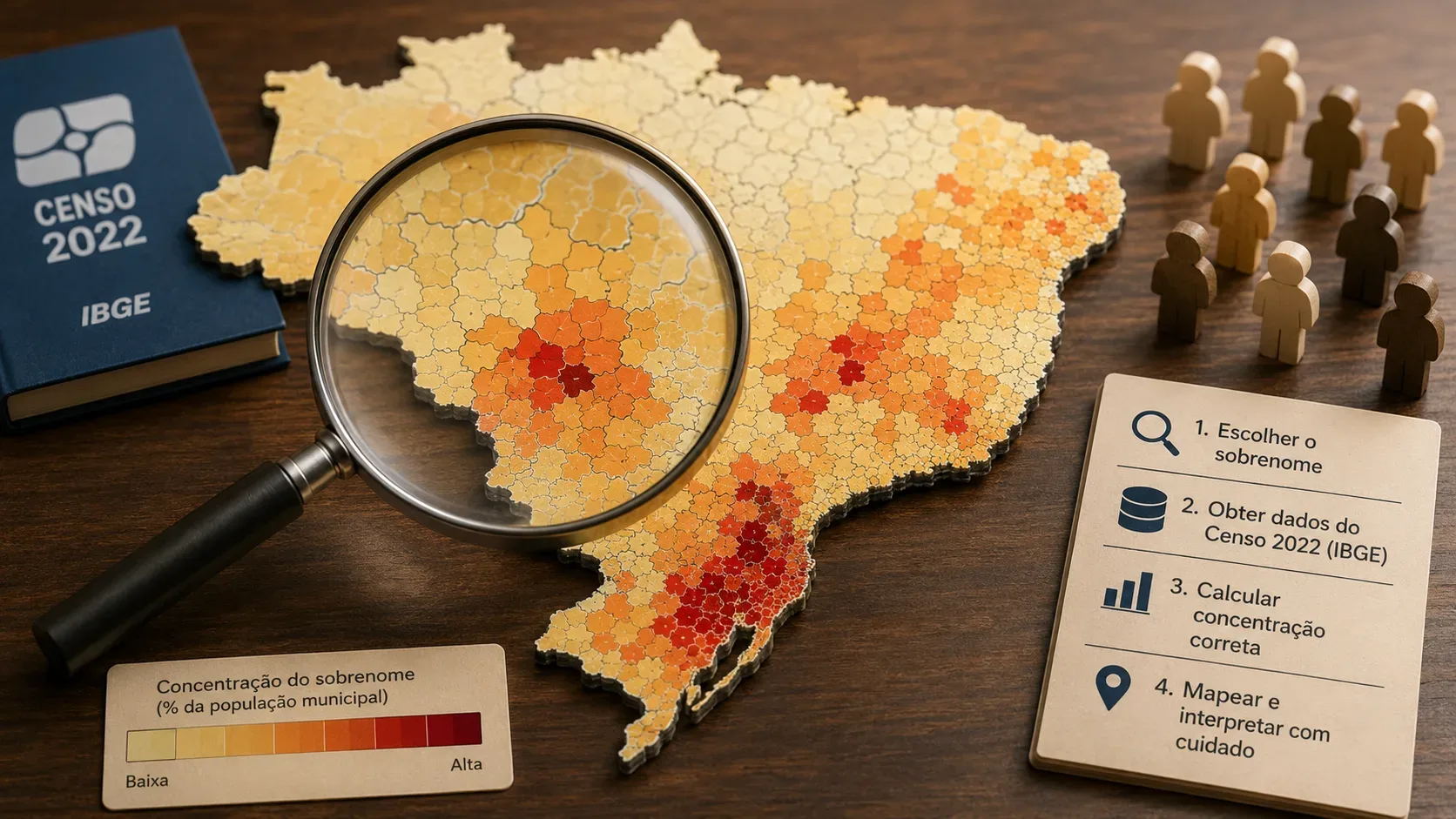
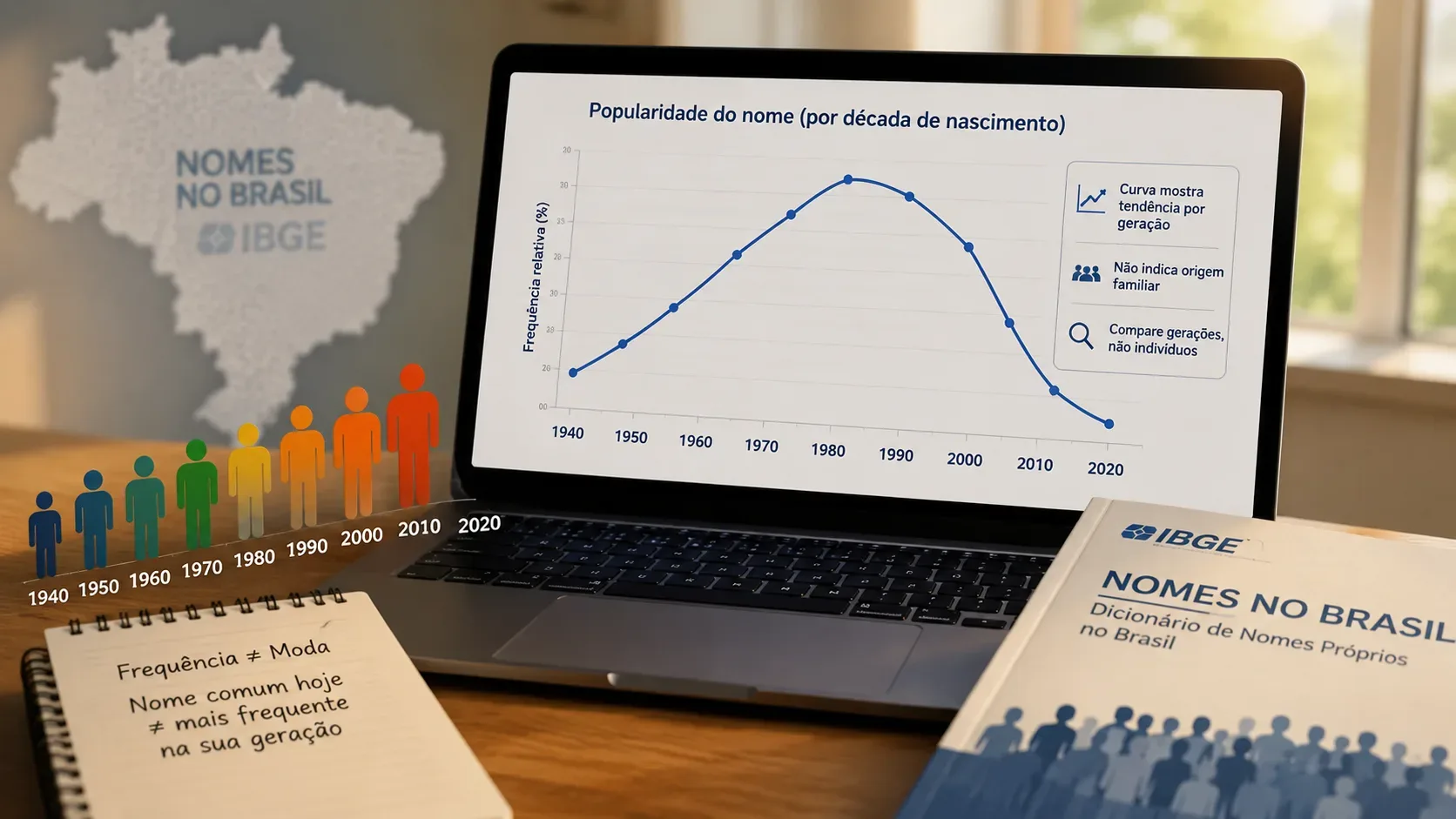
The tool presents the frequency and territorial distribution of names and surnames among registered residents. The results can be consulted for Brazil, the Federation Units and municipalities, forming rankings according to the frequency found in the 2022 Census.
This allows you to answer questions like:
- How many people in the census had a given surname?
- In which states or municipalities does it appear most frequently?
- What position does this surname occupy in a territorial ranking?
- Is the current concentration higher in one region than another?
The tool, however, is not a genealogical base. It does not present family trees, links between those with the same surname, places of birth of ancestors, dates of immigration or documents proving affiliation.
The location shown on the map is the territory where people were registered in 2022. It is not necessarily the place where they were born, where their grandparents lived or where their surname began to be used.
How surnames were counted
In the Census collection, the full name and surname were recorded in separate fields. For disclosure, IBGE counted the words in the surname field separately, regardless of the order in which they appeared. Connectives such as “da”, “das”, “de”, “do” and “dos” were excluded from the calculation.
This means that a person with two or more surnames can contribute to the frequency of each of them. The result does not correspond only to the “last surname” and also does not represent a register of different families.
The IBGE also reports that different graphic forms were counted separately, while diacritical signs — such as accents, cedilla and tilde — were not considered. These methodological decisions may generate differences between spellings and between editions based on the 2010 and 2022 Censuses.
A surname absent in the municipality may be present
The results undergo minimum disclosure limits. A name or surname must appear at least 20 times to be shown in Brazil in total, 15 times in the selected Federation Unit and 10 times in the municipality. The same filters are applied when there are results by decade.
Therefore, not finding a surname in a certain municipality does not necessarily mean that no one used it there. Frequency may be below the disclosure threshold.
For the same reason, the sum of municipalities may be smaller than the state total, and the sum of states may not coincide with the national total.
Does frequent here mean originating here?
No. A high concentration can act as a starting point for an investigation, but it does not prove that the surname arose in that territory.
| What did you observe | What the data allows us to say | What it doesn't prove |
|---|---|---|
| Surname comes first in the city | Many people registered in the municipality used this surname | That the surname arose in the city |
| Greater concentration in one region | There is an unequal territorial distribution | That all carriers descend from the same immigrant |
| Surname associated with a language or country | There may be an etymological or historical hypothesis | That the individual family came from that country |
| Two people with the same surname | There is nominal coincidence | That there is a close or documented relationship |
| Surname similar to that of a historical family | There is similarity in spelling | Nobility, coat of arms or link to that lineage |
| Foreign surname | Can suggest a research trail | Automatic right to citizenship |
The distribution observed in 2022 may reflect old and recent migratory movements, marriages, adoptions, name changes, growth of certain family branches and internal population movements. Studies that use surnames as indicators find territorial patterns in large groups, but warn that these results do not guarantee the cultural or genetic ancestry of a specific person.
Five concepts that should not be confused
1. Statistical frequency
It is the count of occurrences of a surname in the census population, within the criteria used by IBGE.
It describes the distribution of the name, not the individual history of the bearer.
2. Linguistic origin of the surname
It is the investigation of the formation, language, structure or historical meaning of the word.
A surname can have a toponymic, professional, patronymic, religious or descriptive origin, among other possibilities. But the etymology of the word does not replace the family genealogy. An academic review of first and last names in Brazil highlights that its analysis needs to consider, in addition to linguistic aspects, the historical and social context of the sources.
Saying that a surname has Portuguese, Italian, Germanic or indigenous origins is not equivalent to demonstrating that all its bearers descend from a single population or family.
3. Documented kinship
Genealogical kinship requires a chain of documents that connects a person to the previous generation: birth, marriage and death certificates, religious records, inventories, migration documents and other compatible sources.
Two people can share a very common surname without having an identifiable common ancestor in the generations researched. They may also be related and use different surnames due to the ways in which the name is transmitted, marriages, adoptions and registration changes.
Research on surnames in Brazil recognizes that even the analysis of two surnames misses parts of the lineages, especially those that are no longer transmitted by name. Changes resulting from marriage, adoption and other events further reduce the accuracy of the surname as an individual indicator.
4. Ethnicity or ancestry
The surname can offer a historical hypothesis in some contexts, especially when analyzed in conjunction with large databases and other sources. It should not, however, be used in isolation to classify a person's ethnicity, identity or genetic ancestry.
Brazilian history includes the imposition, adoption and circulation of Iberian surnames among populations of different origins. A study on surnames and ancestry in the country warns that classifications of this type are especially inadequate for individually inferring the ancestry of indigenous or Afro-descendant Brazilians.
Ethnic identity, community membership, family history and genetic ancestry are also not interchangeable concepts. The surname represents only a portion of the numerous lines that make up a person's ancestry.
5. Right to citizenship
Citizenship by descent is a legal issue determined by the legislation of the country involved, the status of the ancestor and the documentation that links the generations.
Last name can help locate records, but does not create entitlement. As an example, the official service of Justice in Portugal requires, in requests made by grandchildren of Portuguese people, birth certificates of the applicant, the father or mother who is part of the line of descent and the Portuguese grandfather or grandmother, in addition to other applicable requirements.
The Brazilian National Archive also describes its foreign entry records as documents used after proving the nationality of ancestors. Its collection covers different ports and periods, but finding a person with the same surname is not enough: it is necessary to demonstrate that that record belongs to the correct ancestor.
Nationality rules may change. Before making decisions or hiring services, the situation must be checked directly with the country's official body or with a qualified professional.
How to use the tool without drawing the wrong conclusions
1. Start with the statistical question
Search for the surname across Brazil and then compare the results for the state and municipality of interest.
Record the position, frequency, territory surveyed and reference date: August 1, 2022. This way, the data will not be confused with a real-time photograph or a historical record from previous centuries.
2. Note spelling variations
Search for similar spellings, inversions, Portuguese forms and possible errors present in old documents. The same family branch may appear with surnames spelled differently over time.
Also consider IBGE's own rules: variant spellings may have been counted separately, while accents and other signs were removed.
3. Turn the map into a hypothesis
A territorial concentration may suggest questions such as:
- Did the family live in this region in previous generations?
- Was there a migratory flow to the municipality?
- Are there old civil or religious records with this surname?
- Did different local families adopt or pass down the same name?
The correct formulation is “there is a clue that deserves investigation”, not “the map proved the origin of the family”.
4. Rebuild the family line backwards
Start with yourself and move forward one generation at a time:
- your birth certificate;
- birth and marriage certificates of your parents;
- grandparents' records;
- great-grandparents' documents;
- migratory, parish, military, notarial or naturalization records, when applicable.
Write down full names, dates, municipalities, names of parents and spouses. It is these combinations — and not just the surname — that help distinguish people with homonyms.
5. Compare independent documents
A coincidence becomes stronger when different documents point to the same person and present compatible family relationships.
Similar spellings, approximate dates, or a rare surname still require confirmation. In genealogical research, small incompatibilities may reveal a transcription error, homonym or a mistaken family connection.
6. Separate historical discovery from legal request
A family tree can have an affective or historical purpose. A citizenship, rectification or recognition of relationship process requires the documents and conditions set out in the corresponding legislation.
Before using a genealogical conclusion to exercise a right, check:
- if each generation is documentedly connected;
- if the names and dates are compatible;
- if there are relevant naturalizations, adoptions or registration changes;
- which documents does the competent body accept;
- what is the rule in effect on the date of the request.
What to do after looking up the last name
Use the result as an index, not as a sentence.
Save the territories in which the surname appears, talk to family members about full names and places of birth and gather existing certificates at home. Then, look for the civil records of previous generations and, when there is a documented foreign ancestor, consult the migration records and the relevant official authorities.
The IBGE tool is especially valuable for measuring the most common surnames in Brazil and revealing territorial patterns. Its best use begins when statistical curiosity leads to documentary research — without turning frequency into proof of origin, kinship, ethnicity, nobility or citizenship.
Frequently Asked Questions
Does a rare surname prove two people are related?
No. Rarity can make the hypothesis more interesting and facilitate the search, but kinship depends on identifying a common ancestor through compatible documents.
Is the municipality most often the place of origin of the surname?
Not necessarily. The map represents the residence of residents registered in 2022. The concentration may result from migration, population growth or the formation of different families with the same surname.
Does the absence of the surname mean that no one used it in the city?
No. Municipal results with fewer than ten occurrences are not presented. The absence in the tool may reflect this disclosure limit.
Does having an Italian, Portuguese or German surname entitle you to citizenship?
Not automatically. The right depends on current legislation, the circumstances of the family line and the documents that prove each generation.