Finding the arrival of an immigrant ancestor in Brazil becomes much easier when the research begins with three questions: in what period he probably arrived, through which port or state he may have passed and what data allow us to distinguish him from people with the same name. The National Archives does not concentrate all Brazilian immigration in a single nominal search. The route changes depending on the port, season and type of document available.
If you don't already know the date, ship or port, this doesn't stop you from searching. The initial objective is to reduce the time window using documents from the family itself and records produced in Brazil, such as marriage, birth of children, death, naturalization, address and place where the family settled. Then, SIAN, the National Archives databases, the Immigration Museum and FamilySearch can be used in a complementary way to test hypotheses and confirm identities.
First decide on what you already know
If you know the port and at least the approximate year of arrival, searching the National Archives passenger lists tends to be the most direct route. If you only know the name and suspected entry through Rio de Janeiro between 1875 and 1910, there is a specific nominal basis for this section. If the family settled in São Paulo, the records of the Hospedaria de Imigrantes and the ship's lists linked to the Port of Santos may be more productive. For foreigners residing in the country since the late 1930s, the RNE, known historically as the Model 19, can provide a second trail even when the exact arrival has not yet been located.
When almost nothing is known, start with the Brazilian document closest to the immigrant and work backwards. A marriage can reveal filiation and naturalness; the birth of a child can place the family in a specific city; a death can offer approximate age and name of spouse. These elements turn a vague search by last name into a search with
period, place and family relationships.
SIAN: the central point for the National Archives lists
The National Archive advises that the search for entry of foreigners begins with SIAN, the National Archive Information System. For the Port of Santos, the federal entry control documentation appears associated with the Maritime, Air and Border Police Service, code BS. For other ports, the main reference is the Maritime, Air and Border Police Division, code OL.
SIAN is most useful when you understand that it organizes archival documents, not just people's names. In many cases, the route is to locate the correct fund, choose the port, identify the year, find the list of ships or steamers and then open the corresponding list. For Rio de Janeiro and Santos until 1934, the National Archives itself informs that there are digitized landing lists that can be viewed at the base.
A search just by name may fail even when the document exists. Handwritten lists may not be recognized by text, spellings may vary and part of the collection is browsed by date, port or vessel. Therefore, when there is a guess for a ship or month of arrival, use that information to reach the document and examine the listing image, instead of relying solely on textual search.
What is the coverage by port and period
The National Archives Foreigners Entry page currently reports the following clippings in the SIAN: Aquidauana in 1940; Belém from 1939 to 1962; Barra de Quarai in 1941; Corumbá from 1940 to 1964; Esperança from 1937 to 1951, with an irregular interval; Florianópolis from 1939 to 1953; Foz do Iguaçu in 1943; Guajará Mirim from 1946 to 1954; Manaus from 1938 to 1964; Paranaguá from 1946 to 1956; Porto Esperança from 1937 to 1951; Porto Murtinho from 1941 to 1954; Quaraí from 1940 to 1953; Recife from 1920 to 1961, with an irregular interval; Rio de Janeiro from 1875 to 1964; Salvador from 1939 to 1952; Santos in 1891 and from 1894 to 1982, also with an irregular interval; São Francisco do Sul from 1928 to 1930; and Uruguaiana from 1939 to 1945.
These dates are a coverage of the collection indicated by the National Archives, not a guarantee that all passenger movements for each period are complete or indexed. If the probable arrival is outside the port range searched, the absence of a result is no longer a surprise and begins to indicate the need to look for another set of documents.
Rio de Janeiro between 1875 and 1910: also use the nominal base
For the Port of Rio de Janeiro there is a specific database called Entry of Foreigners into Brazil, focused on the relations of passengers disembarked between 1875 and 1910. It allows you to search by name of the immigrant and cross fields such as ship, date of entry, nationality, education, religion, profession, marital status, origin and destination in Brazil.
This feature is especially useful when you know the name but don't yet know the vessel. A nominal result can provide the date and ship needed to return to the original documentation and check the passenger list. This sequence is safer than treating the table of contents as final proof, because the document image can show additional information, original spelling, and familiar context.
What passenger lists can really show
According to guidelines from the National Archives, disembarkation lists are lists of passengers from ships that arrived at Brazilian ports and are organized by arrival date. In general, they record name and nationality and, in some cases, place of birth or other information. When relatives traveled together, they may appear grouped and identified by family position.
The level of detail varies greatly from one list to another. Therefore, do not discard a document because it has too few fields. A seemingly generic name gains value when it is next to a wife, children or other relatives and coincides with the date, destination and expected age range.
São Paulo and Santos: Immigrant Hostel and boarding lists
For families who went to São Paulo, the Digital Collection of the Immigration Museum is one of the best extensions of the research. The guidance material published by the Museum in 2025 informs that the registration records of the Hospedaria de Imigrantes range from 1882 to 1958. These registrations are digitized and transcribed and usually include the name and surname of the family members, date of arrival at the hostel, name of the ship and nationality. In some cases final destination and naturalness also appear.
The same guide informs that the shipboard lists of ships that arrived at the Port of Santos cover the period from 1888 to 1973 in the Digital Collection. Unlike license plates, these lists are digitized without transcription, which requires manual navigation. This difference is important: not finding a name in the search field does not necessarily mean it is not in a roster image.
In practice, if the family lived in the state of São Paulo and there is suspicion of arrival via Santos, it is worth crossing three paths: passenger lists from SIAN, registration records from the Inn and on-board lists from the Immigration Museum. A registry can provide the ship; another, the date; another, the relatives who traveled together.
Immigration Cards on FamilySearch
FamilySearch maintains large collections of Brazilian immigration cards digitized from public collections. The Rio de Janeiro collection is entitled Brazil, Immigration Cards, 1900-1980 and brings together images held by the National Archives. The collection description itself informs that the cards presented at the port of Rio de Janeiro cover entries from 1900 to 1965 and that the indexes and images can be expanded over time.
These cards may contain full name, date and place of birth, nationality, marital status, affiliation, profession, residence in the country of origin, information about minor children, passport and signature. Some bring photographs. For São Paulo, FamilySearch also maintains a collection of immigration cards from 1902 to 1980, with records held by the São Paulo State Public Archive.
There is also a specific collection of records from the Hospedaria dos Imigrantes de São Paulo from 1882 to 1925. It includes images of registration plates, indexes and passenger lists. As the Immigration Museum's coverage is broader for enrollments, FamilySearch works well as a search shortcut and as a complementary source, but it should not be treated as the only gateway to the São Paulo collection.
When to look for the RNE or Model 19
The National Registry of Foreigners, known as Model 19, is especially useful when the ancestor was already residing in Brazil from the end of the 1930s. The National Archives informs that this registry was instituted on a mandatory basis in 1938 for foreigners under the age of 60 who resided in the country and that there are records from the period from 1939 to 1987.
To request the location of a medical record, the National Archive advises you to provide the foreigner's full name, their affiliation and the city where the registration was made. This type of document can help confirm identity, residence and personal data, but it should be interpreted as registration of a resident foreigner, not automatically as proof of first arrival in Brazil.
For this reason, the Model 19 is particularly valuable when the landing list has not yet been found. Affiliation, city of registration and other data from the medical record can provide clues to go back to passenger lists, immigration cards or hostel records.
How to search for spelling variants without getting lost
Surnames and given names may change between the source document, the ship's list, the Brazilian registry and modern indexing. Do a first search with the known spelling and then test variations in accents, surname particles, order of names and abbreviated forms. If the name was used in Portuguese throughout your life in Brazil, also research the form used in the family's oldest documents.
The important thing is to vary one element at a time. If you change name, year, port and nationality simultaneously, you no longer know which change produced the result. Record the combinations tested and maintain a realistic date window based on the immigrant's age and the first documents found in Brazil.
How to distinguish homonyms before accepting a result
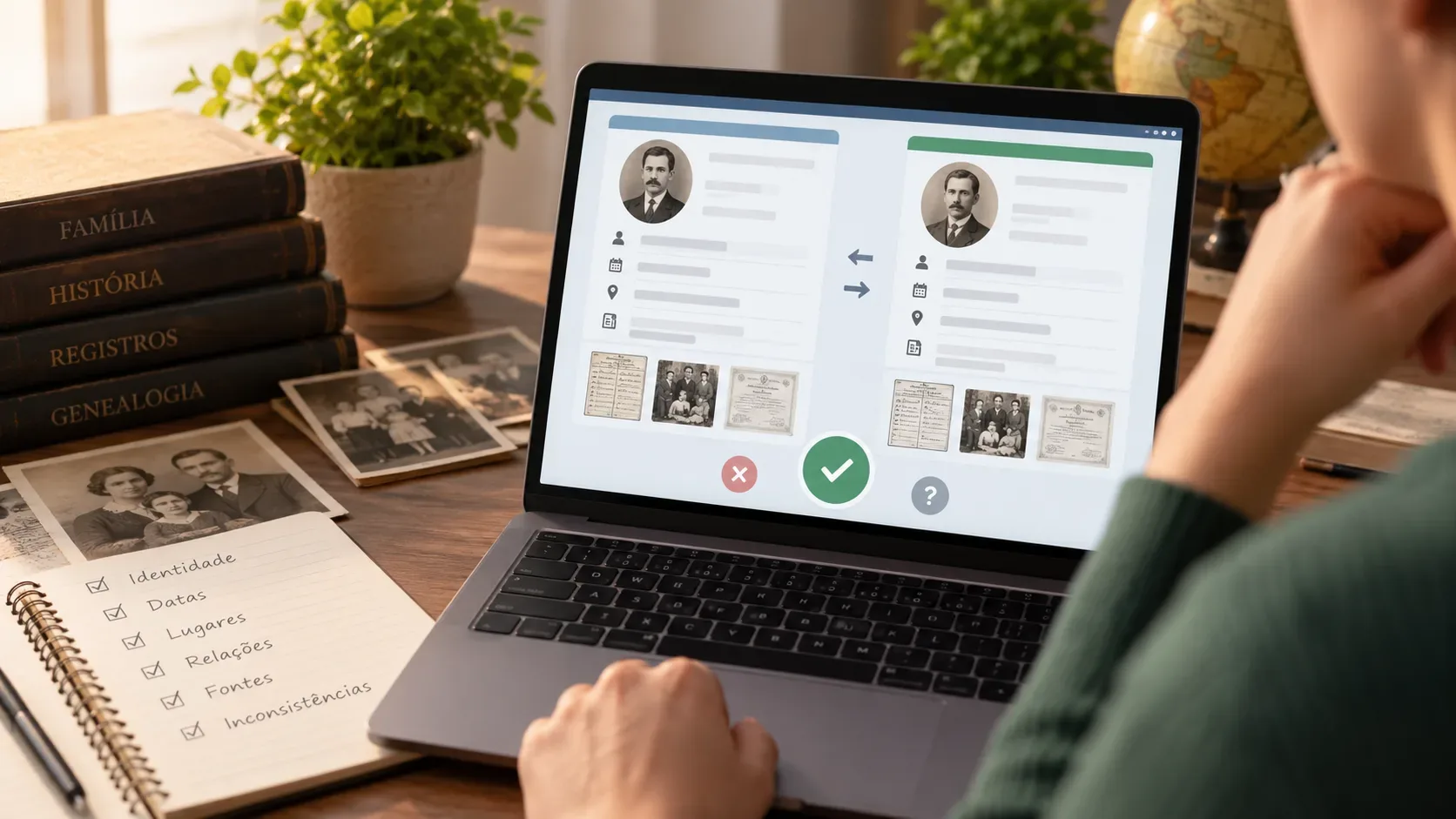
Never close identification just because name and nationality match. Create a comparison sheet for each candidate found and compare age, affiliation, spouse's name, profession, origin, destination, city where they settled, ship, date and accompanying family members.
Some data has greater weight. Parentage, spouse and number of children tend to be more discriminating than profession or nationality. Age may vary between records, and the spelling of the name may change, but a coherent combination of relatives, origin, destination and chronology greatly increases the security of identification.
If two records have the same name, but one points to São Paulo and the other to Rio Grande do Sul, check where the family's first Brazilian documents appear. If a passenger travels with a wife and children whose names match later civil records, this family relationship is stronger than an isolated surname match.
A practical flow for choosing the collection
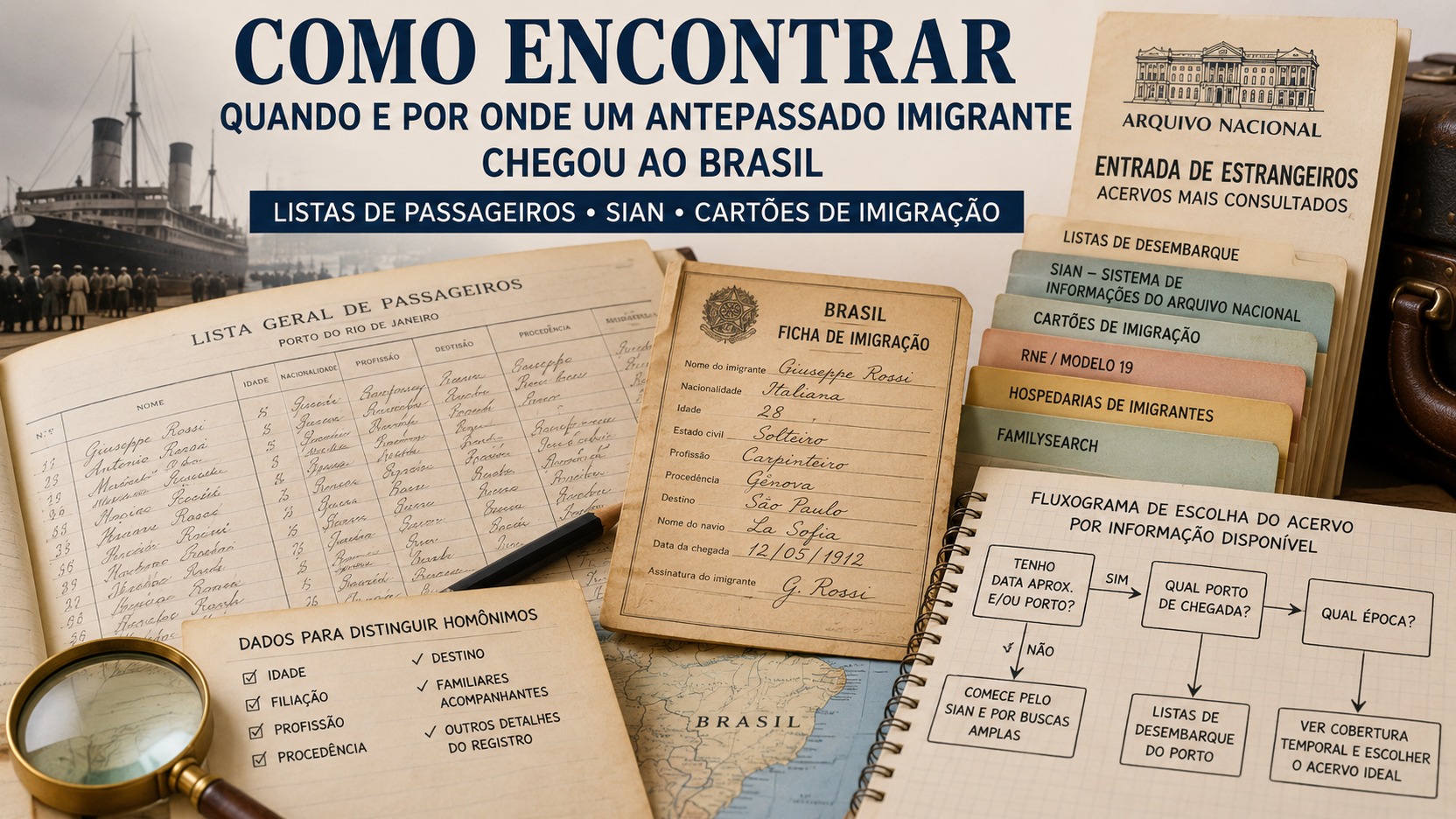
If you know the port, ship or approximate date, start with the SIAN and passenger lists. If you suspect Rio de Janeiro between 1875 and 1910 and only know the name, test the Foreign Entry nominal basis first and use the result to arrive at the original list. If the destination was São Paulo, combine SIAN, the Immigration Museum Digital Collection and the FamilySearch collections. If the ancestor was a resident foreigner from 1938 onwards, add the search for RNE or Model 19.
If you don't know the port or date, go back a documentary generation: look for marriage, birth of children, death and other Brazilian records that indicate age, parentage, place of birth or municipality of residence. Only then expand the migratory search. This path seems slower, but it usually reduces hundreds of irrelevant results and helps you recognize the right person when the record finally appears.
What to do when no results appear
A negative search does not prove that the ancestor did not arrive in Brazil. The record may be outside the period covered by the database consulted, in another port, not yet indexed, only in a handwritten image or registered with a different spelling. It is also possible that the familiar information about the port is incorrect and that the final destination has been confused with the point of entry.
When this happens, change the question. Instead of repeating the name in the same field, search for the ship, spouse, child, destination city, or a smaller range of years. If the family has settled in São Paulo, check the hostel even if you are not sure about the port. If there is a subsequent foreigner's record, use the affiliation and city found there to redo the arrival search.
After locating the list, record the complete reference
When you find the person on a landing list, note the port, ship name, date, document reference code, page and passenger order number. Also keep a copy of the image and record the spelling exactly as it appears in the document.
This data is not just used to organize genealogy. The National Archives informs that it issues a disembarkation certificate free of charge and that, to request it, it is necessary to provide port of entry, name of the ship, date of disembarkation, name of the foreigner, page number and order number in which he appears in the list.
Immigration research becomes more reliable when each base fulfills a function. The SIAN helps to obtain the federal entry document; Rio's nominal base reduces the search to a specific period; the Immigration Museum brings São Paulo’s trajectory closer; FamilySearch makes it easy to consult large digitized collections; and the RNE can fill gaps regarding resident foreigners. The strongest result comes from crossing these sources with the family's own documents, not from a single name found in an index.