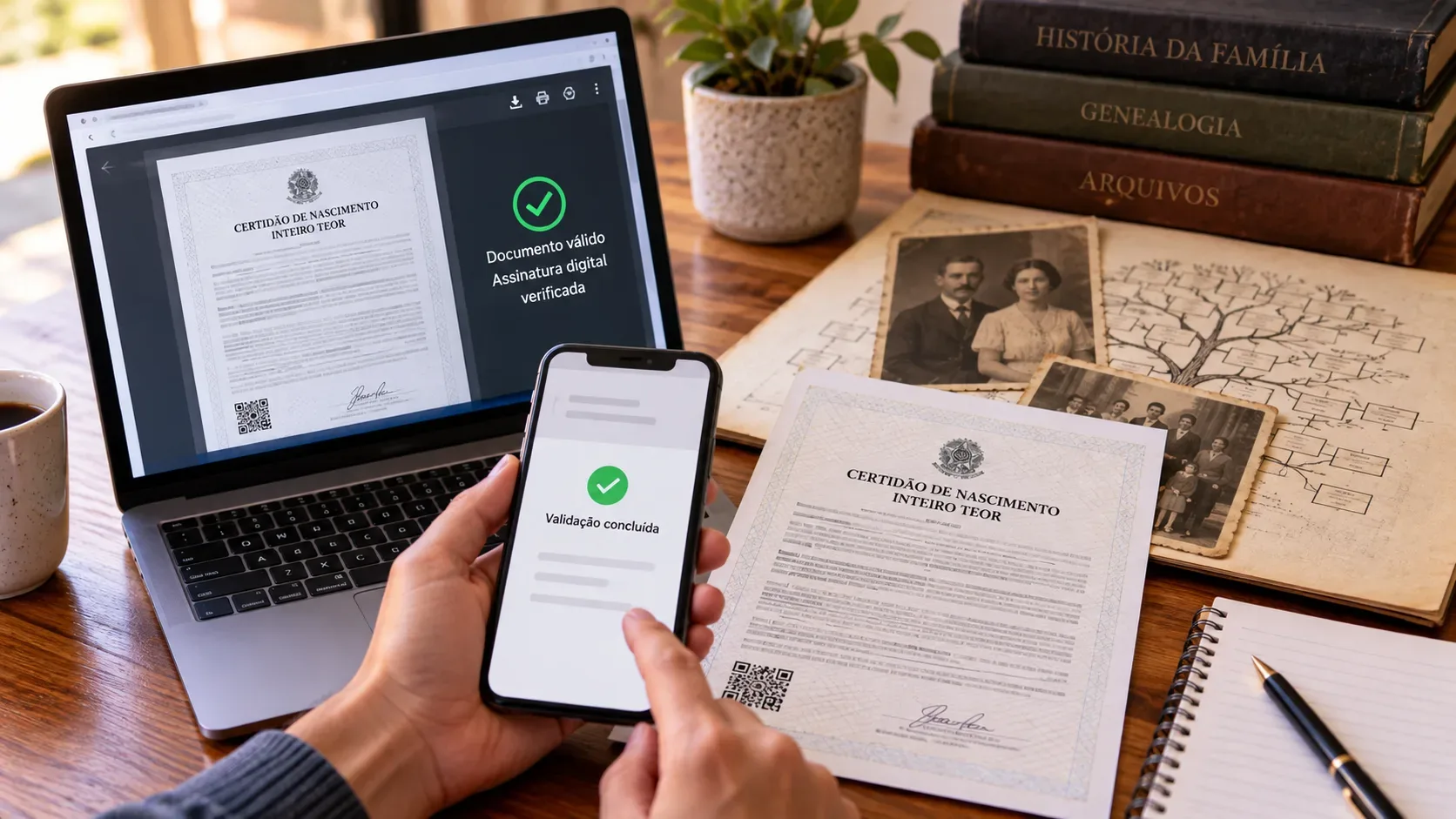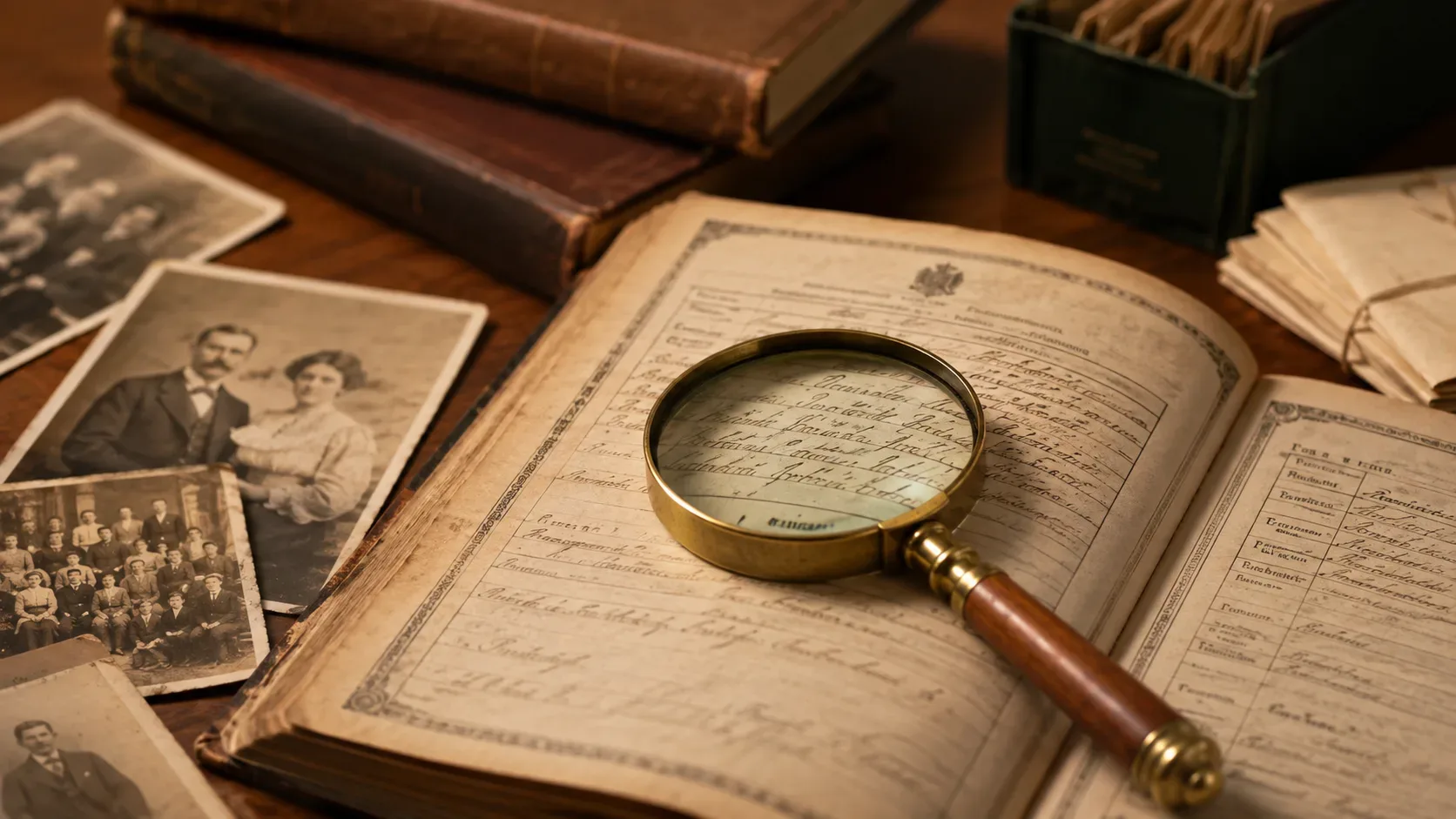
A last name can suggest a direction. A chain of documents supports a conclusion. Along this path, marriage is usually an excellent starting point because it brings two families together, fixes a date and place and can record parents, place of birth, age, profession, residence, witnesses and other elements.
But you need to read the document for what it really is. The certificate proves the existence and content of an official marriage record. It does not automatically transform every piece of information found there into complete proof of biological kinship, ethnic origin, citizenship transmitted to descendants or the veracity of all narratives preserved by the family.
The rule of thumb is simple: treat each field as evidence and at the same time as an indication of the next document to look for.
First, differentiate seat, certificate and qualification
Although the terms are used interchangeably in familiar conversations, they represent different pieces of research.
The marriage seat is the record entered in the appropriate book. The certificate is the official reproduction of what is registered, and can be issued in summary, in detail or in full. The Public Records Law requires that the certificate be authenticated by the official or his legal substitutes and identify the book or document of origin.
qualification for marriage is the procedure prior to the celebration. Depending on the time, location and preservation of the collection, the process may bring together documents presented by the bride and groom, declarations, proof of age, information about residence and marital status and references to previous marriages. The National Archives maintains, among its judicial and extrajudicial collections, qualification processes and birth, marriage and death records from different sources.
This distinction produces an efficient strategy: when the summary certificate does not answer the question, look for the complete seat, the endorsements and, when available, the qualification process.
What may appear on a marriage record
In the legislation currently in force, the civil marriage certificate must contain, among other elements, the identification of the spouses; nationality, place of birth, birth, profession, domicile and residence; information about parents; reference to previous spouse; dates of the proclamations and celebration; documents presented; witnesses; property regime; prenuptial deed, when applicable; change of name and certain data about children.
This does not mean that every historical document will have all these fields. The content found depends on the legislation in force at the time, local practices, the civil or religious nature of the record, the model used and the conservation of the book.
IBGE's own history shows that Brazilian civil registration has gone through different forms of organization. In 1889, registration of births, marriages and deaths ceased to be the responsibility of the Catholic Church and became the civil administration of the State. Therefore, research on previous periods or on locations where implementation was irregular may require joint consultation of parish books, diocesan archives and other sources.
Certificate field, hypothesis and next document
The table below avoids two common mistakes: ignoring valuable clues and turning an isolated clue into certainty.
| Field found | What it might suggest | Next document or source |
|---|---|---|
| Name of spouses | Identity used on the wedding date, spelling adopted and possible surname variations | Birth or baptism, death, immigration documents and other records signed by the person |
| Wedding date and place | Probable district, community attended and period in which the couple was already formed | Original seat, proclamations, qualification, religious registration or book from the competent registry office |
| Age or date of birth | Probable range for locating the birth | Birth certificate, baptism, late registration or historical identity document |
| Naturalness | Municipality, parish, province, state or country where the birth would have occurred | Registration of birth or baptism in the indicated location, considering name changes and territorial limits |
| Parents' name | Hypothesis of affiliation and identification of the previous generation | Birth or baptism of spouse, marriage of parents, inventory and death records |
| Nationality | Nationality declared or registered in that act and context | Passport, alien registration, landing list, naturalization, consular document and applicable legislation |
| Marital status or previous spouse | Possible existence of previous marriage, widowhood, annulment or dissolution | Certificate of previous marriage, death of spouse, endorsement or legal process |
| Residence and domicile | Place where the person lived, not necessarily where they were born | Census, electoral rolls, taxes, deeds, newspapers, directories and local parish records |
| Profession | Occupational status and possibility of other institutional files | Professional, military, functional, union, commercial or social security records |
| Witnesses | Kinship, neighborhood, friendship or work network | Vital records of witnesses and documents in which they reappear with the couple |
| Goods regime | Wedding heritage organization | Antenuptial deed, note books, inventories and shares |
| Children mentioned | Existence and name of children recognized in the context of the record | Birth or baptism of each child, followed by marriage and death |
| Marginal annotations and annotations | Subsequent changes, such as dissolution of marriage, death or name change | Updated certificate and judicial, notarial or registry document that originated the annotation |
The law also provides that subsequent changes to the act are mentioned in the certificate, except in legally protected cases. Therefore, an updated duplicate may contain information that did not appear in an old copy kept by the family.
What the marriage certificate actually supports
In genealogical research, the certificate provides strong evidence that:
- a marriage was registered in that book and served;
- certain people have been identified as spouses;
- the act was associated with a date and, in general, with a circumscription;
- the other transcribed data were part of the consulted record;
- there was a legal marriage relationship according to the registered act;
- certain people, locations and documents were mentioned in the context of that marriage.
Its strength increases when the certificate presents registration, book, sheet, term, service and endorsements. These elements allow you to return to the source, request another type of certificate and check whether the transcription was done correctly.
The document can also bring together information that was dispersed: a spouse's maiden name, both parents, a previous marriage or a change of residence. This ability to connect people and places explains why marriage is often used as a bridge between two generations.
What it doesn't prove alone
A person's entire ancestry
Even though the registry informs the parents of the bride and groom, it does not automatically document grandparents, great-grandparents and other ancestors. Each generational transition must be supported by documents that consistently identify the same people.
Biological kinship in the genetic sense
A civil registry documents legal relationships and information declared or presented in the procedure. It is not equivalent to a genetic analysis and should not be used to erase adoptions, socio-affective parenting or other forms of family formation.
Ethnic origin by surname or nationality
A surname does not necessarily correspond to a single origin. It may have been passed down through different lines, altered in marriage, adapted linguistically, abbreviated, added, or omitted.
Similarly, nationality, birthplace and ethnicity are distinct concepts. Finding a nationality on the seat does not authorize automatically assigning ethnic identity to all descendants.
Current right to citizenship of another country
The mention that an ancestor was Portuguese, Italian, Spanish or of another nationality may be relevant, but does not in itself resolve a citizenship process. It will still be necessary to demonstrate the complete documentation line and verify the laws, dates, naturalization events, certificate formats and requirements of the responsible authority.
For legal, consular or administrative use, confirm in advance which type of document is accepted. Historical research can work with digital images or work transcriptions; An official process may require a recent certificate, full content, apostille, translation or other specific requirements.
Nobility, coat of arms or relationship with a famous person
Surname coincidence does not establish descent. Coats of arms, titles and links with historical families need a continuous documentary sequence, without jumping between homonymous people.
That no marriage existed
Not locating the name in an index or digital database does not prove the absence of the record. The document may be in another district, have been indexed with a different spelling, remain only in physical form, be part of an as yet undescribed fund or have been lost.
How to search for marriage and family on SIAN
The National Archives Information System is an important gateway, but it is not a complete national index of all Brazilian marriages. It brings together descriptions and documents of the collections held by the National Archives, including judicial and extrajudicial funds from different sources.
1. Prepare a form before searching
Register:
- name of each spouse;
- known spelling variations;
- approximate period;
- municipality, district, parish or circumscription;
- names of parents, when known;
- probable religion or parish;
- profession and residence;
- familiar source of information.
Don't just search for the last name. Combine name, location, spouse and period.
2. Enter SIAN and register
The official tutorial informs that access can be done with the system's own registration or with the gov.br account. In the simple search, the initial fields include “Term” and “Fund”, and the results can be refined by period and the existence of a digital file.
3. Search broadly and then refine
Start with different combinations:
- full name;
- first name and last name;
- surname of the other spouse;
- municipality or parish;
- name of one of the parents;
- spellings without accent or with changed letters.
An archival description does not always reproduce all the names within the document. Therefore, the absence of a name in the search engine does not eliminate the possibility of it appearing in a book or process.
4. Use “Funds and Collections > Digital Search”
The National Archive advises you to check this area to see if there is a digital representative available. In the free, advanced or multilevel search modes, the description may indicate “Digital Archive”, allowing immediate access to the copy.
When you spot something promising, make a note of it:
- documentary unit title;
- fund or collection;
- reference code;
- cut-off dates;
- image or page number;
- names found;
- date the query was made.
Without this reference, it may be difficult to find the same document or request a reproduction.
5. Don't stop at indexed results
Open the image and check the original document whenever possible. An index is a finding tool, not a record substitute.
Carefully compare similar letters, abbreviations, numbers, and place names. In manuscripts, “Joaquim” can be read as another name; an age can be 26 or 36; a surname may have been split or joined by the transcriber.
6. Request assistance when necessary
If the document is in the custody of the National Archives, but is not available digitally, consult the service guidelines. The institution informs that it issues certificates in full or by statement, in person or through the Remote Service Module, with service charges in accordance with the applicable table.
For historical-cultural research, the National Archive advises the user to previously survey the references in the SIAN. The service can help with institutional location and provision of services, but does not replace extensive genealogical research carried out by the interested party.
7. Look for the really competent file
When the SIAN does not cover the place or period searched, check:
- civil registry office responsible for the seat;
- successor registry office of an extinct office;
- state or municipal public file;
- court or forum file;
- curia, diocese, parish or religious archive;
- notary file;
- institution that received old books or processes.
The constituency at the time may not coincide with the current municipality. Administrative changes, creation of districts and transfer of collections must be part of the investigation.
How to avoid confusing homonyms
Two records with the same name do not necessarily represent the same person. The National Code of Rules for the extrajudicial forum itself determines that the identification of old records considers the risk of homonyms.
Before joining a document to your tree, compare a set of identifiers:
- spouse's name;
- parents' names;
- age or probable year of birth;
- naturalness;
- profession;
- residence;
- witnesses;
- signature;
- known children;
- dates of other events.
The more common the first and last name are, the more important it is to find matching identifiers. A small difference may result from spelling variation; an incompatible combination of parents, age and location may indicate someone else.
Also record divergences. Do not silently correct “Manoel” to “Manuel”, nor transform “Maria da Conceição” into “Maria Conceição” without preserving the original form. A good transcription separates what the document says from the modern spelling used to facilitate research.
Summary certificate or full content?
For a first screening, the brief report certificate may be sufficient. If parents, notes, documents presented or other relevant information are missing, evaluate a certificate by question or in full.
Current standards distinguish between these modalities. The brief report certificate contains the information provided for by law and normative acts; additional registration data, annotations or endorsements may require a specific or complete certificate. The full request depends on a written request, and there are specific restrictions when third parties request documents with sensitive data.
These rules are especially relevant for living people. Do not publish complete images that expose CPF, address, signature, affiliation or other personal information unnecessarily. Even when access to the document is legitimate, unrestricted disclosure may not be.
A documentary script to save
- Start with the most recent couple you can confidently identify.
- Locate the marriage and record the full reference.
- Read the document image, not just the table of contents.
- Transcribe names, dates, and places without silently modernizing spelling.
- Turn each field into a hypothesis and next document.
- Confirm affiliation with birth, baptism or other independent source.
- Solve homonyms by comparing spouse, parents, age, residence and witnesses.
- Record gaps and divergences instead of hiding them.
- Protect information about living people.
- Only then add the link to the tree as a sustained conclusion.
An isolated certificate can open several doors, but rarely ends the investigation. Save this script, open the search in SIAN or the relevant archive, and start with the best-documented marriage in the family — not the most impressive surname.
As further reading, the article “Does the most common surname in your city prove a family origin? Not necessarily” helps to understand why name distribution and documentary genealogy answer different questions.