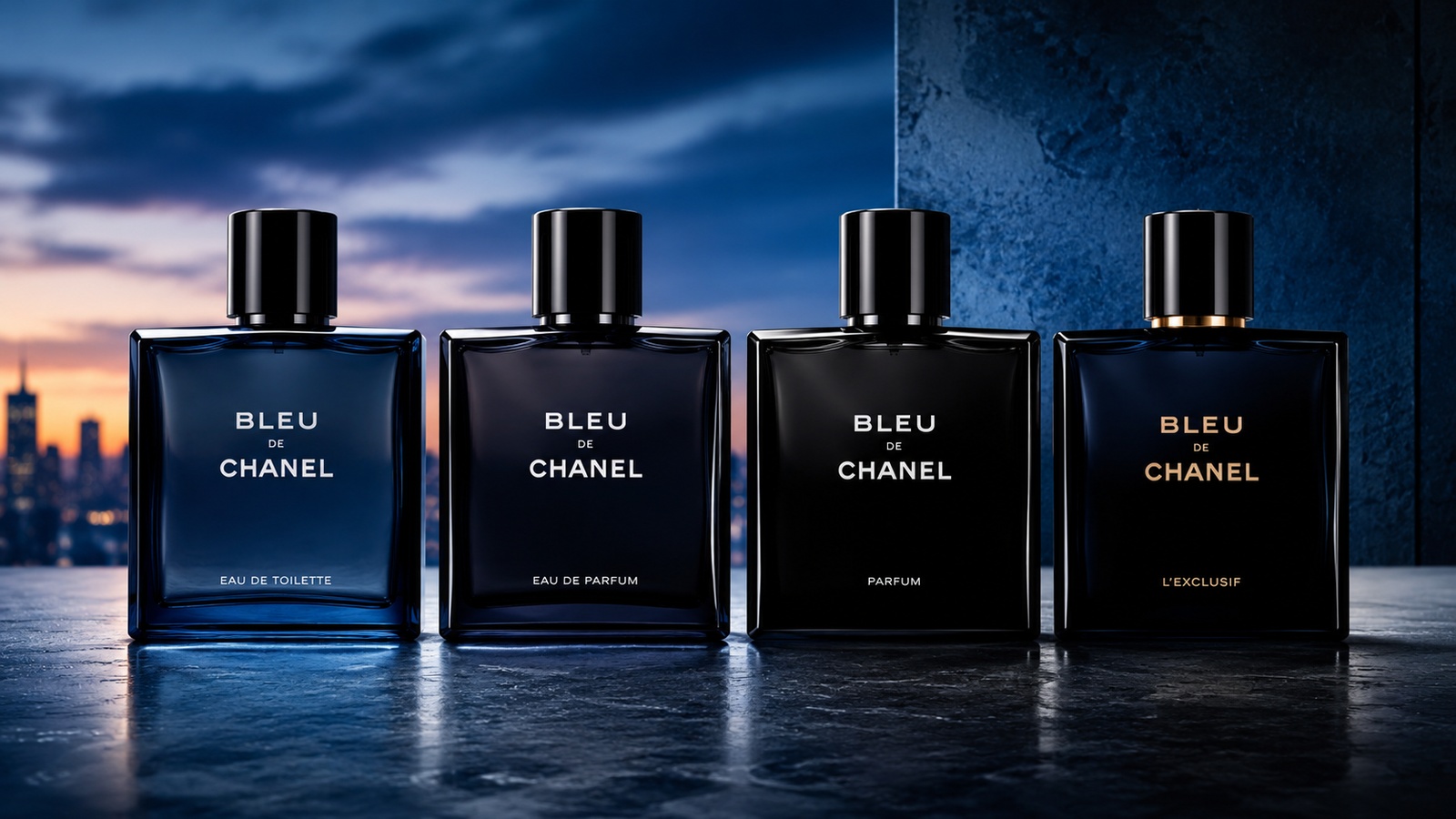
The four current versions of Bleu de Chanel are not simply the same fragrance at progressively higher concentrations. Chanel itself presents them as four interpretations of the same signature, and the most useful difference for a buyer lies in the balance of freshness, warmth, woods, density and versatility. In practical terms, Eau de Toilette is the brightest and freshest; Eau de Parfum is the most balanced for general use; Parfum deepens the woods and sandalwood with a more polished presence; and L’Exclusif takes the line into darker, more ambery, resinous and leathery territory.
If the idea is to buy just one bottle without a very specific use in mind, Eau de Parfum is the easiest choice to recommend. It preserves enough freshness for daytime, adds warmth and depth for evening wear, and usually occupies the safest middle ground between the lightness of the EDT and the denser profile of the two higher versions. That does not make the EDP objectively better: people who live in hot climates or prefer airier fragrances may like the EDT more; those looking for creamy woods and more restrained elegance may prefer the Parfum; and those who want the darkest and most distinctive interpretation of the line may accept the price and lower versatility of L’Exclusif.
What really changes among the four versions
There is a common thread. Chanel highlights sandalwood as a signature present across the Bleu de Chanel interpretations, but shifts the focus in each composition. In Eau de Toilette, the emphasis is on the meeting of invigorating citrus, an aromatic accord, cedar and a warm sandalwood base. In Eau de Parfum, ambery, musky and woody facets carry more weight. In Parfum, sandalwood takes an even more central role, within a structure the brand describes as intensely woody, dense and sophisticated. In L’Exclusif, created as an Extrait de Parfum, Chanel intensifies the woods and explicitly adds leather, amber, resin and labdanum.
This helps avoid the simplistic reading that EDT, EDP, Parfum and Extrait are merely steps on a ladder of strength. Concentration affects the experience, but the formula changes too. A higher concentration does not automatically mean stronger projection for everyone, nor does it guarantee that the most expensive version is the best fit for your use. Chanel itself notes in its Brazilian policy that the perception of longevity and projection varies according to skin, environment, temperature and application habits.
Bleu de Chanel Eau de Toilette: the freshest and most direct choice
Eau de Toilette is the version that puts freshness furthest forward. Chanel describes it as woody aromatic, with stimulating citrus, an aromatic accord, cedar and sandalwood. Within the brand's official comparison of the line, it occupies the brighter and more vibrant side.
In practice, it makes the most sense for someone who wants a clean, energetic signature that is easy to wear on hot days, at work or in casual situations. It tends to feel more open and airy than the others, keeping the Bleu de Chanel identity closer to a fresh fragrance than to a dense woody scent.
The main trade-off is precisely that: by choosing the EDT for freshness, you give up some of the warmth and depth found in the versions that follow. For someone who wants a fuller evening fragrance or a stronger sense of density on the skin, it may feel too simple. For someone living in a hot region who does not want a heavy fragrance, that simplicity can be the advantage.
Bleu de Chanel Eau de Parfum: the best balance for most people
Eau de Parfum shifts the center of gravity without abandoning the line's freshness. The official composition emphasizes amber and musk notes, cedar, musky woods and sandalwood. Chanel positions it as the most sensual interpretation, while independent reviews often describe it as the balance point between brightness, warmth and depth.
That is why the EDP tends to be the safest recommendation for someone who wants a single Bleu de Chanel. It works best as a bridge between day and night, casual and dressed-up settings, moderate heat and milder weather. It is not as bright as the EDT, nor as woody and concentrated in feel as the Parfum, but it covers more situations without forcing the wearer to choose an extreme.
It also makes sense for someone entering the line who does not yet know exactly which facet they prefer. If you later decide you want more freshness, the EDT will be a clear move; if you want more woods and gravitas, Parfum and L’Exclusif point in another direction. The EDP therefore functions as the center of the family.
Bleu de Chanel Parfum: more woods, more sandalwood and less rush
Parfum deepens the woody proposition. Chanel describes an opening of powerful freshness that evolves into a precious accord illuminated by New Caledonian sandalwood, with a dense and sophisticated trail. In the official comparison, it appears as a magnetic interpretation with powerful, refined notes.
The important point is that Parfum should not be bought simply with the expectation that it is a stronger EDP. The overall feel is smoother, more centered on woods and more formal. Instead of chasing citrus brightness, it puts the quality of the sandalwood and the density of the base first.
For someone who wears fragrance to dinners, events, dates or settings where a more polished presence works better than an expansive opening, Parfum has a logic of its own. It is also a coherent choice for someone who likes the Bleu de Chanel DNA but finds the EDT too fresh and the EDP still a little too open. On the other hand, anyone seeking maximum versatility may find the EDP easier to fit into everyday life.
Bleu de Chanel L’Exclusif: the darkest and least universal version
L’Exclusif is the biggest departure within the current family. Created as an Extrait de Parfum by Olivier Polge, it intensifies the woody notes and works with sandalwood, leather, amber, resin and the leathery, resinous facets of labdanum. Chanel defines it as the most mysterious interpretation in the range and positions it as a dense, complex composition with an intense trail.
That is exactly where the biggest trade-off appears. L’Exclusif offers more contrast with the EDT and EDP, but moves away from the transparency many people associate with Bleu de Chanel. In independent reviews since its 2025 launch, there has been a clear split: some reviewers praise the
depth, woody weight and more mature presence; others feel the version loses some of the cleanliness and balance that made the line work so well. That disagreement is a good reason not to buy L’Exclusif blind simply because it sits at the top of the collection.
It makes more sense for someone who already knows the Bleu DNA and specifically wants a darker, warmer and more resinous reading. It is also the least obvious option for strong heat or when a discreet, lightweight fragrance is desired. If the choice is between Parfum and L’Exclusif, the most useful criterion is not “which is stronger?” but “do I want the polished, recognizable sandalwood of Parfum or the more ambery, leathery and resinous facet of L’Exclusif?”.
Price: how much it costs to move up from one version to another
At Chanel's official Brazilian store, checked on August 25, 2026, 100 ml bottles were listed at R$ 1,040 for Eau de Toilette, R$ 1,190 for Eau de Parfum, R$ 1,445 for Parfum and R$ 2,155 for L’Exclusif. Because prices and availability can change, these figures are a snapshot of that moment, not permanent prices.
The difference helps put the decision in perspective. At the same 100 ml volume, L’Exclusif cost about 81% more than the EDP and approximately 49% more than the Parfum. To justify that jump, you need to specifically like the olfactory direction of L’Exclusif. If someone simply wants “the best Bleu” without a preference for amber, resin and leather, the higher price does not settle the choice by itself.
The EDP also stands out in relative cost because its price is much closer to the EDT than to the Parfum, while still adding a noticeable change in warmth and depth. For a buyer looking for a single bottle who does not want to pay for the most exclusive version, that relationship reinforces the recommendation of balance.
Which one to choose for each profile
Choose Eau de Toilette if freshness comes first
The EDT is the best candidate for someone who prioritizes hot weather, a citrus-aromatic feel, daytime wear and a lighter presence. It is also the most coherent option for someone who prefers a fragrance that is easy to reapply rather than a denser base that remains perceptible for many hours.
Choose Eau de Parfum if you want a single bottle
The EDP is the most versatile choice in the line because it does not force an extreme. It has enough warmth and depth for evenings and dressier occasions, but still keeps Bleu de Chanel's fresh, recognizable character. For most people who are genuinely undecided among the four, it is the most rational starting point.
Choose Parfum if you want woody elegance and a more restrained presence
Parfum appeals to those who value sandalwood, creamy texture, a more serious finish and the feeling of a fragrance that is “dressed up.” It does not need to be more expansive to feel more sophisticated. It is an especially good alternative for someone who likes the EDP but wants to reduce the emphasis on freshness and increase the woods.
Choose L’Exclusif if you want the densest and most different version
L’Exclusif is for someone who already knows they like ambery woods, leather, resins and fragrances with more weight. It is the most expensive and least universal version, which also makes it the one that most deserves to be tested on skin before purchase. If the main motivation is simply to own the highest concentration, there is a significant risk of paying more for a direction you will wear less often.
If you already own a Bleu de Chanel, is it worth switching?
Someone who already owns the Eau de Toilette and misses body has two clear paths: EDP to preserve versatility, or Parfum to move further toward woods. Someone who already owns the EDP probably only needs to switch if they want a change in proposition; Parfum is not a mandatory upgrade, and L’Exclusif is even more specific.
For someone who already owns Parfum, L’Exclusif deserves attention mainly because of the move toward amber, leather, resin and labdanum. Some independent reviews find the two close in the drydown, while others see clearly greater depth in L’Exclusif. Because that difference is subjective and the price jump is large, testing them side by side is far more useful than relying only on the concentration name.
Verdict: there is no simple hierarchy
The current Bleu de Chanel line works better when seen as four lateral choices, not four steps in which the last one is automatically the best. The EDT maximizes freshness; the EDP balances; Parfum deepens sandalwood and woods; L’Exclusif darkens the composition with amber, leather and resins.
For a purchase without a specific context, Eau de Parfum remains the most balanced recommendation. For heat and daytime wear, Eau de Toilette may be more pleasant. For woody elegance and more formal occasions, Parfum makes more sense. And for someone who wants the most intense, resinous and different reading of the Bleu DNA - and accepts paying considerably more for it - L’Exclusif is the option that truly changes the conversation.