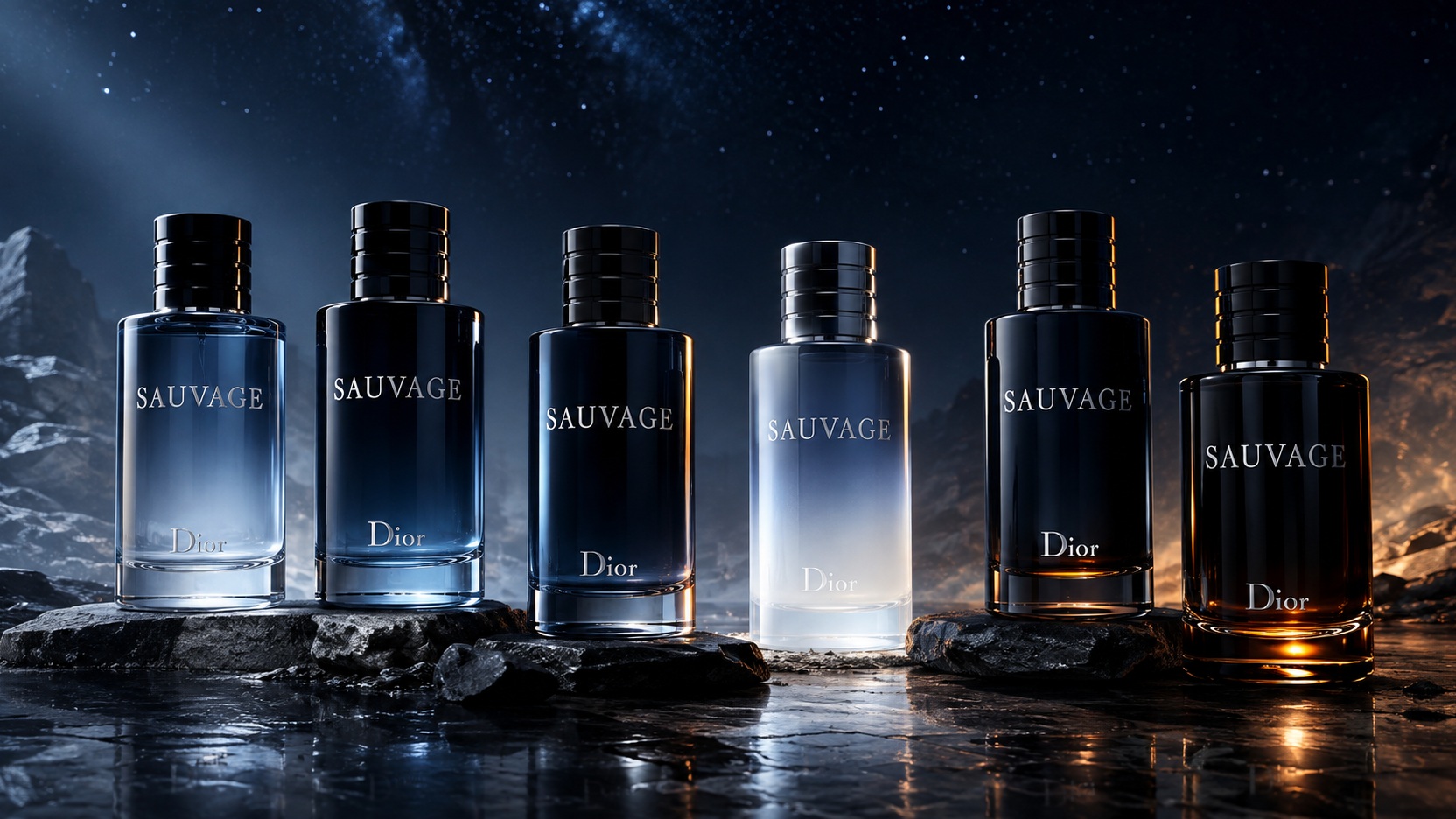
The Sauvage family has grown big enough to transform a simple question - "which concentration do I buy?" - in a profile decision. In 2026, EDT, EDP, Parfum, Eau Forte, Elixir and Extrait are not just six steps of intensity. Dior itself describes formulas with different raw materials and olfactory directions, and the new Extrait deepens this separation by placing Vietnamese oud and a set of woods at the center of the composition.
The short answer is this: EDT is the freshest, citrusy and direct way; the EDP maintains freshness, but gains vanilla and more density; the Parfum becomes creamier and warmer; Eau Forte exchanges citrus logic for cold spices, lavender and musky woods in an alcohol-free formula; the Elixir goes to spices, lavender and rich woods; and Extrait goes in a darker, woodier, smokier, oud-centric direction. The best choice depends much more on the effect you want than on the name of the concentration.
The first rule: don't treat the six as a strength ladder
The names EDT, EDP and Parfum suggest a known progression of concentration, but, within Sauvage, this does not mean that the formula is identical and just receives more aromatic material. The official description already shows structural changes: the EDT highlights bergamot, pepper and amber wood; the EDP adds a vanilla with a subtly smoky tone; and the Parfum works with tangerine, tonka bean and creamy sandalwood.
Eau Forte, Elixir and Extrait make the comparison even less linear. Eau Forte is an alcohol-free composition created to combine freshness and intensity through another architecture. Elixir is a proprietary formula of spices, lavender and rich woods. Extrait, released in 2026, was conceived by Francis Kurkdjian as a denser, woodier interpretation, with Vietnamese oud, patchouli, vetiver and cedar. Therefore, choosing the "more concentrated" label may lead to the wrong perfume for your taste.
Sauvage EDT: the freshest, most incisive and recognizable
In Dior's description, Sauvage Eau de Toilette combines Calabrian bergamot, Sichuan pepper and an amber and marine trail associated with ambroxan. It's the version in which the contrast between bright citrus, spice and clean wood appears most clearly.
As a practical read, it is the easiest option for those who prioritize warmth, daytime use and a feeling of freshness. It's also the safest starting point for anyone who wants classic Sauvage DNA without pushing it toward vanilla, sandalwood, dense spice, or oud. That doesn't mean it's discreet; This means that the olfactory weight tends to be lower than in the darker versions of the family.
If the idea is a single perfume for very hot weather, commuting, routine and informal situations, the EDT makes sense. Those who find the amber accord of the original Sauvage too sharp or synthetic may prefer EDP or Parfum, which round off the signature more.
Sauvage EDP: the easiest middle ground to recommend as versatile
The Eau de Parfum maintains the bergamot, but changes the center of gravity with woody patchouli and vanilla extract from Papua New Guinea, described by Dior with subtly smoky facets. The official result is less purely citrusy and more sensual than the EDT.
In editorial practice, it is the most balanced candidate for those who just want a Sauvage and intend to use it day and night. It remains recognizable as part of the family, but gains enough warmth to get through dressier occasions without reaching the density of Elixir or
Extract.
In hot weather, the amount applied continues to matter. The EDP does not automatically become a cold perfume, but its vanilla and greater body can be more tiring than the EDT under intense heat. For those who live in a hot region and want a single option, the decision between EDT and EDP is usually more useful than simply asking which one "sticks better".
Sauvage Parfum: creamier, warmer and more polished
Sauvage Parfum replaces part of the cutting edge of the first versions with tangerine, tonka bean and sandalwood. Dior describes sandalwood as dense, milky and unctuous, while tonka envelops vanilla and helps create a softer feel.
For this reason, Parfum makes sense for those who like Sauvage, but want a smoother and less aggressive presentation. It's an interesting choice for nighttime, air-conditioned environments, meetings and situations in which a creamier scent matches better than a very open citrus one.
It is not correct to assume that Parfum will necessarily be the one that projects the most or the one that lasts the longest on any skin just because of the name. Projection, perceived persistence and evolution depend on the formula, skin, climate and amount applied. Here, the most useful difference is one of olfactory texture: less citrus edge, more heat and creaminess.
Sauvage Eau Forte: the most different among the fresh options
Eau Forte is not a reinforced EDT. The formula is alcohol-free and combines an aqueous phase with a scented oily formula. Francis Kurkdjian described the creation as fresh as an eau de toilette and intense as a parfum, but the chosen path abandons the traditional protagonism of lemon and bergamot in favor of cold spices, "bleached" lavender and musky woods.
This detail changes the purchase. Those looking for the citrus brightness of the original Sauvage may find Eau Forte strange even if they like fresh perfumes. Those who prefer lavender, musk and a more watery sensation may see it as the most interesting alternative for heat and daytime use.
The main comparative advantage is precisely not repeating the formula of others. If you already have an EDT or EDP, Eau Forte tends to add a greater contrast to the collection than simply purchasing the next strength.
Sauvage Elixir: spices, lavender and high density woods
Elixir is another independent composition. Dior highlights grapefruit, cinnamon, nutmeg and cardamom at the beginning, its own lavender in the heart and a base of rich woods, amber accord, licorice, vetiver and patchouli. It has a spicier and darker profile than EDT, EDP and Parfum.
User reports for years describe Elixir as very present and capable of dominating environments when applied in excess. Since these reports vary by batch, skin, and perception, it doesn't make sense to turn this into a universal number of hours. The reliable point for the decision is that the formula was designed to be concentrated and impactful, and its spice and wood profile favors mild or cold weather, nighttime and occasions when presence is desirable.
If the objective is absolute versatility, Elixir usually requires more care than EDT or EDP. If the objective is a strong, spicy and recognizable signature, it is precisely the version created for
this territory.
Sauvage Extrait: oud and woods in the 2026 launch
Dior Brasil created a launch page announcing availability on August 6, 2026 and, at the time of this article, the Brazilian fragrance page was already highlighting the new Sauvage Extrait. The product's international page presents it in 50 ml and describes it as Dior's first men's parfum extract.
The official construction is woodier than that of Elixir. There is a fresh top of bergamot and lavender from Provence, but the heart is formed by Vietnamese oud essence with leathery facets, while patchouli from Indonesia, vetiver from Madagascar and cedar from Virginia build the base. Dior also says the formula spends 42 days maturing and macerating.
The oud is the difference that changes the choice the most. The brand itself describes this raw material with warm, animal, leather, honey and incense facets. This shifts Extrait into a darker, more resinous camp than simply "Bigger Sauvage."
The first reports from users in 2026 are varied, but there is a clear recurrence in the descriptions: smoke, wood, resin and a feeling of greater distance in relation to classic Sauvage. Some find it more stylish and wearable than they expected; others find the smoky accord heavy or prefer Elixir. This divergence is a good reason not to make a blind purchase if oud, smoke or dense woods tend to divide your preference.
Extrait or Elixir: the most confusing comparison in 2026
If you just look at the hierarchy of names, Extrait seems to simply occupy the place above Elixir. Olfactorily, the decision is different. Elixir is organized around warm spices, lavender, amber accord, licorice and woods. Extrait places oud, leather and contrasting woods at the center, keeping bergamot and lavender as a link to the family.
Choose Elixir if the part that most appeals to you is the combination of spices, lavender and woody sweetness. Choose Extrait if you want a darker, dry, smoky version marked by oud and woods. For night and cold, both make sense; the decisive criterion is not which is "stronger", but which olfactory direction suits you.
It's also worth considering familiarity. Elixir already has a longer history of use and opinions. Extrait is new, and some of the ratings are still being formed under the influence of the release. If the purchase is expensive or difficult to return, testing both on your skin on different days is more informative than just comparing scent strips for a few minutes.
Which one to choose for hot weather
For strong heat, the simplest way is to start with EDT. It preserves the bright citrus and has less density than traditional versions. Eau Forte is the alternative for those who want freshness, but prefer lavender, cold spices and musk to bergamot and ambroxan.
EDP can still work in hot weather, especially with moderate application and nighttime use, but it delivers more body. Parfum, Elixir and Extrait make more sense when the temperature drops, the environment is air-conditioned or the person already knows that they like dense perfumes even in the heat.
Which one to choose for nighttime and mild or cold weather
Parfum is the softest and creamiest option. Elixir is the most spicy and intense. Extrait is the most woody, smoky and oud-centric. EDP is somewhere between worlds: it's still versatile enough for daytime, but has enough depth for nighttime.
If you want a nighttime scent without going into too heavy territory, Parfum or EDP are more conservative choices. If you want presence and contrast, Elixir and Extrait are the natural candidates, each with a very different signature.
Which one to choose if you just want a Sauvage
For most people looking for a single bottle for a variety of situations, EDP is the easiest synthesis: it maintains freshness, adds vanilla and wood, and doesn't stray too far from the known DNA. If your climate is very hot or you prefer sharper scents, EDT may be the most logical choice. If you reject very citrus notes and prefer a smoother texture, Parfum becomes the best candidate.
Eau Forte, Elixir and Extrait are purchases more guided by specific taste. Eau Forte for those who want a watery, alcohol-free reinterpretation; Elixir for those looking for spices and lavender in high density; Extrait for those who want oud, leather and woods in a darker interpretation.
How to test the six versions without making mistakes in the store
Don't compare six perfumes just for the first minute. EDT and EDP open with more citrus brightness, while Elixir and Extrait reveal much of what sets them apart as spices, woods, leather and resins appear. A decision made only at opening unfairly favors the brightest versions.
The best method is to reduce the number of candidates first. Choose two or three from the desired profile and test them on your skin on different days. Observe the opening, the middle phase and the bottom after a few hours. If you're on the fence between Extrait and Elixir, this evolution is especially important, because the point of separation is less in the initial impact and more in the direction of spices versus oud and woods.
Don't use praise from third parties as your main criterion either. Sauvage is a very popular line and, precisely for this reason, opinions about "more praised", "more masculine" or "more sophisticated" carry a lot of personal context. The most useful comparison is between how you smell, the climate you live in, and how often you actually intend to use the fragrance.
Official description, user perception and limits of this comparison
The notes, the alcohol-free formula of the Eau Forte, the oud construction of the Extrait, the 42-day maturation and the August 6 announcement on the Brazilian website come from official Dior pages. Climate, time and versatility indications are an editorial reading based on these olfactory structures, not an official brand classification.
Observations about smoke, wood, perceived power and distance from the classic Extrait DNA were treated as user perception, not objective fact. They appear recurrently in recent discussions, but remain subject to taste, skin, environment and expectations.
This comparison does not include extended use testing of the six versions. Therefore, it does not assign closed fixation or projection numbers and does not transform community reports into measurements. For an individual purchase, especially Elixir or Extrait, try it on your skin
remains the most reliable tiebreaker.
In one sentence: which Sauvage to choose
EDT for freshness and warmth; EDP for balance and versatility; Parfum for creaminess and warmer elegance; Eau Forte for alcohol-free freshness with lavender and musk; Elixir for spice and presence; Extrait for oud, leather, smoke and woods. The line has become broad enough that "more focused" is a secondary question. In 2026, the best Sauvage is the one that occupies the olfactory territory you actually intend to use.