EDT, EDP, Parfum, and Extrait are useful labels, but they do not work like a mathematical scale that can predict how many hours a fragrance will last. In general terms, they indicate how a house positions the concentration of fragrance material relative to the formula's base. The problem begins when that convention is treated as if every manufacturer used the same percentages, the same materials, and the same formula across every version.
Current guides give different ranges for the same names. The Perfume Society, for example, publishes average values that differ from the bands often used in buying guides such as Fragrance Review. That disagreement does not make the labels useless. It shows that they should be read as references for format and positioning within a line, not as a universal guarantee of strength or longevity.
What EDT, EDP, Parfum, and Extrait usually indicate
The ranges below are approximate. They are placed side by side precisely to show that there is overlap and that there is no single percentage used by every brand.
| Format | The Perfume Society reference range | Range frequently cited by Fragrance Review | Practical reading |
|---|---|---|---|
| EDT, Eau de Toilette | about 4% to 8% | about 5% to 15% | It generally occupies a lighter tier within a line, but that does not mean poor longevity in every case. |
| EDP, Eau de Parfum | about 8% to 15% | about 15% to 20% | It normally represents a more concentrated or denser presentation than the EDT in the same line. |
| Parfum | about 15% to 25% | often around 20% to 30% or more | It usually sits in a rich, concentrated tier, but projection and longevity still depend on the formula. |
| Extrait | about 20% to 30% | often grouped with Parfum and sometimes placed in higher ranges | It is generally one of a house's most concentrated presentations. The term can overlap with Parfum depending on the brand. |
These numbers should not be used to claim that an EDT at 10% is necessarily weaker than an EDP from another brand. First, the ranges overlap. Second, the composition of the fragrance concentrate matters as much as its proportion. Having more fragrance material does not by itself tell you which molecules are present, how they are balanced, how volatile they are, or what olfactory effect the perfumer intended.
Concentration is not the same as longevity
When consumers talk about "longevity," they usually mean how long they can still perceive the fragrance on skin or clothing. Concentration, by contrast, is a characteristic of the formulation and the way the product is presented. The two are related, but they are not equivalent.
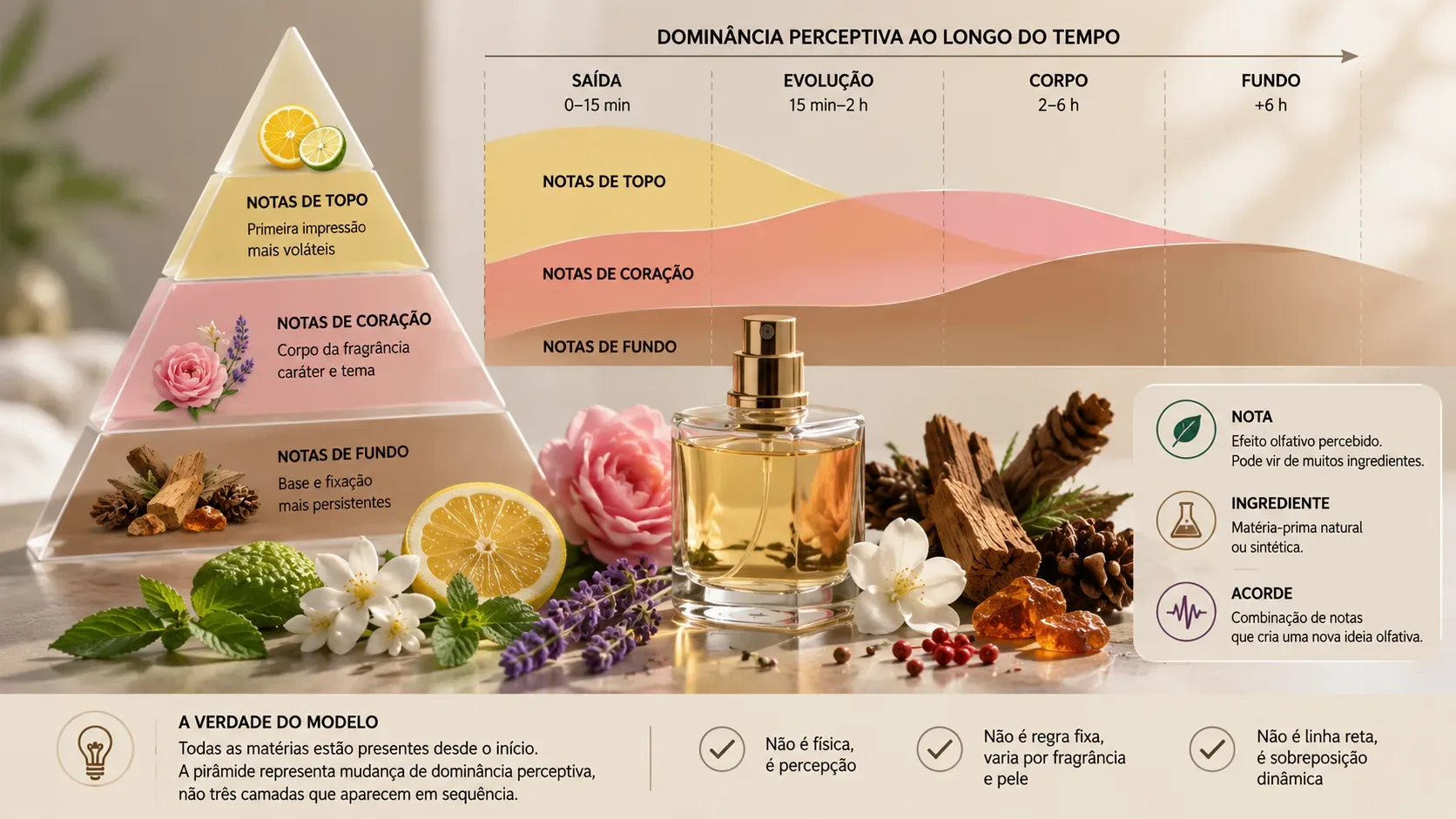
A formula built with slower-evaporating materials such as certain woods, resins, amber materials, and musks can remain detectable for a long time even at a moderate concentration. A composition that relies heavily on citrus, green, or highly volatile top notes may open brightly and become discreet sooner even if it is sold at a higher concentration. Fragrance Review also notes that note structure and formula help explain why two fragrances with the same concentration label can perform very differently.
Application amount, placement, temperature, humidity, skin condition, fabric, storage, and setting can also change the perception of duration and intensity. That is why generic promises such as "EDP lasts eight hours" or "Parfum always lasts longer" oversimplify an experience affected by several variables.
Projection and longevity are different too
Another common mistake is treating "strong," "projects a lot," and "lasts a long time" as synonyms. Projection describes how far the fragrance diffuses and can be noticed at a distance. Longevity describes how long it remains detectable. A fragrance can project strongly for the first minutes and then pull back quickly. Another can stay on skin for many hours with little diffusion into the room.
For that reason, increasing concentration does not guarantee a larger scent cloud around the wearer. In some cases, more concentrated versions can feel denser and closer to the skin. In others, the composition is designed for greater diffusion. The answer depends on the specific fragrance, not only on the letters EDT or EDP, or the word Parfum on the bottle.
An EDP does not have to be simply an EDT with more concentrate
This is where comparing versions of the same fragrance becomes especially important. Some houses use a concentration change as an opportunity to reinterpret the scent. Diptyque states officially that its Eau de Parfum is not simply an Eau de Toilette with a higher concentration. The brand explains that the perfumer may emphasize another characteristic by using new ingredients or a new accord.
In Diptyque's own example, Do Son EDT and Do Son EDP preserve the tuberose identity, but the EDP explores a woodier, more persistent interpretation. This shows why comparing percentages alone can hide the most important difference: the formula may have been rebalanced.
The same principle can apply to Parfum and Extrait. Depending on the house, a more concentrated version may reduce some top notes, reinforce the base, change the texture of an accord, alter the perception of sweetness, or sit closer to the skin. The better question is therefore not only "which has more oil?" but "which version was formulated to create which effect?".
Why concentration ranges overlap
These names developed as conventions within the fragrance market, and different houses adopted their own practices. An average range can therefore guide you, but it does not function as an absolute ruler across brands. The overlap in the table is part of the issue: an EDP from one house may sit in a concentration band similar to a Parfum from another.
It is also important not to confuse concentration with quality. More concentrate can mean a higher formula cost and a richer experience, but quality depends on composition, balance, materials, execution, and the wearer's preferences. A well-constructed EDT can be the better choice for someone who prefers transparency, freshness, or easier reapplication.
How to compare versions without falling for "stronger is better"
- Compare the full product name. EDT, EDP, Parfum, Extrait, Intense, and Elixir can identify different products, not just different strengths.
- Read each version's official notes. Changes in the note pyramid or brand description can signal a reworked accord.
- Test side by side on skin. A blotter helps assess the opening, but real wear shows more clearly how each version develops.
- Watch the opening, middle, and drydown. Do not decide in the first few minutes. Differences between concentrations may become clearer later.
- Separate projection from longevity. Decide whether you want room presence, skin-close persistence, or a balance between the two.
- Consider climate and context. Heat, humidity, enclosed spaces, and spray count can substantially change the experience.
- Do not buy by percentage alone. If a brand discloses concentration, treat it as an additional data point, not a substitute for testing.
So what does the label really tell you?
EDT, EDP, Parfum, and Extrait help identify a version's intended presentation and, in many cases, its relative concentration within the same line. They are useful shortcuts for organizing a comparison. What they cannot do is predict with universal precision how many hours a fragrance will last, how strongly it will project, or whether the more concentrated version will suit you better.
The safest approach is to compare the specific formulas, check how the brand itself describes each version, and test how the fragrance develops in the setting where you plan to wear it. Concentration is an important clue. Perceived performance is the result of the entire formula, application, and environment.