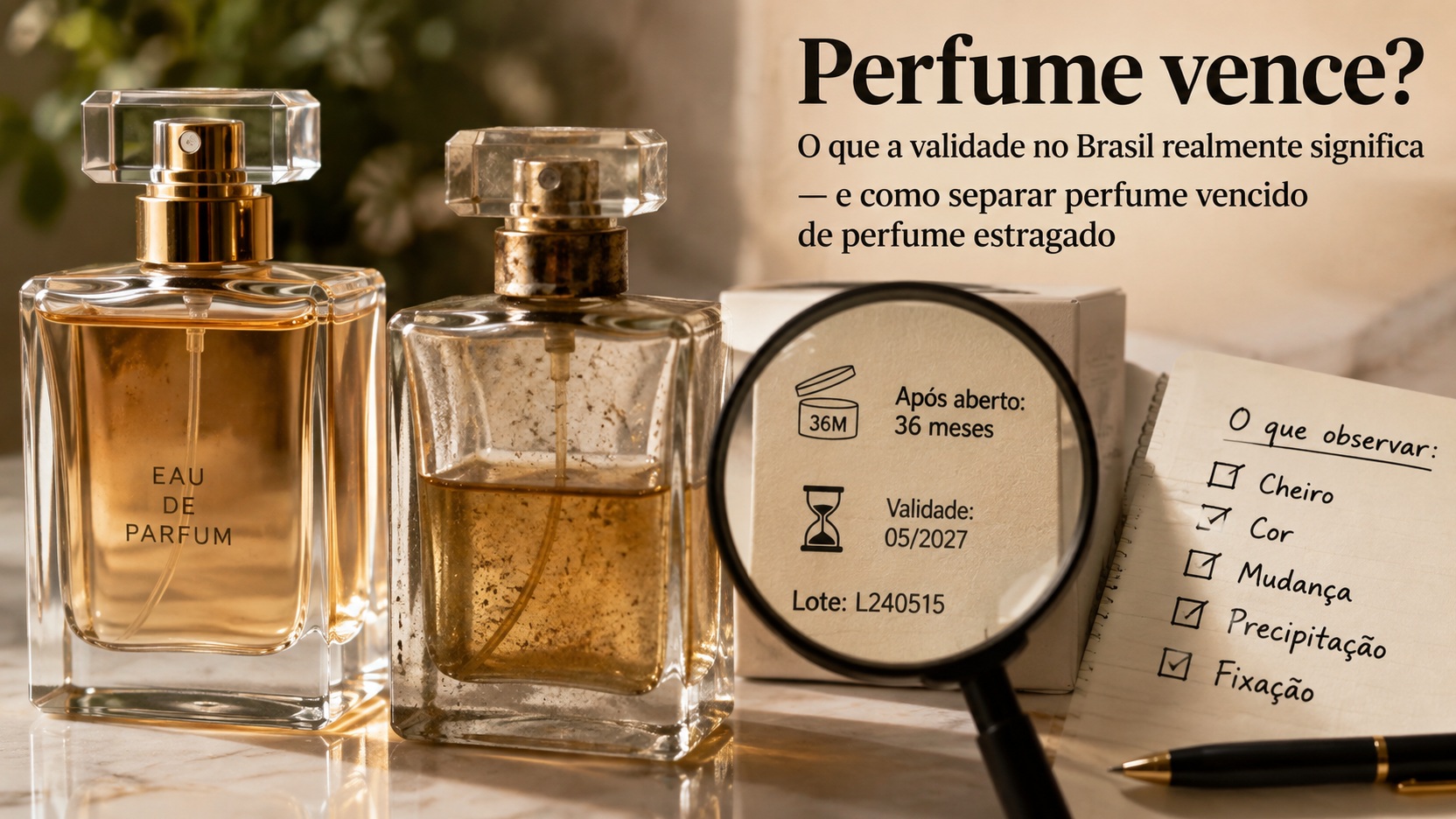
Yes. Perfume expires in the regulatory sense: in Brazil, the product must have a declared expiration date. But the date does not work like a switch that turns a normal liquid into necessarily spoiled perfume from one day to the next. It marks the end of the period during which the manufacturer declares that the product retains its properties under the intended storage and use conditions.
That distinction resolves much of the confusion. “Expired” is a calendar status, defined by the period stated on the product. “Spoiled” or deteriorated describes the actual condition of the contents, when changes indicate a loss of quality, stability, or integrity. The two can coincide, but they are not synonyms.
A perfume's expiration period is not a universal 2, 3, or 5 years
Brazil's current rule is Anvisa RDC 907/2024, as amended. The regulation defines shelf life as the period during which the product retains its properties, provided it remains in its original, undamaged packaging and under appropriate storage and use conditions.
This matters because the rule does not establish a single number of years for every perfume. The declared period depends on the specific product. The same RDC requires, as part of the regularization process, a summary of stability data and states that this summary must include the methodology and conclusion supporting the declared shelf life. The company must also keep the complete stability data available to the health authority.
Therefore, statements such as “every perfume lasts three years” or “perfume always expires after five years” oversimplify an issue that depends on formulation, packaging, process, and stability. Two perfumes can have different expiration periods without either one being irregular for that reason.
Product expiration is not the same as the validity of Anvisa regularization
There is another time period that often creates confusion: the validity of the sanitary regularization. RDC 907/2024 addresses this separately. For products subject to registration, the registration is valid for ten years and may be renewed. For products exempt from registration, maintaining regularization involves declaring an interest in continuing commercialization every ten years.
That ten-year period is an administrative term in the process before Anvisa. It does not mean that a bottle of perfume lasts ten years, nor does it replace the product's expiration date.
The practical distinction is simple. Regularization answers whether that product is authorized to be manufactured, imported, and marketed under the applicable regulatory conditions. The bottle's expiration date answers how long the manufacturer has declared, based on stability, that the product retains its properties under the intended conditions.
Where to find the expiration date on perfume sold in Brazil
Under the current labeling rule, the expiration date must appear on the secondary packaging. The lot or batch number, in turn, must appear on the primary packaging. When the product has no secondary packaging, the mandatory information that would have appeared there must be shown on the primary packaging.
This explains a common situation with older collections: someone kept the bottle but discarded the box. Depending on the presentation, the bottle may retain the lot number without carrying, by itself, the date that appeared on the outer packaging. The lot is useful for traceability, but it should not be treated as a universal formula capable of revealing the expiration date on its own. If the
date is no longer available, the most reliable route is to contact the manufacturer or importer with the lot number in hand.
For imported products, the RDC allows the information required in Brazil to be adapted by means of a label or another method before commercialization. For that reason, a bottle officially intended for the Brazilian market may carry additional information in Portuguese that does not appear in the original artwork from the country of origin.
What about the open-jar symbol with 12M, 24M, or 36M?
This symbol is common on imported cosmetics and usually indicates a period counted after opening. It is a different concept from the printed expiration date. In the general mandatory labeling list in RDC 907/2024, Brazil requires the expiration date but does not include the period-after-opening symbol as a substitute for that information.
If the product carries both references, follow the manufacturer's specific instructions. A “36M” should not be read as permission to go beyond an expiration date that has already passed. Nor does it turn the age of one bottle into a universal rule for other perfumes.
Expired perfume and spoiled perfume: what is the practical difference?
A perfume is expired when it has passed the declared expiration date. From that point on, the period supported by the manufacturer for maintaining the product's properties under the intended conditions has ended. This does not prove that the liquid deteriorated exactly on that date, but neither does it allow you to assume that it still meets specifications simply because it appears normal.
A perfume can, on the other hand, show deterioration before the date if it has been exposed to conditions outside the assumptions for proper storage. The regulatory definition itself makes the stated shelf life conditional on undamaged original packaging and appropriate storage and use. A bottle that spent months in direct sunlight, inside a hot car, or leaking is not in the same situation as one kept closed and protected.
What to observe in an old bottle
A smell very different from what you knew
Odor is one of the classic parameters evaluated in cosmetic stability studies. An obvious and persistent change in the identity of the perfume deserves attention, especially when it appears together with other signs. This is not simply a matter of the fragrance seeming less intense on a particular day, because perception, application, and temperature also alter the experience. The relevant sign is a consistent change in the product itself compared with what it used to be.
Changes in color or appearance
Stability also considers color and appearance. Marked darkening, unexpected cloudiness, separation, particles, or precipitate that were not part of the original appearance can indicate a change. None of these signs, by itself, makes it possible to diagnose the cause at home, and some formulas may change visually without a simple relationship to safety. The point is to recognize an abnormal difference in the same product, not to compare the bottle with a random photograph from the internet.
Compromised packaging, seal, or sprayer
Compatibility between the formulation and packaging is part of stability assessment. Leakage, obvious evaporation, damaged sealing, cracks, unusual corrosion in the assembly, or a sprayer that works abnormally are reasons to question the product's condition. If the packaging no longer protects the contents as it should, the premise used for the stated shelf life is no longer the same.
Weaker longevity alone is a weak sign
A perception that the fragrance lasts less time on the skin can have several explanations and, by itself, does not confirm deterioration. Temperature, amount applied, skin, olfactory adaptation, and comparisons with old memories can all change the sense of performance. Reduced longevity carries more weight when it appears alongside clear changes in odor, color, appearance, or packaging.
What to do with a perfume that is still within its expiration period
If the product is within its stated period, has been stored according to the instructions on the packaging, retains its expected appearance, and the packaging is intact, the date gives no reason to treat it as expired. Even so, any unexpected skin reaction or abnormal change in the product is a reason to stop using it, regardless of the calendar.
It is also worth checking whether the product is regularized if there is any doubt about its origin. Anvisa provides a public consultation service for personal hygiene products, perfumes, and cosmetics. An “active” result indicates that the product is regularized and may be manufactured, imported, and marketed. That consultation, however, does not tell you whether a specific bottle is still within its expiration period and does not replace the label on the lot you have in hand.
What to do with a perfume that has already expired
After the date, the safest information is objective: the declared shelf-life period has ended. A smell that still seems normal does not “revalidate” the bottle, because consumers cannot reproduce stability tests at home or confirm that all specifications continue to be met.
For use on the skin, it is not prudent to treat an expired perfume as equivalent to a product still within its expiration period based only on sensory inspection. If the goal is to keep a rare bottle for sentimental or collection value, that is different from claiming that it remains suitable for cosmetic use. For specific guidance on an old lot, the manufacturer or importer may have technical and historical information that no longer appears on the remaining label.
What to do if the perfume seems spoiled before it expires
The date should not override the evidence. If the perfume shows a significant change in odor or appearance, leakage, compromised packaging, or causes an unexpected reaction, stop using it even if the label still shows a valid period. A product that is within date assumes proper storage conditions and package integrity; the date does not make it immune to quality problems.
If there is a suspected quality deviation in a regularized product, the lot number and manufacturer details are important for contacting the company's customer service and, when appropriate, sanitary surveillance channels.
How to store perfume so you do not shorten its useful life
Heat and light deserve attention. Anvisa's Cosmetic Products Stability Guide treats temperature and light exposure as relevant conditions in studies and notes that light can significantly alter color and odor and lead to degradation of formulation ingredients.
In practice, this favors storage in a place protected from direct sunlight and intense heat sources, with the package tightly closed and the valve or cap assembly intact. Keeping the original box can help reduce light exposure. A car glove compartment, a shelf that receives sunlight, and a bathroom that gets very warm are less favorable environments than a stable, protected cabinet.
What the label actually tells you
The expiration date on a perfume in Brazil is neither a generic guess nor the same thing as the validity of its Anvisa regularization. It is the declared period during which the product is expected to retain its properties, and it must be supported by stability data. For that reason, there is no regulatory basis for imposing the same two-, three-, or five-year period on every fragrance.
When evaluating an old bottle, ask two different questions. First: has the expiration date passed? Second: does the product show signs of change, or has its storage been compromised? The first identifies expiration. The second helps identify possible deterioration. A perfume can be expired without an obvious change, and it can change before the deadline if conditions are unsuitable.
If the box is gone, look for the lot number, contact the manufacturer, and do not confuse the product's regulatory status at Anvisa with the expiration date of that bottle. And when the declared period has ended or there are clear signs of change, smell alone is not a certification that the product continues to meet specifications.