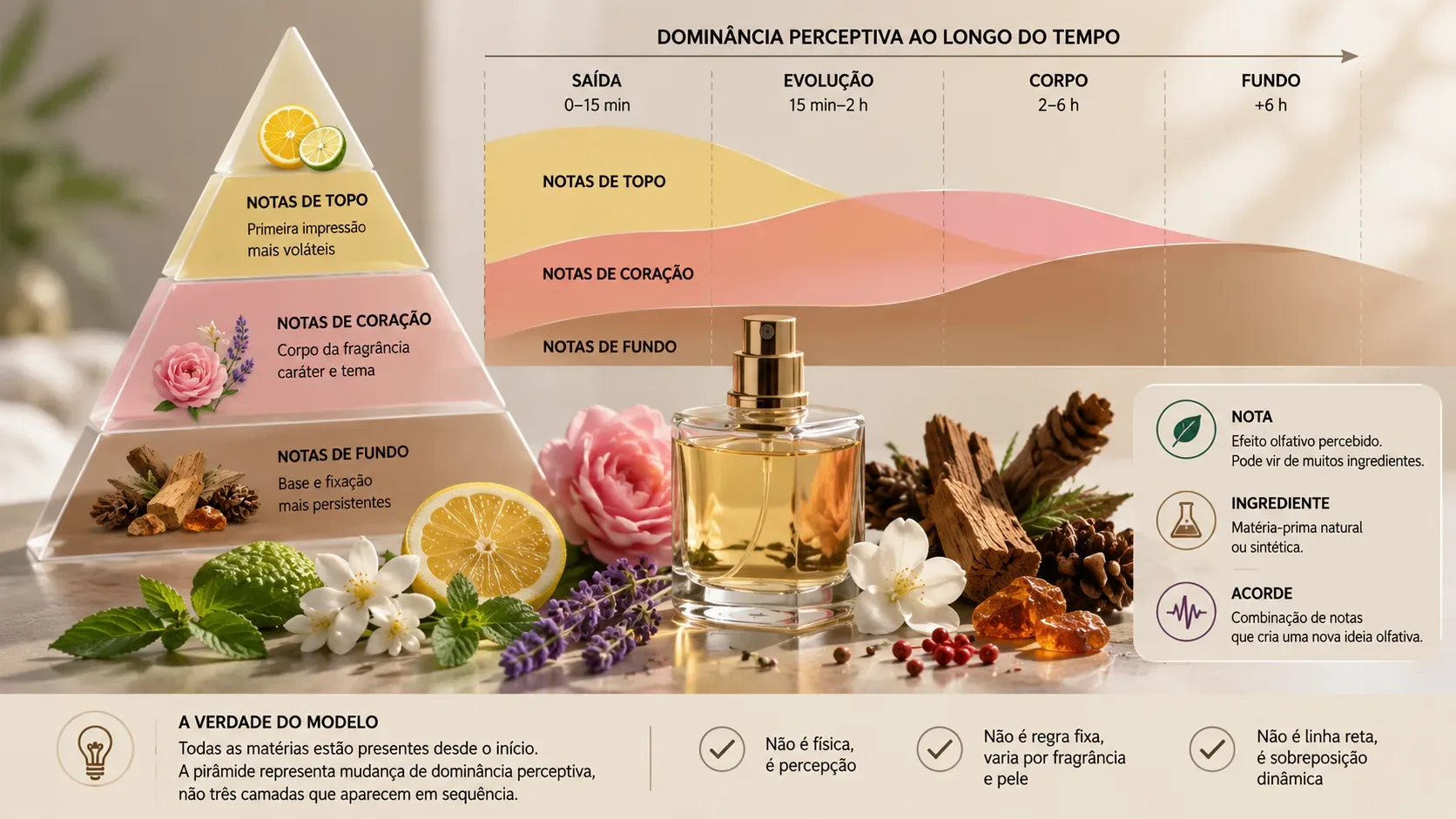
Short answer: no. Top, heart and base notes are not three physical layers that begin evaporating one after another. The fragrance pyramid is a useful model for describing changes in perceptual dominance over time. In a fragrance, multiple odor-active components begin partitioning between the liquid, skin and air from the moment of application, but they do so at different rates and with different perceived intensities.
This is why a citrus effect can dominate the first minutes without being the only material present, why a woody effect may be noticeable early even when it is associated with the base, and why some perfumes evolve dramatically while others feel almost linear. The pyramid organizes the experience; it is neither a stopwatch nor a snapshot of the formula.
What the fragrance pyramid actually represents
Classical perfumery commonly organizes descriptions into three zones: top or opening, heart, and base. The Perfume Society presents this convention as a way to explain fragrance development: lighter materials tend to shape the opening, the heart supports the body of the composition, and more persistent materials contribute more strongly to the dry-down.
The key word is tend. The division is a simplification of a continuous process. A modeling study on the diffusion of perfume mixtures notes that the traditional pyramid view is an oversimplification: odor-active components can begin evaporating from the moment of application, each at its own rate, while the vapor above the fragrance contains a mixture whose composition changes over time. The nose perceives this mixture simultaneously, but with different perceptual weights. See the study in Chemical Engineering and Processing.
So why does the smell change so much over time?
Because chemical presence and olfactory prominence are not the same thing. Perceived evolution depends on several factors working together:
- Volatility: materials with higher vapor pressure tend to reach the air more readily; others remain longer in the liquid, on skin or on surfaces.
- Air concentration: the amount of each component in the headspace changes as the fragrance evaporates and diffuses.
- Odor threshold and intensity: a molecule present in a small amount can have strong olfactory impact, while another may require a higher concentration to become noticeable.
- Mixture interactions: components do not evaporate as if they were isolated. The composition of the liquid can change the relative release of each material.
- Vehicle and surface: alcohol, cream, soap, fabric and skin alter how materials are retained and released.
That last variable is not a minor detail. A headspace study of ingredients applied to skin found different diffusion rates among odorants and showed that the application vehicle can change release speed; in a soap base, for example, components evaporated more slowly than from an alcoholic solution. The abstract is available on PubMed.
More recent research also reinforces that persistence on skin depends on the material's physicochemical properties and its affinity for the skin surface. A 2024 study on measuring fragrance evaporation highlights that volatility, chemical structure and interactions with skin influence release kinetics. See the paper in Talanta.
Top, heart and base: how to read them without turning them into rigid rules
| Zone | What it usually indicates | How to interpret it cautiously |
|---|---|---|
| Top / opening | The initial impression and effects that gain prominence soon after application, often associated with more volatile materials. | It does not mean only those materials are evaporating. Heart and base elements can be perceived from the start. |
| Heart | The perceptual body that becomes more apparent as the opening loses dominance. | There is no universal minute when the heart “starts.” The transition overlaps and depends on formula, dose, skin and environment. |
| Base / dry-down | The more persistent effects that tend to dominate as more fleeting materials decline. | “Base” does not mean absent at the beginning. Persistent materials can contribute texture, volume and character from the first spray. |
For that reason, ranges such as “0–15 minutes,” “15 minutes–2 hours,” or “after 6 hours” should be treated as teaching examples rather than laws. The Perfume Society itself notes that there are modern fragrances described as linear, designed to change relatively little during wear.
The pyramid does not classify molecules by weight alone
Another common shortcut is to think that top means “small molecule,” base means “large molecule,” and that molecular size alone determines the order. In practice, volatility matters, but perception does not depend on a single variable. Vapor pressure, polarity, intermolecular interactions, solubility, affinity with skin, concentration and odor threshold all contribute to the result.
This matters because the pyramid is a sensory and performance model, not a simplified periodic table. Two materials with similar volatility can have very different perceptual impact, and a low-volatility material may be noticeable early if it has enough olfactory presence or if the formulation favors its release.
Note, ingredient and accord are not the same thing
Much of the confusion disappears when these three terms are separated:
- Ingredient: a material actually used in the fragrance composition or mixture. It may be natural, synthetic or functional. The IFRA Transparency List is an example of an inventory of the ingredient palette used by the industry.
- Note: a way of naming a perceived olfactory impression or facet, such as bergamot, rose, leather, tea or “marine.” In consumer-facing descriptions, a note should not automatically be read as a declaration that one specific ingredient is present.
- Accord: a combination of materials that produces a coherent impression, such as an amber, leather or fougère accord. The perceived effect can function as a “note” in a description even though it is built from multiple ingredients.
This distinction also explains why two fragrances listing the same notes can smell very different. The list does not disclose proportions, raw-material quality, supporting molecules, internal accords, solvents or the interactions that control diffusion. IFRA describes fragrances as mixtures of ingredients in carefully measured amounts and explains that perfumers combine natural and synthetic materials to construct a composition; see IFRA's explanation of how fragrance is made.
A better mental model: overlapping curves
Instead of imagining three floors that switch on one after another, imagine several overlapping curves. Some rise quickly and fall early; others maintain a steadier presence; others increase in relative dominance because more fleeting components are declining. What changes is not only “who is present,” but who occupies more of the perceptual foreground at each moment.
This picture explains three situations that a rigid pyramid tends to confuse:
- A base effect noticeable from the start: a wood, musk or amber effect can structure the opening even before it becomes dominant.
- A top effect that lasts longer than expected: formulation, dosage, encapsulation, solvent or interactions with other materials can extend a fresh effect.
- An almost linear perfume: a composition can be designed to maintain a similar signature from opening to dry-down even though the vapor composition continues to change.
How to test a perfume without being misled by the first minute
If the goal is to understand real development, a single sniff immediately after spraying is not enough. A simple test is to observe the fragrance at different moments without imposing universal timings:
- First minutes: record the opening without assuming it represents the whole perfume.
- After alcohol and the most fleeting effects recede: notice what gains body and which accords become clearer.
- Later in the same wear: evaluate the dry-down, persistence and what remains close to skin or fabric.
- Compare blotter and skin: paper helps you observe the composition with less biological variation; skin shows how retention, temperature and surface characteristics affect performance.
The goal is not to find the exact minute when “the heart begins,” but to notice how the olfactory hierarchy changes. For choosing a fragrance, that is more useful than treating the pyramid as a rigid sequence.
What you can conclude from a note pyramid
Used well, a pyramid gives clues about the fragrance's intended trajectory: whether the opening is meant to feel citrusy or aromatic, which accord is likely to support the body, and what type of persistent signature appears in the dry-down. It can also help compare different construction styles.
What it cannot reveal on its own is the formula, the concentration of each ingredient, the exact duration of each phase or the physical evaporation order of every molecule. Those questions would require composition data and instrumental measurements of volatility, headspace and retention under defined conditions.
In short: top, heart and base are best understood as zones of perceptual dominance. Evaporation chemistry occurs simultaneously and interactively; perception reorganizes that mixture over time. The pyramid remains useful—as long as it is read as a map, not as three drawers that open one after another.
Sources and further reading
- The diffusion of perfume mixtures and the odor performance — evaporation modeling and discussion of the limits of the traditional pyramid view.
- Headspace analysis study of evaporation rate of perfume ingredients applied onto skin — ingredient diffusion on skin and the influence of the vehicle.
- An innovative device for in vivo and in vitro study of fragrance evaporation — 2024 work on evaporation kinetics and retention on skin/surfaces.
- The Perfume Society — FAQ — explanation of the top, heart, base convention and linear fragrances.
- IFRA Transparency List and How is fragrance made? — references on ingredients and fragrance composition.