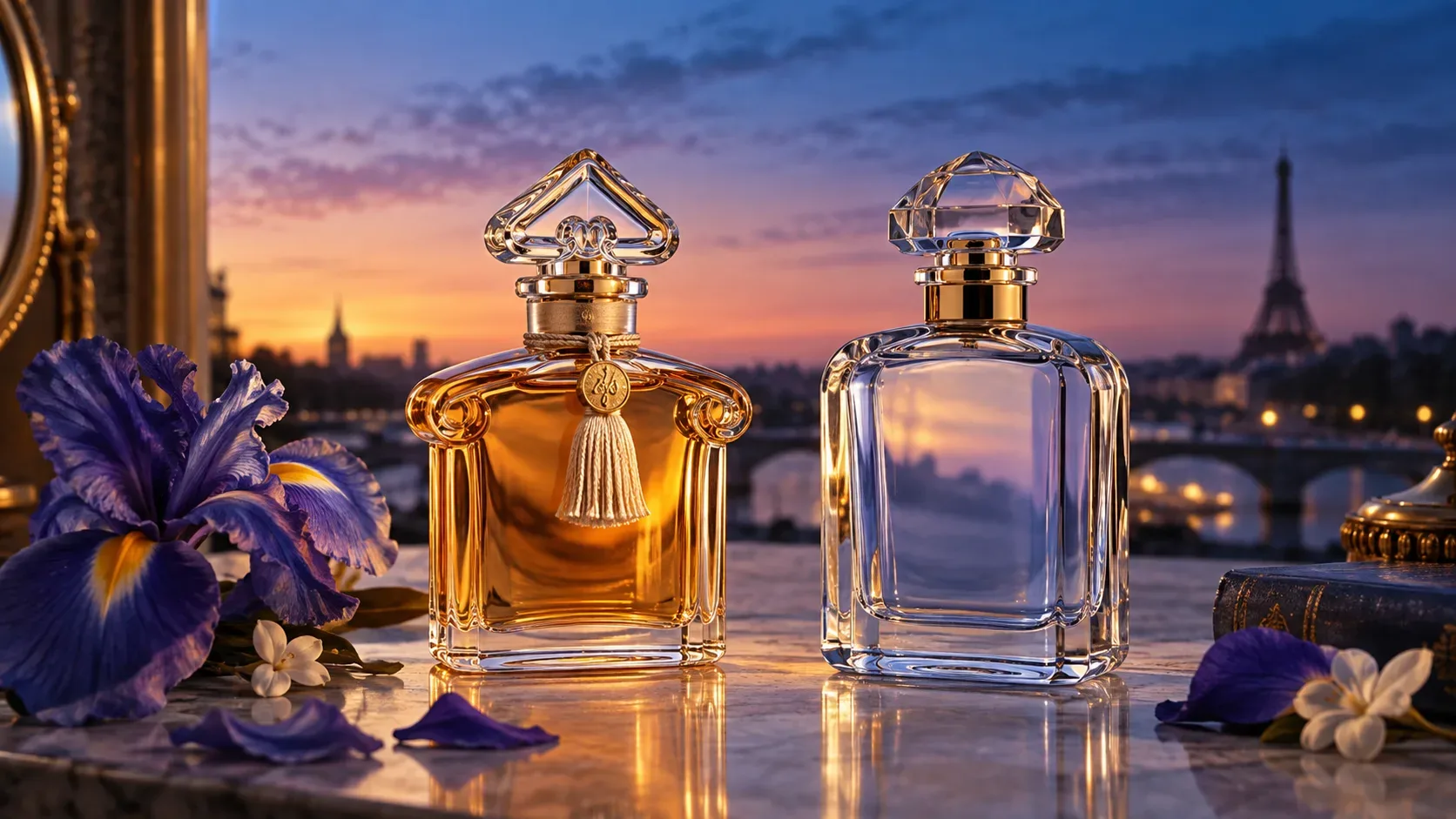
The L’Heure Bleue introduced by Guerlain in 2026 should not be read as a simple formula change to the historic perfume. The Maison itself describes it as a contemporary reinterpretation by Delphine Jelk, while the L’Heure Bleue associated with Jacques Guerlain’s 1912 creation remains in the Les Légendaires collection. That coexistence is the key to comparing them: the new release revisits the “blue hour” idea and several olfactory pillars, but builds a different experience around them.
What the 2026 L’Heure Bleue is
The new Eau de Parfum starts from the same moment between day and night that inspired the 1912 creation, but uses its own olfactory language. On its official product page, Guerlain classifies it as an ambery floral and structures it with an ozonic accord, pear and neroli in the opening; iris tincture, iris butter and jasmine in the heart; and vanilla, Ambroxan and musks in the base. The Maison also stresses that the iris tincture was developed specifically for this fragrance.
According to LVMH’s institutional communication, the tincture uses selected iris rhizomes grown in Italy and is the result of three years of research with Guerlain’s teams at the Orphin manufacture. The process draws on the traditional tincturing principle — macerating a natural material in alcohol — to reveal what the company describes as a fresher, airier facet of iris.
What changes from the historic construction
The difference becomes clearer when the architecture published for L’Heure Bleue 1912 is considered. In the current Les Légendaires presentation, the historic composition is described with aniseed and bergamot at the top, neroli and a carnation accord in the heart, and an ambery, powdery base of iris, vanilla, benzoin and tonka bean, alongside the violet accord associated with the perfume’s identity.
In 2026, the design moves in another direction. The opening emphasizes brightness and air through an ozonic accord and pear; the heart makes iris a material protagonist by combining iris butter with a new tincture; and the base replaces part of the explicitly resinous, powdery vocabulary of the historic perfume with Ambroxan and musks alongside vanilla. The two note structures are therefore related, but not equivalent.
What remains
Three continuities explain why Guerlain kept the L’Heure Bleue name. The first is the blue-hour idea: the suspended instant between light and night remains the narrative center. The second is iris, historically important to the fragrance’s signature and now explored through a different technique. The third is vanilla, preserving the enveloping warmth associated with the Guerlain identity.
LVMH’s communication also says that iris and orange blossom remain central to the new creation. At the same time, the 2026 commercial note pyramid reorganizes that floral universe around neroli, jasmine and two expressions of iris. In other words, “remaining” does not mean repeating the same formula note for note.
Changed, remained, or not replaced?
| Aspect | 2026 | Comparative reading |
|---|---|---|
| Concept | The “blue hour” remains the central image. | Remained. The day-to-night transition links both creations. |
| Iris | Custom iris tincture + iris butter. | Changed and remained. The material is still essential, but its treatment is new and more explicit. |
| Opening | Ozonic accord, pear and neroli. | Changed. The historic construction foregrounded aniseed and bergamot. |
| Floral heart | Iris and jasmine, with neroli placed in the opening of the official pyramid. | Changed. The historic profile emphasizes neroli and carnation, alongside the violet-and-iris universe. |
| Base | Vanilla, Ambroxan and musks. | Partly changed. Vanilla remains; benzoin and tonka, highlighted in the historic construction, give way to a different supporting base in the 2026 description. |
| Historic perfume | Still part of Les Légendaires. | Not replaced. The new Eau de Parfum exists alongside the Maison’s historic creation. |
| Bottle | The inverted-heart shape is reinterpreted with a blue gradient and refillable format. | Remained and changed. The historic silhouette is retained while the finish is contemporary. |
Why the iris tincture is the decisive point
The iris tincture is more than an extra note in the pyramid. It is the technical argument behind the reinterpretation. Guerlain says the ingredient was created under Delphine Jelk’s direction to capture iris more fully, giving it a fresher, more botanical and woody expression. Iris butter, meanwhile, preserves the creamy, velvety density commonly associated with the material.
That combination helps explain the 2026 project. Rather than trying to reproduce the exact powdery-amber texture of the historic construction, the new fragrance creates a contrast between airy freshness, velvety iris and warm vanilla. It continues the theme using a different olfactory grammar.
So is it a reformulation, a flanker, or a new perfume?
For a practical answer, the safest description is: it is a new interpretation of L’Heure Bleue, not a silent replacement of the historic version. “Reformulation” usually implies that an existing product has received a new formula and that the prior version is no longer the commercial reference. Here, Guerlain itself distinguishes L’Heure Bleue 1912 from the new Eau de Parfum and keeps the historic creation in Les Légendaires.
There is also no need to force the “flanker” label if the Maison does not use it. The official positioning is a contemporary reinterpretation: a fragrance that claims the same story while having its own composition, protagonist material and presentation.
How to compare them without expecting one to “win”
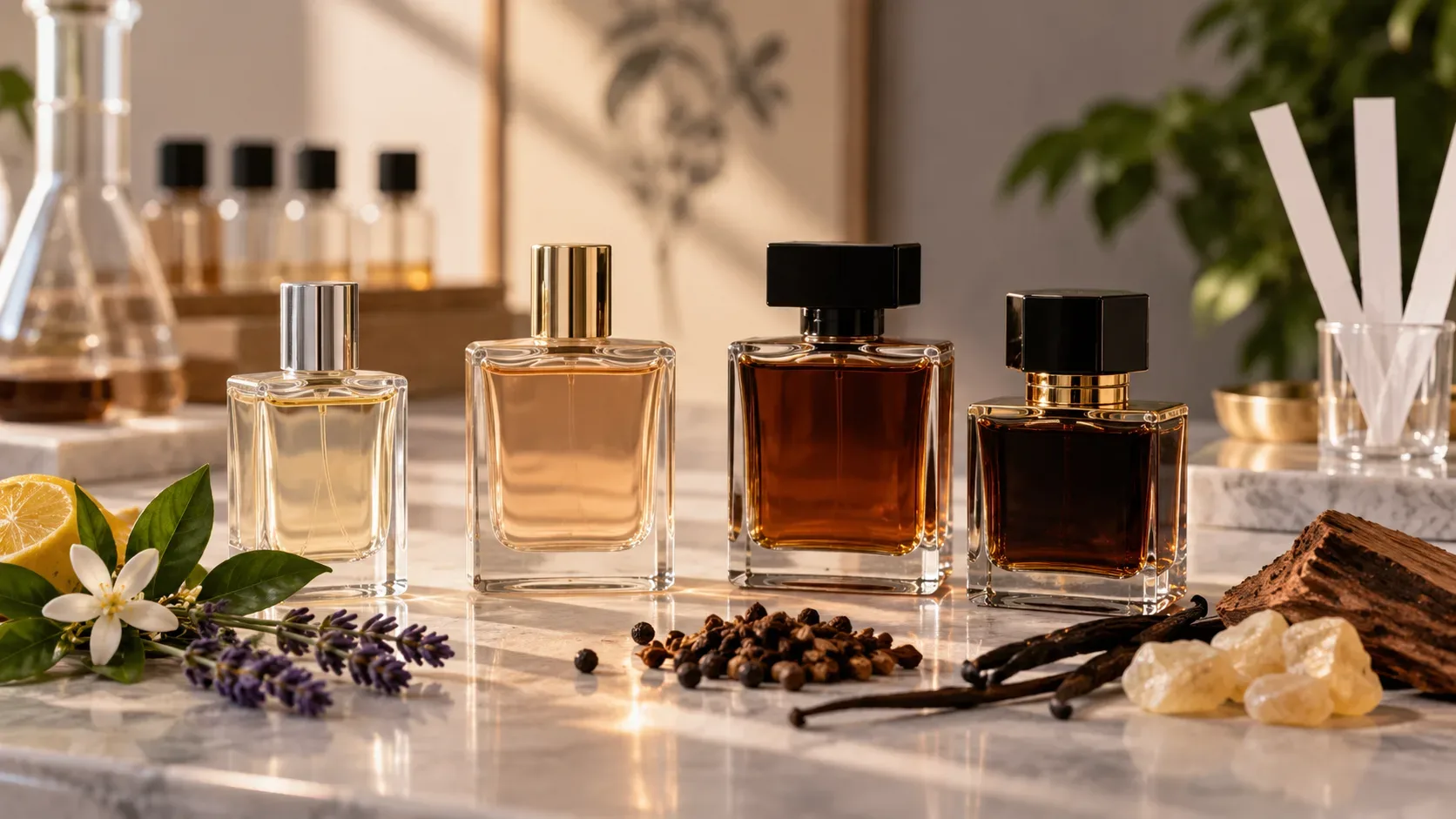
Anyone familiar with the historic L’Heure Bleue can compare the two by axes rather than by immediate similarity. Start with the opening: aniseed and bergamot in the historic profile versus an ozonic, fruity sensation in 2026. Then follow the iris: more integrated into the powdery amber accord in the historic profile, more focused and textural in the contemporary reading. Finally, notice the base: vanilla is the bridge, but its surroundings move from benzoin and tonka to Ambroxan and musks in the published pyramid for the new release.
This approach avoids two simplistic conclusions: that the 2026 edition “modernized and replaced” the old one, or that it is merely a lighter copy. What the official sources show is a deliberate family relationship combined with commercial coexistence.