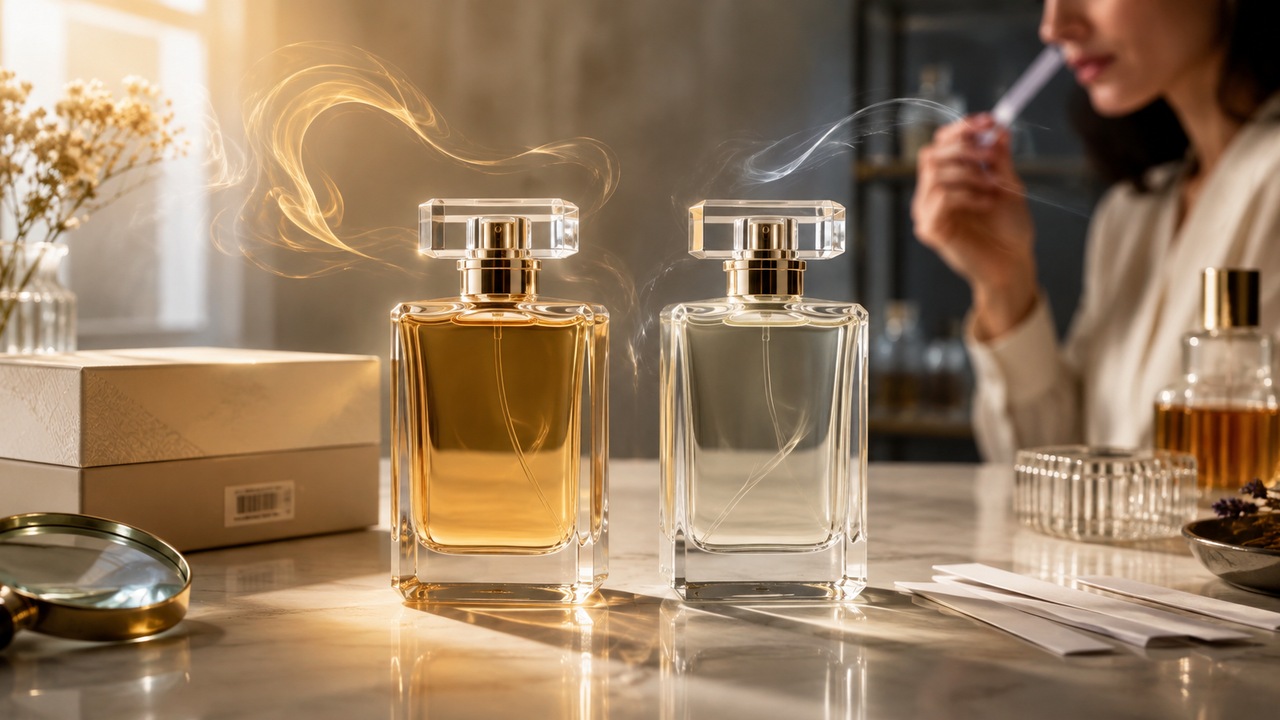
You buy a second bottle of the same fragrance and something seems wrong. The opening is more citrusy, the background seems less dense, the projection has dropped or that note you remembered no longer appears in the same way. The most tempting conclusion is to say that the perfume has been reformulated. The problem is that this hypothesis shares the same space with other explanations: different version, batch from another time, uneven conservation, aging of the liquid, variation in application and even adaptation of the sense of smell itself.
The safest way to investigate is not to look for a magic sign. It’s putting together a hierarchy of evidence. Reformulation is strong when there is documentation or a consistent set of evidence that points to a change in formula at a given time. An isolated batch code, a darker bottle or the feeling that the perfume "no longer lasts" are clues, not proof.
Start by confirming that the two bottles are actually the same product
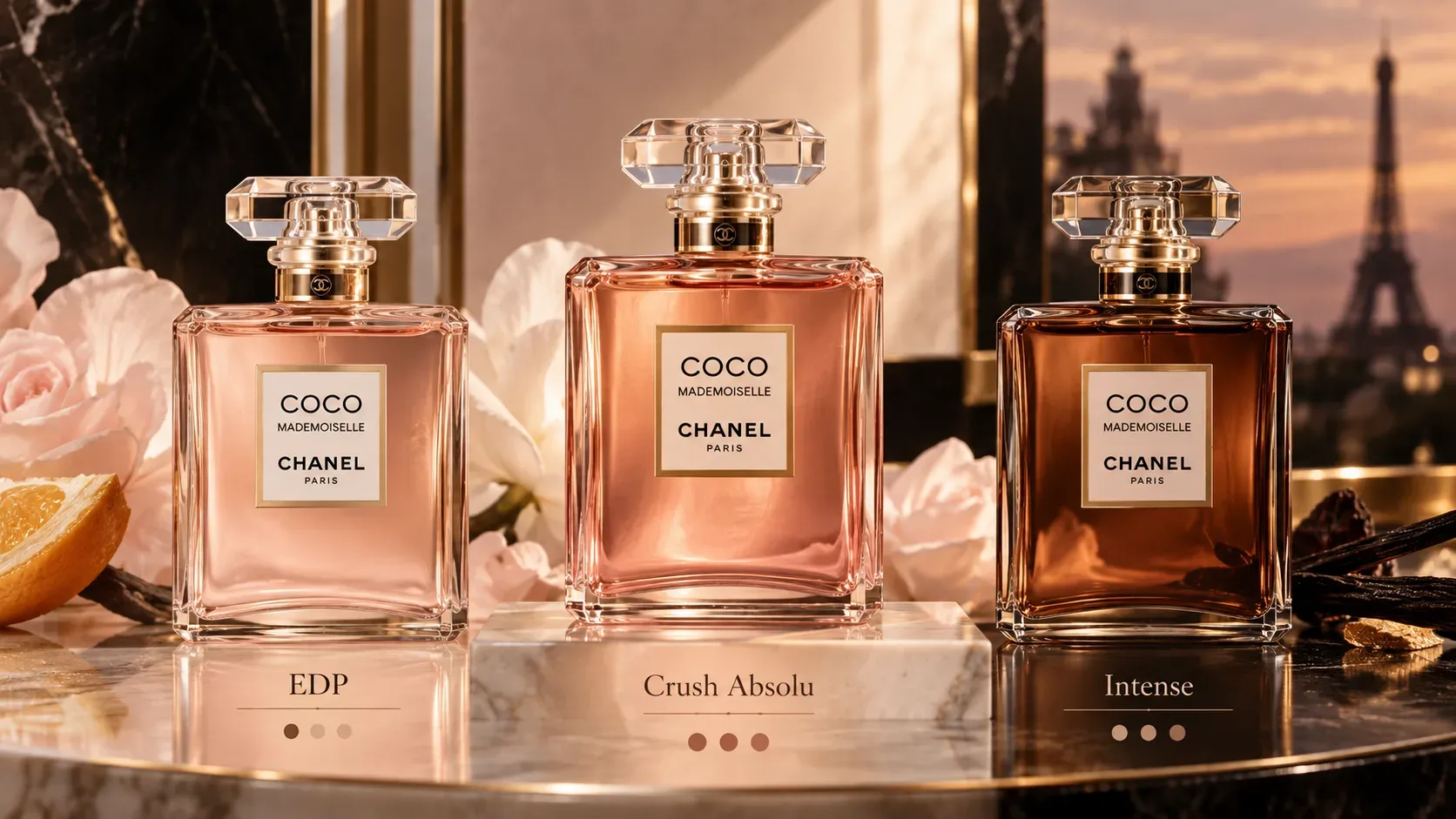
Before comparing smell, confirm the full trade name and concentration. Eau de Toilette, Eau de Parfum, Parfum and "Intense", "Elixir", "Absolu" versions or flankers with almost the same name can share packaging and olfactory DNA without sharing a formula. It is also worth checking that the two bottles have the same commercial presentation, the same licensing brand and that there has been no clear change of manufacturer or distributor indicated on the box.
This step seems basic, but it eliminates an important part of false diagnoses. A consumer may remember the main name and forget that the first bottle was EDT while the second is EDP, or compare an old edition with a variation that retained much of the design.
If the business identification doesn't match exactly, stop talking about reformulation. First you need to prove that you are comparing two generations of the same product.
The batch code helps to create the chronology, but does not reveal the formula
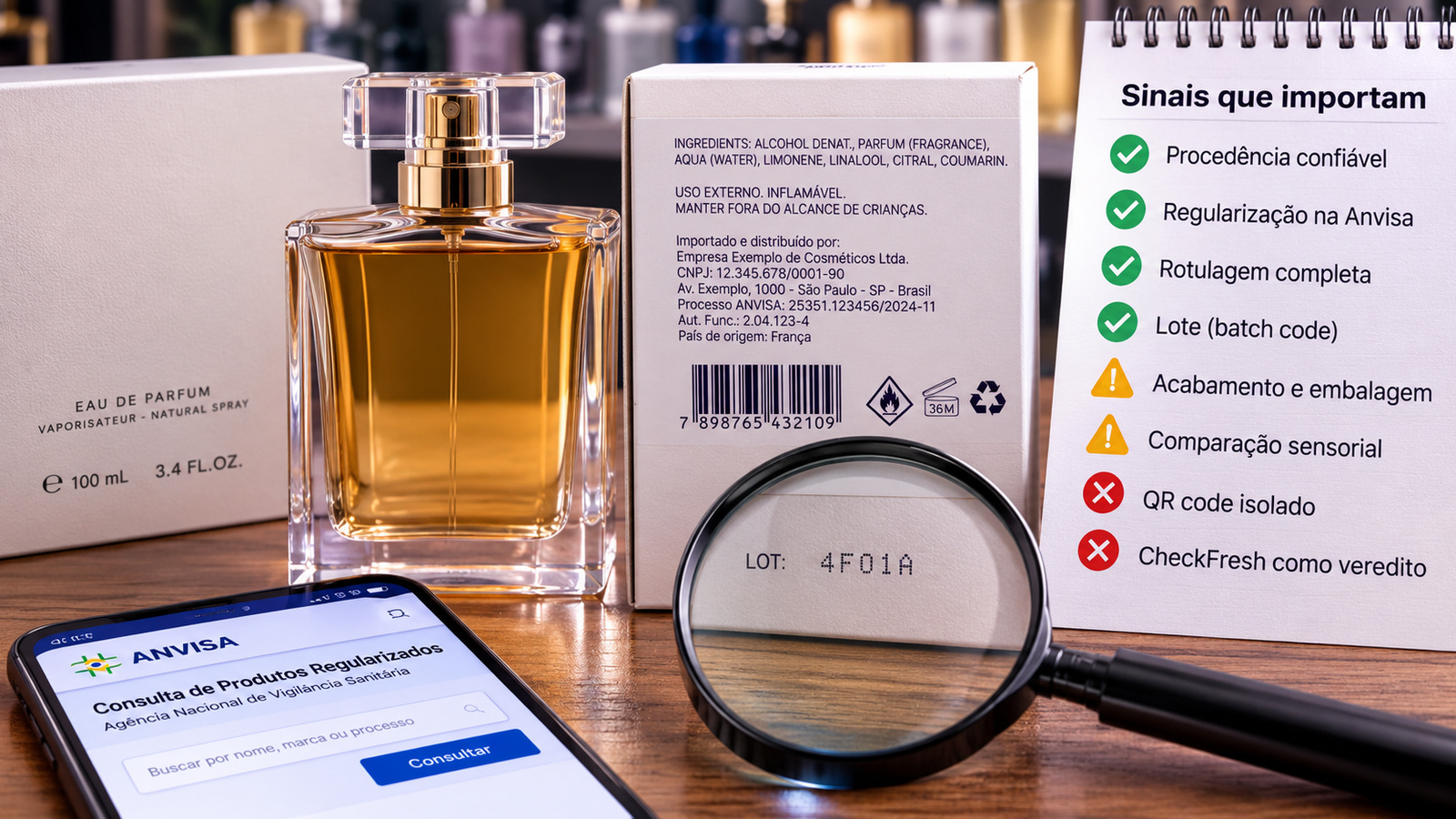
Lot or batch is traceability information. Anvisa requires batch identification on the labeling of cosmetics and perfumes, and European regulations also require a manufacturing batch number or other reference that allows the product to be identified. This makes the code useful for answering an important question: which bottle probably came first and which came after?
The limit is equally important. The batch code is not, in itself, a public composition code. It does not inform which raw materials were changed, in what concentration, nor whether there was a change in formula. When a manufacturer offers an official channel capable of confirming the manufacturing date, this information carries more weight. Third-party decoders can serve as a chronological clue, but should not be treated as a brand document.
Two batches that are distant in time increase the possibility of generation differences. Two nearby lots do not guarantee absolute identity. In neither case does the batch code, alone, close the reformulation diagnosis.
Compare packaging and ingredients, but understand what the label can show
Photograph the two boxes and the two bottles before throwing away any packaging. Compare name, concentration, volume, country of origin, manufacturer or responsible, barcode, warnings and list of ingredients. In Brazil, the INCI nomenclature remains mandatory for personal hygiene products, cosmetics and perfumes, and Anvisa also requires the composition to be made available in Portuguese according to current rules.
A visible change in the ingredient list between authentically dated packaging may be relevant evidence. Still, it needs context. Labeling rules change, ingredients may require a specific declaration and the way components are presented may be updated without this corresponding, in the same proportion, to a noticeable change in smell.
There is another important limit. In markets such as the European Union, the perfume composition may appear generically as "parfum", while certain substances that need to be declared appear separately. This means that two different aromatic formulas can maintain a visually very similar list. The reverse is also possible: the label can change due to declaration requirements without the consumer facing a complete reconstruction of the perfume.
Therefore, an equal list does not prove an equal formula. Different listing increases suspicion, but must be combined with dating and other evidence.
What really weighs in favor of a reformulation
Direct documentary evidence
The strongest proof is confirmation from the brand itself, the manufacturer or technical or regulatory documentation that identifies a change in formula, raw materials or conformity within a given window of time. When this confirmation exists and corresponds to the lots you are comparing, the discussion no longer depends solely on olfactory memory.
Not every brand publishes reformulation announcements. In many cases, the consumer can only get one response from customer service, and some companies respond in a generic way. Still, a specific official confirmation is worth much more than hundreds of comments repeating that "the new batch is weak".
Indirect and repeatable documentary evidence
The second level brings together several coherent pieces: authentic bottles from different eras, batch codes that establish chronology, consistent changes in packaging or ingredients and a sensorial difference that is repeated in controlled tests. None of these pieces are definitive on their own, but the whole can make a strong case.
A laboratory instrumental analysis can demonstrate that two liquids have different chemical profiles, especially when the samples are reliable and have had comparable storage histories. Even so, chemical difference does not automatically identify the cause. Aging, oxidation or poor conservation can also change the profile. The laboratory shows that there is a difference; documentation and context help tell you why.
Collective reports are corroborators, not documents
When many independent users describe the same change from a similar batch range, the pattern deserves attention. It is most useful when people present photos, codes, dates and comparisons side by side, and least useful when the report boils down to "not fixed as before".
Forum consensus can point to where to investigate, but is no substitute for manufacturer evidence or a verifiable set of vials. Memory, expectation, climate, skin and mode of application affect the evaluation of performance and smell.
IFRA can lead to reformulations, but it does not prove that your perfume has been altered
IFRA Standards are a risk management system for the use of fragrance ingredients. IFRA itself explains that its standards may prohibit, restrict or establish purity requirements for certain materials. They are mandatory for association members, although they do not replace the laws and regulations of each market.
The most relevant part for those investigating reformulation is the implementation schedule. IFRA establishes different deadlines for new creations and for existing creations. The association's documentation explicitly says that the longer period given to existing creations is to allow time for reformulation. This confirms that changes in standards may, in fact, require adjustments to existing perfumes.
But the reasoning cannot be reversed. Discovering that IFRA updated a restriction does not prove that a particular fragrance used that raw material, nor that the brand resolved the requirement in a way that is noticeable to the consumer. The cause may also be another: raw material availability, internal product decision, cost, change of supplier or adaptation to a local rule.
In August 2026, for example, public consultation on the 52nd Amendment to the IFRA Standards had already closed, but formal notification was still expected by the end of November 2026. Therefore, citing the "52nd Amendment" as an automatic explanation for any bottle purchased now would be premature. The link between rule and specific perfume needs to be demonstrated.
Storage can really change the smell of a perfume
Perfume is not chemically frozen in time. Aging and stability studies show that light, heat and air contact can accelerate reactions in fragrance materials. There are studies that document photo-oxidation of components and changes associated with exposure to heat and light.
This does not mean that every perfume opened is degrading quickly. A study evaluating retail and consumer hydroalcoholic fragrance products found little peroxide formation under typical storage and use conditions. The practical message is more balanced: aggressive conditions increase the risk of alteration, but age alone does not justify saying that the bottle has "gone bad".
If a bottle has been left on a shelf in direct sunlight for years, in a hot car, close to a heat source or with compromised sealing, the hypothesis of alteration due to storage wins
weight. If the two were kept closed, in a dark, stable and cool place, this explanation loses strength, although it does not disappear completely.
Color should also be read with caution. Darkening may accompany oxidation in some formulations, but dyes, natural raw materials and normal aging can also change appearance. Darker liquid is a clue that needs to match smell, history and chronology.
Your sense of smell can also be the variable in the comparison
The olfactory system reduces the response to repeated stimuli. The literature calls this phenomenon olfactory adaptation and habituation, with mechanisms at different levels of the sensory system. In practice, smelling the same perfume many times in a row can make some notes seem less intense, while a change of context or a pause can alter the perception.
There is also olfactory memory and expectation. You don't compare the second jar to an exact recording of the first; He often compares it to a memory built over months or years. If the first perfume was associated with a trip, season or phase of life, the memory can highlight aspects that do not appear with the same strength in a current test.
Therefore, the phrase "I know this perfume and it has changed" is a legitimate reason to investigate, but it is not the end point of the investigation.
Do a side-by-side test before looking for culprits
Start on paper, not skin
Use two scent strips or similar strips of paper and apply the same amount from each bottle, in the same environment and in a short sequence. Mark A and B discreetly. If someone else can prepare the samples without telling you which is which, even better: this reduces the expectation effect.
Avoid sniffing one bottle repeatedly before testing the other. Take breaks and look for neutral air between assessments. The objective is not to "zero" the nose, something that doesn't happen instantly, but to reduce repetitive exposure and biased comparison.
Compare more than one moment of evolution
A difference only in the opening has a different interpretation than a difference that remains until the bottom. Observe the output, come back after a few minutes, and repeat the assessment later, when the more volatile notes have subsided. If a bottle appears different at all stages, the sensory evidence is more consistent than when the divergence disappears quickly.
It's also worth paying attention to the atomizer. Amount of liquid per spray, spray range and initial evaporation can change the impression of intensity. When possible, compare the smell of the tapes and not just the "strength" of the cloud in the air.
Repeat on another day
A single test may be influenced by olfactory fatigue, environment, nearby scented products or expectation. Repeating the comparison on another day helps to check whether the difference always accompanies the same bottle.
Only then take the comparison to your skin. Use equivalent areas and, in a second test, swap sides. Skin changes evaporation and perception, so a difference that appears only on the body should be interpreted more carefully than a difference that also exists on paper.
How to interpret the result without exaggerating the conclusion
If the difference appears mainly at the outlet and one of the bottles has a worse storage history, the conservation or loss of more volatile materials deserves investigation before reformulation. If the difference disappears when you make a blind comparison, expectation and memory were probably weighing in.
If the difference is repeated on paper, on different days, always accompanies the same bottle and exists from the exit to the bottom, you have much stronger sensory evidence. If, in addition, the batches are separated by a documented change in ingredients, packaging or brand confirmation, the reformulation hypothesis becomes much more solid.
If the only information is that the batch code is newer and the perfume seems "weaker", the conclusion is still weak. Perceived performance is one of the most vulnerable measures to olfactory adaptation, climate, amount applied and expectation.
A practical hierarchy of evidence
Very strong evidence
Specific confirmation of the brand or manufacturer, technical or regulatory document that identifies the change and allows it to be related to the compared bottles. This is the scenario in which the word "reformulated" can be used most safely.
Strong evidence
Authentic bottles from different generations, reliable chronology, coherent change of labeling or ingredients and repeatable sensory difference in controlled comparison. The whole is more important than any isolated signal.
Moderate evidence
Repeatable odor difference without documentation, or many independent reports concentrated in a batch window. It is enough to say that there is a consistent difference to investigate, but not to identify the cause with certainty.
Weak evidence
Batch code alone, liquid color, performance memory, vendor comment, video without documentation, or community consensus without verifiable samples. These elements can start the search, not end it.
Questions that often lead to wrong diagnoses
Batch code proves that there was reformulation?
No. It is mainly used to track batches or help locate production in time. To prove reformulation, the link between that batch and a formula change is missing.
If the perfume is weaker, has it been reformulated?
Not necessarily. Perceived intensity and duration may vary with dose, climate, application surface, olfactory adaptation, atomizer and storage. A reformulation can change performance, but different performance does not demonstrate reformulation in itself.
If the list of ingredients is the same, is the formula the same?
No either. The perfume composition may be represented in aggregate form as "parfum" and internal changes may not be transparent in the public label. An identical list reduces some suspicions, but does not exclude changes in the aromatic composition.
If the list has changed, is the reformulation proven?
It is an important clue, especially when the boxes are authentic and well dated. Even so, check whether there has been a change in labeling rules or an obligation to declare substances that did not previously appear. The conclusion is stronger when the label change coincides with chronology and repeatable sensory difference.
How to ask the brand for confirmation?
Send the full name of the fragrance, concentration, volume, photos of the boxes, ingredient lists, country of purchase and batch codes. Ask objectively whether there was a change in the formula between the identified periods. The more specific the request, the less chance of receiving a generic response about "natural variations" or "quality control."
The safest conclusion might be: it still can't be called a reformulation
Researching perfume requires accepting an intermediate result. You can demonstrate that two bottles smell different without being able to prove why they are different. That's a better diagnosis than turning any difference into a "reformulation."
The order of confidence is simple: first confirm the product, then establish the chronology, compare labels and documentation, control storage and perform a repeatable sensory test. Community reports come in as support. Batch code enters as chronology. IFRA enters as a regulatory context. The word reformulation should remain for when the pieces really converge.
This method does not eliminate the subjectivity of perfumery, but it prevents a real perception from being explained by the wrong cause.