To find out if a perfume is original in Brazil, the best way is not to look for a single code, seal or finishing detail that gives a verdict. The most reliable verification arises when several independent pieces of evidence point in the same direction: origin of the seller, purchase documentation, health regularization compatible with the label, identification of the person responsible for the product, batch, packaging and, when necessary, confirmation by the brand or importer's SAC.
The first distinction avoids much of the confusion: authenticity and regularity in the Brazilian market are not exactly the same thing. A bottle may be genuine and have been purchased abroad for personal use, without labeling prepared for commercial sale in Brazil. Conversely, a forger can copy a CNPJ, a process number, a barcode or even an existing batch. Therefore, none of these elements should be treated in isolation as a certificate of originality.
The short answer: look for coherence between evidence
The stronger the origin of the purchase and the more the physical data of the product coincide with verifiable information, the lower the uncertainty tends to be. The invoice is important because it documents the consumption relationship and helps track who sold it, but it does not analyze the liquid inside the bottle. Anvisa's consultation confirms the regulatory status of the product and the company, but does not authenticate an individual unit. The batch code identifies a batch, but does not function as a cryptographic signature. The finish, smell and fixation can reveal anomalies, but are also influenced by conservation, product version and perception of those comparing.
This changes the question from “what’s the trick to knowing if it’s original?” to “how much independent evidence can I confirm and are there important contradictions among them?”.
Start with the origin of the seller and the purchase documentation
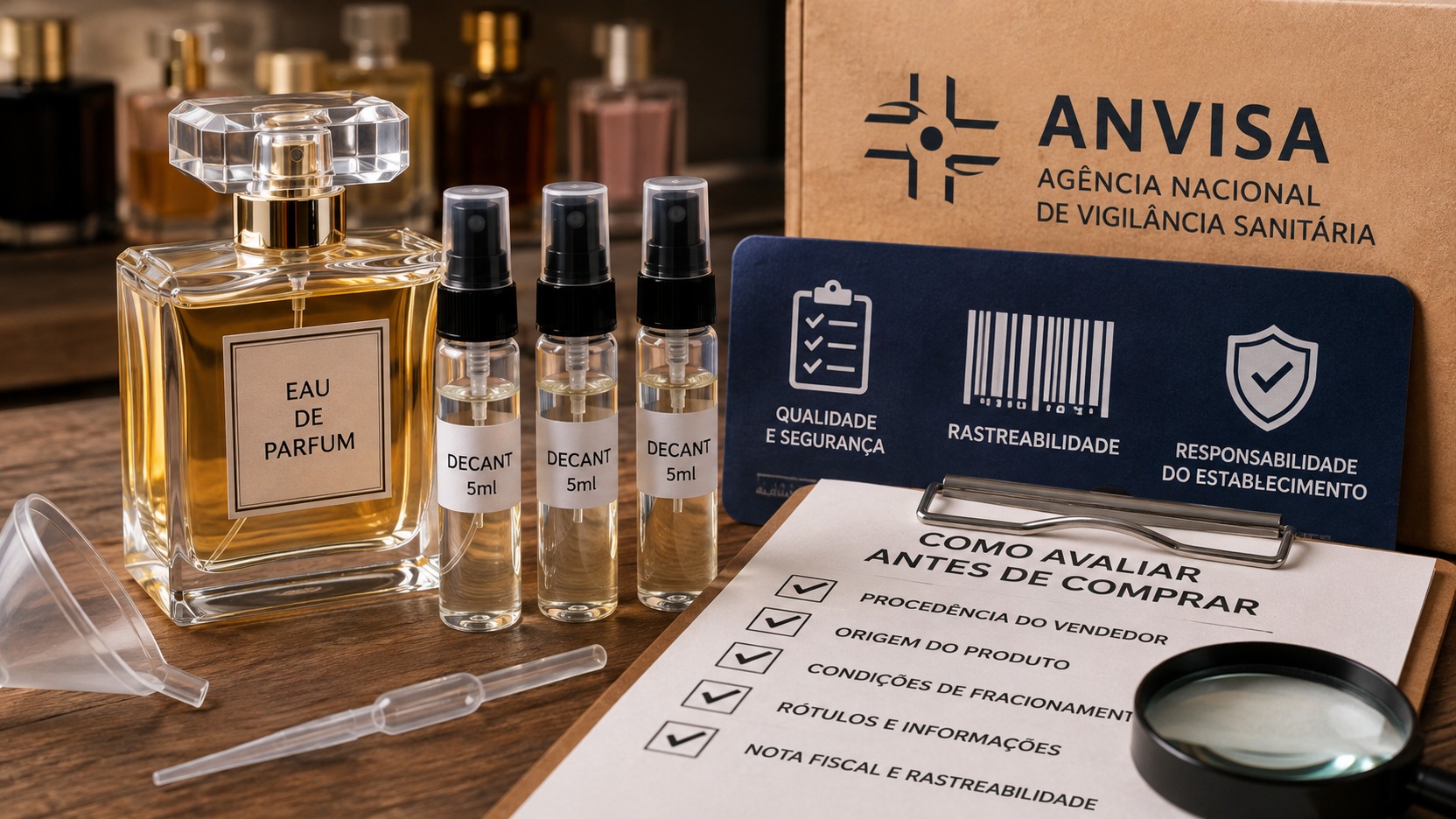
Before looking at the box with a magnifying glass, check who put that perfume on the market. In a physical or online store, identify the seller's corporate name and CNPJ, check whether the commercial activity makes sense and observe whether there are real service channels. In a marketplace, do not confuse the name of the platform with the seller responsible for the ad. The same website can bring together official stores, independent resellers and occasional sellers with very different levels of traceability.
When the brand advertises a network of official stores or authorized resellers, purchasing within this network reduces an important uncertainty: origin. Outside of it, this does not automatically transform the product into a fake, but it increases the need to cross-check other evidence.
Request and keep the invoice. It does not prove that the perfume is original, because a tax document does not physically authenticate the merchandise, but records who sold it, when they sold it and what operation was carried out. In case of doubt, exchange, complaint or inspection, this trail is much more useful than an isolated print of an advertisement. In May 2026, an inspection by Procon Goiás on perfumes with signs of counterfeiting highlighted precisely the absence of invoices and the impossibility of identifying the origin of the products as part of the origin problem.
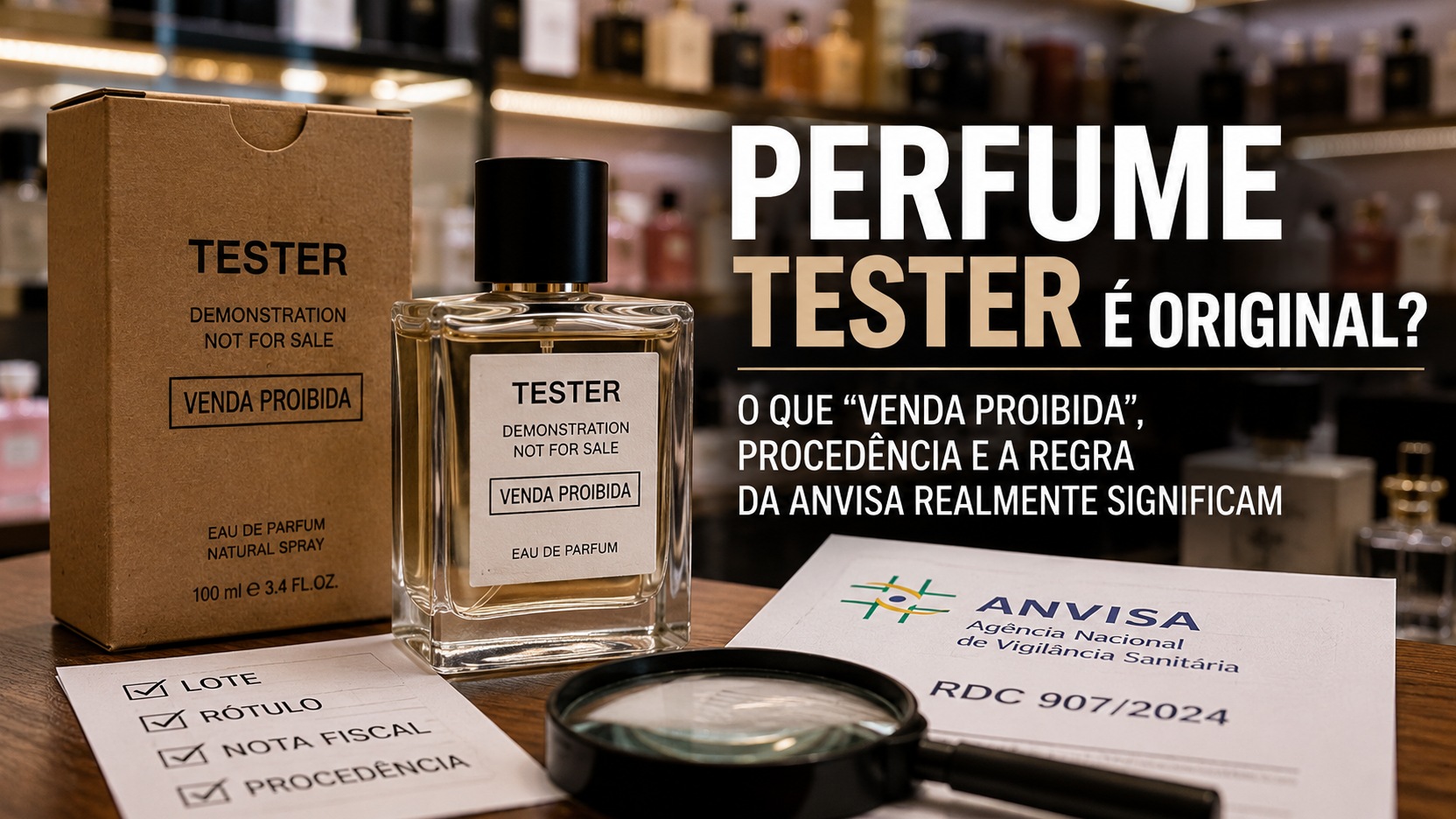
A price well below the market also enters this stage as a sign of risk, not as proof. Legitimate promotions, stock clearances, testers and channel variations exist. The alert appears when the aggressive discount is accompanied by a difficult-to-identify seller, weak documentation, vague description or inconsistent justifications about the origin.
Consult Anvisa, but understand what the consultation actually confirms
Under the current rule, perfume appears among personal hygiene products, cosmetics and Grade 1 perfumes. Anvisa informs that perfume is an example of a product exempt from registration, subject to the notification procedure. “Exempt from registration” does not mean “without Anvisa”: for regular marketing, the product must be regularized in the corresponding category.
On Anvisa's consultation portal, the search for products exempt from registration can be done using data such as product name, regularization process number or CNPJ of the title company. The Agency itself advises that, when available, the process number is a preferred reference; this number starts with 25351 and must appear on the label.
If the official result appears as active or valid and the data matches the name, holder and other information on the label, this confirms that the registered product is regularized. It is strong evidence of the health compliance of the declared product, but it still does not alone answer whether the bottle in your hand left the legitimate chain. A counterfeit label can reproduce data that actually exists.
The opposite situation requires attention. If a perfume sold commercially in Brazil has a process number that does not exist, points to another company, corresponds to another product or is accompanied by incompatible data, the inconsistency is relevant. Before concluding that it is a forgery, however, check that you typed correctly, that you are consulting the database of products exempt from registration and that the presentation is intended for the Brazilian market.
Read the label as a traceability document
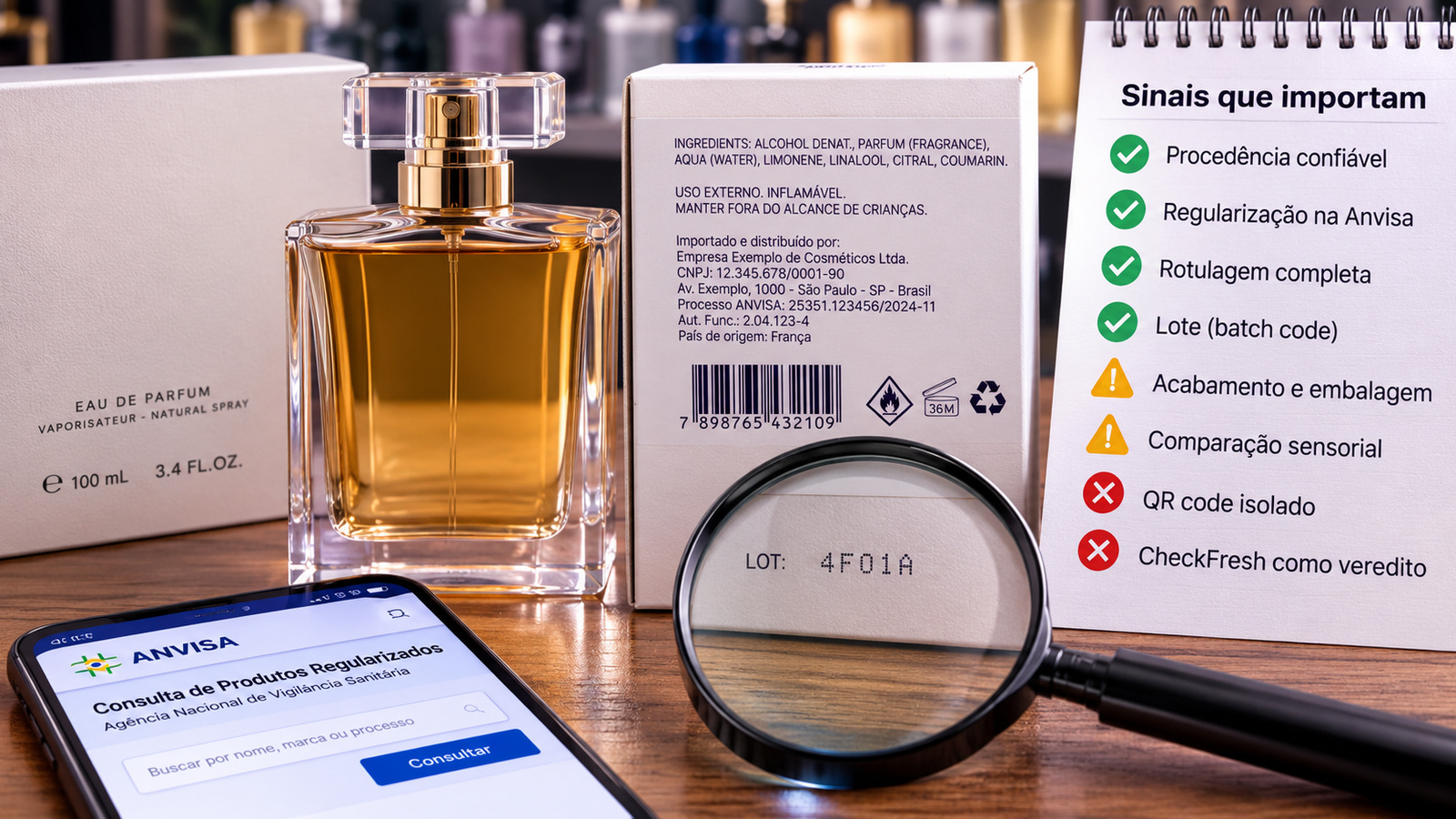
RDC 907/2024 establishes current labeling requirements for personal hygiene products, cosmetics and perfumes. The primary packaging must contain, among other applicable data, batch or batch, brand and name of the product. On secondary packaging, the rule provides for information such as content, customer service channel, regularization process number, holder's AFE and CNPJ, holder's corporate name, ingredients in INCI nomenclature, name, brand, country of origin and expiration date.
When there is no secondary packaging, the information that would normally be there needs to migrate to the primary packaging. The standard also determines that mandatory information must be legible in Brazilian Portuguese, with specific exceptions, and allows imported products to receive a suitability label before marketing when the original label does not contain what Brazil requires.
This possibility is important because a label in Portuguese applied to a foreign box is not, in itself, a sign of counterfeiting. In imports regularly sold in the country, it may be exactly the mechanism used to adapt Brazilian labeling. What matters is the coherence of the data: holder or responsible importer, CNPJ, process, origin, validity, composition and service channels must form a verifiable set.
The lack of mandatory information, data that is impossible to check, gross errors or discrepancies between the product and the company indicated increase suspicion. A visually perfect label reduces some doubts, but does not end the analysis, because graphic elements and texts can be copied.
Batch code: useful for testing coherence, insufficient for authentication
The batch code is the batch or batch code. In regulation, batch is the quantity of product manufactured in a duly identified and homogeneous cycle. This identification allows production traceability, investigation of deviations and quality control.
The decisive point is that the specific number of each batch does not function as a public certificate of authenticity of the bottle. Anvisa itself clarifies, in its labeling guidelines, that the numbers or codes used to track production are not presented to the Agency for product regularization. This means that the official health consultation does not validate an individual batch code as if it were a unique serial.
Sites like CheckFresh and other decoders can be useful for a plausibility check when they know the standard used by a certain brand. If the result indicates a date that is incompatible with the version, packaging or commercial history of that product, a valid question arises. But finding an apparently correct date does not prove originality. Plausible code can be copied, repeated, or interpreted on an incomplete basis.
Use the batch code to check consistency, not to replace origin, regularization and contact with the person responsible for the product. If the box and bottle display codes and there is a discrepancy between them, ask the brand or importer for an explanation before making a conclusion.
There is no universal “Anvisa seal” to authenticate perfumes
The general rule for labeling perfumes does not create an Anvisa seal that functions as a universal certificate of originality. Health legislation may require sealing or security sealing in specific situations, and brands may also adopt their own packaging, holography or tamper-evident features. These elements need to be evaluated according to the specific product, not by a generic internet rule.
This explains why the phrase “if it doesn't have a seal, it's fake” is dangerous. A perfume may not use any special seal. Another may have a proprietary seal. A third brand can change the closing system between versions. The correct parameter is to compare the same presentation, size, market and period, preferably with official brand material or guidance from your SAC.
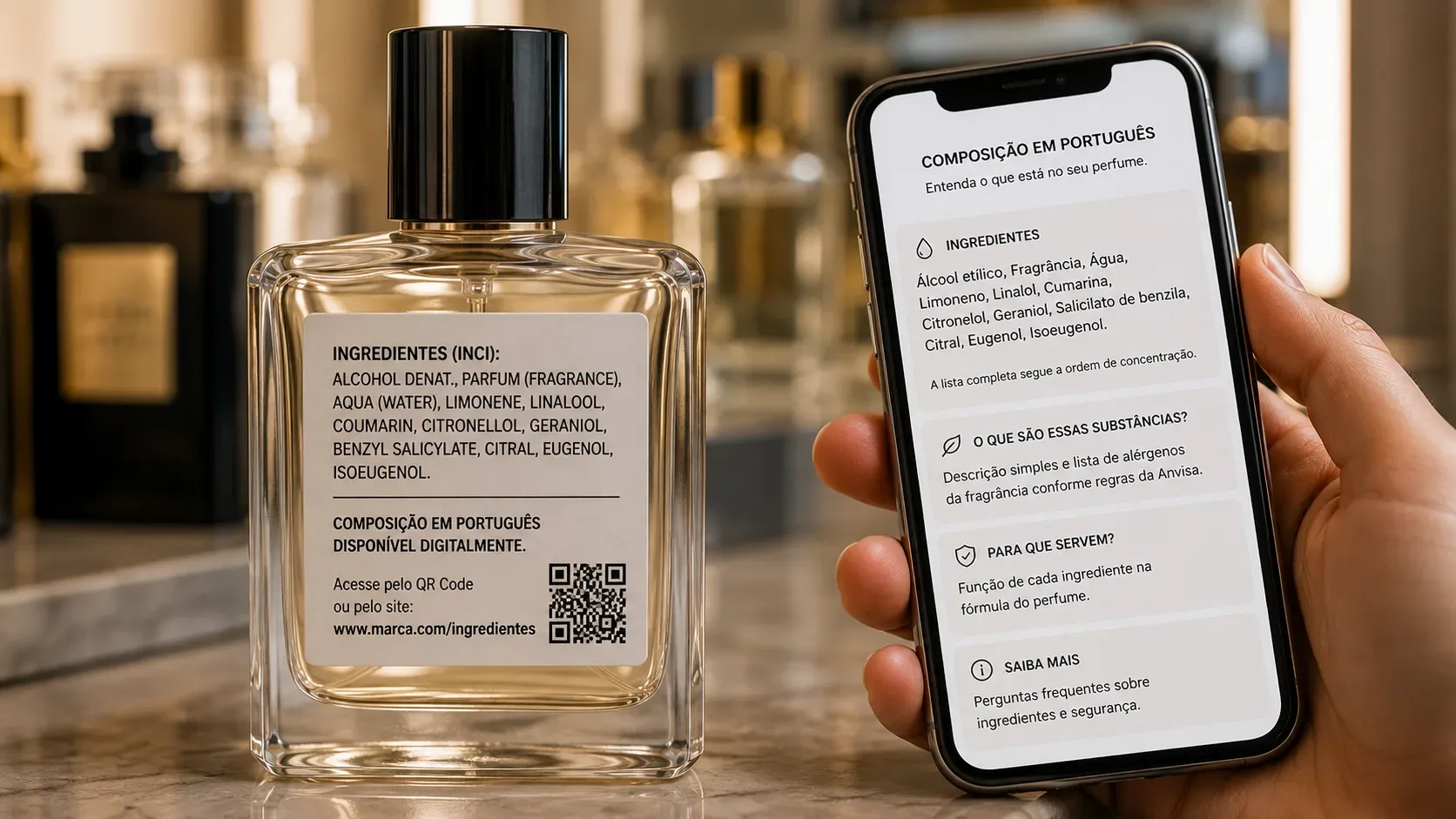
The same reasoning applies to QR codes. Anvisa allows the use of digital media in a specific context to access the composition in Portuguese, and many companies use QR codes for institutional pages, campaigns or their own traceability. Scanning a QR and arriving at a real website does not prove that the code was not copied from a legitimate package. The value of the QR depends on the system behind it, especially when there is individual validation and official brand response.
Barcode is also not an individual serial of authenticity. It helps identify a commercial reference, but may be reproduced in false packaging.
Bottle and finish are for comparison, not for sentence
Glass, lid, valve, printing, engravings, fitting, cellophane, case texture, and finish quality are useful because poorly executed fakes often leave inconsistencies. The problem is turning this into absolute rules, like “the fountain has to be two millimeters from the edge” or “the original spray bottle always has a certain color”.
Packaging changes. Suppliers change. Old lots coexist with new ones. Imported products may receive Brazilian labels. A visual comparison only gains strength when the same concentration, volume, target market and temporal version of the product are placed side by side.
Prefer references from the brand's official website, official stores or service provided by the person responsible in Brazil. Random photos from ads, forums and videos can help raise hypotheses, but they should not be the only reference because they can mix different versions or even reproduce another fake.
Smell, color and fixation are the easiest signs to overestimate
An important sensory difference may warrant investigation, especially when it appears together with problems of origin, label or packaging. Alone, however, it is weak evidence. Perfumes are products subject to storage conditions, aging and subjective comparison. Furthermore, the consumer may be comparing concentrations, versions, batches or presentations from different periods.
Therefore, “it doesn’t hold up like my old one” is not a test of authenticity. Perception can guide the next check, but it should not end the diagnosis. Likewise, a lighter or darker color deserves context before becoming an accusation of counterfeiting.
The brand's or importer's SAC is the best option when the pieces don't close
RDC 907/2024 requires consumer service data on secondary labeling. Use this channel, preferably also confirmed on the official website of the brand or company responsible, when there is a relevant inconsistency.
Send clear photos of the front, back, base of the bottle, box, batch, Brazilian label and details that raised doubts. Enter where you purchased it, date of purchase, seller, invoice number and, if applicable, ad link. Ask if that presentation, labeling, importer or holder and batch are compatible with the product sold in that period.
Not every brand offers remote authentication of a unit, and some do not confirm batches to the consumer. Still, an official answer about packaging, responsible country, or identification standard weighs more than a generic rule found in a video or batch decoder.
What really proves, what only increases confidence and what doesn't prove alone
Evidence that weighs most
Traceable origin, with an identifiable seller, tax document and chain consistent with the brand or person responsible for the product, is one of the strongest evidence to reduce risk. Confirming that the label data corresponds to a product regulated by Anvisa adds a second independent layer. When there is specific doubt and the manufacturer, holder or importer confirms that the presentation and analyzed data are compatible, confidence increases even more.
None of these layers equates to a laboratory analysis of the content, but together they form a much more solid foundation than any isolated “quick test.”
Evidence that increases or reduces suspicion
Plausible batch code, well-executed packaging, consistent printing, compatible valve and cap, similar color, price close to that charged by reliable sellers and good seller history are useful signs. They help form context. They also work in the opposite direction: many printing errors, mismatched data, strange batch, exceptionally low price and untraceable seller increase suspicion.
Weight increases when several independent signals converge. A single visual detail rarely merits a definitive decision.
Elements that do not prove originality alone
A positive result in CheckFresh, a QR code that opens a valid page, a recognized barcode, a generic seal, “perfect” cellophane, a batch code with a plausible date, a similar smell or good fixation do not authenticate a unit by themselves. All may be true in an original product, but none should be treated as an isolated verdict.
An important exception: perfume purchased outside Brazil
The absence of a label in Portuguese or a Brazilian process needs to be interpreted according to the origin of the purchase. Anvisa provides different rules for imports by individuals intended for their own use, which may be exempt from prior authorization from the Agency. Thus, a bottle purchased in person abroad may be original and not have the labeling required of a product regularly offered for sale in Brazilian commerce.
The reasoning changes when a seller sells the product in Brazil. In this case, the discussion is not just “is it original?”, but also “is it regularized and labeled for sale in the country?”. A genuine item may be in irregular commercial or health status, and a counterfeit item may imitate regulatory data. Separating these two questions avoids wrong conclusions.
A practical guide before and after purchase
Before buying, identify the seller, compare the price with realistic references and find out if the brand provides official channels or authorized resellers. Check whether there will be an invoice and avoid advertisements that hide the company name, change the product description or promise “imported original” without explaining the origin.
With the perfume in hand, first check the regulatory and documentary set. Find the person responsible, CNPJ, regularization process, country of origin, validity, composition and service channels on the label. Consult the product on Anvisa's official database for products exempt from registration and compare the data, not just the commercial name.
Then use batch, packaging and sensory aspects as additional filters. If something doesn't work, don't try to resolve the issue by just typing the batch code on several websites until you find a result that seems convincing. Gather the evidence and escalate it to the SAC of the brand, the holder or the importer.
If suspicion continues, preserve the evidence
Keep invoice, packaging, batch, photos, prints of the ad and conversations with the seller. If the origin cannot be clarified or there are relevant signs of irregularity, contact the seller and the platform to register the dispute. Consumer protection bodies can be contacted when there is a problem in the consumer relationship, and Anvisa maintains channels for notifying technical complaints related to cosmetics and perfumes.
If there is a strong suspicion of counterfeiting or health irregularities, avoid continuing to use the product while seeking clarification. The purpose of this verification is not only to protect the money spent, but also to avoid exposure to a product whose composition, conservation and origin cannot be confirmed.
The best test is the sum of the evidence
The safest way to evaluate a perfume in Brazil is to build a hierarchy. Start with origin and documentation. Then, confirm that the health situation and label data are consistent with Anvisa. Then, use batch, packaging, QR code and sensory comparison as complementary evidence. When there is an important contradiction, take the case to the official responsible for the product.
Batch code is not a certificate of authenticity. Correct labeling alone does not authenticate a bottle. QR code does not become proof just because it opens a website. And there is no universal Anvisa seal that resolves the issue in seconds. The decision is more reliable when different signals, from different sources, tell the same story.