Groups planning to reach Belém on foot or by bicycle for the 2026 Círio de Nazaré can already register their caravan with the Peregrinos de Nazaré project. The Diretoria da Festa de Nazaré (DFN) says roadside assistance is scheduled for October 5–10, 2026, with logistical support for pilgrim groups and an expected 27 support points. Safer planning starts before departure: register the group, provide an estimated arrival time and build the route around only the coverage officially announced.
What you need to plan the pilgrimage
| Item | Official information |
|---|---|
| Who can register | Pilgrim groups traveling to Belém on foot or by bicycle. |
| Assistance period | October 5–10, 2026. |
| Support points | Expected 27 points: 24 on the main route and 3 being added in the Salgado region. |
| Planned services | Water, food, massage and health care. |
| Registration | Through the official Círio website or the Pastoral da Acolhida at +55 (91) 4009-8419, Monday through Friday, 8 a.m. to noon. |
Before you leave: register the caravan
The DFN asks groups to register as early as possible. The official announcement does not give a specific registration deadline, so it is not advisable to wait until pilgrimage week. The form is available on the Peregrinos de Nazaré — Círio 2026 page.
The form requests information that helps identify and size the group: city of origin, parish, group name, leader’s name, email, phone number, expected departure date and time, expected arrival date and time, pilgrimage type, number of people and planned stops. The estimated arrival in Belém deserves particular attention because the DFN says it uses this information to organize reception at Casa de Plácido.
Groups unable to use the form can contact Pastoral da Acolhida at +55 (91) 4009-8419, Monday through Friday, from 8 a.m. to noon, according to the service information released by the organizers.
Why registration helps with safety
According to the DFN, identifying caravans in advance helps organize support, coordinate with the security agencies involved in the project and prepare for the groups’ arrival. Registration is therefore more than a formality: it gives organizers a reference for who is on the road, where the group starts and when it expects to arrive.
On the road: how to use the 27 support points
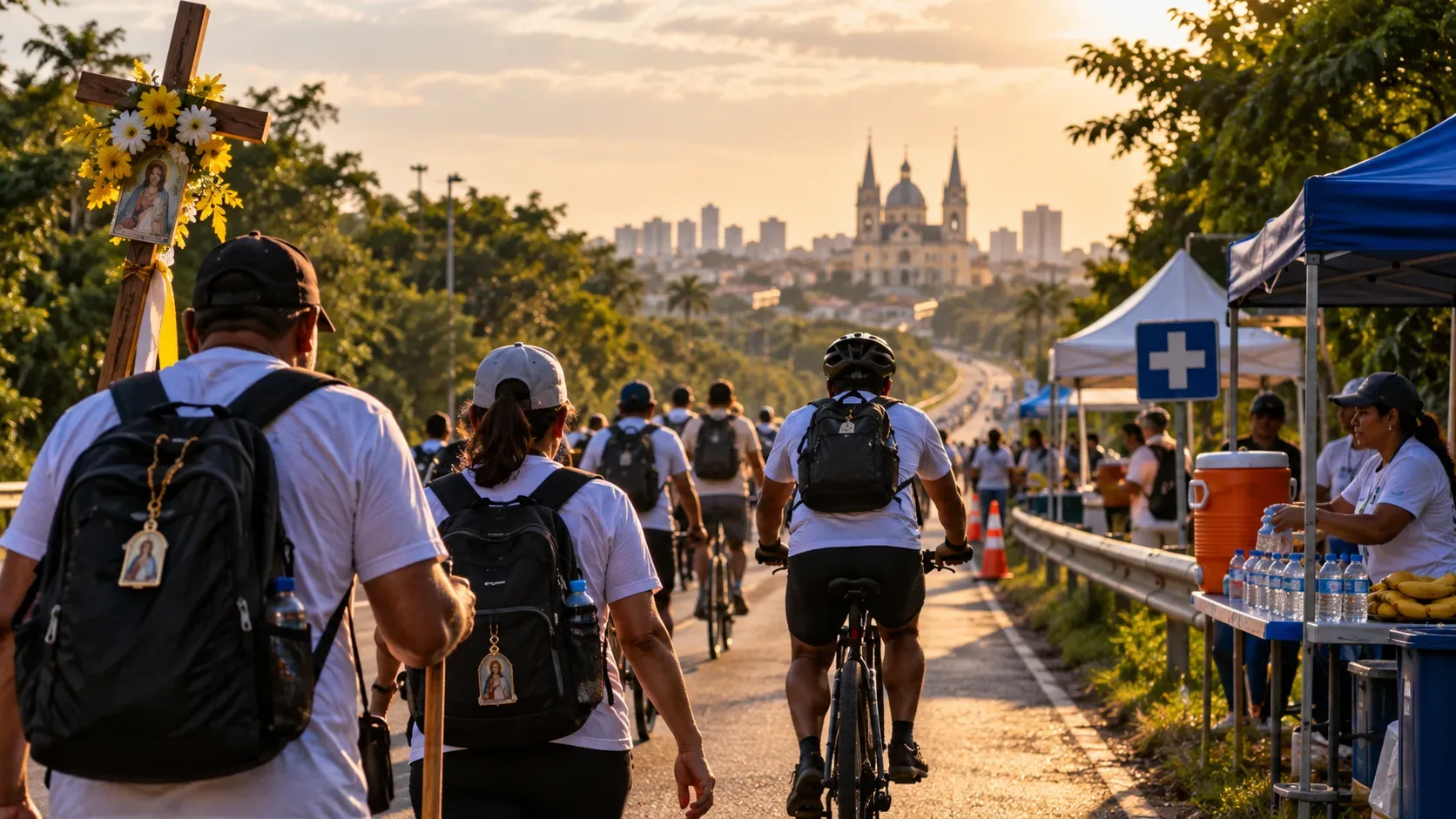
The official service information summarizes the operation as an expected 27 support points during October 5–10. The announcement itself details 24 points along the route and adds three points being expanded in the Salgado region, bringing the expected total to 27.
The corridors named in the service information are BR-316 and the Alça Viária/PA-483, plus the three additional points in the Salgado region. Locations mentioned in the detailed text include Acará, Santa Maria do Pará, Apeú, Santa Izabel, Benevides, Benfica, Marituba and Ananindeua. In Belém, the DFN reports two points on Avenida Almirante Barroso leading toward Casa de Plácido. In Salgado, the announced points are in Santo Antônio do Tauá, Santa Bárbara do Pará and Terra Alta, with the Terra Alta point on PA-136.
The announcement does not provide the individual address of every post. The list should therefore be used as a reference for the announced coverage, not as a final map of every stop.
What is planned at the support points
- support tents;
- portable toilets;
- identification and location signs;
- a QR Code for issuing a participation certificate;
- water, food, massage and health care.
The organizers themselves advise pilgrims to stop at the assistance points when needed. Because the structure is described as planned and distributed along specific routes, groups should still plan their own water, food, rest and support without assuming that a post will be available on every stretch of the journey.
How to plan without assuming coverage outside the announced routes
The main precaution is to separate what has been confirmed from what would only be an assumption. The DFN announces assistance on the corridors and locations listed above, but it does not promise continuous coverage on every road used by caravans arriving from other regions.
- Map the caravan’s actual route: compare each segment with BR-316, Alça Viária/PA-483 and the announced Salgado points.
- Do not turn “expected” into a guarantee: 27 is the official forecast released on September 1, 2026, and it should be checked again closer to the trip.
- Plan for self-sufficiency between stops: consider distance, group pace and the needs of walkers and cyclists without relying on a post along a segment that the organizers did not specifically include.
- Recheck official information before departure: the Círio website is the reference for any changes to assistance, routes or instructions.
On arrival: the time provided in registration matters
The DFN asks the group to provide an expected arrival time in Belém specifically so reception at Casa de Plácido can be organized. That makes arrival part of the plan rather than merely the end of the route. When completing registration, use an estimate that is realistic for the caravan’s pace and planned stops.
The two support points mentioned in Belém are on Avenida Almirante Barroso, on the way toward Casa de Plácido. For groups completing a long journey, these posts serve as final references within the support network announced by the organizers.
Checklist before departure
- register the caravan on the official website or contact Pastoral da Acolhida;
- confirm the city of origin, leader, contact details, number of people and pilgrimage type;
- provide expected departure and arrival dates and times;
- enter the planned stops in the form;
- check which segments of the journey match the published support routes;
- do not assume assistance outside the announced corridors and locations;
- review the project’s official page close to the travel date.
Official sources
This guide was organized from the Diretoria da Festa de Nazaré announcement about Círio 2026 caravans and the official Peregrinos de Nazaré registration page.