The 20th Primavera dos Museus will take place from September 21 to 27, 2026, under the theme “Museums for all people”. For visitors looking for an activity, the most useful starting point is not a parallel list on social media: it is the official program on Visite Museus, the platform used by Brazil’s Institute of Museums (Ibram) to bring together activities registered by participating institutions.
Ibram says the 2026 edition is meant to address access, participation, diversity and the right to memory, including physical, economic, communication, technological, cognitive, sensory and attitudinal barriers. The program may include exhibitions, talks, workshops, seminars, discussion circles, educational activities and other formats. Read Ibram’s official notice.
Where to find the official program
Open the 20th Primavera dos Museus page on Visite Museus and use the listing as your first screening step. When you open an activity page, check the details published by the organizing institution. Individual pages commonly show date and time, whether the activity is free, age rating, format, physical address, region, state, city, contact details and the responsible institution.
The program page itself notes that the information provided is the responsibility of the participating institutions. If a detail is essential to your visit — accessibility, reservation requirements, capacity, a time change or the venue — confirm it through the contact information on the activity page before you go.
How to find activities near you
- Start with location. Look for your city, state, region or the name of a museum you already know, then open the activities that seem feasible.
- Confirm the actual activity address. Some events take place at the museum itself, while others use a different venue. Read the address section rather than relying only on the institution’s name.
- Match the date and time to your travel plans. An activity may last for a single time slot, several days or even extend beyond the main Museum Spring week.
- Check the organizer’s contact details and website. Phone, email, WhatsApp or a website may be needed to confirm capacity, accessibility or registration.
Four practical filters for choosing a visit
| Criterion | What to check on the activity page | How to decide |
|---|---|---|
| Location | Region, state, city, neighborhood, street address, additional address details and geolocation when available | Prioritize activities within a realistic travel radius and check whether the event is held at the institution’s own address |
| Accessibility | Activity description, any stated resources and the institution’s contact details | Do not assume every activity offers the same resources. If you need step-free access, an elevator, Brazilian Sign Language (Libras), audio description, tactile materials, reserved seating or other support, confirm it directly with the venue |
| Age suitability | Age rating and any description of the intended audience | For visits with children or teenagers, remove options that do not fit the group’s age before comparing the rest |
| Registration or booking | Ticket field, external link, registration notes, “advance booking” wording or instructions in the description | If a reservation is required, complete it before traveling; if the page is unclear, use the published contact details |
Registration is not presented the same way for every activity
The activity pages show that procedures can vary. For example, a discussion event at Museu do Amanhã includes a ticket field with a dedicated registration link. A guided visit at the Memorial of the Public Prosecutor’s Office of Minas Gerais, meanwhile, states in the description that group visits require advance booking. That is a good reason to open the full activity page instead of deciding from the title alone.
How to assess accessibility without making assumptions
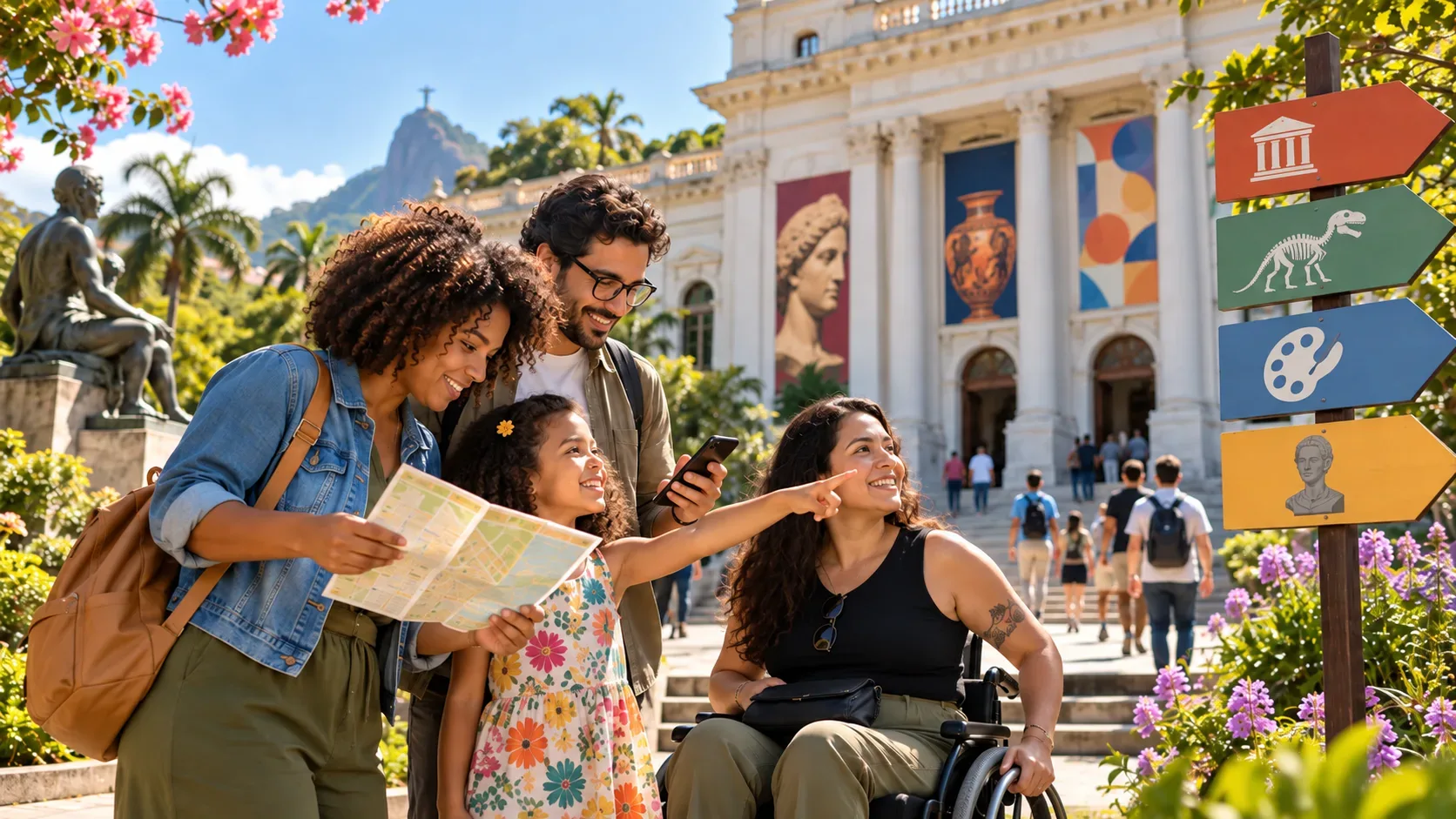
The theme “Museums for all people” places accessibility and inclusion at the center of the 2026 edition, but that does not mean every activity has the same infrastructure or resources. Some activity pages describe Braille, tactile resources, audio description or other approaches; others may provide less detail.
If accessibility is a condition for your visit, use the activity page as a first check and then confirm with the institution. Ask about the specific resource you need and, when relevant, the full visitor route: entrance, restroom, circulation, seating, parking or drop-off area.
A five-minute method for building your schedule
- Shortlist two or three activities by city or neighborhood.
- Remove those that conflict with your available time or travel distance.
- Check age ratings if children or teenagers are joining you.
- Look for ticket, registration or advance-booking requirements.
- Confirm the accessibility resources you need and the final address.
- Save the institution’s contact information in case of a last-minute change.
If two options seem equally good, prefer the one with clearer information about time, access, reservations and contact details. That reduces the chance of arriving and finding a restriction that was not obvious in the summary.
What the 2026 theme changes about how to read the program
The official theme is more than a campaign slogan. According to Ibram, it frames discussion around different access barriers and the representation of social groups in museum narratives and practices. For visitors, that is a cue to look beyond what is happening and also ask who the activity was designed for, how participation works and what access conditions were considered.
Before leaving home
- Reopen the activity page the day before or on the day of your visit.
- Confirm the date, time and address.
- Check whether it is free and whether a ticket, registration or booking is required.
- Check the age rating.
- Confirm the accessibility resources you actually need.
- Contact the institution if any essential detail is incomplete or ambiguous.