
A CNIS contribution below Brazil's minimum wage does not always have to be lost. Since November 13, 2019, the General Social Security System allows adjustments to a competência, meaning a monthly contribution period, when the total remuneration for that month was below the minimum threshold. The adjustment can be made by topping up the contribution, transferring a surplus from another contribution month, or combining below-minimum months. The key restriction is that months used for transfer or grouping must belong to the same calendar year.
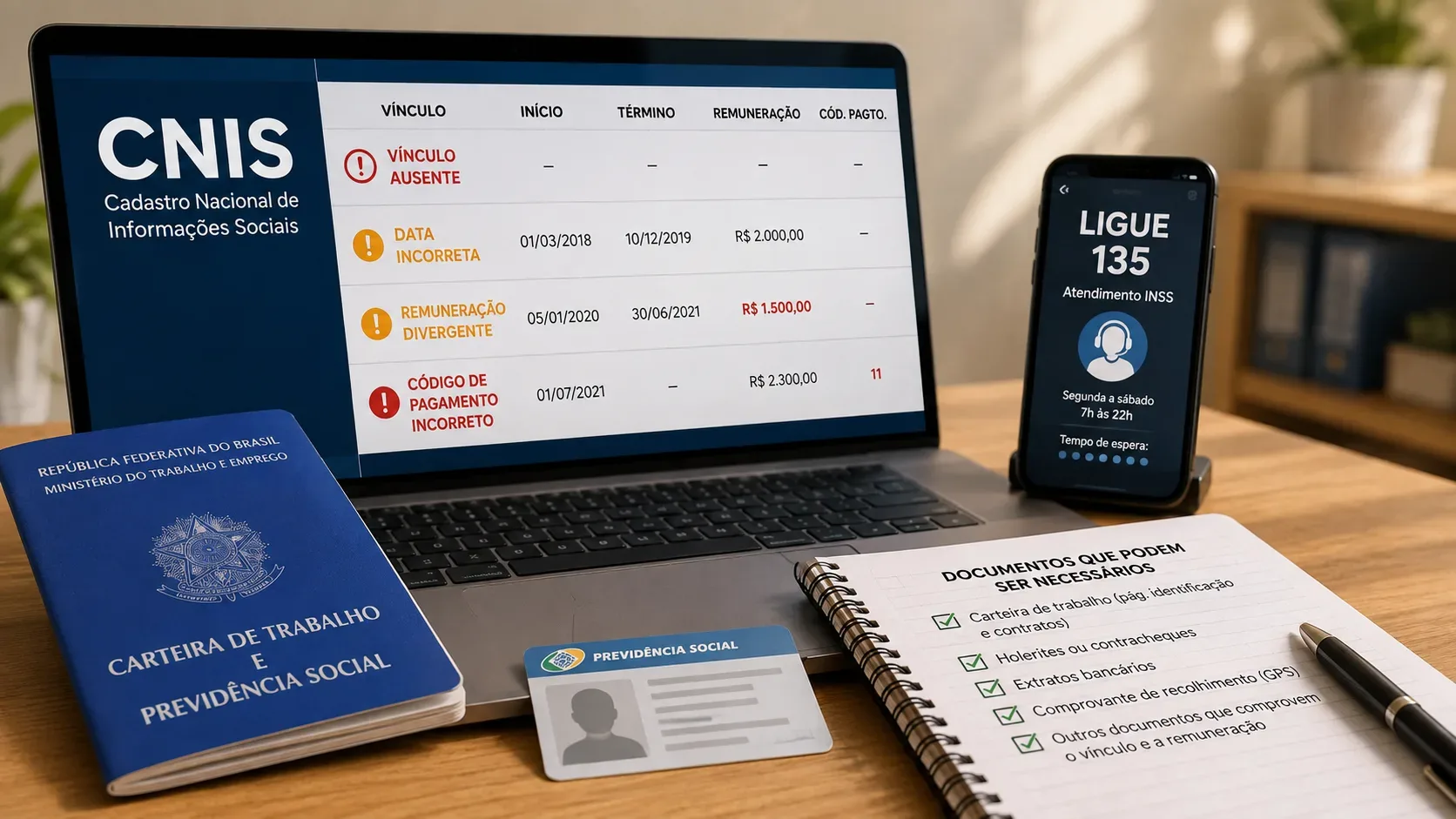
This adjustment is not the same as correcting an employment record or remuneration amount that was entered incorrectly in CNIS. If the recorded amount is wrong, the first issue is the accuracy of the record or the supporting evidence. The EC 103/2019 adjustment mechanism is for a month whose correctly determined amount was actually below the required minimum.
First, confirm that the contribution month is really below the minimum
INSS looks at the sum of remuneration received in the month. Someone who had more than one job or activity in the same contribution month should therefore check the consolidated total before concluding that there is a shortfall. If the total already reaches the minimum wage in force for that month, there is no insufficiency adjustment to make under this mechanism.
For contribution months from November 2019 onward, the rule comes from Article 29 of Constitutional Amendment 103/2019 and was incorporated into the Social Security regulations. Because the rule began in November, only November and December 2019 fall under this adjustment framework for that year. Thirteenth-salary contributions are not used in transfers or grouping between contribution months.
Decision tree: which adjustment fits each situation
- Is the contribution month before November 2019? Then this specific EC 103/2019 service does not apply. Regularization may follow another rule depending on the insured category and the type of payment.
- Does the total remuneration for the month already reach that month's minimum? If yes, there is no shortfall to correct through this mechanism.
- Is there another contribution month in the same year with a contribution salary above the minimum? The surplus may be transferred to complete one or more below-minimum months.
- Are there two or more below-minimum contribution months in the same year? They may be grouped to produce one or more valid months, without exceeding the minimum in the month that receives the value.
- Is there not enough surplus, or do you need to complete a specific month? A top-up lets you pay the amount needed to reach the minimum.
Top-up: when there is a difference to pay
With a top-up, the insured person pays the amount needed for the contribution month to reach the minimum threshold. Under the EC 103/2019 adjustment service, the top-up is paid through a Darf according to the rules applicable to the insured category and the specific month. The calculation starts with the difference between the minimum wage in force for the month and the consolidated remuneration below that minimum, with the applicable contribution rate then applied.
This is usually the most direct route when there is not enough surplus in another month of the same year or when the goal is to make a specific month valid without using amounts from other months. The exact amount depends on the insured category, the period, and the contribution arrangement, so the calculation should follow the official procedure.
Using a surplus: when another month in the same year exceeded the minimum
If a contribution month in the same year has a contribution salary above the minimum, the excess portion can be used to complete another month below the minimum. The source month keeps the amount needed to remain at the minimum, and only the surplus is transferred.
In a simplified example, if one month reached 130% of the minimum and another reached 70%, the 30% surplus from the first can complete the second to 100%, provided both months are in the same calendar year and the adjustment follows INSS rules. Surpluses from more than one month may also be used to complete a single insufficient month.
If the receiving month is still below the minimum after the surplus transfer, the regulations allow the remaining shortfall to be paid through a top-up.
Grouping: when several insufficient months can form one valid contribution month
Grouping combines below-minimum contribution salaries from different months in the same year so they can be used in one or more contribution months. The result of the grouping cannot exceed the minimum in the month that receives the value.
In a simplified example, two months with contribution salaries equal to 60% and 40% of the minimum can be combined to create one month at the minimum. This does not automatically turn the two months into two valid months. One contribution month may receive the amount it needs while another becomes zero or is partially used, depending on how the adjustment is structured.
Grouping should therefore not be understood as a simple addition that preserves every month. It can reduce the number of contribution months that are usable at that point. The regulations allow a month that was reduced to zero by grouping to later receive a new payment so it can reach the minimum, but the grouping that has already been processed is not reversed.
The three mechanisms can be combined
The options are not always mutually exclusive. The rules allow, for example, a surplus from another month to be used first and the remaining shortfall to be paid afterward. They also allow below-minimum months to be grouped and, if the result is still below the minimum, the remaining amount to be covered by a top-up or by surplus from other months in the same year.
| Mechanism | When it can help | What happens | Main limit |
|---|---|---|---|
| Top-up | When a contribution month still needs value to reach the minimum | The applicable difference is paid | Follows the rules for the insured category and the contribution month |
| Use of surplus | When another month in the same year was above the minimum | The surplus is moved to an insufficient month | Only between contribution months in the same calendar year |
| Grouping | When several contribution months are below the minimum | Amounts from insufficient months are combined to create a valid contribution month | The receiving month cannot exceed the minimum as a result of the grouping |
Same calendar year does not mean the request must be filed that year
INSS states that top-up, surplus transfer, and grouping may be requested at any time. The restriction is different: the contribution months used together for the adjustment must belong to the same calendar year, from January 1 through December 31. A surplus from December of one year therefore cannot be used to complete January of the next year.
This distinction matters because "same calendar year" is often mistaken for a filing deadline. The official rule concerns which contribution months can be combined, not a requirement to submit the request by December 31 of that year.
The adjustment is irreversible after it is processed
The most important warning before confirming the request is irreversibility. INSS states that the adjustments become irreversible and cannot be waived after they are processed. This matters especially for surplus transfers and grouping because the choice changes how contribution salaries are distributed across months.
Before submitting the request, check which months will receive value, which months will provide surplus, which months may be reduced to zero, and whether the chosen combination matches the intended social-security objective. If CNIS itself contains an incorrect record, that discrepancy should be examined separately so that an amount that should have been corrected is not adjusted instead.
Who can use the EC 103/2019 service
The official service "Ajustes para Alcance do Salário Mínimo - Emenda Constitucional 103/2019" lists employees, domestic employees, casual workers covered by the RGPS, and individual contributors, including people with concurrent activities. For optional insured persons, special insured persons, or other below-minimum payment situations, INSS provides separate regularization and GPS calculation guidance that may follow a different procedure.
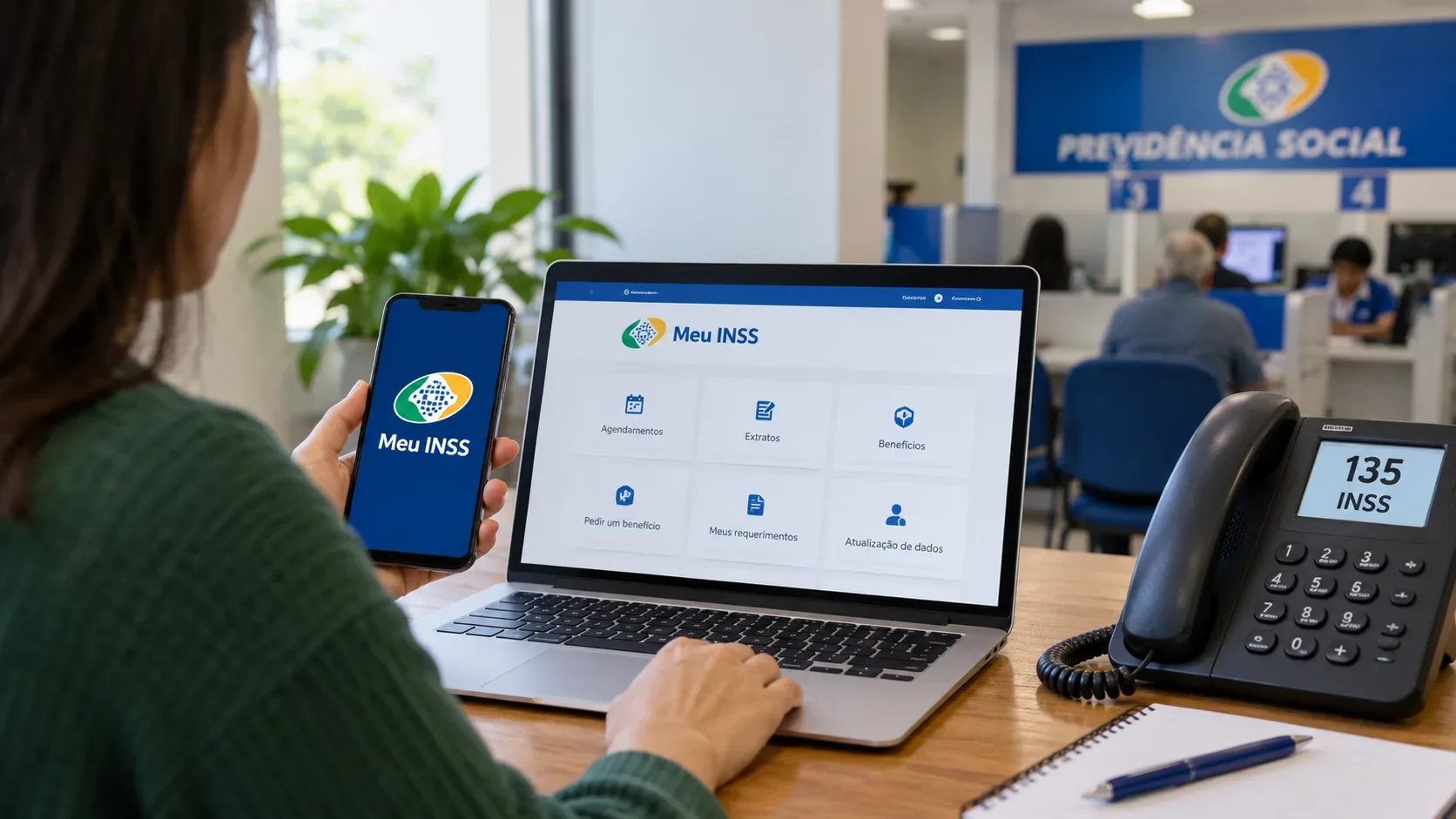
How to request the adjustment through Meu INSS
- Access Meu INSS with your CPF and gov.br password.
- In the service search field, type "Ajustes".
- Select "Ajustes para Alcance do Salário Mínimo - Emenda Constitucional 103/2019".
- Review the listed contribution months, required documents, and adjustment method before proceeding.
- Keep the protocol number and track the request in Meu INSS.
According to the official INSS channel list, this service is provided through Meu INSS. The government service page states that the request is completed online and does not require a visit to an INSS office to start the process.
Checklist before choosing a top-up, surplus transfer, or grouping
- Confirm the minimum wage in force for each contribution month under review.
- Add all remuneration from the same month before classifying it as insufficient.
- Separate the contribution months by calendar year.
- Identify months above the minimum and calculate only the available surplus.
- Check which below-minimum months could be grouped without exceeding the receiving month's limit.
- Compare that result with the top-up alternative.
- Review the effect on the number of contribution months that remain usable.
- Do not confirm the request without understanding that a processed adjustment is irreversible.
Official sources for checking the rule
The rules and request channel can be checked on the INSS page on minimum-wage adjustments, the government service page Request adjustments to reach the minimum wage, Article 29 of Constitutional Amendment 103/2019, and the Social Security Regulations. For situations that do not fit this service, also consult the official Social Security Contribution Regularization guidance.