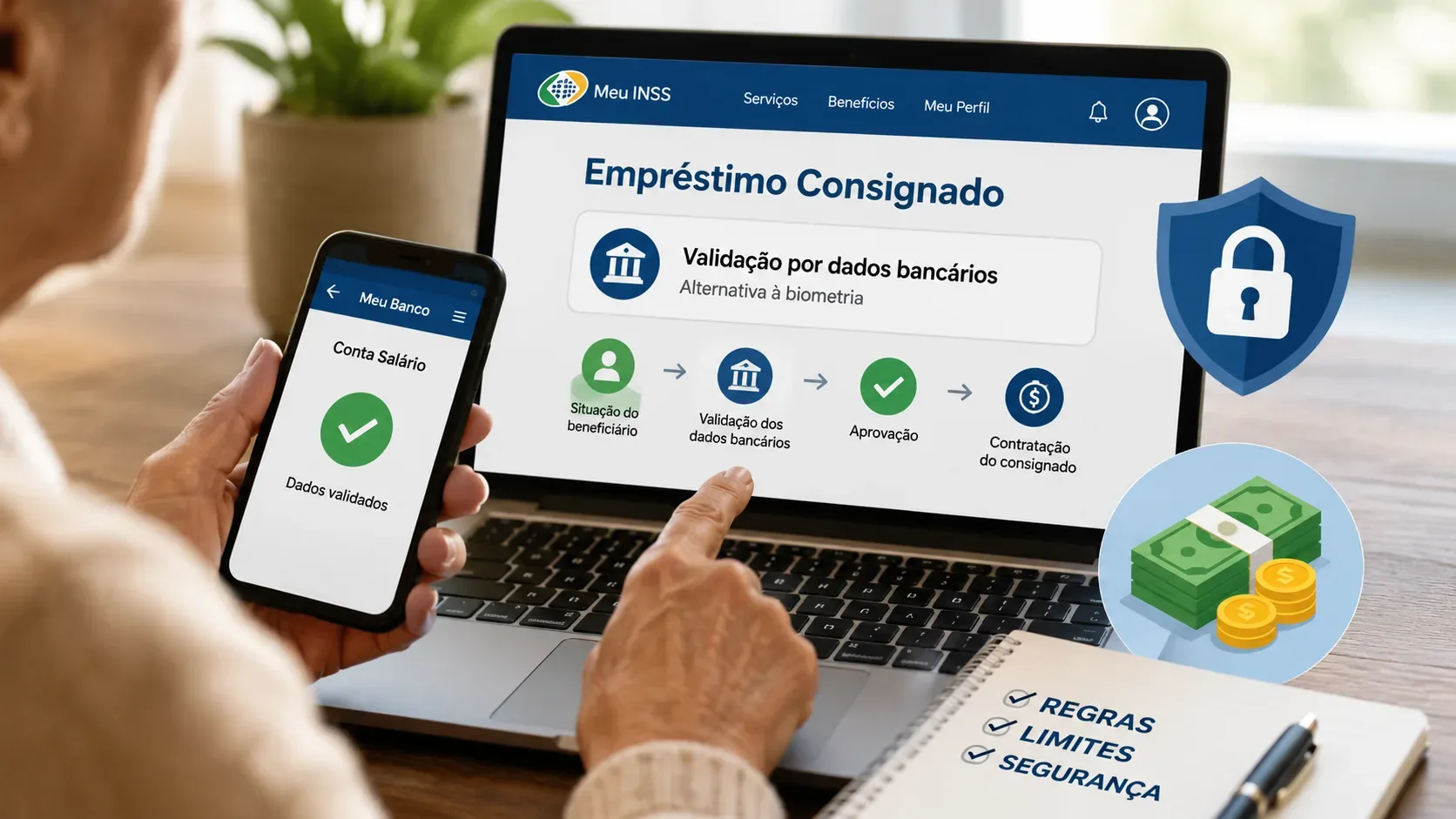
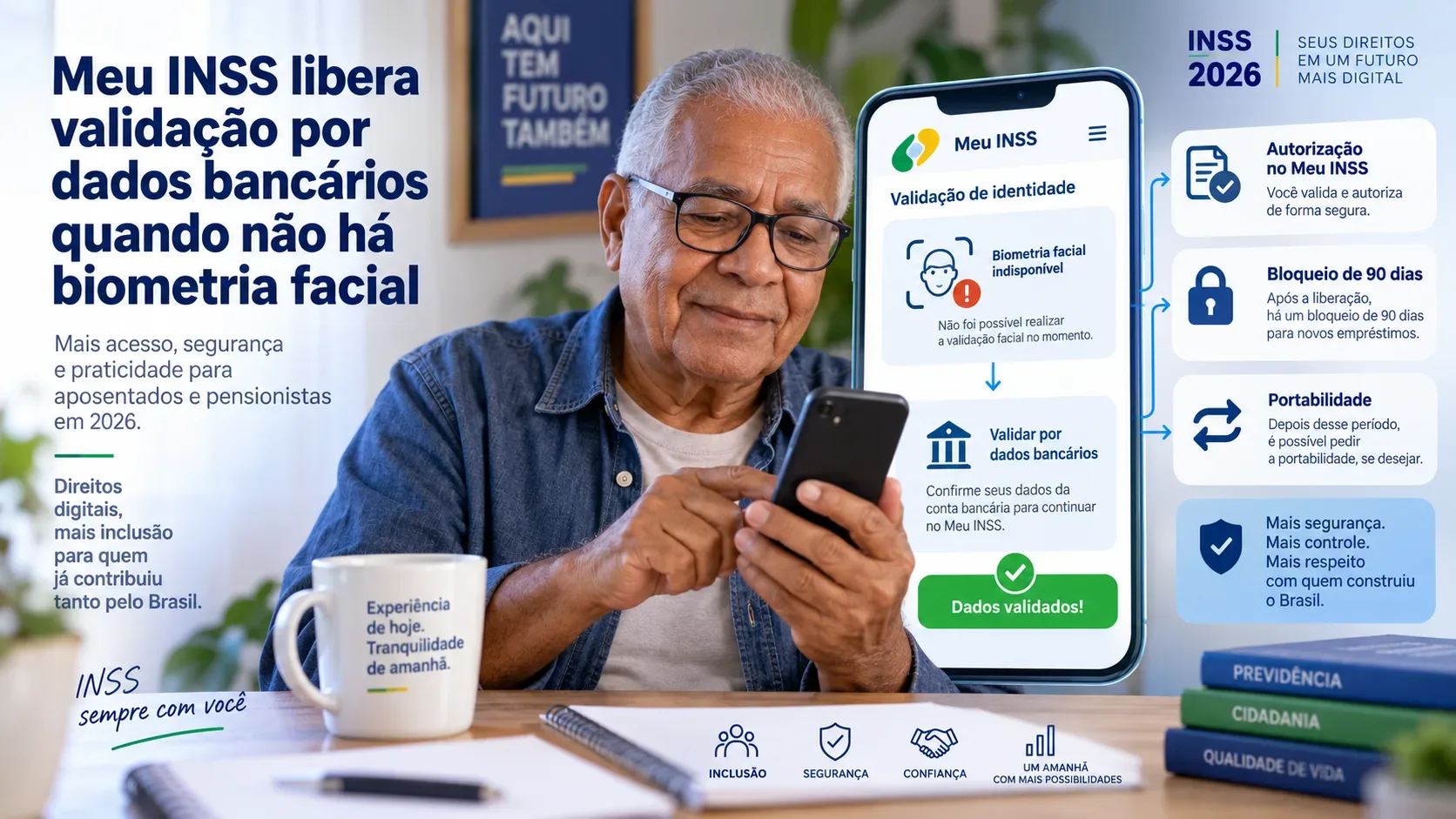
Bank-data validation has not become a freely selectable option for every INSS payroll-loan transaction. Since INSS Normative Instruction PRES/INSS No. 213, dated August 17, 2026, it has worked as an alternative route when Dataprev cannot find the beneficiary's biometric record in government databases. If biometrics are available, biometric validation remains the first route presented by Meu INSS.
In practice, the decisive point is whether the system finds an existing biometric record. The absence of biometrics does not remove the other requirements: the benefit must be in a status that allows unlocking, the holder's authorization remains mandatory, and specific rules still apply to new transactions and portability. This article reflects rules checked on September 10, 2026.
Who can use bank-data validation
The rule was created for INSS beneficiaries who need to authorize a payroll-loan transaction but do not have biometrics found in the databases consulted by the government. The INSS explains that Dataprev first checks whether a biometric record is available. Only when that search finds no biometric data does the system release Gov.br access using bank-data validation.
This means that “I could not complete facial recognition” and “no biometric record exists in the government databases” are not necessarily the same situation. The rule describes the second case. The alternative is released based on the system's verification, not on a manual choice by the user to skip biometrics.
At what stage the alternative appears in Meu INSS
The flow can be understood as an automatic authentication decision within the authorization of the transaction:
- the beneficiary accesses Meu INSS to perform the procedure related to the payroll loan;
- Dataprev checks whether biometrics are available in government databases;
- if biometrics are found, they remain the first validation method;
- if no biometrics are found, the system may release Gov.br access with bank-data validation;
- after authentication, the holder must still expressly authorize the transaction.
The change therefore solves an authentication barrier for people whose biometric records are not found by the government. It does not turn bank data into automatic authorization to take out credit, and it does not allow the bank to dispense with the beneficiary's consent.
Biometrics found or not found: what changes
| Situation verified by the system | Validation route | What remains mandatory |
|---|---|---|
| Biometrics found | Biometrics remain the first option | Personal and express authorization by the holder |
| Biometrics not found | Meu INSS may release Gov.br with bank-data validation | Personal and express authorization by the holder and all other payroll-loan requirements |
The consolidated version of Law No. 8,213/1991 requires prior, personal and specific authorization to unlock a benefit for payroll-loan deductions. The same law prohibits taking out or unlocking payroll credit through a power of attorney or by telephone call center.
The 90-day block still applies
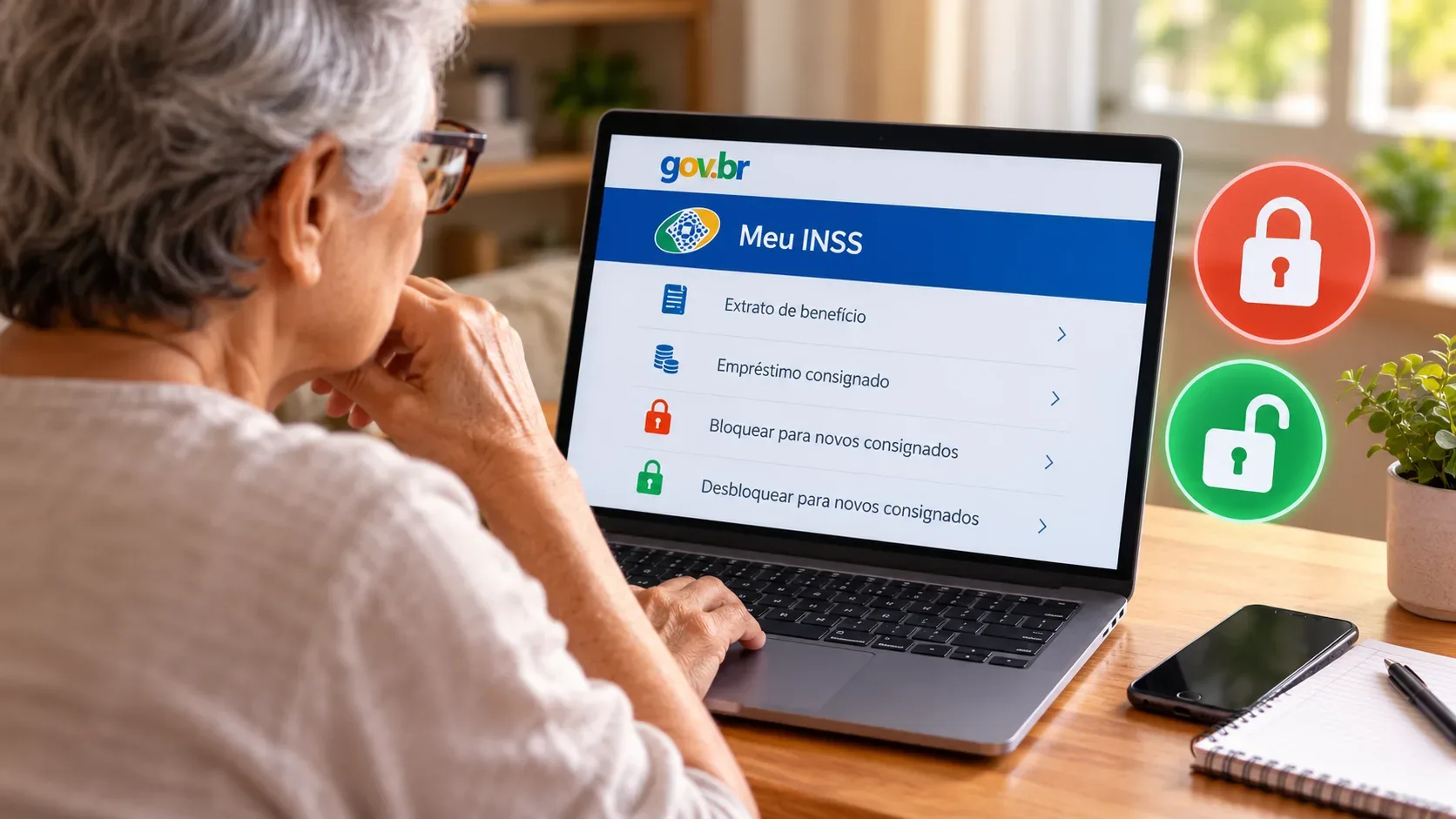
Bank authentication does not remove the initial block on the benefit. According to INSS, as a rule, a newly granted benefit remains blocked for payroll loans during the first 90 days. After that period, the holder may request unlocking through Meu INSS. The 90-day rule must also be observed when the payment locality of the benefit is transferred.
There is another rule that should not be confused with those 90 days: the law now provides that, after each payroll-loan transaction, the benefit is blocked again for new transactions, requiring a new unlocking procedure. This post-transaction block does not, by itself, mean another 90-day waiting period.
What bank validation does not remove
Even when Meu INSS releases bank-data authentication, the financial institution remains subject to the transaction's document controls. Under the rules disclosed by INSS, the bank must submit information and documents such as the contract, an official photo ID, CPF and the authorization for the deduction from the benefit.
INSS also states that the institution must send proof of the loan deposit within seven business days after the transaction. If the required information is not sent on time, the institute may stop the deductions and withhold transfers to the bank until the issue is corrected.
The rule announced in August also set a maximum term of 108 consecutive monthly installments. That operational rule is separate from the payroll-loan margin, whose legal basis changed later at the end of August.
Attention: the margin cited in August changed legal basis
The INSS news item published on August 24 and updated on August 25 mentioned a payroll-loan margin of up to 40%, based on Provisional Measure No. 1,355/2026. However, the National Congress records that the provisional measure lost effect on August 31, 2026.
On September 10, 2026, the consolidated version of Law No. 10,820/2003 again showed, for RGPS retirement and survivor-pension benefits, a global limit of 45% of the benefit: 35% exclusively for loans, financing and leasing, 5% for payroll-deducted credit cards, and 5% for the payroll-deducted benefit card. BPC benefits have their own limits under the same law. Therefore, the 40% figure in the August news item should not be treated as the current rule without checking current legislation.
How portability works without biometrics
The bank-data validation alternative also applies to portability authorization when no biometrics are found. The beneficiary requests portability from the destination institution and authorizes the procedure in Meu INSS. If biometrics exist, they are used; if no biometric record is found, bank-data validation may be used.
In addition to authentication, the Portability Authorization Term must be signed. The original institution has up to 20 days to confirm the transaction; if confirmation does not occur within that period, portability is canceled.
What to check before completing authorization
- whether the screen actually states that no biometrics were found and offers the bank route;
- whether the benefit can already be unlocked, especially if it is new or its payment locality was transferred;
- whether the transaction details shown match the contract the holder intends to authorize;
- whether a portability request includes the required specific authorization term;
- whether the available margin is being calculated under the current legal rule rather than an outdated reference to Provisional Measure No. 1,355/2026.
The main 2026 change is therefore narrow and objective: when Dataprev does not find biometrics in government databases, Meu INSS may offer bank-data validation as an alternative authentication route. Blocks, personal consent and transaction controls continue to apply.
Sources consulted
- INSS — Beneficiaries without biometrics may use bank-data validation
- INSS — 2026 Normative Instructions, including PRES/INSS No. 213
- Planalto — Consolidated Law No. 8,213/1991
- Planalto — Consolidated Law No. 10,820/2003
- National Congress — status of Provisional Measure No. 1,355/2026
- Agência Brasil — coverage of the new authentication rules