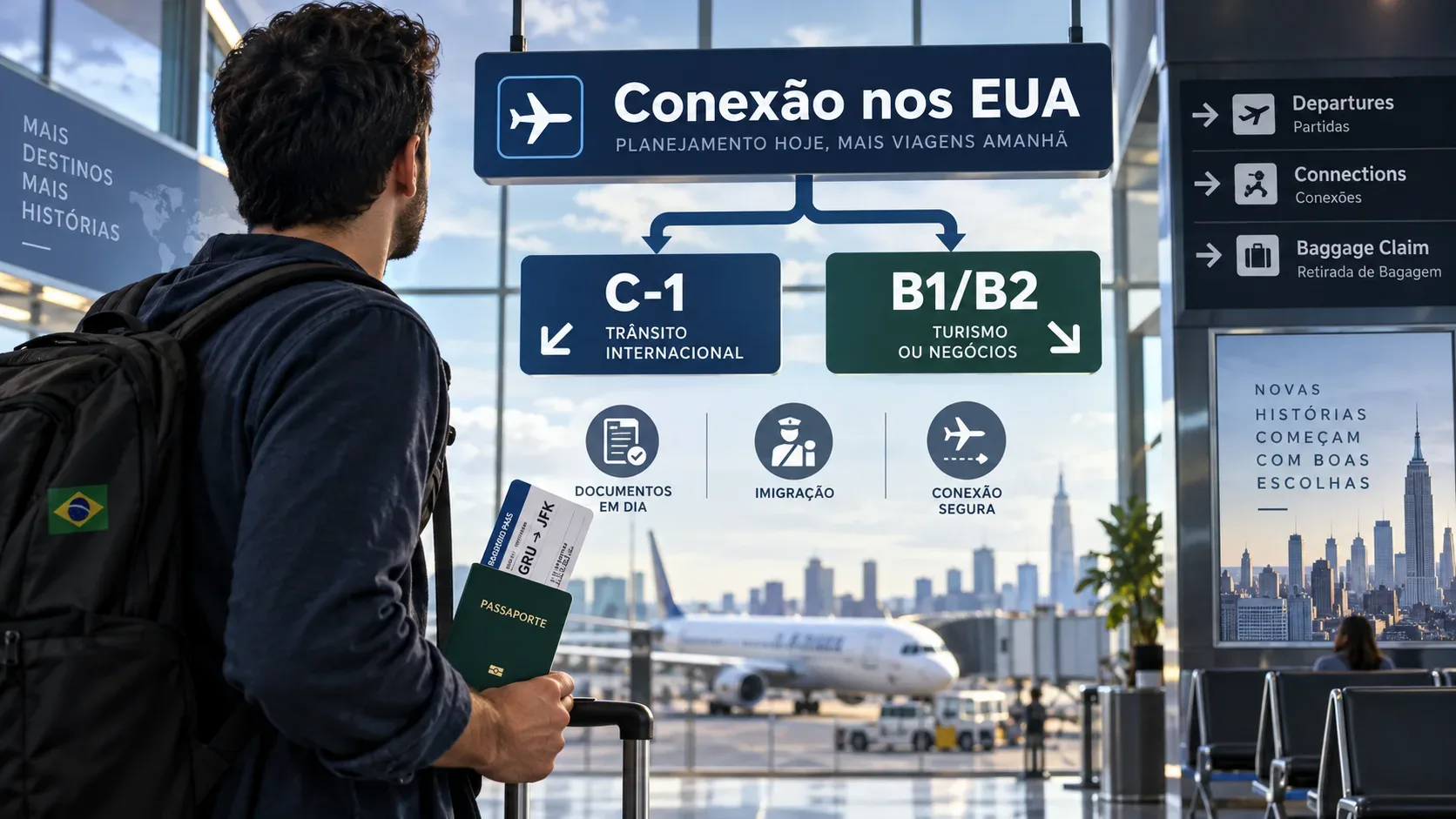
Yes: travelers using a Brazilian passport normally need U.S. entry documentation for a connection in the United States even when the only plan is to change planes and continue to another country. U.S. rules do not create an automatic exemption simply because the passenger intends to remain inside the airport. The U.S. Department of State treats transit as a form of temporary entry and provides the C visa for transit; it also states that a valid B visitor visa may be used to transit. American Airlines' Brazil guidance says Brazilian passengers connecting through the United States must present a valid U.S. visa.
Quick answer: C-1 or B1/B2?
| Situation | What generally applies | Key point |
|---|---|---|
| You already have a valid B1/B2 visa | A B1/B2 can be used for the connection. | Check passport and visa validity, plus the documents required for your final destination. A visa lets you request admission; it does not guarantee entry. |
| You do not have a U.S. visa and will only make an immediate connection to another country | The C-1 is the specific category for immediate and continuous transit. | Your itinerary should show that your purpose is to pass through the United States on the way to another country, without using the stop for tourism or a visit. |
| You want to use the stop for tourism, visiting someone, or permitted business activity | C-1 does not cover that purpose; you need to qualify for the appropriate category, generally B1/B2 for a temporary visit. | Choose the category according to the real purpose of the trip, not merely the connecting airport. |
| You have dual citizenship and will travel on a passport from a Visa Waiver Program country | Transit under the VWP with ESTA may be possible if all requirements are met. | Brazil is not on the current VWP country list; eligibility depends on the passport used and the program's other rules. |
Why is a visa required even if you do not “leave the airport”?
For an international connection through the United States, the decisive issue is not whether you walk out of the terminal into the city. The U.S. Customs and Border Protection (CBP) states that travelers in the United States must clear CBP at the first port of entry. On a typical itinerary originating in Brazil, that means going through U.S. border processing at the first U.S. airport before continuing the journey.
For that reason, travelers should not assume that an international transit area eliminates U.S. entry-document requirements. The Department of State defines the C visa as a nonimmigrant visa for people in immediate and continuous transit through the United States on the way to another country.
What the C-1 allows — and what it does not
The C-1 has a narrow purpose: passing through the United States reasonably quickly on a prearranged itinerary while traveling to another country. The Department of State gives the example of a passenger with a brief U.S. layover whose only reason for entering the country is transit.
This category should not be treated as a layover tourism visa. If the purpose of the stop is to visit friends, sightsee, or use the layover for a reason other than simple transit, the Department of State says the traveler must qualify for the visa category appropriate to that purpose, such as a visitor visa.
If I already have B1/B2, do I need a C-1 just for the connection?
As a practical rule, no. The official transit visa page says that a traveler who already has a valid B visitor visa may use it to transit the United States. A traveler with a valid B1/B2 therefore does not need to obtain a C-1 solely because a future itinerary includes a U.S. connection.
This does not make a B1/B2 a guarantee of entry. The Department of State notes that a visa allows a traveler to reach a U.S. port of entry and request admission; CBP makes the final admission decision.
Decision flow before buying the ticket
- Will you travel on a Brazilian passport? If so, do not assume Visa Waiver Program eligibility. Brazil is not on the current official list of VWP participating countries.
- Do you already have a valid B1/B2? If yes, the Department of State allows a valid B visa to be used for transit. Also verify the passport you will present and the visa details before booking.
- Do you have no U.S. visa and is the sole purpose to connect onward to another country? C-1 is the category created for immediate and continuous transit. Check the official visa page for current requirements and procedures.
- Do you want to sightsee, visit someone, or conduct permitted business during the stop? Do not frame the trip as simple C-1 transit; review the visitor category that matches the actual purpose.
- Do you hold another passport? If that passport is from a VWP country, verify ESTA eligibility and restrictions before booking. Dual citizenship alone is not enough; all VWP requirements must be met.
Practical checklist before booking a route that connects in the U.S.
- Passport: check validity and the requirements for travel to the United States and the final destination.
- Applicable visa or authorization: make sure the U.S. visa will be valid on the travel date. If you plan to use the VWP through another nationality, confirm ESTA and eligibility.
- Purpose of the stop: distinguish pure transit from a stop that includes tourism, a visit, or business; that purpose affects the appropriate immigration category.
- Documents for the destination and other stops: a U.S. connection does not replace visas, authorizations, or health/immigration requirements imposed by other countries on the itinerary.
- Connection time: leave enough time for immigration, baggage procedures, and another security screening when applicable. Airport and airline operations vary.
- Airline rules: confirm document checks before departure. American Airlines Brazil, for example, says Brazilian passengers connecting through the United States on the way to other countries must present a valid U.S. visa.
Common mistakes that can derail the trip
- Buying a ticket on the assumption that “I will not leave the airport” means no visa is needed. U.S. border processing still applies to many international connections.
- Applying for C-1 when the real plan includes tourism or visiting someone. C-1 is limited to transit.
- Applying for a new C-1 despite already holding a valid B1/B2. The Department of State allows a valid B visa to be used for transit.
- Checking only U.S. requirements. The final destination and any other connection countries may have their own documentation rules.
- Treating a visa as guaranteed admission. CBP decides admission at the border process.
What is the safest rule of thumb for Brazilian travelers?
If you travel on a Brazilian passport, plan a U.S. connection as a journey subject to U.S. entry rules, not simply as a gate change. If you already hold a valid B1/B2, it can normally be used for transit. If you do not have a visa and the trip is only an immediate connection to another country, C-1 is the specific category to review. If the stop includes tourism, a visit, or another purpose, C-1 is no longer the appropriate answer.
Before booking, verify the current rules directly with the U.S. Department of State, CBP, and the airline. Immigration requirements and airport procedures can change, and the correct analysis depends on the passport used, the real purpose of travel, and the complete itinerary.