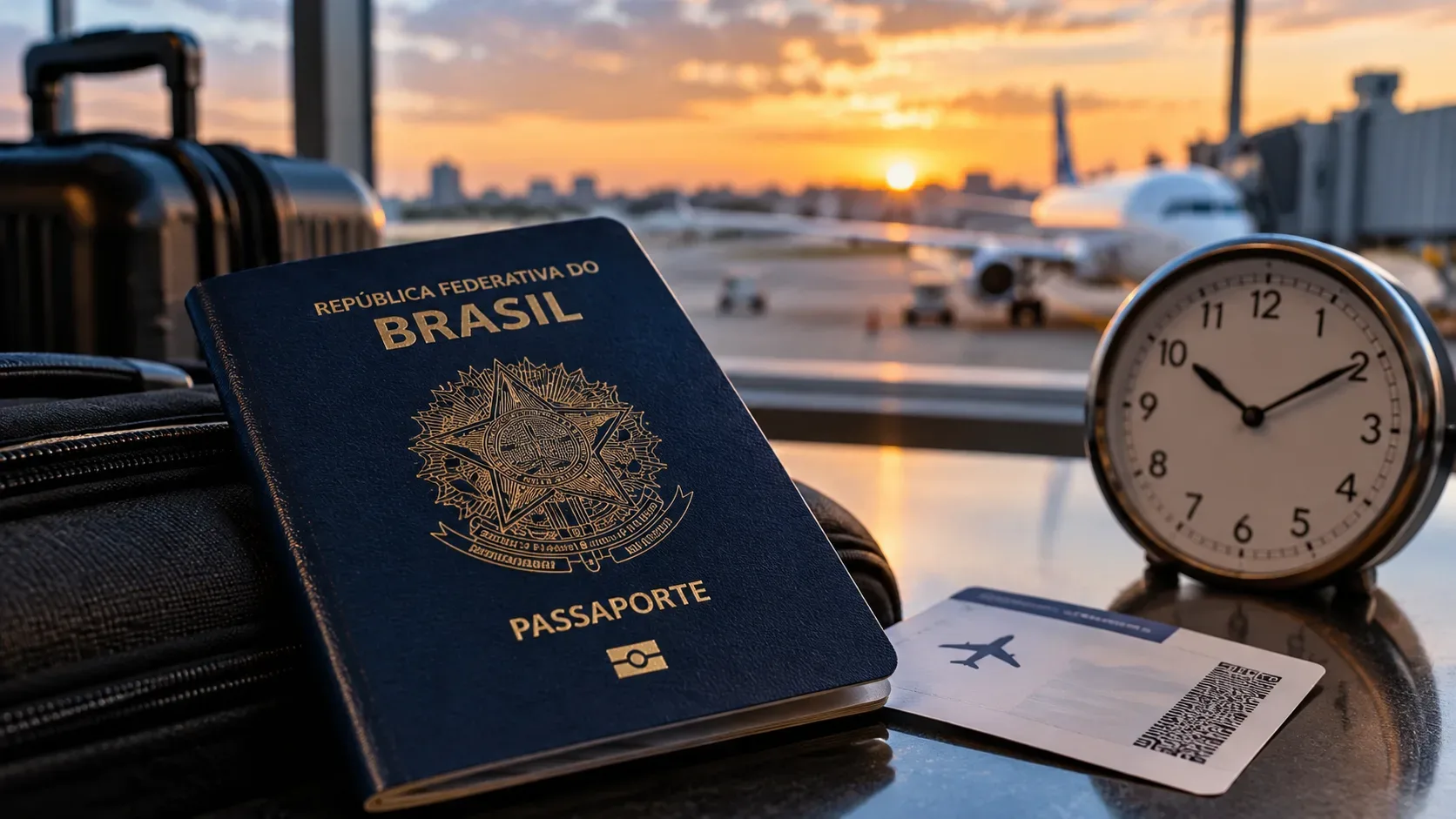
When travel is close, “urgent” and “emergency” are not interchangeable terms in the Brazilian Federal Police passport process. Both routes shorten the standard delivery time, but their deadlines, validity and eligibility rules differ. The practical baseline is this: a regular passport is delivered within 6 business days after the in-person appointment; the urgent route can reduce that to up to 72 business hours; and the emergency route to up to 24 hours, provided the need is documented and accepted by the Federal Police.
Urgent vs. emergency: the difference that changes your choice
| Type | Federal Police delivery time | Validity | When it may apply | Key caution |
|---|---|---|---|---|
| Urgent | Up to 72 business hours | Up to 10 years | When the applicant proves they cannot wait for the standard 6-business-day delivery period | The applicant must document why the normal deadline does not meet the need |
| Emergency | Up to 24 hours | 1 year | When the applicant proves they cannot even wait for the urgent route | Not accepted by every country; acceptance must be checked before travel |
Both are exceptional forms of issuance. The Federal Police states that an additional R$ 77.17 fee applies on top of the regular passport process fee. This additional charge is issued during the in-person appointment only if the applicant meets the criteria.
When the Federal Police may accept an urgent request
The rule for urgent issuance is broader: it may be requested whenever the applicant can prove that the standard delivery time does not meet a concrete need. Simply saying that a trip is approaching is therefore not enough; documents must show the date, the commitment and why waiting 6 business days is not feasible.
The request is assessed at the service location. The Federal Police states that the unit supervisor determines which passport type is appropriate based on the documents presented and the delivery times available at that location.
When emergency issuance may be accepted
Emergency issuance is narrower because it assumes that even the urgent route of up to 72 business hours is too slow. According to the Federal Police, grounds may include:
- natural disasters, armed conflicts or the interest of the Public Administration;
- work-related necessity or humanitarian aid;
- travel for the health of the applicant, spouse or a relative up to the second degree;
- protection of property or tourism;
- another serious emergency whose cause could not have been foreseen or avoided by the applicant.
There is an important caveat for tourism: the Federal Police currently treats tourism as a possible reason for an emergency passport, but it also warns that other countries may not regard tourism as an emergency. A country may therefore refuse entry to a Brazilian tourist carrying this type of passport.
Which documents can help prove urgency or emergency
In addition to all general documents required for a regular passport, the applicant must bring specific evidence of the exceptional need. The Federal Police gives examples such as tickets, hotel reservations, professional letters and enrollment records.
In practical terms, the evidence should make three things clear to the officer: what the commitment is, when it will occur and why the standard deadline — or, for emergency issuance, the urgent deadline as well — is insufficient. The more directly a document connects the person, the date and the reason for travel, the clearer the request is for assessment.
How to apply: steps before going to the Federal Police unit
- Gather the general documents required for a regular passport.
- Prepare proof of the urgent or emergency need, such as a travel ticket, reservation, employer letter, medical document or other evidence relevant to the case.
- Complete the passport application form in the official system to generate the protocol and regular fee.
- Pay the regular fee and keep proof of payment.
- Check a unit that issues urgent and emergency passports. The Federal Police states that every state capital has a service point for these routes.
- Go to the chosen unit during opening hours, avoiding the end of the day, with the general documents, specific evidence and proof of the paid fee.
At the appointment, the supervisor decides whether the requirements are met and which passport type best fits the situation. If exceptional issuance is approved, the additional R$ 77.17 fee is generated there as a federal payment form.
72 business hours or 24 hours: what the deadline actually means
An urgent passport is scheduled for delivery within up to 72 business hours. An emergency passport is scheduled for delivery within up to 24 hours. The official wording differs: the Federal Police uses “business hours” for urgent issuance and simply “hours” for emergency issuance.
These are the stated maximum delivery windows for the exceptional routes, not a promise that the passport will be issued immediately when the traveler arrives at the service point. Local operational conditions may differ, and the supervisor considers that unit’s delivery times when deciding the case. Anyone with imminent travel should therefore seek service as soon as the supporting documents are available rather than wait until the day before departure.
Validity: why an emergency passport can be a more limited solution
An urgent passport has validity of up to 10 years, while an emergency passport is valid for 1 year. This difference matters if the traveler expects to make additional trips after the immediate commitment.
Beyond the shorter validity, an emergency passport has an international limitation: not every country accepts it. Before requesting this route, verify through the destination country’s official channels whether the document is accepted for your purpose of travel. This is especially important for tourism.
What if the regular passport is already in transit?
If a passport has already been requested and is in transit for delivery, the Federal Police says its deadline cannot simply be shortened because an urgent need arose afterward. If a documented need appears before delivery, the applicant may start a new application process to seek urgent or emergency issuance, including payment of the applicable fees again.
Which route to choose when the trip is close
- If the standard 6-business-day delivery period still works for your trip, use the regular process.
- If the regular deadline does not work and you can document the need, consider urgent issuance.
- If even the 72-business-hour urgent route is too slow and the situation qualifies as an emergency, take the documents to a service point for assessment.
- If an emergency passport is the only workable option, confirm that the destination country accepts it before relying on it.
The final classification is made by the Brazilian Federal Police during the in-person appointment. Current rules and guidance are available on the official passport FAQ: Brazilian Federal Police — Passport FAQ.