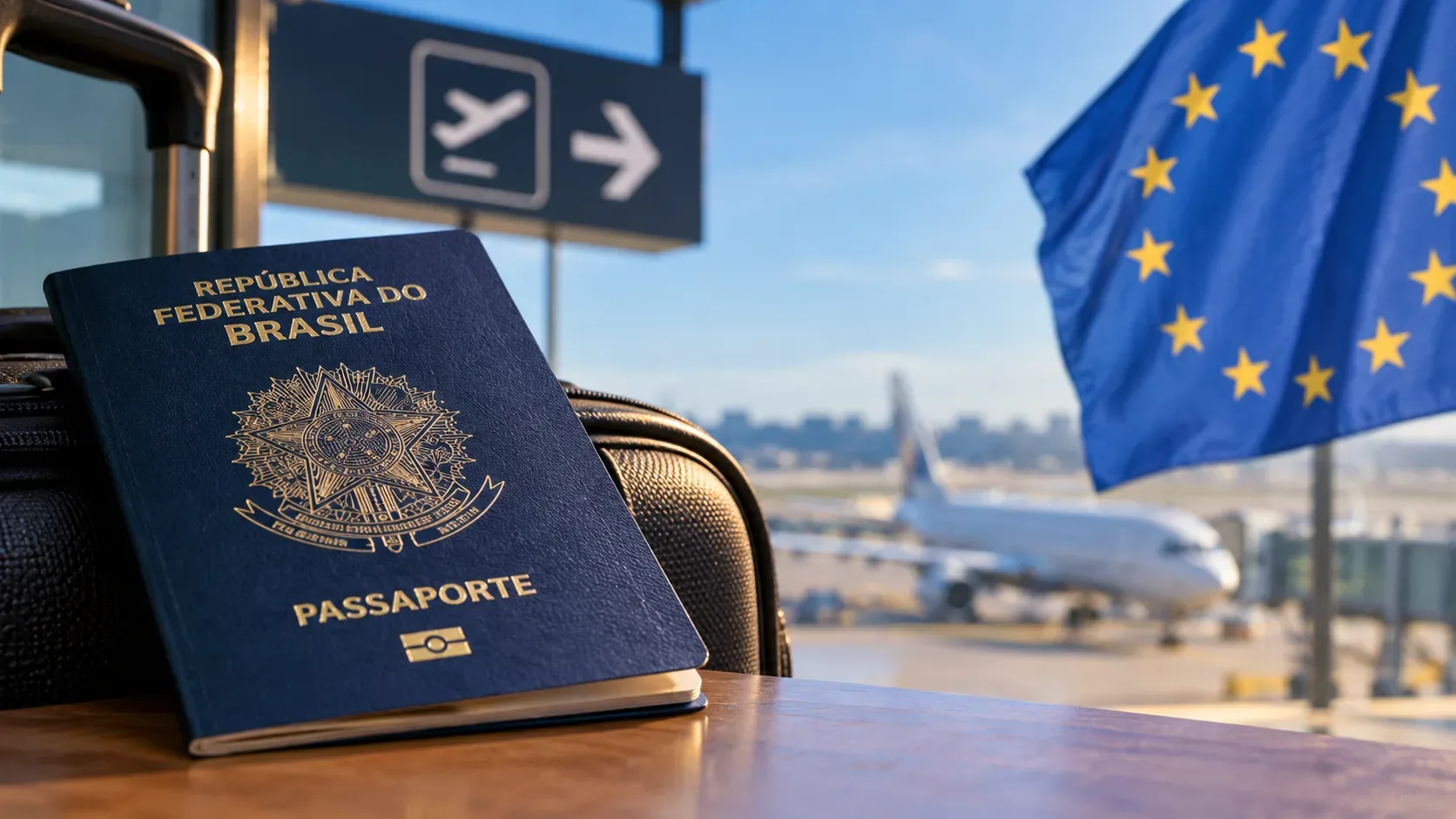
As of September 11, 2026, ETIAS is still not in operation. The European Union states on its official portal that it is not collecting travel-authorisation applications and that the specific start date will be announced several months before launch. For Brazilians planning a short trip to Europe, that means there is no official application to submit and no official fee to pay right now.
The best use of this period is to prepare documents and information, follow official channels only, and avoid websites that present themselves as if they could already issue an ETIAS authorisation. The official portal is travel-europe.europa.eu/etias.
What is the ETIAS status in September 2026?
ETIAS — the European Travel Information and Authorisation System — will be a travel authorisation for nationals of visa-exempt countries making short stays in participating European countries. Brazil is on the list of nationalities that will generally need the authorisation once the system becomes operational, subject to the exemptions that apply to certain travellers and residence documents.
For now, however, the key point is simple: the system is not accepting applications. The European Union itself says travellers do not need to take any action to obtain ETIAS at this time. If a page says you must “apply immediately” for a future trip, compare that claim with the notice shown in the official ETIAS portal.
What Brazilians can prepare now
You do not need to send information to any website to get ahead. You can prepare for the trip without filing an application that does not yet exist.
- Passport: check its expiry date and make sure the details are readable and correct. ETIAS guidance generally requires a travel document valid for more than three months after the planned departure from the countries requiring ETIAS and issued less than ten years earlier, with specific exceptions.
- Personal email account: the address entered in the application will be used for communications about the application and authorisation. Plan to use an account you can access directly.
- Personal details: verify your first and last names, date and place of birth, nationality, home address, phone number, and your parents’ first names.
- Trip details: the form will ask for the first country of your intended stay and your destination address. Your entire itinerary does not need to be fixed, but it helps to organise your first accommodation or reference address.
- Professional and background information: the system includes questions about education, current occupation and certain situations such as criminal convictions, previous travel to war or conflict zones, and return decisions.
- Payment method: once the system opens, the official fee announced by the EU will be €20, with exemptions for applicants under 18, applicants over 70, and some family members covered by EU free-movement rules.
What not to do before launch
| Now | Once the EU opens ETIAS |
|---|---|
| Check your passport, email and personal details. | Complete the form on the official website or official app. |
| Save the official portal address and monitor the launch notice. | Pay the applicable official fee and keep your application number. |
| Avoid giving passport and card details to pages claiming they can complete ETIAS today. | Carefully review your name and passport number before submitting. |
| Organise dates and the first intended destination. | Wait for the decision and respond to any requests for additional information. |
How to spot an unofficial site or risky intermediary
The European Union says its portal is the only official website for submitting an application directly. Other websites may act as intermediaries once the system is operational, but they will use the official channel on the traveller’s behalf and may charge their own service fees.
Pay particular attention to these warning signs:
- the site tries to make you believe it is the EU’s official channel even though its address is not on the official europa.eu domain;
- it presents an intermediary’s extra charge as if it were a mandatory ETIAS fee;
- it asks for sensitive personal or financial data now, while the official system is still closed;
- it charges far more than the official fee without clearly explaining the additional service;
- it does not clearly explain who will submit the application, how data will be protected, or how you will receive official communications.
The EU portal itself lists as abusive practices attempts to impersonate the official channel, fraudulent use of personal or financial data, excessive charges, and failure by an intermediary to submit an application within the required time, format, and quality. The official Report abuse page sets out this guidance.
Will intermediaries always be prohibited?
No. Once ETIAS is operational, you will be able to authorise another person or a commercial intermediary, such as a travel agency, to apply on your behalf. That does not make the intermediary an official channel or make its additional fee mandatory. According to the EU, both the applicant and representative will need to sign a declaration of representation, and the traveller should keep personal access to the email account used in the application.
For travellers who can complete the form themselves, the simplest route is the official website or app. If you use a third party, compare its price, privacy policy, business identity, service terms, and the way it gives you access to messages about the application.
How the application will work after launch
Once applications officially open, the authorisation will be linked to the travel document. The EU says most applications should be processed within minutes. Some cases may take up to four days, and the timeframe can be extended when extra information or an interview is required. The official advice is therefore to apply well in advance.
After approval, the authorisation will be valid for up to three years or until the passport used in the application expires, whichever comes first. A new passport requires a new authorisation. ETIAS is not a visa and does not guarantee automatic entry: border authorities will still check whether the traveller meets the applicable entry conditions.
If you have already paid or shared data with a site before launch
First, keep receipts, payment records, emails, accepted terms, and screenshots of the page you used. Check what was promised: today the EU is not collecting official ETIAS applications. If you shared financial details or suspect fraud, contact your card issuer or bank and consider the security measures available to you.
For abuse involving intermediaries, monitor the EU’s official reporting page. The European Union also notes that this mechanism does not replace administrative, civil, or criminal remedies available under national law.
Checklist before any payment
- Confirm on the official ETIAS portal that the system has actually opened.
- Do not treat a page accepting a “pre-application” as if it were the official system.
- Check whether any extra charge is a third-party service fee rather than the official fee.
- Use a personal email account you control and review the passport number carefully.
- Keep your application number and official messages once applications actually exist.
In short: on September 11, 2026, a Brazilian traveller’s task is not to apply for ETIAS but to prepare the required information and verify the source. Completing a form and paying should only begin after the European Union officially announces that the system is open.