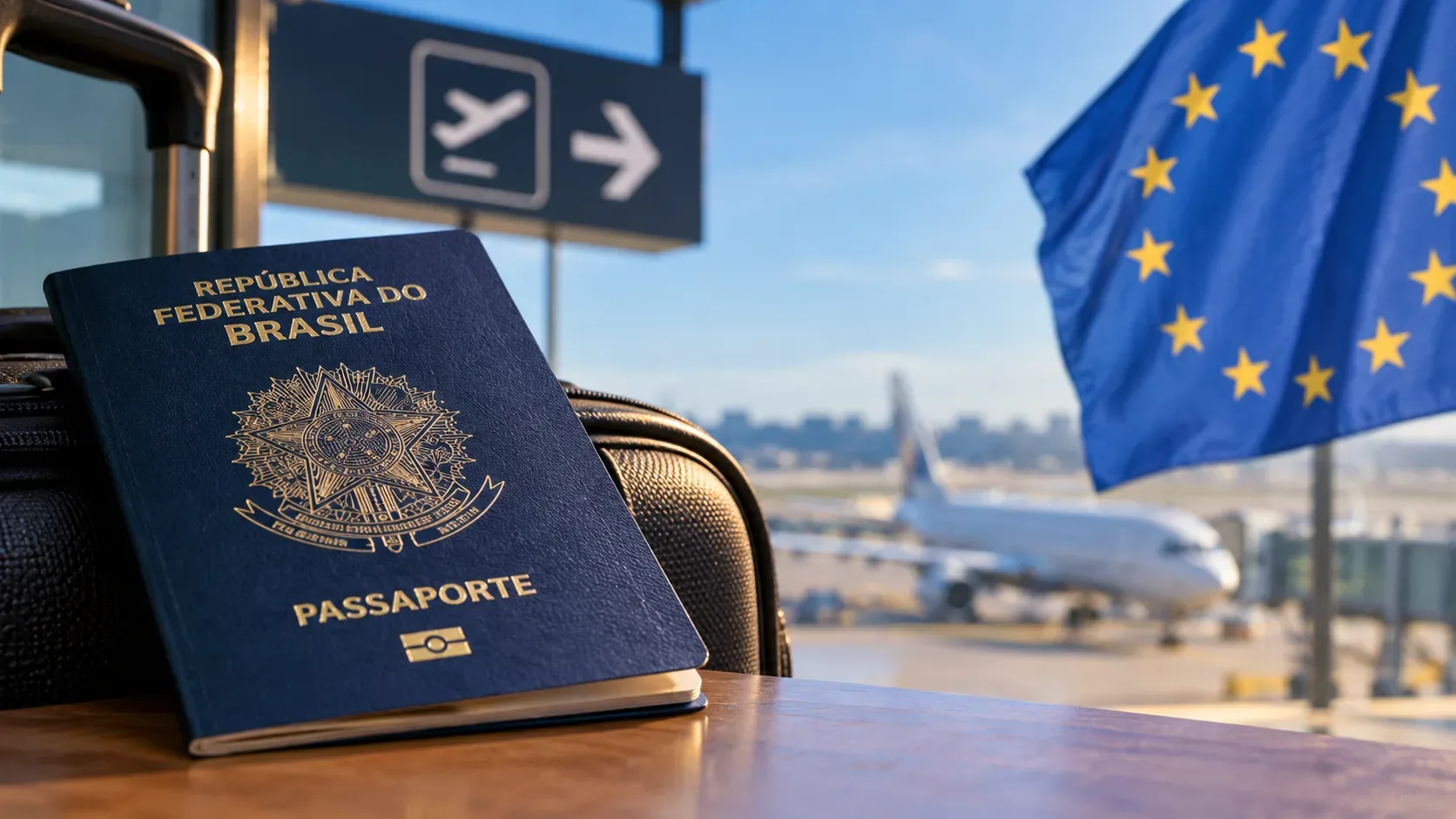
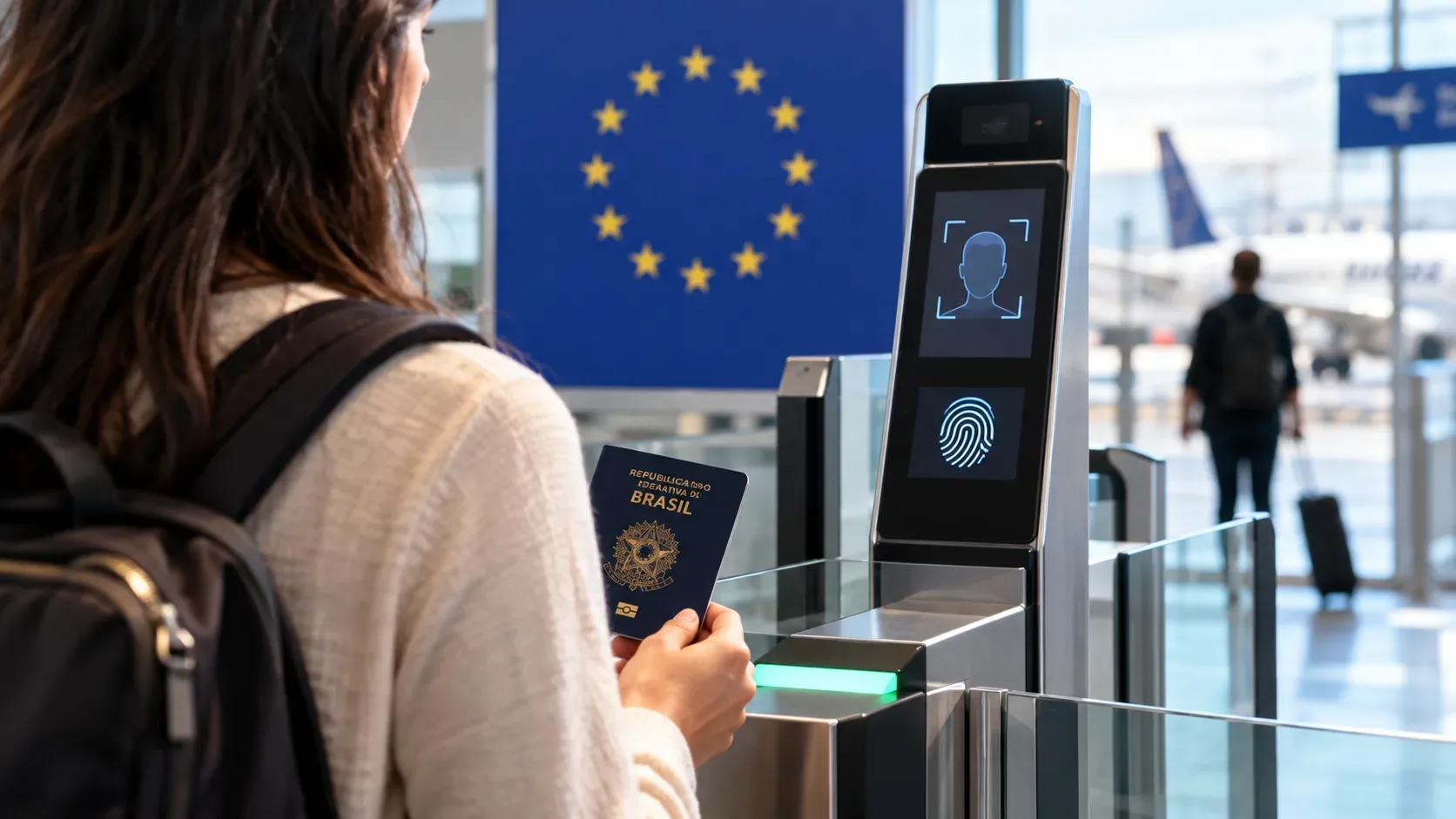
Since 10 April 2026, the Entry/Exit System (EES) has been fully operational at the external borders of the 29 European countries using the system. For Brazilians travelling for tourism or another visa-free short stay, the most visible change is straightforward: entry and exit are recorded digitally, using passport data and biometrics, instead of a manual passport stamp. The EES, however, is not a travel authorisation and does not require an advance application.
That is the key difference from ETIAS. As of 14 September 2026, the official ETIAS website says the system is not yet operational and is not accepting applications. It is still scheduled to start in the last quarter of 2026, with the exact date to be announced by the European Union. The European Commission also explicitly distinguishes the two systems: EES records the traveller at the border; ETIAS will be an authorisation obtained before travel by visa-exempt nationals such as Brazilians.
EES vs ETIAS: the difference in one table
| Point | EES | ETIAS |
|---|---|---|
| What it is | An electronic entry and exit registration system. | A travel authorisation for visa-exempt nationals. |
| When it happens | When crossing the external border of a country using EES. | Before starting the trip, once ETIAS becomes operational. |
| Who is affected | As a rule, non-EU nationals on short stays, with or without a visa, subject to exemptions. | Nationals of visa-exempt countries who fall under ETIAS rules; Brazil is on the list. |
| Biometrics | Stores a facial image and, for visa-free travellers such as Brazilians, normally four fingerprints. | The application is online; ETIAS is not the EES biometric collection procedure. |
| Passport | Entries and exits are recorded digitally; passports are no longer stamped under EES. | The authorisation, once required, is linked to the passport used in the application. |
| Coverage | 29 Schengen countries using EES. | 30 European countries; it includes Cyprus, which does not use EES. |
| Status on 14 Sep 2026 | Fully operational since 10 Apr 2026. | Not yet operational; applications are not open. |
How EES works for a Brazilian traveller in practice
1. Before the trip: there is no “EES application”
Travellers do not need to create an EES authorisation, pay an EES application fee or receive approval before boarding. The system works at border control. This does not remove other entry requirements: a valid passport, the purpose and conditions of the trip remain subject to the applicable rules, and the border officer retains the decision on admission.
2. The first EES crossing usually involves a fuller registration
According to the official How EES works guidance, the first border crossing after the system's introduction is when the traveller's digital record is created or completed. For a Brazilian on a visa-free short stay, EES stores travel-document data, a facial image and four fingerprints. Children under 12 are covered by EES, but their fingerprints are currently not scanned.
The first registration can add steps to border control, especially when biometrics need to be collected. On later crossings, the system already has the biometric file and the border can verify the existing data, which should reduce repeated enrolment. Where compatible equipment is available, biometric-passport holders may use self-service systems, without eliminating all border checks.
3. The stamp is replaced by a digital record
EES records the date and place of entry, the date and place of exit and any refusal of entry. The European Commission states that, since full operation began on 10 April 2026, the system replaces passport stamping for travellers within its scope. Travellers who used to rely on passport stamps to reconstruct time spent in Schengen therefore need to think in terms of the electronic record instead.
4. Exit matters too
EES is not only about arrival. It connects entries and exits and helps calculate the length of authorised stay. The general short-stay rule has not been expanded by EES: it remains, as a rule, up to 90 days in any 180-day period for travellers under that regime. The system digitises and makes enforcement of that rule more traceable; it does not create extra days.
At which airport does a Brazilian enter EES?
Registration takes place when the traveller crosses an external border of a country using EES. On a São Paulo–Lisbon–Rome itinerary, for example, entry into the Schengen area occurs in Lisbon: that is where the passenger goes through border control and EES. Lisbon–Rome is normally an internal Schengen journey and does not create a new EES entry.
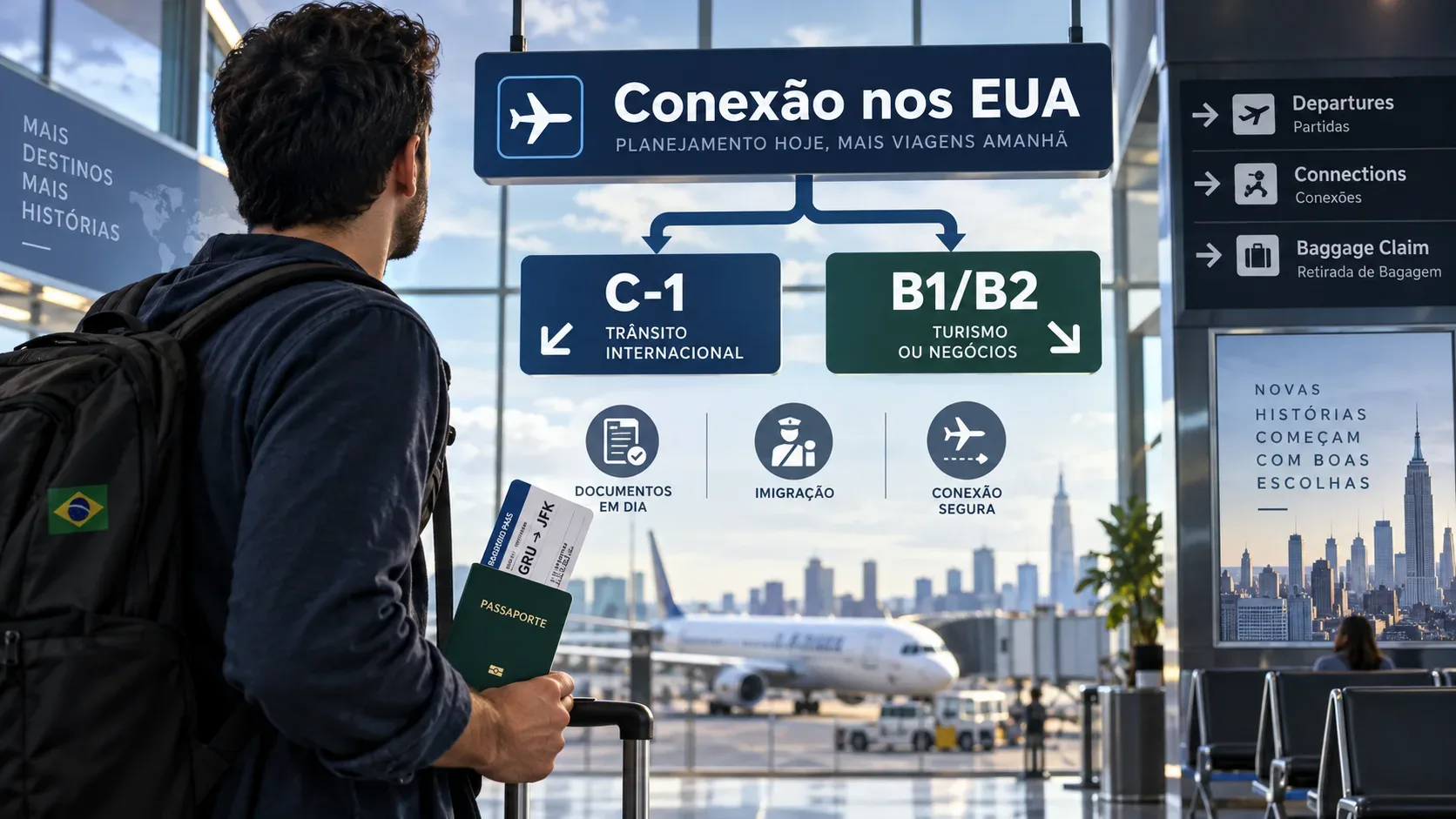
If the trip only involves a connection in an airport's international transit area, without crossing border control, the passenger has not yet entered through EES at that point. The situation changes when immigration must be cleared to continue the journey.
Which countries use EES — and why that is not exactly “the whole European Union”
EES is used by 29 countries: 25 EU Member States participating in this border regime and four Schengen-associated countries — Iceland, Liechtenstein, Norway and Switzerland. Ireland and Cyprus are EU members but do not use EES; passports of travellers within scope continue to be stamped manually in those two countries. The list and exceptions are maintained on the official Travel to Europe — EES portal.
This detail also explains why EES and ETIAS do not cover exactly the same territory. ETIAS is planned for 30 countries: the 29 linked to EES plus Cyprus. Ireland is not part of the group that will require ETIAS.
What changes at the airport — and what has not changed
- Changes: for travellers within EES scope, entry and exit registration becomes electronic and includes biometrics.
- Changes: manual passport stamping is no longer the normal registration method at borders using EES.
- May change: the physical airport flow may include self-service kiosks or facial and fingerprint capture, depending on local infrastructure.
- Does not change: EES is not a visa, is not an advance authorisation and does not guarantee entry.
- Does not change: the other border conditions and short-stay rule still apply.
- Still unchanged as of 14 Sep 2026: ETIAS is not operational, and the official site says travellers should not apply at this time.
What about ETIAS for Brazilians?
Brazil appears on the official list of visa-exempt nationalities that will need ETIAS for short stays in participating countries once the system starts. The logic is pre-departure: the traveller will submit an online application, and the authorisation will be linked to the passport. A valid ETIAS, however, will not replace border control or guarantee admission; the traveller will still need to meet entry conditions.
The most important point for anyone travelling now is to avoid websites presenting ETIAS as already mandatory or describing EES as an online registration step. On 14 September 2026, the official guidance remains: ETIAS applications are not open. Once the EU announces the start date, travellers should check the official portal directly before paying or providing personal data to third parties.
Quick pre-travel checklist
- Confirm whether the first country where you will clear immigration uses EES.
- Allow some extra time for biometric collection, especially if this is your first registration in the system.
- Carry the passport you will use throughout the trip and keep documents that may be requested at border control accessible.
- Do not look for an “EES authorisation”: EES is a record created at the border.
- For ETIAS, check the official portal close to your travel date. As of 14 Sep 2026, it is not accepting applications.
- If your itinerary includes Ireland or Cyprus, check the rules separately: they do not use EES, and the future ETIAS coverage is not identical.
In short
For Brazilians on short stays, EES is already an operational reality: it records passport data, entry, exit and biometrics at the external border of participating countries and replaces the manual stamp. ETIAS is something different: it will be a pre-travel authorisation for visa-exempt travellers, including Brazilians, but it was not yet operational on 14 September 2026. Keeping these two moments separate — EES at the border, ETIAS before travel — resolves most of the confusion.