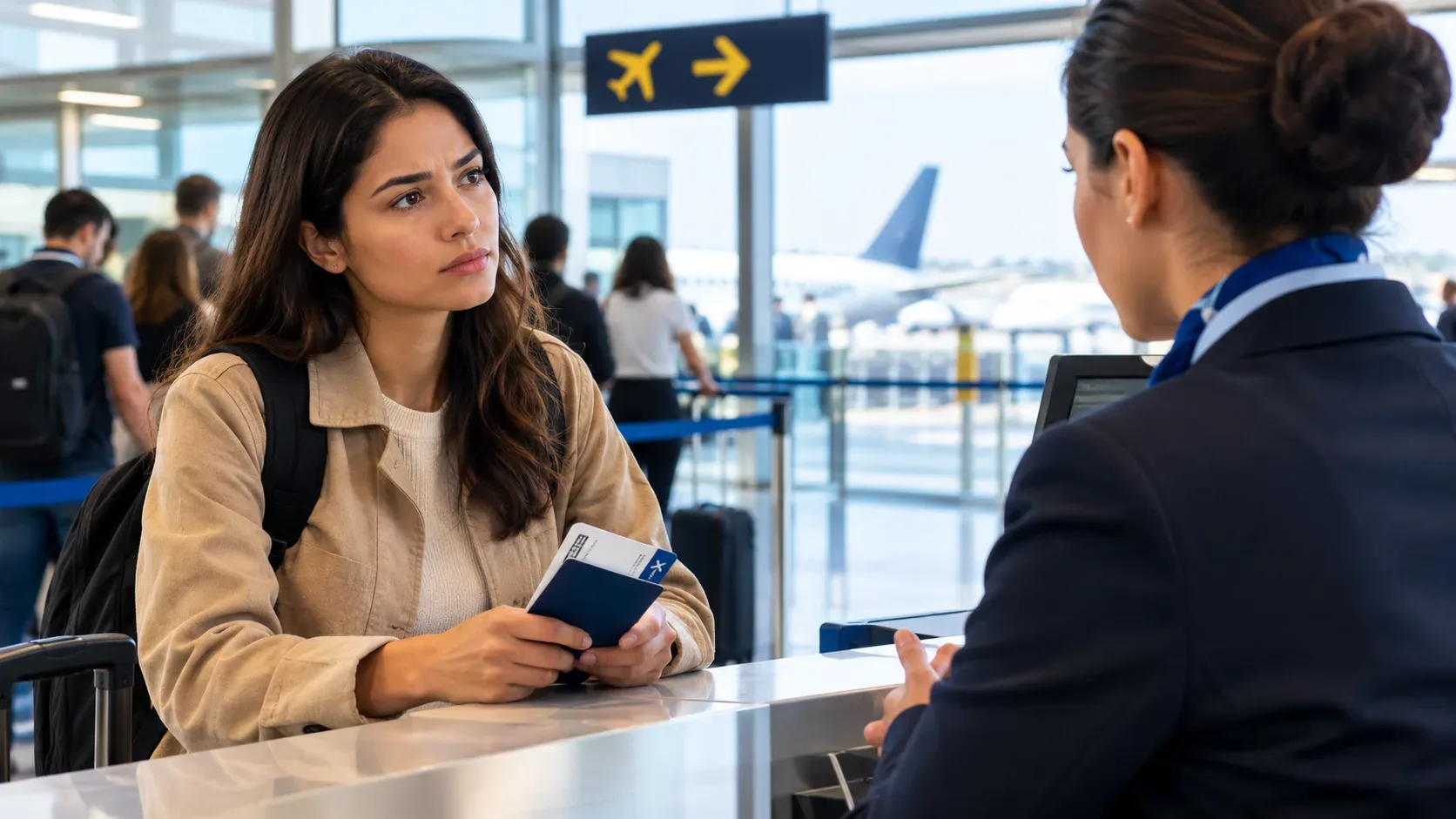
Being denied boarding because there are more passengers than available seats does not mean the traveler must accept the first solution offered at the counter. Under ANAC Resolution No. 400, when an airline fails to transport a passenger who presented for the contracted flight and the situation qualifies as denied boarding (preterição), specific rights apply: a choice among travel alternatives or reimbursement, material assistance when applicable, and, for involuntary denied boarding, immediate financial compensation.
Overbooking is one situation that can lead to denied boarding, but the terms are not perfect synonyms. To act efficiently at the airport, the key point is to confirm whether the airline is in fact refusing to board you even though you complied with the travel requirements.
Checklist: what to request at the counter, in order
- Confirm that the airline is denying boarding. State that you presented yourself within the required time, with a valid booking and appropriate documents, and ask whether the case is being treated as denied boarding under the regulation.
- Ask for the reason in writing. Resolution 400 requires the airline to provide the reason for denied boarding in writing when the passenger requests it.
- If there are more passengers than seats, check whether the airline sought volunteers. The carrier must look for passengers willing to take another flight in exchange for negotiated compensation before treating the lack of seats as involuntary denied boarding.
- If you are not a volunteer and are denied boarding, request the immediate compensation. It is 250 Special Drawing Rights (SDR) for a domestic flight and 500 SDR for an international flight.
- Choose how the trip will be resolved. The passenger chooses among re-accommodation, reimbursement, or completion of the service by another mode of transport, within the cases covered by the rule.
- Request material assistance according to the waiting time. Communication, food, accommodation, and transportation follow specific waiting thresholds and conditions.
- Keep evidence. Save your boarding pass, booking, case numbers, written reason, expense receipts, messages, and records of the alternatives offered.
When a boarding refusal qualifies as denied boarding
Resolution 400 treats it as denied boarding when the carrier fails to transport a passenger who presented for boarding on the originally contracted flight, subject to specific accessibility situations covered by a separate rule. In practice, this must be distinguished from a refusal caused by the passenger, such as arriving after the required time, lacking the appropriate documents, or failing to meet travel requirements.
If you met the requirements and the airline says there is no seat, an operational aircraft change occurred, or another internal reason prevents carriage, ask the airline to clearly record the occurrence. Written documentation helps prevent the case from later being characterized merely as a “flight change” or “no-show.”
Volunteering for another flight is not the same as being involuntarily denied boarding
When the number of passengers exceeds the available seats, the airline must seek volunteers to be re-accommodated. The compensation offered to a volunteer is negotiated: it may involve money, travel credit, a benefit, or another condition accepted by both sides. The airline may ask the passenger to sign a specific acceptance form.
A passenger who voluntarily accepts that arrangement and re-accommodation is not treated as involuntarily denied boarding for this purpose. Therefore, the automatic 250 or 500 SDR compensation for involuntary denied boarding does not, as a rule, stack on top of the volunteer agreement. Before accepting, get the new flight, compensation, validity, restrictions, and handling of baggage and connections in writing.
When immediate financial compensation applies
If denied boarding is actually established, the airline must immediately pay the financial compensation set out in Article 24 of Resolution 400, without affecting the passenger’s other travel-resolution options.
| Flight type | Regulatory compensation |
|---|---|
| Domestic | 250 SDR |
| International | 500 SDR |
SDR means Special Drawing Rights, an international unit used in the regulation. It should therefore not be treated as a fixed amount in Brazilian reais: the converted value changes. The rule allows payment by bank transfer, voucher, or cash.
This immediate compensation is different from ticket reimbursement, reimbursement of expenses, and any damages claim. Those issues have separate legal bases and timelines. Resolution 400, by itself, does not turn every inconvenience into an automatic court-awarded indemnity.
Re-accommodation, reimbursement, or another mode: the passenger chooses
In a denied-boarding case, the airline must offer the alternatives required by ANAC, and the passenger makes the choice. Re-accommodation is free and may occur:
- at the earliest opportunity, on the same airline or another carrier to the same destination; or
- on a date and time convenient to the passenger, on the original carrier’s own flight.
If continuing the trip no longer makes sense, the passenger may choose reimbursement. As a general rule, the regulatory deadline for reimbursement is up to 7 days from the request, respecting the payment method used for the purchase. If the disruption occurs at a stopover or connection and the travel already completed is no longer useful, the rule provides for full reimbursement with return to the airport of origin; if the completed segment still benefits the passenger, reimbursement may be proportional to the unused segment.
Completion of the service by another mode of transport may also be available depending on the case. Before choosing, compare the actual arrival time, connections, hotel needs, and commitments at the destination — not only the departure time of the next option.
Material assistance while you wait
Material assistance is free and depends on waiting time. Under ANAC’s compiled rule, when the wait exceeds:
- 1 hour: communication facilities;
- 2 hours: food appropriate to the time of day, through a meal or individual voucher;
- 4 hours: accommodation in the event of an overnight stay and round-trip transportation.
If the passenger lives in the locality of the departure airport, the airline may omit hotel accommodation but must provide round-trip transportation. Passengers requiring special assistance and their companions have specific protection regarding accommodation. The airline may also stop providing material assistance when the passenger chooses re-accommodation on its own flight at a date and time convenient to the passenger or chooses full reimbursement.
Evidence worth keeping at the airport
An organized record reduces later disputes over what happened. Keep or photograph:
- the ticket receipt, booking confirmation, and boarding pass;
- check-in confirmation and evidence of when you reached the gate;
- the written statement explaining the boarding refusal;
- service case numbers and identification of the service channels used;
- re-accommodation offers and available times, including other carriers when discussed;
- any volunteer agreement before signing it;
- proof of the 250 or 500 SDR compensation when due;
- receipts for food, transportation, or accommodation you paid for if required assistance was not provided.
You do not need to turn the airport into a confrontation. The goal is to leave the counter with your chosen solution, the terms documented, and enough evidence if a complaint becomes necessary later.
If the airline does not comply: how to file a complaint
First, seek a solution through the airline’s own service channels and keep the case numbers. If the issue remains unresolved, ANAC provides the ANAC Passageiro platform for complaints against airlines. According to the Agency, the airline has up to 10 calendar days to respond in the platform. ANAC monitors complaints for regulatory and enforcement purposes, but it does not adjudicate each individual claim.
If the dispute continues, the passenger may contact consumer-protection bodies and, depending on the circumstances, consider other appropriate avenues. For general guidance on boarding, delays, cancellations, and assistance, also consult ANAC’s Passengers page.
Practical summary for denied boarding at the airport
If you met the travel requirements and the airline denied boarding, ask for the reason in writing. If you did not voluntarily accept another arrangement and the case qualifies as denied boarding, request the immediate compensation of 250 SDR for a domestic flight or 500 SDR for an international flight. Then choose among re-accommodation, reimbursement, or another mode of transport and request the material assistance corresponding to the waiting time. Leave the airport with case numbers and evidence of what happened — especially the refusal, the option you chose, and what the airline did or did not pay.