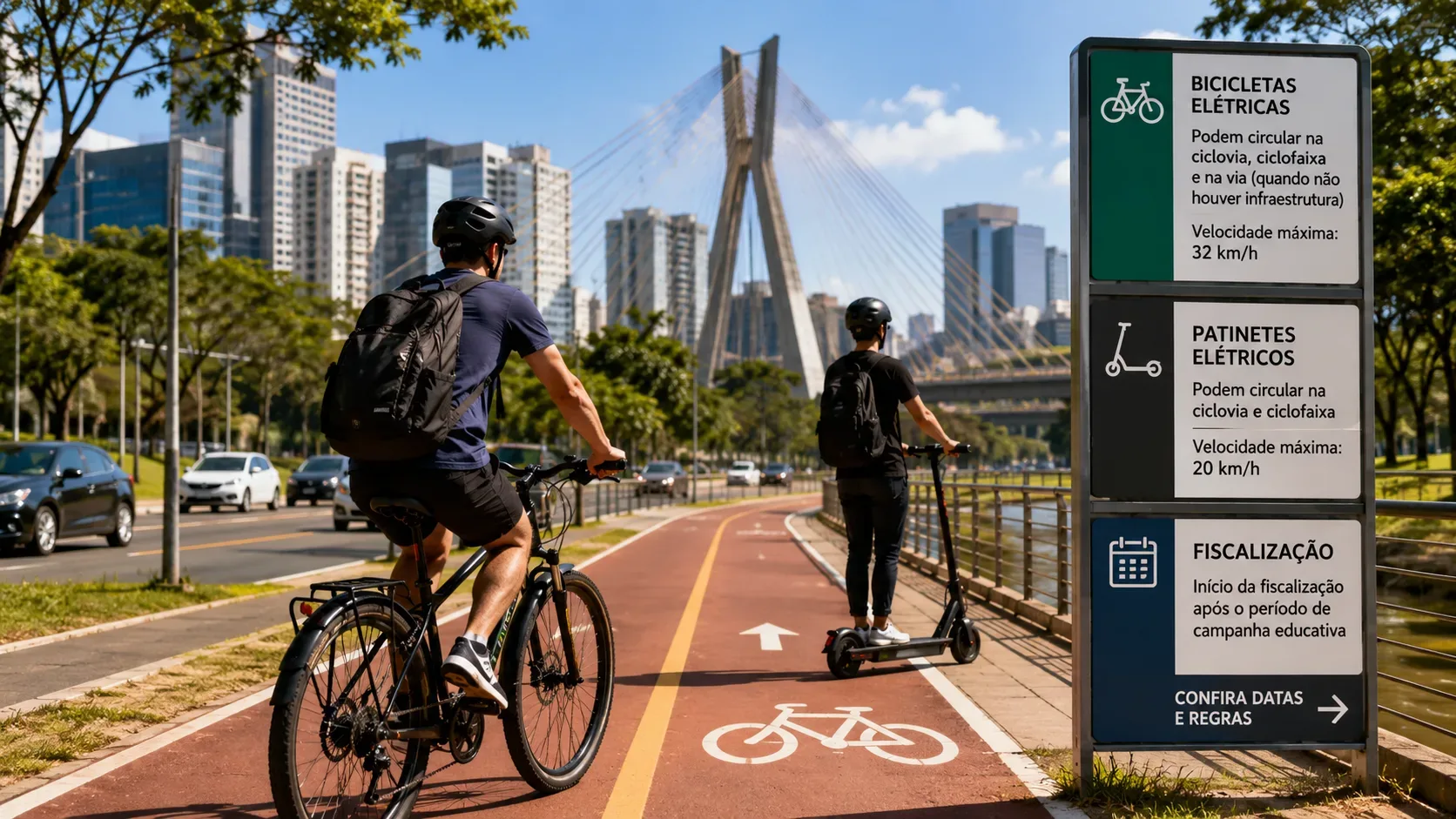
Municipal rules for e-bikes, electric scooters and other self-propelled personal mobility devices are already in force in the city of São Paulo. Since August 28, 2026, the city has focused on education. The Traffic Engineering Company (CET) has 45 days to prepare its operational plan, and City Hall says enforcement is expected to begin on October 12, 2026. That does not automatically mean fines: the city itself says it is still assessing which conduct can be enforced and notes that any citations depend on a legal basis and specific regulation.
What is already in force and when enforcement starts
- August 14, 2026: Ordinance SMT.SEMTRA No. 23 was published, setting circulation and speed rules.
- August 28, 2026: educational campaigns and guidance actions began.
- October 12, 2026: City Hall's expected date for the enforcement stage to begin, after the 45-day period.
The schedule changed through Ordinance No. 25/2026, which amended Article 7 of Ordinance No. 23. During the educational period, CET announced signs, banners, guidance content and speed-display devices. These devices show riders their speed but are not enforcement cameras.
Where each vehicle can travel and the applicable limit
| Location | E-bike | Standing electric scooter/self-propelled device | Seated or straddled self-propelled device |
|---|---|---|---|
| Cycle track or on-road bike lane | Allowed, up to 20 km/h | Allowed, up to 20 km/h | Allowed, up to 20 km/h |
| Bike lane on a sidewalk/median formally shared with pedestrians | Allowed, up to 6 km/h | Allowed, up to 6 km/h | Allowed, up to 6 km/h |
| Signed shared space for pedestrians and cyclists | Allowed, up to 6 km/h | Prohibited | Prohibited |
| Pedestrian street or pedestrian area | Allowed, up to 6 km/h | Prohibited | Prohibited |
| Street/avenue without a cycle track or bike lane | Allowed if the road limit is up to 50 km/h; ride near the edge, in the same direction as traffic, and obey the road speed regulation | Allowed if the road limit is up to 40 km/h; device limited to 20 km/h | Allowed if the road limit is up to 50 km/h; obey the posted speed regulation |
| Express road or highway without a shoulder/dedicated lane | Prohibited, except for the ordinance's exception for bicycles designed for sporting use | Prohibited when the road's regulated speed exceeds 40 km/h | Prohibited when the road's regulated speed exceeds 50 km/h |
| Ordinary sidewalk, outside the signed situations above | No general authorization in the ordinance; use only the shared/signed spaces specifically provided for | Prohibited | Prohibited |
First identify your vehicle's legal category
The practical rule depends on technical classification. Under Contran Resolution No. 996/2023, an e-bike has pedal assistance, no throttle or other manual power-control device, an auxiliary motor of up to 1,000 W, and motor assistance limited to 32 km/h. A self-propelled personal mobility device may have one or more wheels, a motor of up to 1,000 W, a maximum design speed of up to 32 km/h, width up to 70 cm, and wheelbase up to 130 cm, with a specific power exception for self-balancing unicycles.
This distinction matters because a vehicle exceeding those technical limits may no longer be treated as an e-bike or self-propelled personal mobility device and may instead be classified as a moped, motorcycle, scooter-type motorcycle or tricycle. In that case, different requirements apply, including registration, a license plate and the appropriate driver's license.
E-bikes: 20 km/h on cycle infrastructure and roads up to 50 km/h
On infrastructure reserved for bicycles, an e-bike may travel at up to 20 km/h. On a bike lane located on a sidewalk or median and shared with pedestrians, in a signed pedestrian-cyclist shared space, and on pedestrian streets or areas, the maximum drops to 6 km/h.
Where there is no cycle track or bike lane, an e-bike may use the roadway if the street or avenue has a regulated speed of up to 50 km/h. The ordinance requires riders to stay near the edge of the roadway, travel in the same direction as traffic and follow the local speed regulation.
E-bikes are prohibited on express roads and highways without a shoulder or dedicated lane. The rule contains an exception for bicycles and e-bikes designed for sporting use, subject to the conditions stated in the ordinance and road signage.
Electric scooters: the road's speed limit also decides whether they may enter
For a typical standing electric scooter, the rule is more restrictive. It may use a cycle track, on-road bike lane or signed cycle route at up to 20 km/h. It may also travel at up to 6 km/h in a bike lane located on a sidewalk or median when that lane is formally shared with pedestrians.
On an ordinary roadway, the scooter may circulate only where the regulated road speed is up to 40 km/h, and the device itself must stay at or below 20 km/h. On roads above 40 km/h, circulation is prohibited.
Electric scooters and other self-propelled devices may not use ordinary sidewalks, pedestrian areas or general pedestrian-cyclist shared spaces. Article 6 provides an exception for devices similar to wheelchairs used by people with disabilities or impaired mobility.
Seated or straddled self-propelled devices follow a different rule
The ordinance separately addresses self-propelled devices ridden seated or straddled. They may travel at up to 20 km/h on cycle tracks and on-road bike lanes and at up to 6 km/h on sidewalk/median bike lanes formally shared with pedestrians. On streets and avenues without cycle infrastructure, they may circulate where the regulated road speed is up to 50 km/h.
That is why appearance alone can be misleading. Before choosing a route, check the vehicle's technical classification and factory specifications.
A sidewalk is not a blanket authorization
There is an important difference between a bike lane formally shared with pedestrians, a signed pedestrian-cyclist shared space, and an ordinary sidewalk. The ordinance defines these structures separately. E-bikes are expressly allowed at 6 km/h in the shared spaces covered by the rule; self-propelled devices are prohibited on ordinary sidewalks, pedestrian areas and general shared spaces, although they may use a formally shared bike lane at 6 km/h.
In practice, a wide sidewalk does not by itself mean that an electric scooter or e-bike is allowed there. Signage and the type of infrastructure matter.
What the expected October 12 enforcement date means
Ordinance No. 25 states that traffic-circulation enforcement actions are to occur after 45 days counted from August 28. In an official notice dated August 27, City Hall translated that milestone into an expected start date of October 12, 2026.
Until then, CET is preparing the operational plan and running educational actions. City Hall says it is still analyzing enforcement methods and which conduct agents may verify, including vehicle condition and mandatory equipment. It also says that for certain unregistered self-propelled devices, there is currently no federal rule allowing a direct fine to the rider; any citations will depend on legal authorization and specific regulation.
The practical reading is therefore: the circulation rules are already in force; operational enforcement is expected to begin on October 12; and enforcement does not automatically mean a fine in every case.
Mandatory equipment may also be checked
Contran Resolution No. 996 requires self-propelled devices to have a speed indicator or electronic speed limiter, a bell, and front, rear and side nighttime lighting/signaling. For e-bikes, the list includes a speed indicator or limiter, bell, front, rear, side and pedal nighttime signaling, a left-side rear-view mirror, and tires in minimum safe condition.
Because City Hall says enforcement may consider the condition and equipment of vehicles, route planning is only part of the task: riders should also check whether the vehicle is correctly classified and equipped under the national rule.
Checklist before riding
- Confirm whether the vehicle is an e-bike, a standing self-propelled device or a seated/straddled self-propelled device.
- Check the regulated speed of the street before entering an ordinary roadway.
- On a cycle track or on-road bike lane, respect the 20 km/h limit set by the ordinance.
- In authorized shared spaces, reduce to 6 km/h and verify whether your vehicle category is allowed there.
- Do not treat an ordinary sidewalk as an allowed route for electric scooters.
- Check the mandatory equipment required by Contran.
- Treat October 12, 2026 as City Hall's expected start date for enforcement and follow any later CET guidance.
Official sources
- Ordinance SMT.SEMTRA No. 23/2026 — consolidated text from the City of São Paulo
- Ordinance SMT.SEMTRA No. 25/2026 — change to the education and enforcement schedule
- City of São Paulo — educational actions and expected enforcement from October 12
- Contran Resolution No. 996/2023 — classification and mandatory equipment