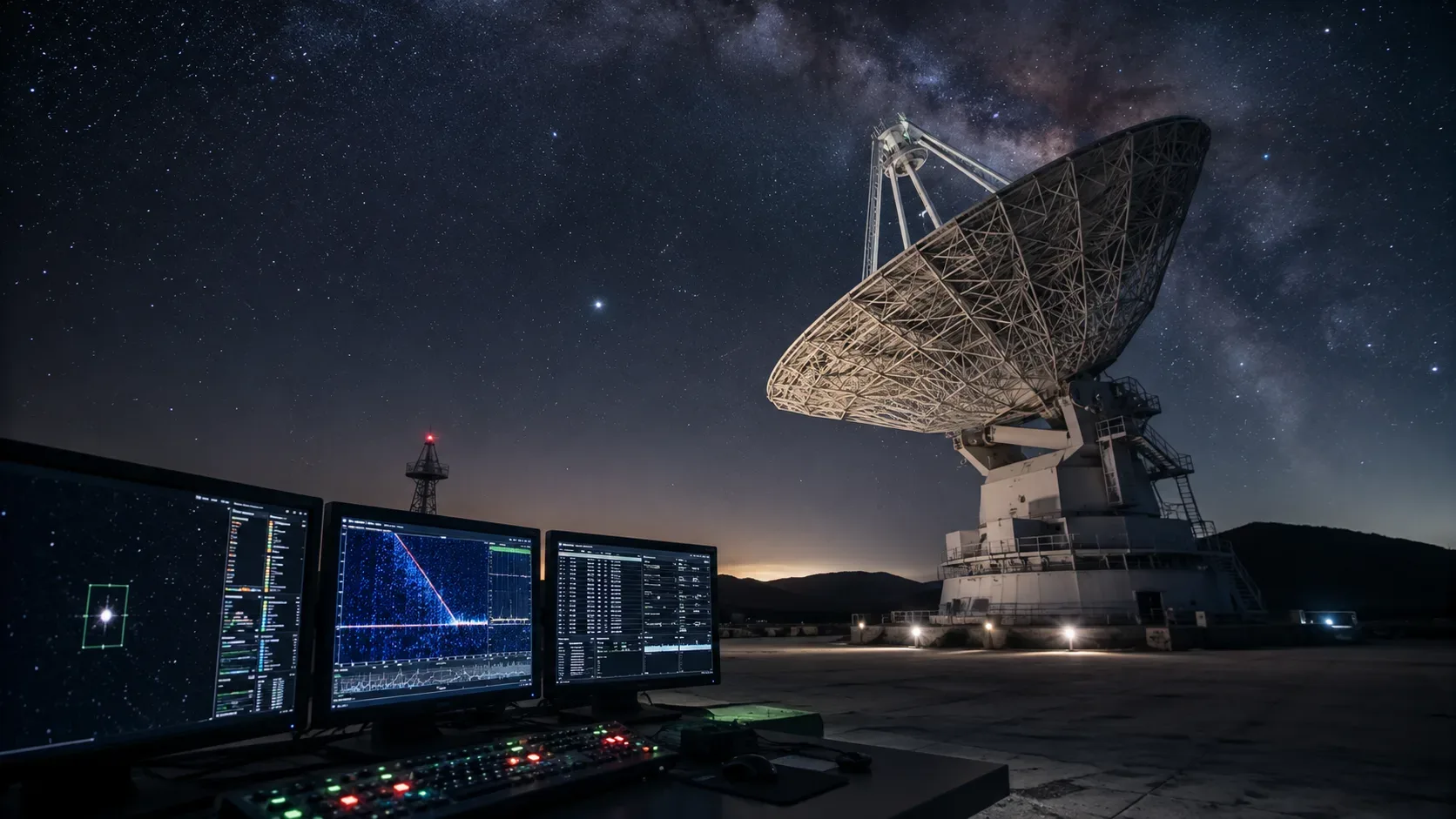
When a radio telescope finds a narrow signal, with behavior that appears artificial and coming from the direction of a star, the first task is not to demonstrate that extraterrestrials exist. It's trying to destroy this hypothesis: check the equipment, look for human interference, compare other regions of the sky, analyze the frequency drift and try to detect the signal again. The BLC1 case, observed toward Proxima Centauri, showed why each of these steps matters. A signal that passed through the initial filters ended up being attributed to terrestrial interference after much deeper investigation.
This caution also appears in the updated principles of the SETI Committee of the International Academy of Astronautics in 2026. For possible detection, the recommendation is to seek authentication and confirmation, ideally with independent observations, multiple facilities, different organizations and other instruments or methods. An “interesting signal”, therefore, is a long way from a confirmed detection of extraterrestrial intelligence.
What makes a radio signal attract SETI attention?
One of the signatures sought in SETI radio astronomy is a signal that is extremely narrow in frequency. In the BLC1 study, the researchers highlighted that an emission with a width of the order of hertz does not correspond to the known astrophysical mechanisms capable of producing natural emissions of that type. This may indicate technology — but “technological” still includes radars, satellites, transmitters, electronics, and other equipment built on Earth.
Another important indication is the Doppler drift. If transmitter and receiver have radial acceleration relative to each other, the received frequency changes over time. A planet's rotation and orbit could produce this effect in a distant transmitter. Therefore, pipelines like those used by Breakthrough Listen look for narrow lines that gradually move across the spectrum.
But a slanted line on a spectrogram is not an “alien stamp.” Moving satellites also exhibit Doppler, while the frequency produced by electronic components can vary with temperature, voltage, and other conditions. The framework itself created from BLC1 determines that the evolution of the drift is compared both with movements expected for the astronomical system and with electronic movements and drifts produced by human technology.
The ON/OFF test: does the signal follow the star or the telescope?
One of the most useful techniques is to alternate observations ON, with the telescope pointed at the target, and OFF, pointed at another region of the sky.
The logic is simple. If a signal really is located in the direction of a star, we would expect to find it when the telescope points at it and not in the reference observation. If the same emission appears both ON and OFF, there is a strong indication of local interference or another source that is not associated with the target. This strategy has been used for years by Breakthrough Listen to eliminate large amounts of radio frequency interference, or RFI.
But ON/OFF is not an isolated test. Interference can be directional, appear through the side lobes of the antenna, vary rapidly in intensity or simply turn on and off at the exact interval between observations. BLC1 provided a particularly important example: its interference varied in ways that coincided with the cadence of observations, creating an apparent association with Proxima Centauri.
For this reason, researchers also look for the signal in OFF observations using lower thresholds, analyze the sensitivity of each pointing and take into account integration time, positions used as reference and telescope displacements. In the BLC1 study, these details were important because the original campaign used an atypical cadence: 30-minute observations on Proxima Centauri alternated with just 5 minutes on the calibrators.
How a candidate is put to the test
The framework published by the Breakthrough Listen team after the BLC1 investigation proposes ten checks for narrow signals. In practice, they can be understood as a sequence of six main questions. The specific procedure varies depending on the instrument and type of search; There is no single universal test that automatically transforms a signal into a technosignal.
- Was the equipment working properly?
Telescope logs, receivers, recording and processing systems need to be examined. An instrumental defect or electronic artifact must be eliminated before a more exotic explanation is considered. - Does the signal really disappear when the telescope leaves the target?
OFF observations are examined again, including below the thresholds used by automatic search. The team also needs to consider antenna lobes and differences in sensitivity between points. - Is there known interference on that frequency?
Local catalogs, registered transmitters and the observatory's own radio frequency environment are consulted. Even so, not finding a registered transmitter does not solve the case: unwanted signals can also appear as harmonics or electronic mixing products at frequencies at which no one intended to transmit. - Doppler drift best matches an object in space or human technology?
The rate of change of frequency and its evolution over time are compared with possible movements of the Earth, the target and objects in the Solar System, as well as satellites and electronic instabilities. A non-zero drift increases interest but does not eliminate terrestrial origin. - Are there “relatives” of the signal hidden in the data?
Researchers look for previous occurrences in the archive and signals with a similar shape at other frequencies. This context can be decisive: an apparently single emission can be part of an entire family of interferences that the initial filter did not identify. - Can the phenomenon be observed again?
The target is revisited and, when possible, other telescopes participate in the verification. The BLC1 study even recommends simultaneous observations from different locations when this is feasible. The 2026 update to the IAA SETI Committee principles reinforces the importance of independent examinations by multiple facilities and organizations.
BLC1: how an excellent candidate ended up becoming interference
BLC1 appeared in data obtained by the Parkes radio telescope, now called Murriyang, on April 29, 2019 during observations of Proxima Centauri. The signal was close to 982 MHz, was narrow, showed drift and appeared in observations facing Proxima, but not in the reference notes used by the initial filter. It persisted for approximately 2.5 hours and had a measured drift of about 0.038 Hz per second.
The funnel shows how strict the filters need to be. The search found more than 4.17 million initial detections. After comparing ON and OFF, 5,160 events remained. Only one survived the remaining filtering steps and visual inspection as a signal of interest: BLC1.
At that point, several characteristics seemed favorable to a distant origin. The signal was narrow, drifted, appeared toward the target, and did not immediately correspond to a known RFI source. Even so, none of these properties were treated as confirmation.
The investigation began looking for similar signals across the entire frequency range and in archived observations. That's when the interpretation changed. The team found several signals with similar morphology, including cases present in the OFF observations and, therefore, clearly associated with interference. Some had frequency spacings compatible with multiples of an electronic oscillator around 2 MHz. The analysis led to the conclusion that BLC1 was a product of intermodulation caused by variable human interference, and not a transmission originating on Proxima Centauri.
This also explained a disconcerting detail: BLC1 had managed to pass the ON/OFF test. Its intensity or cycle of activity coincided with the cadence of observation sufficiently to make it appear to be located in the direction of the star. In other words, the filter worked as it should when selecting something unusual for analysis — but that filter alone couldn't determine the source of the signal.
What if the signal never appears again?
Repeatability is powerful evidence, but the absence of new detection does not automatically solve the mystery.
Proxima Centauri was observed again in November 2020 and in an extended campaign between April and May 2021. BLC1 did not reappear near its original frequency. Still, the framework itself notes that relying solely on reobservation is insufficient, especially since a hypothetical transmitter could be intermittent, periodic, or observable only in certain circumstances. In the BLC1 case, the strong argument against extraterrestrial origin was not simply “it didn't appear again,” but the body of evidence that connected it to a population of terrestrial interference.
This is also why simultaneous observations from two locations can be so useful. A phenomenon detected in a compatible way by different and geographically separated instruments is much more difficult to explain as interference confined to a single observatory. The updated SETI principles in 2026 treat independent verification as a desirable part of authenticating possible detection.
Where the Wow! get into this story
The Wow! helps show the difference between an intriguing event and a confirmed detection. It was recorded by the Big Ear radio telescope on August 15, 1977. The six points recorded by the system corresponded to approximately 72 seconds of the signal passing through the telescope's beam, and subsequent attempts were unable to redetect it.
This does not demonstrate what its origin was. It means that a piece was missing that would be extremely valuable for modern validation: a new observation capable of testing the phenomenon with other data, instruments and methods. It is for this reason that the Wow! signal remains a historical example of an unconfirmed signal, while modern cases can be subjected to RFI analysis, digital files, ON/OFF cadences and follow-up that simply were not available in the same way in 1977.
The bridge between the two cases is precisely this: scientific interest begins when the signal survives the first filter, it does not end there.
A technosignal needs to survive the most common explanations
The goal of SETI validation is to accumulate independent evidence. Spectral narrowness may indicate technology; Doppler drift may be compatible with motion; ON/OFF can suggest location in the sky; repetition can strengthen the association with the target. None of these elements, in isolation, demonstrates an extraterrestrial origin. BLC1 went through several of these before being explained as RFI.
If a future signal remains present after instrumental verification, investigation of the interference environment, Doppler analysis, search for similar signals, reobservation and independent confirmations, the scientific problem changes scale. Until then, the most productive question remains less spectacular and much more rigorous: what terrestrial explanation has not yet been eliminated?