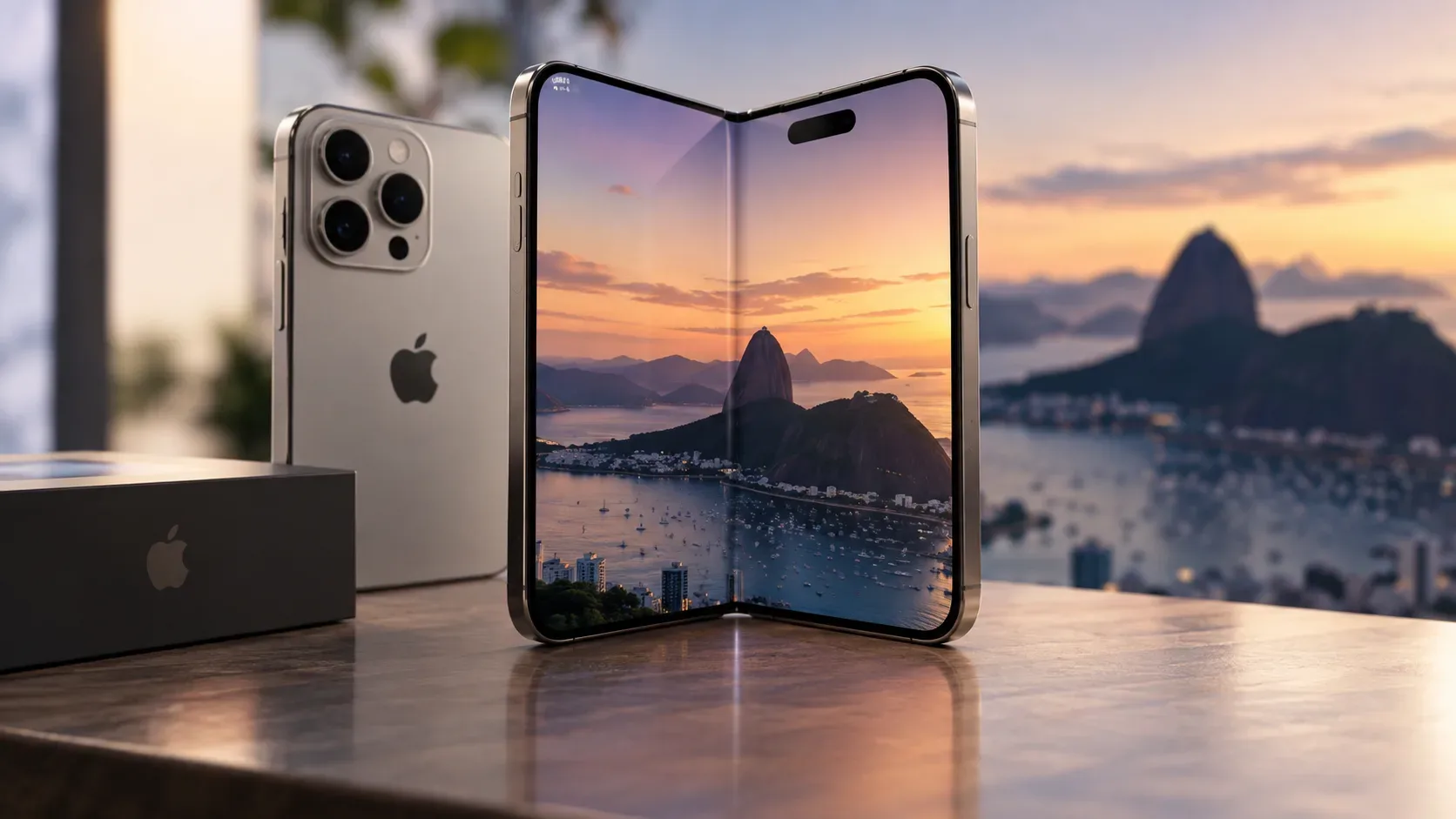
The iPhone Duo now has a confirmed launch schedule and pricing for Brazil. Apple lists pre-orders for October 16, 2026 at 9 a.m., with availability beginning October 23. The first foldable iPhone starts at R$21,999 with 256GB and reaches R$30,999 with 2TB. Price alone, however, is not the key decision: the Duo trades part of the traditional Pro package for a 7.6-inch inner display, two distinct ways to use the phone, iOS 27 multitasking, and camera features built around the dual-screen design.
iPhone Duo prices and dates in Brazil
On Apple's Brazilian online store, all four storage capacities are listed in Star White and Night Sky, with no price difference between colors. As of September 10, 2026, the official price table is:
| Storage | Price in Brazil |
|---|---|
| 256GB | R$21,999 |
| 512GB | R$23,499 |
| 1TB | R$26,499 |
| 2TB | R$30,999 |
Pre-orders begin on October 16 at 9 a.m., and the first units become available on October 23. That means a longer wait than for the iPhone 18 Pro line, whose pre-orders begin in September. For anyone comparing the two, the wait for the Duo is part of the buying decision.
What actually changes with Apple's first foldable iPhone
The Duo is not simply a large iPhone that folds. Closed, it uses a 5.4-inch outer Super Retina XDR display; opened, it switches to a 7.6-inch foldable inner display with a nano-texture finish. Both offer ProMotion up to 120Hz, Always-On display, up to 3,000 nits of outdoor peak brightness, and the same display aspect ratio to keep content transitions consistent. The official specifications also list compatibility with Apple Pencil (USB-C), while Apple’s launch announcement says that support arrives later in 2026.
- Closed: the goal is one-handed use in a shorter device, although it is thicker than a conventional iPhone.
- Opened: the larger canvas is better suited to reading, video, gaming, editing, and two-window tasks.
- In iOS 27: Split View allows two apps side by side, two windows of the same app, and saved app pairs.
- With the camera: the outer display can show a live preview to the person being photographed, and the phone can be partially folded and propped up in some situations.
Those are the practical gains that make the Duo worth evaluating on its own rather than treating it as merely a more expensive Pro.
The main trade-offs versus iPhone 18 Pro
A comparison with the Pro line shows where Apple prioritized the foldable form factor. The Duo uses the same A20 Pro chip, but it does not reproduce the full camera, authentication, and ergonomics package of the conventional Pro models.
| Area | iPhone Duo | iPhone 18 Pro / Pro Max |
|---|---|---|
| Starting price in Brazil | R$21,999 | iPhone 18 Pro from R$11,999 |
| Weight | 254g | 211g on Pro; 249g on Pro Max |
| Thickness | 5.2mm open; 11.3mm closed | 8.75mm |
| Biometric authentication | Touch ID in the side button | Face ID |
| Rear cameras | 48MP Main + 48MP Ultra Wide; optical-quality 2x | 48MP Fusion Pro system with a dedicated 4x Telephoto and optical-quality 8x |
| Digital zoom | Up to 10x | Up to 40x |
| Professional formats | HEIF/JPEG photos; HEVC/H.264 video | Includes DNG/ProRAW and ProRes/ProRes RAW |
| Typical battery use | Up to 24 hours | Up to 23 hours on Pro; up to 29 hours on Pro Max |
The Pro figures come from Apple's iPhone 18 Pro and Pro Max specifications and Brazilian online store. The conclusion is not that the Duo is always worse or the Pro is always better; the products prioritize different things.
Camera: the Duo gives up reach but gains foldable-specific uses
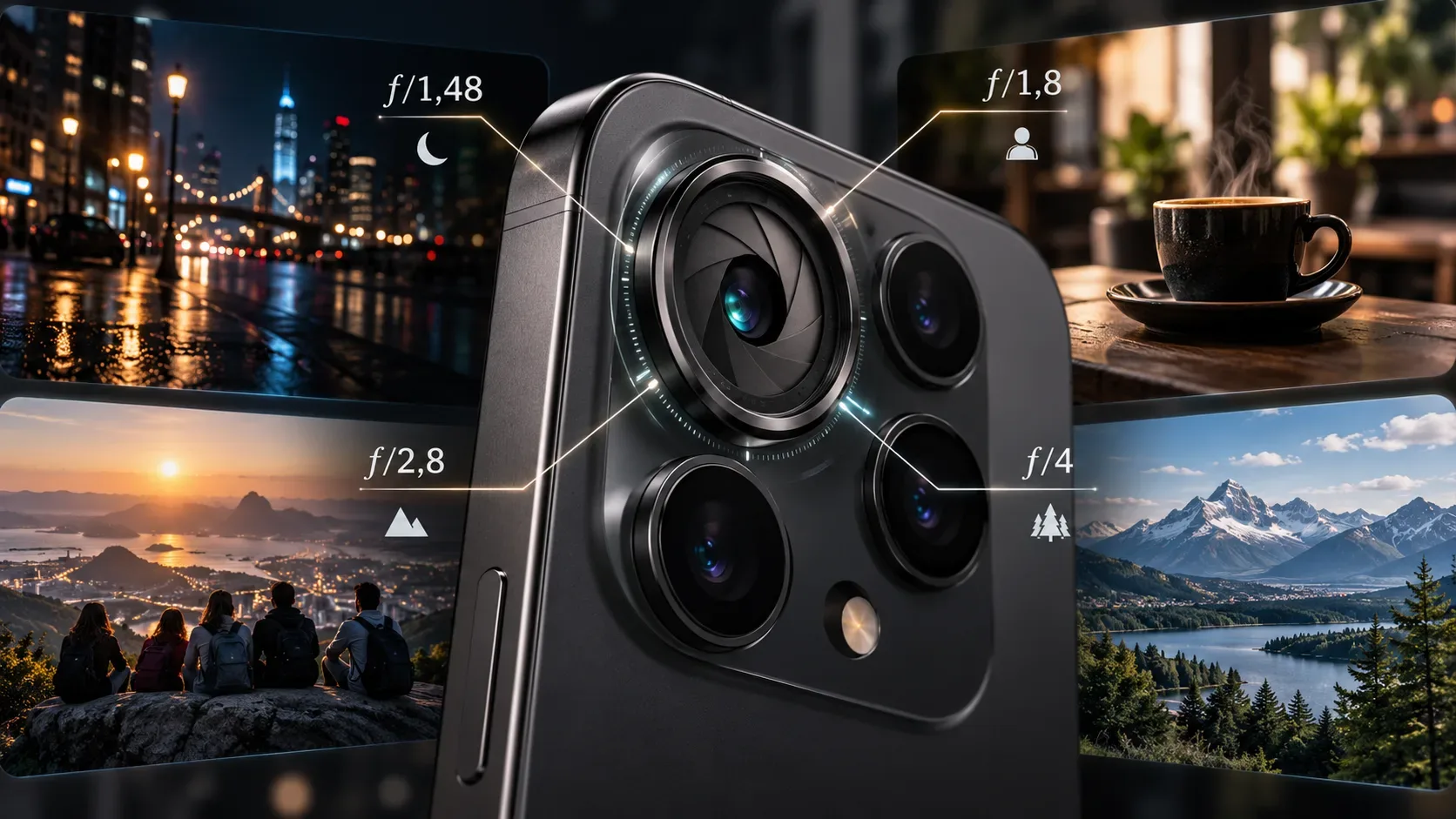
The Duo has two 48MP rear cameras, Main and Ultra Wide, and uses the Main camera for an optical-quality 2x crop. The iPhone 18 Pro adds a dedicated 48MP telephoto camera, reaches 4x and optical-quality 8x, and offers digital zoom up to 40x. It also retains professional capture workflows such as ProRAW, ProRes, and ProRes RAW.
In exchange, the Duo can use the outer screen as a viewfinder for the subject, lets users take selfies with the rear cameras, and introduces features such as Duo Preview and Smart Take. For everyday portraits and shared framing, those tools may matter more than a long telephoto lens; for concerts, sports, travel zoom, or professional video, the Pro line remains more capable.
Touch ID instead of Face ID, plus eSIM with no physical tray
The Duo replaces Face ID with Touch ID built into the side button. That is a meaningful workflow change: people used to unlocking an iPhone by simply looking at it will need to use the fingerprint sensor instead. The model is also eSIM-only and does not support a physical SIM card. Before buying, it is worth confirming that the buyer's carrier and plan support eSIM activation and transfer.
Thinner when open, thicker and heavier when closed
Opened, the Duo is 5.2mm thick and is Apple's thinnest iPhone in that position. Closed, thickness rises to 11.3mm. It weighs 254g, more than the 211g iPhone 18 Pro and slightly more than the 249g Pro Max. The benefit of carrying a 7.6-inch screen in a pocket therefore comes with a different physical feel: the closed phone is thicker and heavier than a conventional Pro.
Battery life cannot be reduced to a single number
Apple rates the Duo for up to 24 hours of typical use. For video playback, it reaches up to 44 hours using the outer display and up to 31 hours using the inner display. The iPhone 18 Pro is rated for up to 23 hours of typical use, while the Pro Max reaches up to 29 hours. For video playback, the Pro Max reaches up to 43 hours.
In practice, the Duo can last a long time when it is used mostly closed, but the larger inner display consumes more energy. Anyone buying the foldable specifically to spend much of the day on the 7.6-inch screen should pay attention to the inner-display figures rather than only the best headline number.
Performance is not the main compromise
The iPhone Duo uses the same A20 Pro chip as the iPhone 18 Pro line, with a six-core CPU, seven-core GPU, and dual 16-core Neural Engine. Apple also designed a vapor chamber and two internal batteries to manage heat and power across the two halves. In other words, Apple is not positioning the foldable as a lower-performance option; the more meaningful differences are in cameras, biometrics, body design, and how the phone is used.
Durability: what is confirmed and what still needs time
Apple says the Duo uses a grade 5 titanium structure, Ceramic Shield 2 on the front, Ceramic Shield on the back, IP68 resistance, and a hinge made from more than 100 components. The inner display uses flexible layers, a scratch-resistant coating, and a titanium support plate. Apple's official product announcement describes these engineering measures in detail.
There is still an important limit to any evaluation made now: the phone has not reached consumers yet. As of September 10, there are not months of public use available to judge crease wear, hinge looseness, marks on the inner panel, or behavior after thousands of real-world folding cycles. Buyers who consider those points decisive have a reasonable case for waiting for independent testing after October 23.
Who the iPhone Duo makes the most sense for
- Choose the Duo if the 7.6-inch inner display, side-by-side multitasking, and dual-screen camera uses are features you expect to use frequently.
- Choose the iPhone 18 Pro or Pro Max instead if long telephoto reach, ProRAW/ProRes, Face ID, a thinner body when pocketed, and a lower price matter more.
- Wait until after launch if hinge durability, app compatibility, accessories, and the real-world behavior of the inner display are central concerns. Those questions will be easier to assess once independent testing is available.
Checklist before the October 16 pre-order
- Choose storage based on real use. The price jumps between 256GB, 512GB, 1TB, and 2TB are substantial.
- Confirm eSIM activation with your carrier, especially if you currently rely on a physical SIM.
- Decide whether the Duo's 2x camera is enough or whether you regularly use the Pro line's telephoto reach.
- Consider the weight and thickness of the phone when closed, not just the 5.2mm figure advertised for the open device.
- Think about how much time you will actually spend on the inner display. That is what determines whether the foldable advantage is worth the premium.
Bottom line
The iPhone Duo arrives in Brazil as a category of its own within the iPhone family: it costs from R$21,999 to R$30,999, goes up for pre-order on October 16, and becomes available on October 23. The gain is a 7.6-inch screen that folds into a pocketable device, with multitasking and camera features designed around two displays. The trade-offs are just as concrete: Touch ID instead of Face ID, a less versatile camera system than the Pro line, a 254g body that is 11.3mm thick when closed, and complete reliance on eSIM. For buyers who specifically want a foldable and will make real use of the inner screen, the Duo offers something no other iPhone does; for those who prioritize Pro cameras, facial biometrics, conventional thickness, and price, the iPhone 18 Pro line is the stronger comparison.