
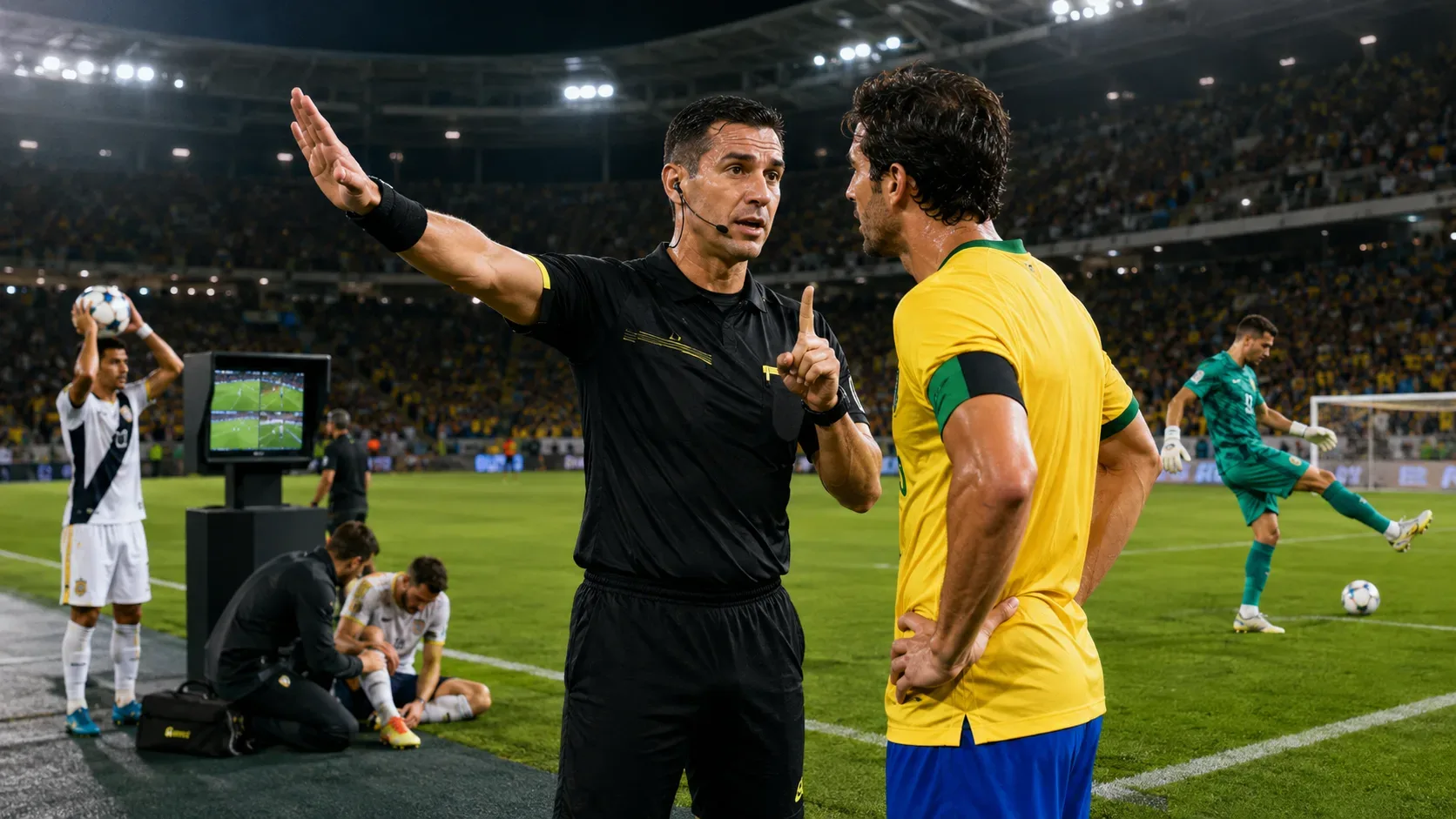
The package approved by the CBF on August 10, 2026 began to be applied in Brazil’s Série A in the 23rd round, on the weekend of August 15 and 16. In the official list published by the federation, eight measures took effect immediately, while a ninth — allowing VAR to correct a clearly wrongly awarded corner kick — was left for 2027. The stated goal is to reduce delays, speed up restarts and increase effective playing time.
One distinction matters: the items do not all have the same legal status. Part of the package comes directly from the IFAB Laws of the Game 2026/27; other items are protocols or options that a competition may adopt. The practical reading therefore needs to take both the CBF announcement and the IFAB wording into account.
The 8 measures already in force in the 2026 Brasileirão
| Rule | Match situation | What happens |
|---|---|---|
| 1. Five seconds for a throw-in | The referee decides that the team is deliberately delaying the restart. | The referee whistles, signals and starts a visible five-second countdown. If the ball is not in play by the end, the throw-in is awarded to the opponents from the same place. |
| 2. Five seconds for a goal kick | There is a deliberate delay in taking the goal kick. | The referee starts the visible countdown. If the restart is not taken in time, a corner kick is awarded to the opponents on the side closest to where the goal kick was to be taken. |
| 3. Ten seconds to leave during a substitution | The substitution board is shown or the referee signals the change. | The player being substituted must leave within ten seconds, except in circumstances such as injury or safety. If the limit is exceeded without justification, the substitute may only enter at the first stoppage after one minute has elapsed following the restart. |
| 4. One minute off after treatment | An outfield player causes a stoppage because of an actual or suspected injury, receives assessment/treatment on the field or asks for treatment after the referee checks with them. | After leaving, the player must remain off for one minute of running time after the restart, subject to the exceptions in Law 5. |
| 5. Goalkeeper treatment sends one outfield player off for a minute | The goalkeeper receives treatment on the field. | Under the operating guidance published by the CBF, the coach nominates an outfield player to spend one minute off after the restart. |
| 6. Captain as the main interlocutor | There is an important decision, an argument or a risk of players surrounding the referee. | The CBF adopted the one-interlocutor principle. IFAB guidelines still allow normal interactions, but they permit access to be restricted in key situations and a yellow card for a player who ignores the captain-only zone. |
| 7. Covering the mouth in a confrontation can mean red | A player intentionally covers their mouth during a confrontational situation with an opponent. | The CBF adopted the option approved by IFAB/FIFA under which the conduct may be punished with a red card — a measure the federation began calling the “Vini Jr Protocol”. |
| 8. VAR may correct a clearly wrong second yellow | A second yellow card causes a sending-off and there is clear evidence that the caution was incorrectly given. | VAR is now allowed to assist the referee in correcting the disciplinary error. The final decision on the incident and restart follows the referee team’s conclusion. |
1. Throw-ins: the five seconds do not automatically start on every restart
The CBF’s short-form communication says the count starts once the player has the ball in their hands. The full IFAB protocol is more specific: the mechanism is designed to combat deliberate delay. Once the referee identifies time-wasting, they may warn the player verbally, whistle, signal the restart and show a visual five-second countdown.
The count can even begin before the thrower has possession if the player is intentionally slowing the restart — for example by retrieving the ball slowly or taking up the wrong position. If time expires without the throw-in being taken, possession is reversed. A yellow card is not automatic for the original delay; it applies if, after the reversal, the player or a team-mate then excessively delays the opponents’ restart.
2. Goal kicks: delaying the restart can turn into a corner
The same principle applies to goal kicks. When the referee identifies deliberate delay, a visible five-second countdown begins. If the team does not put the ball back into play, the opponents are awarded a corner kick on the side closest to where the goal kick would have been taken.
In practical terms, the change makes defensive time-wasting more costly: the team does not merely lose seconds; it can hand the opponent an attacking set piece.
3. Substitutions: leaving slowly can temporarily reduce a team to ten
Once the substitution is signalled, the player going off has ten seconds to cross the boundary line. The existing instruction to leave by the nearest point remains, unless the referee directs otherwise.
If the limit is exceeded without an acceptable reason, the substitution is not cancelled, but the incoming player is prevented from entering immediately. Play restarts, and the substitute may only enter at the first stoppage after one minute of running time has elapsed. Exceptions apply when an injury clearly prevents a quick exit or when the nearest point is unsafe. A yellow card is only contemplated if the delay is excessive.
4. Medical treatment: the minute starts after play resumes
For outfield players, IFAB now requires a player who is treated or whose injury causes the stoppage to leave and remain off for one minute after the restart. In other words, it is not “one minute from the moment the player leaves”; the relevant clock starts when play resumes.
The measure is intended to reduce tactical stoppages without removing proper medical assessment. The protocol allows time for an initial evaluation and retains the Law 5 exceptions for cases in which the player is not required to leave the field.
5. If the goalkeeper is treated, the CBF says an outfield player serves the minute
The CBF’s operational list adds a specific procedure for goalkeeper treatment: the coach designates an outfield player to spend one minute off after the restart. This deserves attention because the summary in IFAB Circular 32 frames the general one-minute protocol around injured outfield players; for the Brasileirão, the practical reference is the specific guidance published by the CBF for its competitions.
That means a stoppage for goalkeeper treatment can create a temporary numerical disadvantage even if the goalkeeper remains on the field.
6. “Only the captain speaks” does not mean every other player must remain silent
The CBF summarised the measure as “only the captain speaks to the referee”, with one interlocutor per team. IFAB’s guidelines are more detailed: normal interactions remain allowed, but after major decisions or in tense situations the referee may limit who can approach and create a protected area around them.
Players who enter that area without permission may be shown a yellow card for dissent by action. If the captain is the goalkeeper, the team may nominate an outfield player to act as the interlocutor when needed. IFAB decided that this protocol will become compulsory worldwide for competitions starting on or after July 1, 2027; the CBF chose to implement it earlier in Brazilian football.
7. The so-called “Vini Jr Protocol” can lead to a sending-off
In April 2026, IFAB approved, following a FIFA proposal, a disciplinary option for cases in which a player covers their mouth during a confrontation with an opponent, making lip-reading difficult. The CBF incorporated the measure into its domestic package and publicised it as the “Vini Jr Protocol”.
The official wording treats the act as potentially punishable by a red card, rather than automatic proof of what was said. In the first weekend under the new rules in Série A, the CBF reported one application of the protocol in Vitória v Botafogo.
8. VAR gets a new entry point: a second yellow that wrongly sends a player off
Previously, VAR intervention was centred on goals, penalties, direct red cards and mistaken identity within the protocol’s limits. The 2026/27 edition now allows assistance when a dismissal results from a clearly incorrect second yellow card.
This does not mean that every second yellow must be reviewed. The threshold is clear evidence of an error. The purpose is to prevent a wrongly issued caution from producing a sending-off that video assistance could correct.
The 9th change waits until 2027: VAR on a clearly wrong corner kick
IFAB authorised, as a competition option, VAR assistance to correct a clearly wrongly awarded corner kick when the correction can be made immediately and without delaying the restart. The CBF, however, announced that this check is approved for 2027.
Therefore, in the 2026 Brasileirão, supporters should not expect a VAR check for every debatable corner. The VAR addition announced by the CBF for this season is the intervention on a clearly wrong second yellow that results in a sending-off; the specific corner-kick correction enters the Brazilian package only the following year.
Why do some lists mention 9 or 10 changes?
There is a common source of confusion: the eight-second limit for a goalkeeper controlling the ball with the hands or arms. That rule had already been introduced in IFAB’s 2025/26 season, with a corner awarded to the opponents if the goalkeeper exceeds the limit. IFAB Circular 32 of 2026 itself refers to it as a measure introduced the previous year.
Some reports therefore add that goalkeeper rule to the August package and arrive at ten items. By contrast, the official list published by the CBF on August 10 and again on August 17, 2026 contains nine items: the eight that took effect immediately in the announcement and the corner-kick VAR check reserved for 2027. For following this season’s package, that is the most consistent count.
What changed in the first weekend
The rules debuted in Série A in the 23rd round. After the nine matches played on Saturday and Sunday, the CBF reported that average ball-in-play time increased from 52:54, measured before the World Cup break, to 55:29. The initial increase was 2 minutes and 35 seconds per match.
The federation itself urged caution: it was only the first weekend, and a robust assessment would require a larger sample. Before implementation, the CBF had presented an estimate that the package used at the World Cup could add 5 minutes and 49 seconds of ball-in-play time per match. The early figure is therefore a signal, not definitive proof of a permanent effect.
How to spot the new rules during a match
- Throw-in or goal kick: watch for the whistle and visible five-second countdown when the referee identifies deliberate delay.
- Substitution: see whether the player leaves promptly after the board is shown; unjustified delay can postpone the substitute’s entry.
- Treatment: the one-minute period off is counted after the restart, not while play is stopped.
- Goalkeeper treatment: the CBF says a nominated outfield player serves the minute off.
- Arguments with the referee: in key situations, approaches should be channelled through the captain.
- Confrontation with the mouth covered: the conduct can lead to a red card under the protocol adopted by the CBF.
- Second yellow: a sending-off based on a clearly wrong caution may receive VAR assistance.
- Corner kick: the specific VAR check announced by the CBF is scheduled for 2027.
Official sources
The Brazilian list was published by the CBF on August 10, 2026 and repeated in its Série A opening-weekend review on August 17. For the international wording, useful references are IFAB Circular 32, the throw-in and goal-kick countdown protocol, the time-limited substitution protocol, the off-field treatment and assessment protocol and the “only the captain” guidelines. The red-card option for covering the mouth during a confrontation was announced by FIFA/IFAB on April 28, 2026.