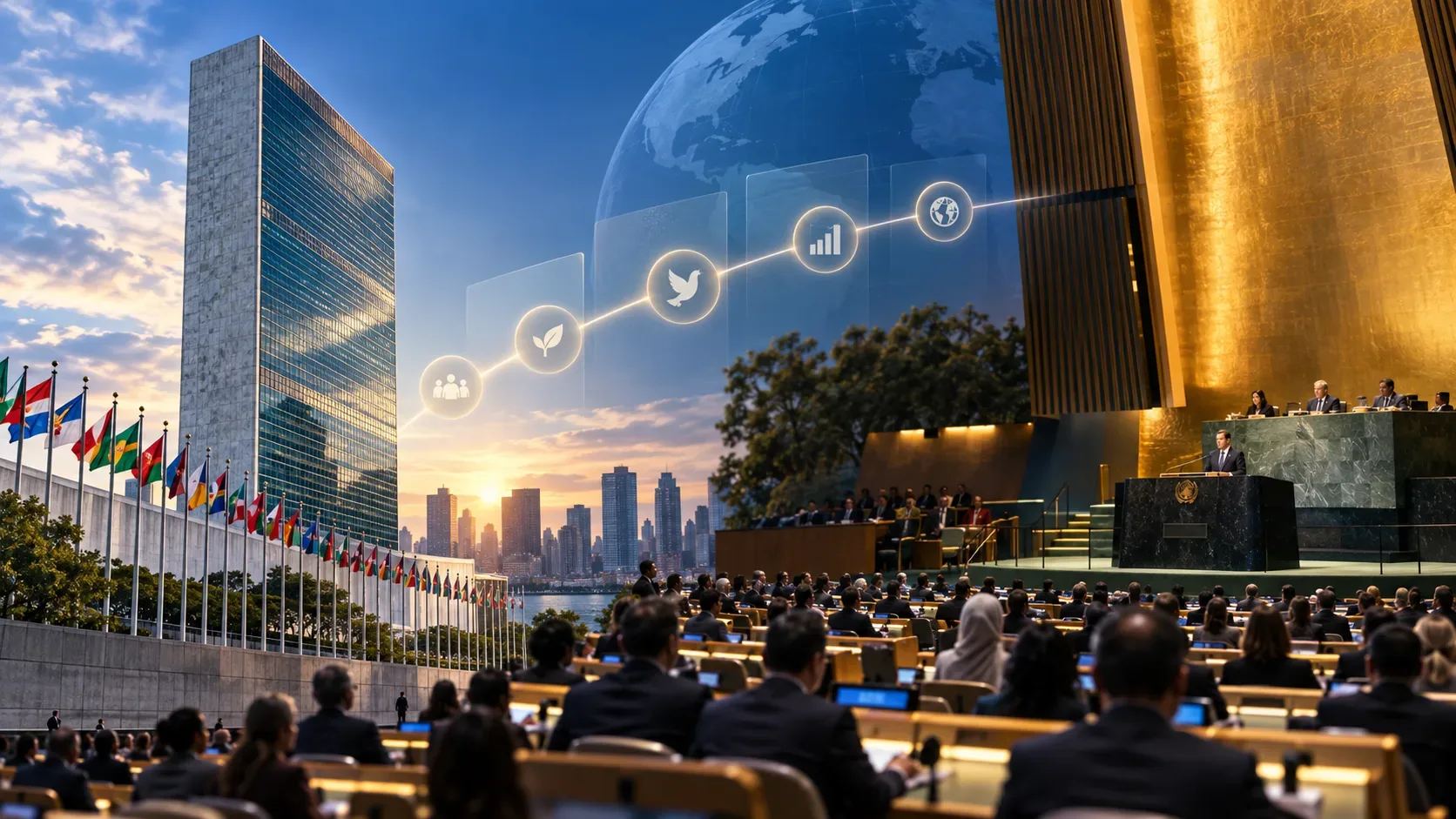
The 81st session of the United Nations General Assembly opened on 8 September 2026, but the period that concentrates Heads of State, Heads of Government and thematic high-level meetings begins later. To follow the agenda without mixing up different events, it helps to separate four things: the formal opening of the session, High-Level Week, the General Debate and high-level meetings with their own mandates.
The UN’s official calendar places High-Level Week from 18 to 28 September. The General Debate runs from 22 to 26 September and resumes on 28 September. The meeting on the total elimination of nuclear weapons takes place on 29 September: it is part of the 81st session’s high-level meeting calendar even though it falls outside the period branded by the UN as High-Level Week.
The quick map of the dates that really matter
| Date | Event | What may come out of it |
|---|---|---|
| 18 Sep | SDG Moment | Political momentum, announcements and commitments to accelerate the SDGs; no formally negotiated decision is advertised as a mandatory outcome. |
| 22–26 Sep and 28 Sep | General Debate | National statements, diplomatic signalling and priority-setting; the debate itself does not automatically adopt resolutions. |
| 23 Sep | 40th anniversary of the Declaration on the Right to Development | Political and institutional stocktaking, reports and dialogue; official materials do not announce a new negotiated declaration as a mandatory product. |
| 23 Sep | Climate action and the just transition | Commitments and political coordination on the energy transition, finance, adaptation and climate justice; it is not presented as a formal General Assembly resolution-adoption process. |
| 24 Sep | Meeting on sea-level rise | A concise, action-oriented, intergovernmentally negotiated declaration to be agreed by consensus. |
| 25 Sep | Pandemic prevention, preparedness and response | A concise, action-oriented political declaration negotiated in advance by consensus. |
| 28 Sep | 25th anniversary of the Durban Declaration and Programme of Action | Political mobilization for implementation of the anti-racism agenda; the official High-Level Week page does not advertise a new mandatory negotiated text. |
| 29 Sep | Total elimination of nuclear weapons | Reaffirmation of positions and diplomatic pressure on disarmament; the official mandate is commemorative and promotes the objective of total elimination. |
The session opening, High-Level Week and the General Debate are not the same thing
The 81st session is an institutional cycle that extends far beyond September. It opened on 8 September 2026 and runs until 7 September 2027. Saying that the General Assembly “starts” during leaders’ week is therefore imprecise: the body is already in session when the high-level agenda begins.
High-Level Week is the concentration of political and thematic events highlighted by the UN between 18 and 28 September. The General Debate takes place within that period, but the two terms are not synonyms. High-level meetings run alongside the debate, and some activities during the week are not formal General Assembly decision-making sessions.
The General Debate is the annual sequence of national statements in the plenary hall. In 2026, it runs from 22 to 26 September and resumes on 28 September. Sunday, 27 September, is outside the sequence of speeches. The debate is crucial for reading priorities, coalitions, disputes and possible future negotiations, but a Head of State’s speech is not the same thing as an adopted resolution.
18 September: the SDG Moment opens the political phase with a focus on the 2030 Agenda
The 2026 SDG Moment is scheduled for 18 September in the General Assembly Hall. Convened by the Secretary-General under resolution 74/4, it is designed to showcase progress, gaps and catalytic actions to accelerate the Sustainable Development Goals in the final stretch to 2030.
The key point is not to treat it as a voting session. Its effect is mainly political and mobilizing: governments, the UN system and other actors present initiatives, financing needs, partnerships and commitments. It can influence priorities and give visibility to proposals, but the official documentation does not define it as a meeting with a mandatory negotiated declaration.
22 to 28 September: the General Debate shows where governments want to spend political capital
The General Debate is the Assembly’s most visible event. National leaders use the podium to set out positions on wars, security, trade, climate, development, institutional reform and other issues. The 81st session is presided over by Khalilur Rahman of Bangladesh, and its theme is “Restoring trust, managing transformation: A United Nations that delivers for all.”
What matters is not only “who spoke” but what changes in diplomatic language: support for or resistance to proposals, new priorities, coalition announcements, financial commitments, shifts in tone on conflicts and signals about future votes. Even so, the General Debate should not be confused with a block of formal decisions: General Assembly resolutions and decisions follow their own procedures.
23 September: two different events with different effects
40th anniversary of the Declaration on the Right to Development
The 23 September high-level meeting marks four decades since the Declaration on the Right to Development. Resolution A/RES/80/207 keeps the issue on the Assembly’s agenda, provides for a Secretary-General’s report and calls for dialogue with specialized mechanisms.
The meeting can strengthen political interpretations of development, international cooperation, inequality and means of implementation, as well as shape later debates. But unlike the sea-level rise and pandemic meetings, the official high-level agenda materials do not present a new intergovernmentally negotiated declaration as a mandatory outcome of the day.
Climate action and the just transition
Also on 23 September, the Secretary-General convenes a high-level event on climate action and the just transition. The UN identifies three central tracks: accelerating a just and orderly energy transition, scaling up affordable finance and investment for developing countries, and strengthening adaptation and resilience.
The expected diplomatic gain is coordination and the presentation of commitments. The event can produce national or collective announcements and increase political pressure ahead of other climate negotiations, but it should not be described as if it were automatically a General Assembly vote.
24 September: sea-level rise has a formal outcome built into its mandate
The meeting on the existential threats posed by sea-level rise has a feature that distinguishes it from several other events that week: its mandate explicitly provides for a negotiated product. Decision 78/558 requires the 81st-session meeting to result in a concise, action-oriented, intergovernmentally negotiated declaration agreed by consensus.
That gives the meeting institutional weight beyond political visibility. The final text can consolidate common language on international cooperation, adaptation, protection of coastal communities, the situation of small island developing States and responses to rising seas. As with any consensus negotiation, the final version will also reflect the limits of what Member States can agree.
25 September: pandemics also come with a political declaration expected
The high-level meeting on pandemic prevention, preparedness and response will conduct a comprehensive review of implementation of the 2023 political declaration. Its mandate is set out in resolution A/RES/79/333, and the UN’s official page states that the meeting is expected to approve a concise, action-oriented political declaration negotiated in advance by consensus.
It is therefore one of the dates with the greatest potential for a formal outcome. The text can guide political commitments on national capacities, financing, equity, multilateral coordination and preparedness for future public-health emergencies. That does not make the declaration a treaty, but it gives it weight as a collective political commitment adopted in the General Assembly context.
28 September: Durban combines anniversary, implementation and political disagreement
The 28 September meeting marks 25 years since the Durban Declaration and Programme of Action, adopted at the 2001 World Conference against Racism. The official 2026 theme is to mobilize global public support for the full and effective implementation of that framework.
The meeting serves to measure political support, renew commitments and expose disagreements over the international agenda against racism, racial discrimination, xenophobia and related intolerance. Because the official High-Level Week page does not announce a new mandatory negotiated text for the event, readers should distinguish political statements and commitments from any separate formal decision.
29 September: the nuclear meeting is high-level but outside the official “High-Level Week” label
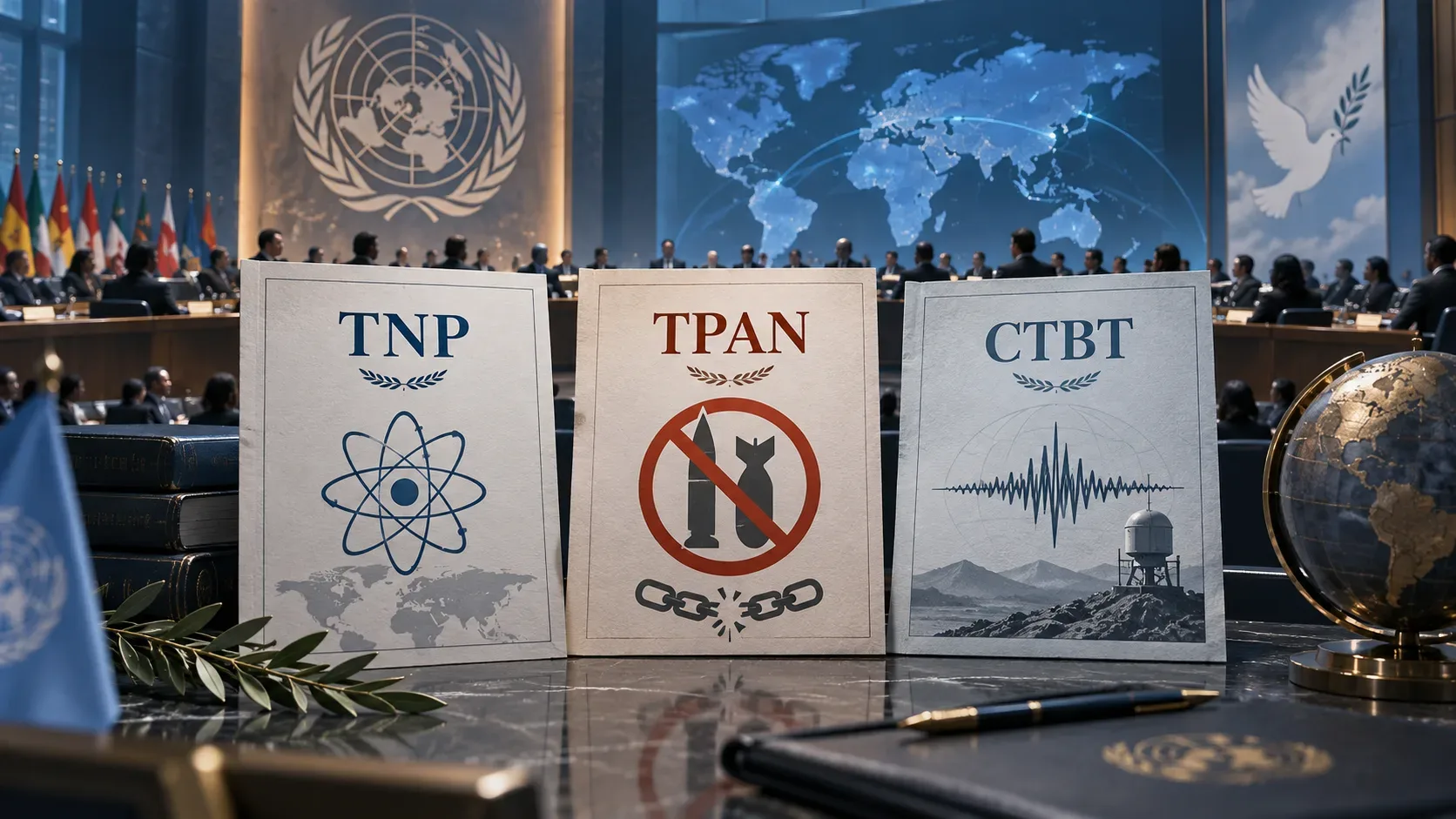
The 81st session’s high-level meeting calendar includes, on 29 September, the plenary meeting to commemorate and promote the International Day for the Total Elimination of Nuclear Weapons. This is an important detail: the High-Level Week page ends on 28 September, but the session’s high-level programme continues the next day.
The mandate is primarily to mobilize and reaffirm political support for nuclear disarmament. Countries can use the meeting to defend priorities, criticize nuclear policies, support treaties or propose negotiating pathways. The existence of the meeting, however, does not mean that a new disarmament agreement will be decided there.
How to tell an “important” meeting from one that actually approves something
- Mandated negotiated outcome: there is an explicit requirement to produce and approve a text. In the 2026 schedule, the clearest cases are sea-level rise and pandemics.
- Political commitment event: leaders may announce measures and coordination without a mandatory intergovernmental text as the meeting’s product. The climate event is the clearest example.
- Debate and signalling: the main products are speeches, positions and alignments. This is the General Debate.
- High-level commemoration: it can renew commitments and shape the agenda but should not automatically be treated as a vote or adoption of a new instrument.
What to follow through 29 September
Because the UN itself labels part of the calendar provisional, the best way to follow changes is through the official 81st-session meetings page, the High-Level Week page, UN WebTV and the official documents linked to each meeting. Changes to times, rooms, speakers or negotiated texts may appear close to the date.
For readers, the key is simple: 18 September opens the political SDG arc; 22–28 September concentrates the General Debate; 23–28 September brings thematic meetings with different institutional weight; and 29 September closes this guide with the nuclear issue. What each date “decides” depends on the formal mandate of each meeting, not simply on how many leaders attend.