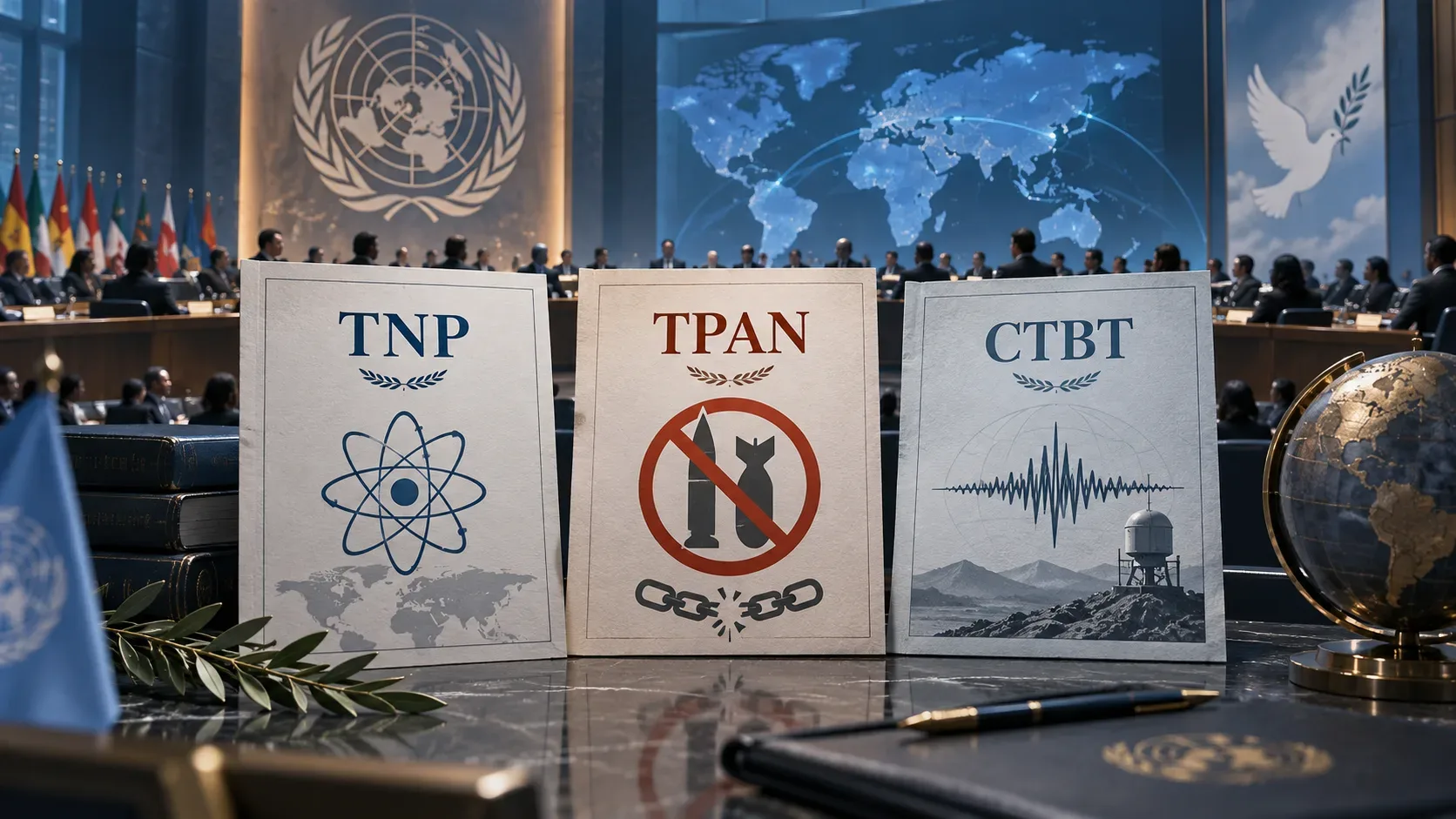
The NPT, TPNW and CTBT often appear together in nuclear-disarmament debates, but they do not do the same legal job. The Treaty on the Non-Proliferation of Nuclear Weapons (NPT) organizes a regime built around non-proliferation, safeguards and a disarmament commitment; the Treaty on the Prohibition of Nuclear Weapons (TPNW) establishes broad prohibitions for its States Parties; and the Comprehensive Nuclear-Test-Ban Treaty (CTBT) specifically targets nuclear test explosions — although it has still not entered into force.
That difference in scope is essential to understanding why “prohibition,” “non-proliferation” and a “test ban” are not synonyms. It also helps explain the high-level meeting the UN General Assembly will hold on September 29, 2026: the meeting promotes the political objective of the total elimination of nuclear weapons, but it does not merge the three treaties into a single regime or automatically change the legal obligations of any State.
In one sentence: what each treaty does
- NPT: seeks to prevent additional States from acquiring nuclear weapons, places peaceful nuclear activities of non-nuclear-weapon States under safeguards, and binds all members to pursue negotiations on disarmament measures.
- TPNW: prohibits a broad set of nuclear-weapon-related activities for its States Parties, including developing, testing, producing, acquiring, possessing, stockpiling, transferring, using or threatening to use nuclear weapons.
- CTBT: bans any nuclear weapon test explosion or any other nuclear explosion and was designed with an international verification system, but its entry into force depends on ratification by all 44 States listed in Annex 2.
NPT vs TPNW vs CTBT: legal and practical comparison
| Treaty | Participation and status in September 2026 | What it prohibits or requires | What it does not prohibit by itself | Entry into force and verification |
|---|---|---|---|---|
| NPT | 191 States Parties, according to the United Nations. | Nuclear-weapon States recognized by the treaty may not transfer nuclear weapons or assist non-nuclear-weapon States in acquiring them; non-nuclear-weapon States may not receive, manufacture or otherwise acquire them. Non-nuclear-weapon States must accept IAEA safeguards. All members undertake under Article VI to pursue good-faith negotiations on disarmament. | It does not impose an immediate, general ban on possession of nuclear weapons by the five States the treaty itself recognizes as nuclear-weapon States. Nor is it, by itself, a comprehensive nuclear-test-ban treaty. | In force since 1970 and extended indefinitely in 1995. IAEA safeguards are central for non-nuclear-weapon States. |
| TPNW | 95 signatories and 75 States Parties in the UN depositary status dated September 8, 2026. | Prohibits developing, testing, producing, manufacturing, acquiring, possessing, stockpiling, transferring, receiving, using or threatening to use nuclear weapons; it also prohibits assistance, encouragement, inducement and certain forms of stationing or deployment. | As a treaty, its prohibitions bind its States Parties; Article 1 does not automatically bind non-parties. None of the current nuclear-armed States is a party. | In force since January 22, 2021. It also includes obligations related to victim assistance, environmental remediation and pathways for eliminating arsenals. |
| CTBT | 188 States have signed and 179 have ratified. Of the 44 Annex 2 States, 35 have ratified. | Prohibits carrying out any nuclear weapon test explosion or any other nuclear explosion, and prohibits causing, encouraging or participating in such explosions. | It is not a general treaty banning possession, production, transfer or use of nuclear weapons. Its legal object is the nuclear test explosion or other nuclear explosion. | Not yet in force. Article XIV requires ratification by all 44 Annex 2 States; nine have not ratified. The CTBTO Preparatory Commission operates extensive monitoring infrastructure before entry into force. |
NPT: non-proliferation built on an asymmetric structure
The NPT entered into force in 1970 and became the foundation of the international non-proliferation regime. The United Nations describes it as having three central purposes: preventing the spread of nuclear weapons and weapons technology, promoting cooperation in peaceful uses of nuclear energy, and advancing nuclear disarmament. In 2026, the UN lists 191 States Parties.
The asymmetry is written into the treaty. Article I requires nuclear-weapon States recognized by the NPT not to transfer nuclear weapons or control over them and not to assist non-nuclear-weapon States in manufacturing or otherwise acquiring them. Article II requires non-nuclear-weapon States not to receive, manufacture or otherwise acquire nuclear weapons. Article III connects that commitment to safeguards administered by the International Atomic Energy Agency (IAEA), designed to verify that nuclear material intended for peaceful purposes is not diverted to weapons.
The NPT, however, is not a convention that simply declares “nuclear weapons are prohibited for everyone.” For treaty purposes, five States are defined as nuclear-weapon States because they manufactured and exploded a nuclear device before January 1, 1967: China, France, the United Kingdom, the United States and the former Soviet Union, whose treaty position is now held by the Russian Federation. The NPT does not immediately abolish their possession of nuclear arsenals, but Article VI obliges all parties to pursue negotiations in good faith on ending the nuclear arms race and on nuclear disarmament.
This is why “non-proliferation” primarily means preventing the number of nuclear-armed States from expanding and controlling the diversion of material and technology. It is not the same as imposing a uniform ban on every military nuclear activity for every member.
TPNW: the logic is broad prohibition for States that join
The TPNW was adopted in 2017 and entered into force on January 22, 2021. In the United Nations depositary record updated on September 8, 2026, it had 95 signatories and 75 States Parties.
The difference from the NPT appears in the basic obligations. The TPNW prohibits its States Parties from developing, testing, producing, manufacturing, otherwise acquiring, possessing or stockpiling nuclear weapons or other nuclear explosive devices. It also prohibits transferring or receiving such weapons, using or threatening to use them, assisting or encouraging prohibited activities, and allowing certain forms of stationing, installation or deployment in territory under a State Party’s jurisdiction or control.
This makes the TPNW the broadest of the three instruments in terms of explicit prohibitions on the weapon itself. At the same time, its direct legal reach remains treaty-based: it binds States that consent to become parties. As of September 2026, none of the States currently possessing nuclear weapons is a State Party to the TPNW.
The treaty also goes beyond a prohibition list. It includes obligations on assistance to people affected by the use or testing of nuclear weapons, environmental remediation and international cooperation, and it provides procedures relevant to States that eliminate nuclear arsenals in connection with joining the treaty.
CTBT: the legal target is the nuclear explosion, not the entire arsenal
The CTBT was adopted by the General Assembly on September 10, 1996. Article I is direct: each State Party is to refrain from carrying out any nuclear weapon test explosion or any other nuclear explosion and is to prohibit and prevent such explosions at places under its jurisdiction or control. States are also to refrain from causing, encouraging or in any way participating in such explosions.
That wording explains why a “test ban” is not the same thing as a “ban on nuclear weapons.” The CTBT was not designed as a general prohibition on possessing, producing, transferring, deploying or using nuclear weapons. It closes a specific and strategically important activity: nuclear explosions, which historically served the development and refinement of arsenals.
The treaty has a distinctive legal problem: it has not yet entered into force. Article XIV requires ratification by all 44 States listed in Annex 2, selected on the basis of nuclear-related capabilities existing during the negotiations. In September 2026, 35 of those 44 had ratified. The nine that had not were China, the Democratic People’s Republic of Korea, Egypt, India, Iran, Israel, Pakistan, the Russian Federation and the United States; among them, the DPRK, India and Pakistan had not signed.
Globally, the CTBTO recorded 188 signatures and 179 ratifications in September 2026. Even though the treaty is not legally in force, its Preparatory Commission already operates the International Monitoring System and the International Data Centre, components designed to detect signals that may indicate a nuclear explosion.
Why “prohibition,” “non-proliferation” and “test ban” are not synonyms
The three concepts answer different legal questions:
- Non-proliferation: who may acquire or transfer weapons and related materials, how the regime seeks to prevent additional nuclear-armed States, and how peaceful activities are verified.
- Prohibition: which nuclear-weapon-related activities are forbidden to States Parties, including possession, development, use and threat of use.
- Test ban: whether a nuclear explosion may be conducted and how the international system is designed to detect a possible violation.
There is overlap. The TPNW also prohibits testing for its parties; the NPT pursues disarmament and contains rules that reduce proliferation; and the CTBT strengthens the barrier against qualitative development of arsenals through explosive testing. But each instrument has its own membership, entry-into-force rules, obligations and mechanisms.
Why the UN returns to the issue on September 29, 2026
The General Assembly observes September 26 as the International Day for the Total Elimination of Nuclear Weapons. In 2026, the President of the General Assembly will convene a September 29 high-level plenary meeting to commemorate and promote that day. The UN High-Level Week describes global nuclear disarmament as the organization’s highest disarmament priority.
The meeting comes in a year when the legal and political debate is particularly strained. The 11th NPT Review Conference, held from April 27 to May 22, 2026, ended without consensus on a substantive outcome. That does not suspend or amend the NPT, but it highlights persistent disagreements over disarmament, non-proliferation, security and implementation. At the same time, 2026 marks 30 years since the CTBT was adopted, with entry into force still pending, while the TPNW continues to expand its participation.
The September 29 meeting should therefore be read as a high-level political forum intended to reinforce the goal of total elimination and press for implementation, universalization and diplomatic progress. It does not “replace” the NPT, TPNW or CTBT, and it does not automatically turn a signatory to one instrument into a party to another.
How to read a nuclear-treaty headline without confusing legal status
- Identify the treaty: the NPT, TPNW and CTBT regulate different things.
- Separate signature from ratification or accession: signature signals political intent and carries certain good-faith implications under treaty law, but it is not the same as becoming a party when ratification is required.
- Check entry into force: a treaty can have many ratifications and still not be in force, as the CTBT shows.
- Read the specific rule: “may not acquire,” “may not possess” and “may not test” are different prohibitions.
- Look for the verification mechanism: under the NPT, IAEA safeguards are central for non-nuclear-weapon States; under the CTBT, the international monitoring architecture is a core part of the regime’s design.
The practical rule is straightforward: the NPT organizes non-proliferation and a disarmament commitment; the TPNW broadly prohibits the weapon for its States Parties; the CTBT seeks to close the door on nuclear test explosions. Using that framework prevents complementary regimes from being mistaken for synonyms.
Official sources
- United Nations — General Assembly High-Level Week 2026
- United Nations — 2026 High-level Meeting for the Total Elimination of Nuclear Weapons
- United Nations — NPT background and status in 2026
- United Nations — text of the NPT
- United Nations — outcome of the 2026 NPT Review Conference
- United Nations Treaty Collection — TPNW status
- CTBTO — CTBT text and scope
- CTBTO — CTBT signatures and ratifications